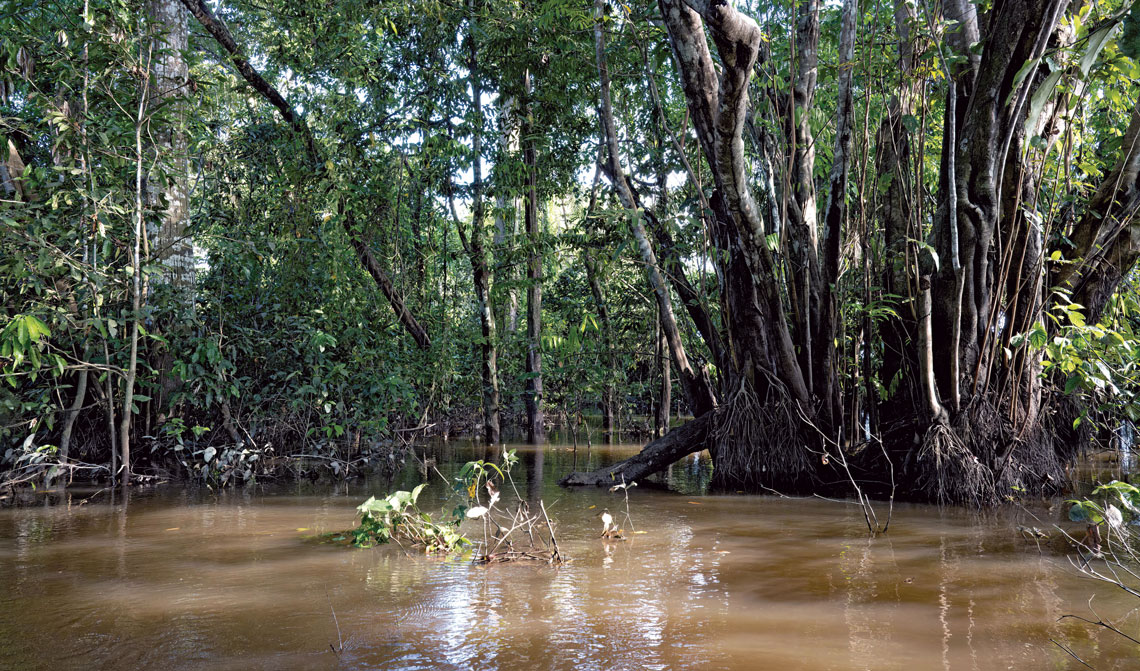
Beneath the submerged leaf litter of the Amazon’s forest streams, microscopic fungi help keep local food chains in balance and turn dead organic matter into nutrients that nourish insects, fish—and, indirectly, millions of people. A study published in Science of the Total Environment in June warns that these unassuming organisms could be disrupted by the combined effects of microplastics and climate change—altering their reproduction, diversity, and the way they decompose organic matter.
The research, led by scientists at the Federal University of Pará (UFPA) in collaboration with teams from the Brazilian Institute for Amazon Research (INPA), the Federal University of Bahia (UFBA), and the Federal University of Mato Grosso (UFMT), used climate-controlled chambers to recreate environmental conditions projected for the Amazon through the year 2100. In these simulations, researchers exposed leaf-decomposing fungi to different concentrations of microplastics, along with changes in temperature and carbon dioxide levels. “We saw clear changes in fungal reproduction,” says UFPA biologist Viviane Caetano Firmino, the study’s lead author. “The effects were strongest when high microplastic levels were compounded by extreme climate conditions,” she adds. The total species richness did not decrease, but some species within the fungal communities were replaced. More tolerant or competitively dominant species took over, while others nearly vanished.
The fungi’s ability to decompose organic matter also declined, posing direct risks to nutrient cycling—the natural process that recycles nutrients back into the ecosystem for use by other organisms. “Microplastics have already made their way into Amazon streams. That means we could lose some essential ecosystem services—and that’s what worries us most,” says biologist Leandro Juen of UFPA. Juen is one of the study’s coauthors and leads the National Institute of Science and Technology for the Synthesis of Amazonian Biodiversity (SinBiAm).
His concern centers on the possibility that disruptions at the base of the food chain could ripple upward—affecting not just insects and fish that rely on fungal nutrient cycling, but also the food security of millions of people. “Fungi make decaying plant matter more palatable to other organisms,” Juen explains. “They’re the invisible gears that keep Amazonian stream ecosystems running.” When decomposition is less efficient, stream water tends to turn more acidic and less potable.
The experiments were carried out in climate simulation chambers at the National Institute for Amazonian Research (INPA) in Manaus, which can recreate in real time various climate scenarios projected for the rainforest. Under the extreme scenario, water temperatures increased by 5.1 °C and carbon dioxide levels surpassed 1,080 ppmv (parts per million by volume). In the moderate scenario, temperature rose by 3.3 °C and CO2 reached about 700 ppmv. These conditions mirror projections developed by the United Nations’ Intergovernmental Panel on Climate Change (IPCC).
Meanwhile, the fungi were exposed to varying microplastic concentrations—from none, to low (1.8 × 10 particles per milliliter), to moderate (1.8 × 10² particles per milliliter). To determine the combined effects of these factors, the researchers used disks cut from the leaves of shirua (Nectandra cuspidata)—a tree species common throughout the Amazon—prepared so that natural decomposer fungi from local streams could colonize them.
Over 15 days, the team tracked several key metrics of aquatic ecosystem health and balance, including spore production, species diversity, and how efficiently the fungi decomposed organic matter.
According to Spanish ecologist Luz Boyero, from the University of the Basque Country, studying multiple stressors together is essential as it reveals how their interactions can be mutually reinforcing (additive effects) or interact in more unpredictable, complex ways (nonadditive effects). “In Amazonian fungi, production of conidia [the reproductive spores] responded to microplastics differently depending on climate conditions,” Boyero explains. “That may reflect differences in how sensitive each species is and how fast it reproduces.”
Boyero wasn’t part of the project, but one of her 2023 studies on microplastics, published in Environmental Pollution, helped inform the Brazilian team’s experimental design. “In one of our studies, we found that higher temperatures combined with eutrophication [excess of nutrients in the water] changed how organisms feeding on decomposing matter balanced elements like carbon, nitrogen, and phosphorus in their bodies, even though the decomposition process itself stayed the same,” she says.
Insects and other small aquatic invertebrates that feed on decomposing matter began showing altered internal ratios of carbon, nitrogen, and phosphorus. While the leaf litter continued to decompose, shifts in the animals’ internal chemistry could affect the nutritional quality of food available to organisms higher up the food chain.
Biologist Adalberto Val, a researcher at INPA who wasn’t involved in the study, celebrated the UFPA team’s research—but noted how it underscores the scale of the climate crisis. “Climate change in the Amazon turns warm waters warmer, low-oxygen waters even more depleted, and acidic waters more acidic,” Val summarizes. “That’s why studies like this one—probing the ecosystem’s future—are so critical.”
The story above was published with the title “Invisible fungi, visible impacts” in issue 356 of October/2025.
Scientific articles
FIRMINO, V. C. et al. Climate change and microplastic effects on conidial fungal assemblages associated with leaf litter in an Amazonian stream. Science of the Total Environment. Vol. 992, 179968. Aug. 25, 2025.
PÉREZ, J. et al. Warming overrides eutrophication effects on leaf litter decomposition in stream microcosms. Environmental Pollution. Vol. 332, pp. 121966. Sept. 1, 2023.