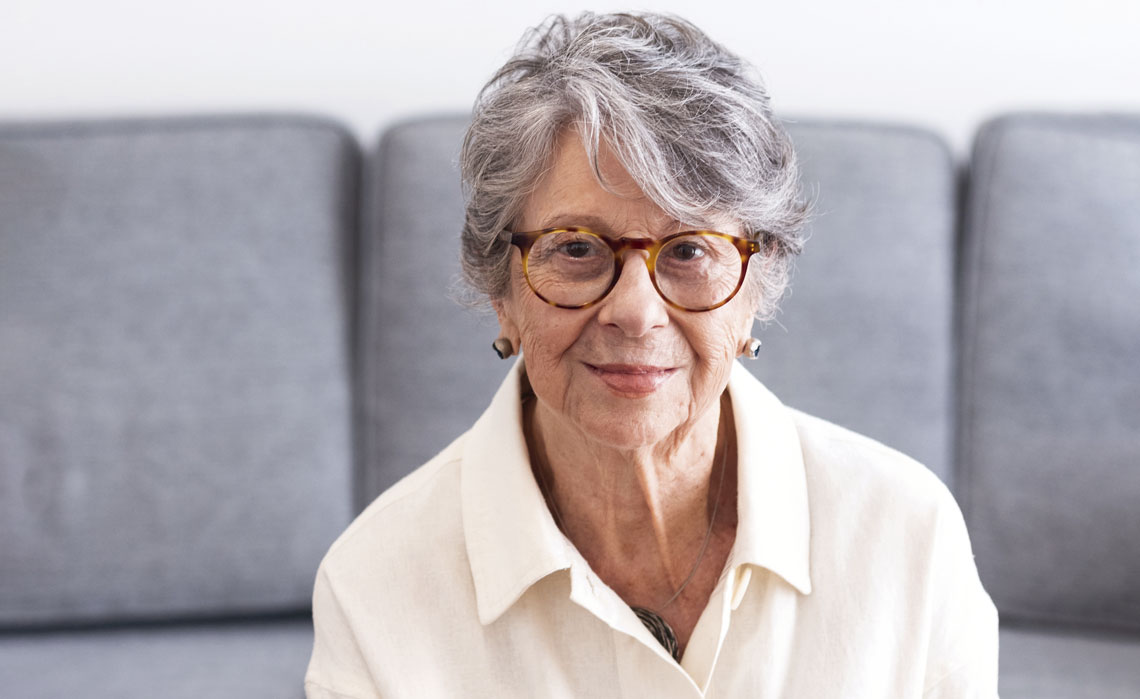
The daughter of a lawyer who offered free legal services to poor farmers in rural São Paulo and was affiliated with the Communist Party, Maria Hermínia Tavares de Almeida grew up closely following debates on Brazil’s turbulent politics. “At that time, I learned that differences of opinion could be argued passionately without driving apart people who cared for one another,” she recalls.
This idea guided her academic career, where she became a leading figure in political science by addressing themes such as trade unionism, federalism, and public policy. Almeida began teaching at the University of Campinas (UNICAMP) in the 1970s. In the following decade, she joined the University of São Paulo (USP), where she retired in 2013. In 2024, she was awarded the title of professor emeritus by the Department of Political Science in USP’s School of Philosophy, Languages and Literature, and Human Sciences (FFLCH).
In the institutional arena, she took part in initiatives such as the founding of the National Association of Graduate Studies and Research in Social Sciences (ANPOCS) in 1977 and the reestablishment of the Brazilian Political Science Association in 1986, which she presided over from 2004 to 2008.
At 82, she shows no signs of slowing down. She writes a weekly column for the newspaper Folha de S.Paulo and serves on the board of trustees of the Padre Anchieta Foundation, which manages TV Cultura. She is also one of the coordinators of the International Postdoctoral Program at the Brazilian Center for Analysis and Planning (CEBRAP). “I usually advise young participants to take charge of their own research—without fear and with boldness,” she says.
Field of expertise
Political science
Institution
Brazilian Center for Analysis and Planning (CEBRAP)
Educational background
Bachelor’s degree in social sciences (1969) and PhD in political science (1979) from the University of São Paulo (USP)
Are political scientists in Brazil always trying to respond to current issues and paying little attention to the past?
Yes. My generation, for example, was educated during the military dictatorship, and it was impossible to turn a blind eye to that reality. Universities, for better or worse, were a kind of oasis where one could reflect on that moment. Part of the redemocratization agenda was shaped by debates that took place at universities or, for instance, at institutions such as CEBRAP and other private research centers. Even under the democratic system, now 40 years old, there are strong incentives to focus on the present. We are sought out by the press and invited to debates. Those who study relations between the executive and legislative branches, political parties, or electoral processes are more likely to be interviewed and to have their texts read by laypeople than those who study the authoritarian systems or ideologies of the 1930s. As a result, the study of the past—which is vital both for advancing theory and for understanding how certain political systems function—has been neglected.
Is this different from what happens in the United States, for example?
The social sciences are always in dialogue with social processes, with what is happening in society. And this is true both here and in countries where the field has been consolidated for longer, such as the United States. There, however, the discipline is broader: there are more political scientists, some dedicated to the risky task of analyzing the present and others who look to the past for evidence to test theories or to understand more complex or long-lasting phenomena.
Does political science have the tools to deal with the complexity of today’s world?
Yes and no. As with all organized knowledge in the social sciences, it is easier to explain what has happened than what is happening now. Social scientists, whether economists, sociologists, anthropologists, or political scientists, are concerned with explaining human behavior. And human beings calculate, evaluate, and above all learn from past experiences. Thus, it is never possible to say that, under the same circumstances, they will make the same decisions. Knowing the past does not guarantee us the ability to fully understand the present, much less predict the future. Even so, political science today has more accumulated knowledge. People have always reflected on politics throughout human history, but political science as an academic discipline is relatively recent, only back to the twentieth century.
How did politics enter your life?
There was a lot of talk about politics in my house. My father came from Recife [Pernambuco] and moved to Monte Aprazível, in the interior of São Paulo State, in the 1920s. Later, he went to São José do Rio Preto [São Paulo], where I was born in 1942. There, my father formed a circle of friends who became his second family. He was a lawyer, held a government job, and provided free legal services to poor farmers. He even ran for federal deputy with the Communist Party in 1947, though he remained an alternate. Persecuted, we moved to São Paulo when I was a child, where my mother’s family, originally from São Carlos, lived. In São Paulo, there were also members of my father’s “new family.” They were communists or affiliated with the Brazilian Labor Party (PTB), but they were also close to Luiza Mesquita, a relative of the owners of the newspaper O Estado de S. Paulo and sympathetic to the UDN (National Democratic Union, a conservative party and proponent of economic liberalism). At her house, always full of people, my father and his friends played cards and argued passionately about politics. It was UDN against PTB and the Communist Party. In that environment, I learned that politics mattered—and that differences of opinion could be debated vehemently without driving apart people who loved one another. I like to tell this story to show that dialogue is possible despite ideological differences.
In Brazil, political scientists focus on the present and set aside the study of the past
Doesn’t this idea seem utopian nowadays?
We are currently living in a time of greater intransigence, one that seems hostile to debate and differences of opinion. But from a civilizational point of view, I think we cannot lose sight of the importance of listening to and reading those with whom we disagree, of debating their ideas, and of accepting contradictions. I believe intellectuals should play this role. Intellectuals exist to question easy consensus and to challenge rigid positions.
Why did you study social sciences?
It wasn’t an immediate choice. After finishing middle school, I went to high school with the idea of becoming a psychiatrist. But I gave that up when I realized medicine would be a difficult path for me—I couldn’t stand the sight of blood. I also considered psychology, but my father’s friend, the philosopher João Cruz Costa [1904–1978], a professor at USP, discouraged me. I don’t remember exactly why I ended up in social sciences. The fact is that I enrolled at USP in 1962, studied for a year, and then stopped for a while.
What happened?
I became involved in a left-wing, Trotskyist organization and devoted myself to activism. I stayed with that group until around 1968 but returned to college two years earlier. I abandoned activism out of disillusionment and a desire to pursue an academic career. During my undergraduate studies, I wavered between political science and anthropology. I had three fantastic professors: anthropologists Gioconda Mussolini [1913–1969], Eunice Durham [1932–2022], and Ruth Cardoso [1930–2008]. Cardoso had studied with anthropologist Claude Lévi-Strauss [1908–2009] in France and passed on what she learned to her students at USP. I was fascinated by Lévi-Strauss’s analytical model, which is very sophisticated. However, at the end of my undergraduate studies, I took a course with Francisco Weffort [1937–2021], which definitively led me to political science.
What was it about?
It was a course that combined theory and research. Together with my colleague Cassiano Marcondes Rangel, who did not pursue an academic career, I carried out a survey on strikes during the João Goulart administration [1961–1964]. We found that most strikes took place in the public sector, promoted by workers from the union base that supported Goulart. At the end of 1968, AI-5 [Institutional Act No. 5] came into force, forcing some of our professors out. The following year, some of them founded CEBRAP under the leadership of Fernando Henrique Cardoso. Even though he was not expelled, Weffort joined in the founding of CEBRAP and created a center for studies on the working class and unions there—though he did not leave USP. At the time, he invited me to complete at CEBRAP the survey on strikes that I had begun during my undergraduate studies.
Did you do your master’s degree at USP?
Because of political repression in the country, I wanted to pursue postgraduate studies abroad and even began the application process for Columbia University in the United States. While still an undergraduate, in 1967, I started working as editorial secretary in the serial publications division at Abril publishing house, which produced titles such as the Conhecer encyclopedia. By the time I graduated, my boss, sociologist Pedro Paulo Poppovic [1928–2025], said that his friend Fernando Henrique could recommend me for a place in the postgraduate sociology program at FLACSO [Latin American School of Social Sciences] in Chile. I decided to accept, since Columbia’s response would take time. I enrolled in the sociology program, which was considered stronger than political science. It was a master’s program with an emphasis on sociological theory and development theories, along with extensive coursework in statistics and research methodology.
We found that the strikes during the João Goulart period originated from the union base that supported the government
How was your time in Chile?
I arrived in Santiago in March 1970. FLACSO welcomed students from all over Latin America, and I lived alongside colleagues from Argentina, Uruguay, Mexico, Peru, Bolivia, and Venezuela. I also joined the community of Brazilians exiled by the dictatorship. During that period, before the 1973 military coup, Chile hosted many international organizations that had set up their Latin American offices there. This was the case with ECLAC [Economic Commission for Latin America and the Caribbean], a United Nations [UN] agency created in 1948 to explore paths for economic development in the region. In the early 1970s, Brazilian economists such as Maria da Conceição Tavares [1930–2024] and Antônio Barros de Castro [1938–2011] were there. I attended courses at Escolatina [School of Latin American Studies for Graduates], part of the University of Chile, and became friends with them. With a scholarship from FAPESP, I was able to dedicate myself fully to my studies, but I never submitted my final thesis to complete the degree. I returned to Brazil in November 1972.
What brought you back?
Weffort sent me a letter saying that my place in the doctoral program was guaranteed and that he was proposing my appointment as an assistant professor at USP. At his invitation, I stayed at CEBRAP while waiting to be hired by USP, which, however, did not happen. I asked Leôncio Martins Rodrigues [1934–2021], who had been my undergraduate professor and had become a close friend, to find out what was happening. He had access to the inner workings of the university administration. There, the so-called third stage operated—later revealed by the USP Truth Commission [2013–2018], of which I was a member, to have been the Special Advisory Office for Internal Security. It worked alongside the dean’s office to screen appointments and had two staff members, not from USP, who gathered information on candidates from intelligence agencies such as the Department of Political and Social Order [DOPS] and the National Information Service [SNI]. Leôncio warned me: “Your contract will not be approved.”
What was the reason?
I was never arrested during the dictatorship, but between 1966 and 1969 I was tried in a military court because of my involvement in that Trotskyist organization. This information appeared in the USP report, which is why I was not hired as an assistant professor. While researching his book As universidades e o regime militar [Universities and the military regime] [Zahar, 2014], historian Rodrigo Patto Sá Motta, from the Federal University of Minas Gerais (UFMG), found these documents and sent me a copy.
What did you research for your doctorate?
The title of my dissertation is The State and the Working Classes in Brazil (1930–1945). I conducted my research between 1973 and 1979 at USP, under the supervision of Weffort. In the dissertation, I analyze how labor and union institutions were established during the Vargas government. I argue that these measures did not arise from demands by the working class but from a state elite seeking to regulate capital-labor relations and control union leaders.
During your doctorate, you wrote the article “O sindicato no Brasil: Novos problemas, velhas estruturas” [Trade unions in Brazil: New problems, old structures], published in 1975, in which you discuss the trade union movement in the ABC region of São Paulo in the 1970s. How did the idea come about?
At the beginning of my doctorate, Weffort told me: “There is something new happening in the ABC region, something different from the more traditional, more compliant union leadership.” So, I went there to see what it was. That was in 1973. At the time, the president of the Metalworkers’ Union of São Bernardo do Campo and Diadema was Paulo Vidal, who remained in office until 1975, when he was succeeded by Lula. Even after writing the article, I continued to visit the union. Leôncio and I organized seminars for those workers and closely followed the strikes of 1978 and 1979. We also witnessed Lula’s transformation into a figure of national prominence during and after those strike movements.
Today, the issue is not so much creating social policies as deepening and complementing those we already have in Brazil
When did you go to UNICAMP?
At the end of 1973, while waiting to be hired at USP, I gave a seminar at UNICAMP at the invitation of professors Carlos Estevam Martins [1934–2009] and Paulo Sérgio Pinheiro. I spoke about what I had observed in the ABC region of São Paulo. Early the following year, French philosopher Michel Debrun [1921–1997], who coordinated the political science department at the university’s Institute of Philosophy and Human Sciences [IFCH], invited me for a conversation. Professor Roberto Gambini, now a psychoanalyst, had just resigned, leaving a vacancy in the discipline of History of Brazilian Political Thought in the undergraduate social sciences program. I knew very little about the subject, but I accepted the position and asked Bolívar Lamounier to help me put together a course. I spent two months immersed in the literature and then taught it.
Did you become interested in the study of public policy at UNICAMP?
In the early 1980s, as Brazil moved toward redemocratization, my colleague in political science at UNICAMP, Vilmar Faria [1941–2001], said that universities needed to engage with public policy, especially social policy. With that in mind, he, Paulo Renato Souza [1945–2011] from the Institute of Economics, and I organized seminars and invited leaders from areas such as health and education to participate. The idea took off. In 1982, during the administration of Rector José Aristodemo Pinotti [1934–2009], the Center for Public Policy Studies [NEPP] was created, which I helped to found and later directed, along with the Center for Population Studies (NEPO), headed by mathematician and demographer Elza Berquó. Then, in 1984, I went on a postdoctoral fellowship at the University of California (UCLA) in Berkeley to deepen my work on the public policy agenda. I spent about four months there, practically “living” in the library. At that time, there was no internet, and Brazilian libraries lagged far behind in terms of access to what was being produced abroad.
What did you do when you returned to UNICAMP?
I had helped set up the master’s program in political science as soon as I arrived. USP had an older, more tutorial-based graduate model: admission was decided by the advisor, and students took two or three credits however they chose. The only real requirement was delivering the thesis. At UNICAMP, we decided to formalize the process, with admission based on exams and a structured curriculum. It was more organized, and many USP graduates came to do their master’s degree at UNICAMP. When I returned from Berkeley, we began discussing the next step: organizing a doctoral program. We created a multidisciplinary doctoral program structured around research areas that brought together political scientists, sociologists, and anthropologists. The program ran that way for a long time but always had difficulty fitting into the CAPES [Coordination for the Improvement of Higher Education Personnel] evaluation system, which favored discipline-specific graduate programs.
How did you become interested in federalism?
During my time at Berkeley, I spent months reading literature on the welfare state. In Brazil, this system of social protection is deeply intertwined with the issue of federalism. The diagnoses that led to the reforms of major social protection policies—health, education, and social assistance—after 1988 highlighted the centralized nature of the system under the authoritarian regime, as well as its regressivity, which favored higher-income workers at the expense of the poorest. Much of the debate during redemocratization focused on how to redefine the powers of the federal government, states, and municipalities so that the system could become universal, fairer, and more efficient. In other words, the discussion involved considering changes that required redefining the roles of federal entities and the coordination between them so that social protection policies could be more redistributive and comprehensive. That is how I became involved in the question of federalism. One of my most cited articles to date is precisely “Federalism and Social Policies,” from 1995, in which I discuss the obstacles to transferring responsibilities between levels of government.
What social policies should the state have in place to improve the quality of life of the Brazilian population?
Today, the problem is less about creating new policies than about deepening and complementing those we already have and funding them properly. Since the country’s redemocratization with the 1988 Constitution, Brazil has undergone a long process of social reform. We have established a universal and respectable public health system, the SUS; education has come to be considered a right for all and a duty of the state; and basic education has finally become universal. With currency stabilization in the 1990s, the Fernando Henrique [1994–2002] and Lula I and II [2003–2011] administrations brought into society a population that had been living in extremely precarious conditions through income transfer programs such as Bolsa Família. In addition, programs such as PROUNI [University for All Program] guaranteed part of the population access to higher education. Affirmative action policies have meant that Brazil today has less exclusively white elites. In other words, progress has been slow but palpable. Our biggest challenge now is to reduce the inequalities and inefficiencies that persist in each area of social policy. It is also essential to reduce the regressivity of tax policy, which undermines redistributive social policies. Despite current fiscal constraints, Brazil needs to take a step forward in this direction.
I don’t know of any better place than the university, nor anything more stimulating than academic work
Why did you go to USP?
I spent 13 years at UNICAMP, from 1974 to 1987, and that period was fundamental to my training as an intellectual and as a coordinator of academic institutions. But in the end, I felt unchallenged. When I moved to USP, the social sciences were divided into three departments: Political Science, Anthropology, and Sociology. The Department of Political Science had been formed under the leadership of José Augusto Guilhon Albuquerque and José Álvaro Moisés. They invited researchers from outside USP, such as Simon Schwartzman, who was in Rio, and Argentine Guillermo O’Donnell [1936–2011], who I consider the most important political scientist in Latin America. From UNICAMP, they brought in Maria D’Alva Kinzo [1951–2008] and me. At Guillermo’s suggestion, and with funding from the Ford Foundation, we joined Guilhon and Moisés in founding the Center for Research in International Relations in 1987. USP had changed a great deal, and so had I. I was no longer a young professor at the start of her career, and working alongside my former professors was not as daunting as it once had been. Weffort remained head of the department for a while, until he joined Fernando Henrique Cardoso’s government in 1995 as Minister of Culture.
Have you ever thought about working in government?
I had a brief stint as an advisor to Paulo Renato, who was Secretary of Education in São Paulo under the Franco Montoro administration from 1984 to 1986. But I didn’t enjoy it much: the world of politics is very hierarchical—your boss really controls everything, even your schedule. I was used to the freedom of academic life. Besides, I like to make things work, but even more I like to analyze them, to understand how they work. I don’t know of any better place than the university, nor anything more stimulating than academic work.
How did you end up at the Institute of International Relations [IRI] at USP?
In 2000, I was head of the Political Science Department when the dean of USP, Jacques Marcovitch, set up a committee with professors from different fields to design an undergraduate course in international relations. I became a member of that committee. We developed a multidisciplinary project with courses in law, economics, history, and political science. The bachelor’s degree in international relations began in 2002 and has since ranked among the five USP programs with the highest cut-off scores in the entrance exam. The first director of IRI was Professor Walter Colli, from the Institute of Chemistry, and I was his deputy. I later served as director from 2010 to 2013. It was my second experience with a multidisciplinary project, where I was able to put all my previous experience to use. It is always a challenge, since the administrative obstacles and, above all, the intellectual dilemmas are immense. The organization of universities into departments structured around specific disciplines greatly hinders not only student mobility but also the creation of genuinely interdisciplinary projects. Academic culture, evaluation criteria, and research practices can be very different, even among fields within the humanities.
Was it difficult to migrate to international relations?
International relations are part of political science. From the perspective of my academic career, I sought to build a bridge between public policy and international issues. I found a path through a collaborative project based in Mexico around 2009, dedicated to the study of public opinion on foreign policy and international issues. This was the research initiative Las Américas y el mundo [The Americas and the World], in which I recently coordinated the subproject Brazil, the Americas, and the World: Public Opinion and Foreign Policy, with funding from FAPESP.
What are you currently doing in academic terms?
At the moment, I am transferring coordination of this project to a younger colleague at IRI. It is time to pass the baton, but I will remain as a researcher. In addition, since 2019, I have been coordinating CEBRAP’s International Postdoctoral Program with Professor Vera Schattan Coelho. I often tell young participants that this is a space for them to free themselves from their advisors, take ownership of their research, and become authors—without fear and with boldness, as an academic career should be.
The above interview was published with the title “Maria Hermínia Tavares de Almeida: Why dialogue matters” in issue 355 of September/2025.
Republish