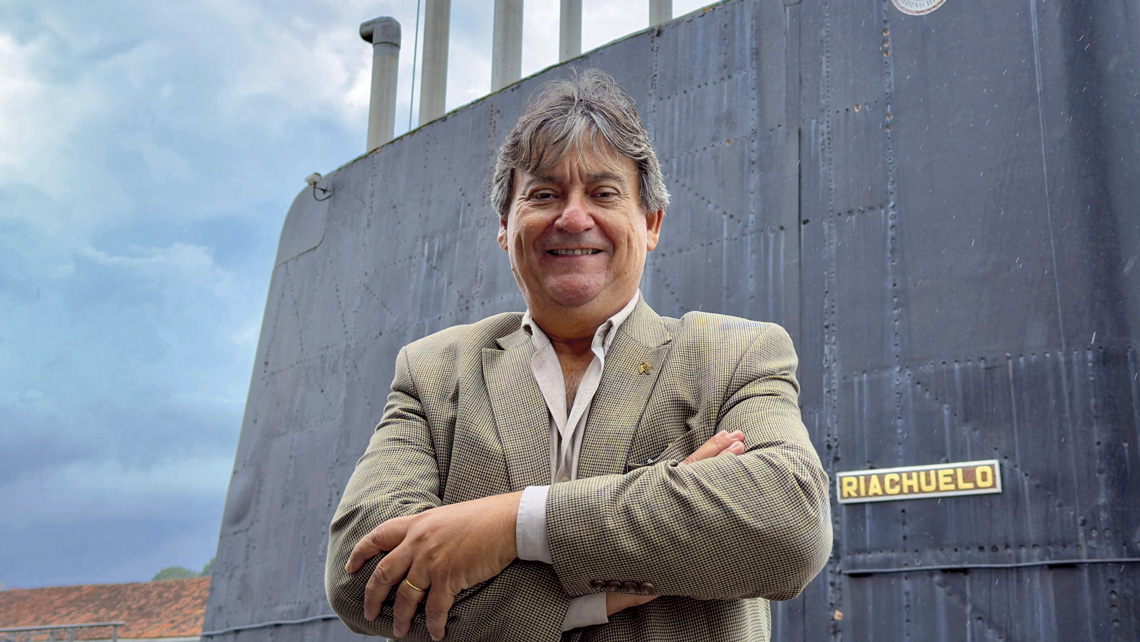
At the age of 15, Renato Machado Cotta visited the Museum of Modern Art in Rio de Janeiro. The trip played a decisive role in the young high school student’s decision about his professional future. He had been thinking about pursuing a diplomatic career, but after visiting the Nuclear Brazil Exhibition in 1975, he felt drawn to nuclear technology. “I was fascinated by the life of Admiral Álvaro Alberto [1889–1976], who pioneered the Brazilian Nuclear Program, and by the Navy’s role in this sector,” he recalls.
After graduating in engineering with an emphasis on nuclear science from the Federal University of Rio de Janeiro (UFRJ), he did a PhD at North Carolina State University (NCSU), USA, the first institution in the world to offer a nuclear engineering course.
Cotta completed his doctorate in 1985 and was soon invited to work as a consultant for the Navy’s Nuclear Program, in parallel with his teaching activities at the Technological Institute of Aeronautics (ITA) in São José dos Campos, São Paulo. With the Navy, he contributed to projects including the development of ultracentrifuges for uranium enrichment, equipment essential for turning the mineral into fuel for nuclear reactors.
Mechanical & nuclear engineering
Institution
Federal University of Rio de Janeiro (UFRJ) & Brazilian Navy
Educational background
Bachelor’s degree from UFRJ (1981) and PhD from North Carolina State University (1985)
Cotta, 65, recently received the most prestigious global award in thermal science, the Luikov Medal. He was the first researcher from the Southern Hemisphere to win the prize. “At the award ceremony, I delivered the most important speech of my career, before an audience of 800 scientists,” he says.
Cotta is married to mechanical engineer Carolina Cotta, who is a professor, like him, at UFRJ’s Alberto Luiz Coimbra Institute for Graduate Studies and Research in Engineering (COPPE). They have three children: Victor, 22, Clara, 15, and Gabriel, 13. Bianca, his eldest daughter, from a previous marriage, died in a plane crash in 2009, aged 25.
What do you think of Brazil’s investment in the nuclear sector?
We could invest more, for several reasons. Firstly, we have technologically mastered the nuclear fuel cycle and possess significant uranium reserves. With the current resurgence of nuclear power and rising geopolitical tensions between uranium producers and consumers, Brazil could benefit as an exporter of enriched uranium, which has a high added value. To achieve that, we would need to invest in expanding the INB [Nuclear Industries of Brazil] plant in Resende, Rio de Janeiro, in addition to the Navy’s ultracentrifuge production capacity—keeping in mind that we can also research and optimize the design of these ultracentrifuges. This technology is restricted to just a handful of countries, such as the USA, China, Russia, France, Germany, the Netherlands, the UK, and Japan. But before that, we would need to increase uranium mining and yellow cake (uranium concentrate) production, starting with the ore extraction project in Santa Quitéria, Ceará. We also need to complete the uranium hexafluoride [UF6] conversion pilot plant in Iperó, São Paulo, which will serve as a model for a larger facility once we reach the economic scale needed to convert all the UF6 needed by the country. In its gaseous form, uranium hexafluoride is enriched in ultracentrifuges to turn it into nuclear fuel.
What other reasons are there to invest in this field?
After designing and building IPEN/MB-01—the first critical unit [a research reactor that does not generate power] fully developed in Brazil—in 1988, we are finally getting close to commissioning our first Brazilian power reactor, which will generate thermal and electrical energy: Labgene [Nuclear Power Generation Laboratory]. The facility is a land-based prototype of the nuclear propulsion reactor to be used by the future Álvaro Alberto nuclear-powered submarine [see report on page 68]. In addition to this, the Brazilian Multipurpose Reactor [RMB], designed to produce radioisotopes used in radiopharmaceuticals for nuclear medicine, secured sufficient funding to begin construction in Iperó. Over the coming years, it will be the country’s biggest nuclear project, until construction of the Angra 3 plant is resumed. Angra 3 is no longer in question—it is an inevitability. Successive postponements of the project, however, reflect political resistance to its completion. The logic of the energy transition is the best argument for it to be resumed.
Despite geopolitical resistance, the Navy continues its mission to develop a nuclear-powered submarine
How can nuclear power plants, considered environmental villains for so many years, help in the energy transition?
Electricity from nuclear power has always suffered from the stigma of its connection to nuclear weapons, despite the sector’s best communication efforts to separate the two. Public trust was also shaken by three nuclear power plant accidents, especially Chernobyl in the former Soviet Union in 1986 and Fukushima in Japan in 2011, increasing this “radiophobia.” The third accident was at Three Mile Island, USA, in 1979. Countries that have invested significantly in nuclear energy, such as France, which has decommissioned coal and oil power plants, have achieved major reductions in CO₂ [carbon dioxide] emissions, despite continued population and economic growth. International pressure to reduce emissions naturally leads to nuclear energy as a stable foundation for energy mixes in industrialized countries whose renewable sources are intermittent. On top of that, nuclear cogeneration, especially using the heat produced in reactors to reduce emissions in other industrial sectors—such as steelmaking, hydrogen generation, oil and gas production—makes new advanced generation IV reactors and small modular reactors [SMRs] particularly attractive.
What are small modular reactors and what are they used for?
The two biggest arguments against nuclear power plants have always been the high cost of construction, despite the low operating costs, and fears about nuclear safety, even though accidents and deaths are very rare. At the turn of the twenty-first century, a new type of reactor emerged: the SMR. The idea behind smaller, modular units was to reduce initial energy-production costs and to offer advantages in safety and operational control. There are also micronuclear reactors [MNRs], which do not use the intrinsic concept of modularity [see Pesquisa FAPESP issue no. 353]. They are designed for specific applications, such as cogeneration in industries that require independence from the grid or in remote, off-grid regions. Today, more than 100 SMR and MNR projects are in development worldwide, with progress reviewed every two years by the International Atomic Energy Agency (IAEA). This new paradigm, which coincides with a renaissance of nuclear power, has led to a high number of new reactor designs, but not all will become reality. There are various obstacles to implementing these technologies. The American company SMR NuScale, for example, encountered funding difficulties despite being licensed.
Is Brazil working on anything in this area?
The country could have its first nuclear microreactor project in Labgene. Originally built for a nuclear-powered submarine, it has an inherently dual use. With modifications, it can provide a stable power source in microgrids supplied by intermittent renewables, especially wind and solar. Although they are usually Generation II pressurized water reactors [PWRs] typical of the 1970s and 1980s, many reactors from that era remain in operation around the world. Research and development must not be stopped. We have to think about the next reactor, starting with a design in line with its intended use. The demands for cogeneration of hydrogen and desalinated water, as well as applications in the oil and gas sector, are clear and immediate use cases for smaller reactors. One option is to adapt and redesign the Labgene to meet additional operational profiles and safety requirements. Another would be to develop a new family of microreactors more aligned with today’s new generation IV concepts. Both paths can be followed simultaneously during the conceptual phase.
How is the Brazilian nuclear-powered submarine project going?
Despite geopolitical resistance and technological constraints, the Navy remains committed to equipping the country with its first conventionally armed nuclear-powered submarine [SNCA]. Nuclear submarines are the primary naval deterrent in any scenario. With our immense “Blue Amazon,” rich in minerals and biodiversity, we must not give up on the goal of obtaining this platform. Achieving it would totally change Brazil’s geopolitical position on the international stage. The Submarine Development Program (Prosub) is advancing rapidly, the fourth and final conventional submarine is now being assembled in partnership with France and manufacturing tests for the SNCA rings have begun. At the same time, the Navy’s Nuclear Program is entering the final phase of electromechanical assembly of Labgene’s reactor block. Delays have arisen due to multiple reasons—from funding interruptions to contract breaches and blocked imports—against an unfavorable geopolitical backdrop in which those with the technology have no interest in seeing Brazil succeed in what is the largest technological project ever undertaken by the country. The completion of the nuclear-powered submarine depends directly on the success of the assembly and testing being done at Labgene. These tests should be completed by 2030. The plan is for the submarine to be completed within the next decade.
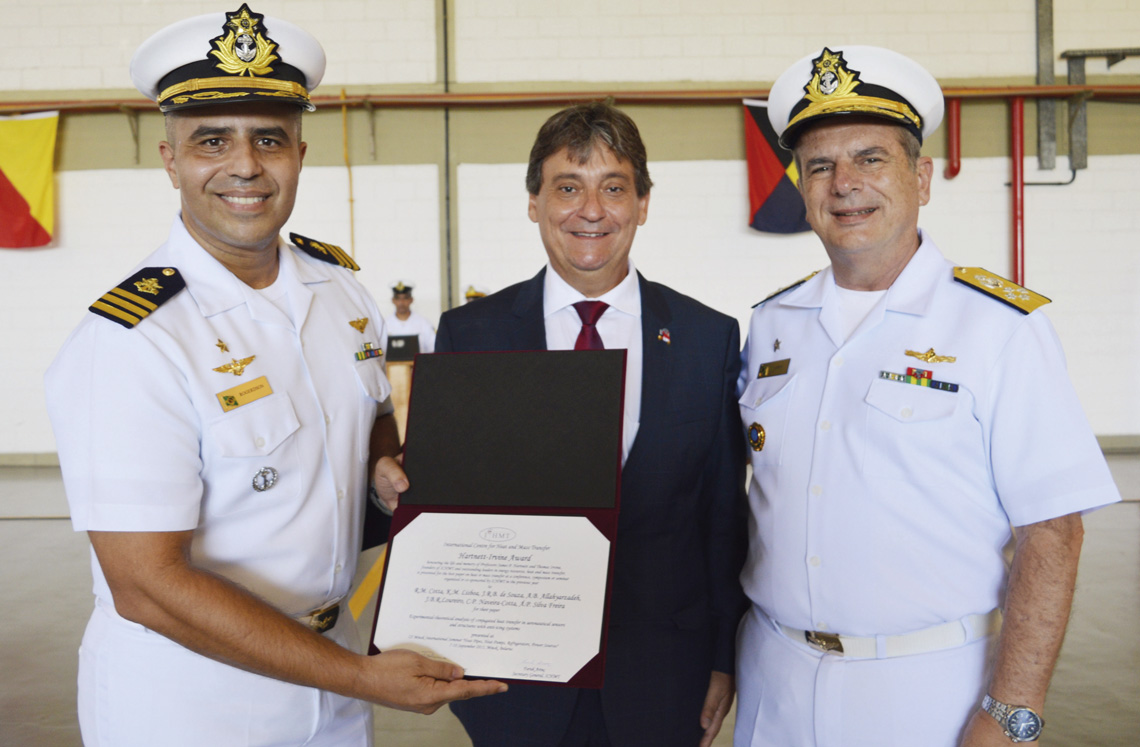
Personal archiveCotta shared the award for research into the AF447 accident with Admiral Liseo Zampronio (left) and Captain Rogerdson da SilvaPersonal archive
What projects are you currently involved in?
I have taken leave from UFRJ to work at the state-owned defense company Amazônia Azul Tecnologias de Defesa (Amazul), which is linked to the Brazilian Navy. Since 2019, I have been a technical consultant for the Navy’s Directorate-General of Nuclear and Technological Development [DGDNTM] in São Paulo, currently led by Admiral Alexandre Rabello de Faria. I work as a coordinator or collaborator on projects of interest to the Navy’s Technological Center in São Paulo [CTMSP], which is more closely related to nuclear research, as well as projects at the Technological Center in Rio de Janeiro and its institutes, more focused on non-nuclear issues. All this falls within my area of expertise involving heat and mass transfer and fluid mechanics—the core disciplines of the broad field known as thermal sciences. Topics include nuclear desalination, membrane distillation with heat recovery, thermal metamaterials for heat concentration, gas capture and removal using zeolites [a group of minerals with a porous structure] and membranes, and harvesting energy from fluid flows using piezoelectric materials, among others.
What exactly does the field of thermal sciences encompass?
Thermodynamics, fluid mechanics, and heat and mass transfer are the three fundamental disciplines of classical physics that form the theoretical basis of what we call thermal sciences, or in applied contexts, thermal engineering. I have devoted my life to studying the phenomena of heat and mass transfer and their roles in modern engineering challenges, always seeking to innovate in analysis methodologies. This broad field poses scientific and technological challenges in various sectors, such as nuclear, aerospace, mechanical, environmental, chemical, and biomedical engineering. You only need to look around to realize that thermal sciences are present in almost everything around us and with which we interact, from our own bodies to everything that happens in the world, whether by human action or naturally occurring. To illustrate this scope, my work has ranged from thermal protection for rockets reentering Earth’s atmosphere to studies of the thermal effects of ultrasound physiotherapy on human tissue.
What have been your biggest contributions in the field of thermal sciences?
With the advent of the digital computer, computer simulation in engineering and related sciences grew rapidly worldwide, especially from the 1970s onwards. This new scientific wave was marked by the rapid development of so-called numerical or discrete methods for solving the governing equations of engineering problems. The new approach almost completely replaced the classical analytical methods of the nineteenth and early twentieth centuries, which formed the theoretical foundations of engineering sciences before the existence of the computer. Throughout my career, I have advocated for a synergistic combination of both approaches, aiming to develop hybrid numerical/analytical methods with higher accuracy and lower computational cost. For example, I proposed and developed the Generalized Integral Transform Technique [GITT] and the Coupled Integral Equations Approach [CIEA]. Both initially became well-known in the field of heat and mass transfer and were later extended to other fields of science. The improvements in accuracy, robustness, and computational efficiency compared to classical numerical methods proved significant and the techniques have earned international recognition. Brazil is acknowledged as their principal source of development.
You have been a part of major national projects, such as the ultracentrifuge for uranium isotope enrichment. How important has this been for your career?
After I finished my PhD at NCSU in 1985, I had the chance to meet Admiral Othon Luiz Pinheiro da Silva, who was head of the Brazilian Navy’s Nuclear Program, at the Office for Special Projects [COPESP]. At the time, COPESP was located next to the Institute for Energy and Nuclear Research [IPEN] on the University of São Paulo campus, where the CTMSP currently operates. I was invited to join COPESP to work on the ultracentrifuge project, but I had already promised Professor Pedro Carajilescov that I would return to the ITA. However, the opportunity arose to work as a consultant on the ultracentrifuge project while I kept working at the ITA. I started in 1986 and remained involved until 2001, witnessing the development of the first generations of ultracentrifuges and contributing through mathematical modeling and computational simulation. The methodology used was an extension of what I developed in my doctorate. By the end of 1986, we had achieved a full simulation of the ultracentrifugation process at low computational cost. The following year, to accelerate development, I spent four months in São Paulo focusing entirely on ultracentrifuge simulations. Only in 2000 was I finally able to publish an article describing the methodology and its application in ultracentrifuges.
When did you first become interested in nuclear engineering?
In 1975, when I was 15 years old and still in high school, I visited the Nuclear Brazil Exhibition at the Museum of Modern Art in Rio de Janeiro. At the time, I was considering a diplomatic career with a scientific focus on energy, influenced by the 1973 oil crisis and the geopolitical tensions that followed. The exhibition, composed of scale models and panels, introduced me to the life of Admiral Álvaro Alberto da Motta e Silva, a pioneer of Brazil’s nuclear program, and to the Navy’s role in the sector. Convinced of the technology’s promising future, I decided to study nuclear engineering. At that time, there was no such course in Brazil, so the only option was to do a postgraduate degree in the area. In 1976, I started my engineering degree at Fluminense Federal University before I even finished high school, but I decided to also apply to UFRJ, which had just begun offering an engineering course with a nuclear emphasis. After my studies and research in the nuclear field, I interned at the Institute of Nuclear Engineering [IEN], where I worked at the Argonauta reactor and studied the thermohydraulic circuits of sodium and water. In my final undergraduate year, I simultaneously took courses for my master’s degree in nuclear engineering—although I did not write or defend a dissertation—and did a final-year project on the thermal analysis of nuclear fuel for PWRs.
Thermal sciences are involved in almost everything around us, from our own bodies to everything that happens in the world
How did your academic path continue from there?
Encouraged by my professors at UFRJ and with funding from the National Commission for Nuclear Energy [CNEN], I made the easy decision to go abroad to study a PhD without having completed my master’s degree. At the age of 21, I arrived at NCSU, which had the world’s first university nuclear reactor and nuclear engineering program. Interestingly, it was also where Hervásio de Carvalho [1916–1999], the Brazilian scientist who became CNEN president at the time that I was starting my doctorate, became the first person in the world to earn a PhD in nuclear engineering. After returning to Brazil, I never left the nuclear sector, which was the foundation of my training. Alongside my work on the ultracentrifuge project for uranium enrichment, which gave Brazil autonomy over the nuclear fuel cycle, I also helped analyze the safety of radioactive waste stored after the cesium-137 accident in Goiânia in 1987. Later, in the early 2000s, I took part in environmental and radiological impact analyses of uranium mining in Caetité, Bahia, among other projects.
What did receiving the Luikov Medal in 2022 mean to you?
It was probably the highlight of my professional life. The award, granted by the nongovernmental organization International Centre for Heat and Mass Transfer (ICHMT), recognizes researchers who have made exceptional contributions to the science and art of heat and mass transfer, as well as to international scientific cooperation through ICHMT programs. The list of winners includes nine Americans, seven Europeans, two Russians, and two Japanese, meaning there were previously no scientists from the Southern Hemisphere. At the award ceremony, I delivered the most important speech of my career, before an audience of 800 scientists from the field.
At what stage is your project on desalinating seawater using membrane technology to cogenerate electricity, distilled water, and green hydrogen?
Desalination is, in essence, a solute-solvent separation process aimed at removing salt from brackish water or seawater. It requires a lot of thermal or electrical energy. One way of improving energy efficiency is to adopt desalination methods that recover waste heat from other processes. In this context, using nuclear reactors for desalination is part of a broader concept of nuclear energy that aims to cogenerate other products of economic and social interest as well as electricity. Today, it is understood that economic competitiveness, sustainability, and public acceptance of nuclear technology depend not only on its use for generating electricity, but also on the establishment of new markets and products. With the progress being made on Brazil’s first nuclear power reactor, Labgene, we will soon have a platform that will encourage proposals for cogeneration and higher energy efficiency.
Could you give an example?
Yes. The Brazilian development of a small modular PWR for cogeneration of water and electricity would help address water scarcity, while the cogeneration of electricity and hydrogen would create new opportunities for the production of this new and strategic type of fuel. In 2016, when I was president of CNEN, I began studying a new modular reactor: the Dessal project. In recent years, contributions to this project have included innovations in thermal-recovery systems and desalination by membrane distillation, with the goal of improving integration between the reactor’s secondary circuit and the desalination unit.
Developing a small modular reactor to cogenerate water and electricity will help address water scarcity
What other desalination projects are you involved in?
I am also part of the EnerGente Project, based on the concept of a Sustainable Polygeneration Island, which is led by mechanical engineer and UFRJ professor Carolina Cotta, who happens to be my wife and closest colleague. Funded by Petrogal Brasil through the National Agency of Petroleum, Natural Gas and Biofuels [ANP], the project focuses on the cogeneration of electricity using high-concentration photovoltaic panels while recovering heat from the panels to power desalination via membrane distillation. This initiative won the ANP Award for Technological Innovation in 2024 and is currently being assessed by the federal government for deployment in isolated communities in Brazil’s semiarid Northeast.
And you are also involved in aerospace projects?
The beginning of my career at ITA and close interactions with the IAE [Institute of Aeronautics and Space] and the INPE [Brazilian National Institute for Space Research] naturally led me to research in this field. One of the projects I worked on was a thermal analysis of the launch pad of the VLS-1 satellite launch vehicle [a Brazilian rocket that exploded on the launch pad in 2003, killing 23 people]. I also took part in the analysis of super-insulators for satellite thermal control and the development of a thermal protection system for SARA—the IAE’s atmospheric reentry satellite. I recently coordinated research that involved the theoretical and experimental analysis of anti-icing systems for pitot tubes, which are used to provide data on the speed and altitude of aircraft. The study, carried out in collaboration with the Navy and the company ATS4i, included the design and construction of the first ice formation wind tunnel at COPPE. By performing flight tests using the Navy’s Skyhawk A4 jet, we were able to explain the phenomenon of ice formation in pitot probes, the cause of the 2009 tragedy involving Air France Flight 447 [the plane was flying from Rio de Janeiro to Paris when it crashed into the Atlantic Ocean, killing all 228 people on board]. The article describing this research won an important award from the ICHMT in 2015. My work studying the causes of the AF447 accident had a deeply emotional and personal motivation—for me, it was a way of coming to terms with the tragic loss of my daughter Bianca and my son-in-law Carlos Eduardo, who were on the plane on the way to their honeymoon. It was the most important research of my life, not only to demonstrate how the tubes freeze, but also to propose ways of preventing it from ever happening again. It was the way I found to ease the pain, devoting myself to a study that drew attention to an engineering problem that affects aviation safety, in the hope that I could save people from suffering a similar fate in the future.
The above interview was published with the title “Renato Cotta: In defense of nuclear energy“in issue 354 of August/2025.
Republish