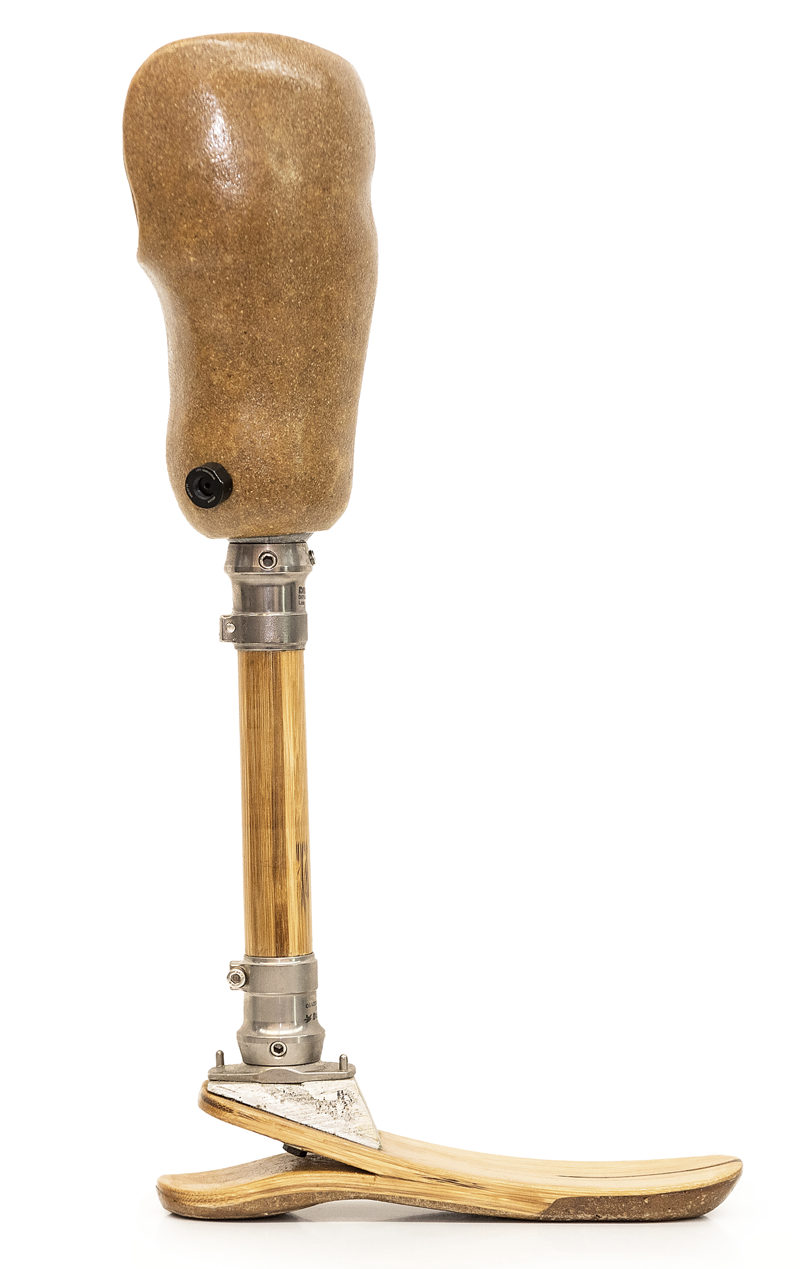
Léo Ramos Chaves / Revista Pesquisa FAPESPA below-the-knee prosthesis made from bamboo fibers and castor bean resinLéo Ramos Chaves / Revista Pesquisa FAPESP
A cost-effective prosthetic leg made from bamboo fibers and castor oil resin is close to becoming a market-ready product. The device—designed for below-the-knee amputees—should cost significantly less than conventional models made from imported carbon fiber and epoxy resin, such as those currently provided by Brazil’s National Healthcare System (SUS). Developed at São Paulo State University (UNESP), the prosthetic has been patented through the university’s innovation agency (AUIN), and negotiations with a prospective manufacturer are well advanced.
“We believe we can sell the bamboo version for under R$2,000, depending on production scale and capacity,” says João Victor Gomes dos Santos, the product designer heading the project. “That’s about a third the cost of a typical carbon fiber prosthesis purchased by the SUS.” Santos, who holds undergraduate and graduate degrees from UNESP’s School of Architecture, Arts, Communication, and Design (FAAC) in Bauru, says bamboo’s mechanical strength is comparable to that of carbon fiber, but with the added benefits of being inexpensive and abundant in Brazil.
A locally made, affordable prosthesis could help shorten the long wait many SUS patients face, Santos believes. “Today, someone who loses a limb might wait a year or longer for a prosthetic,” he says. In 2022 alone, Brazil’s public health system performed 31,190 lower-limb amputations—about 85 every day, according to the Brazilian Society of Angiology and Vascular Surgery.
To make the bamboo-reinforced composite, fibers are extracted from the plant’s outer layer—close to the rind—and bonded with castor-based resin, Santos explains. “Besides being eco-friendly, recyclable, and cheaper than synthetic fibers, natural-fiber-reinforced polymer composites may be better suited to certain applications,” Santos and colleagues wrote in the book Design, artefato e sistema sustentável (Sustainable design, devices and systems; Blucher, 2018). These composites are highly versatile: they can be engineered for particular applications and molded into complex shapes that are hard to produce using conventional materials.
In another paper presented at the 6th International Conference on Integrity-Reliability-Failure in Portugal in 2018, the team used computer modeling to show that the bamboo prosthesis could safely support users weighing up to 100 kilograms.
Assistive technologies
Santos’s bamboo prosthesis project is among those selected for funding by a new Multidisciplinary Center for Development of Assistive Technology (CMDTA)—one of two Science for Development Centers (CCDs) launched by FAPESP in 2024 to develop innovative technology for people with physical disabilities. The second CCD, the Center for Assistive Technologies for Daily Living (CTecvida), is based at the University of São Paulo (USP).
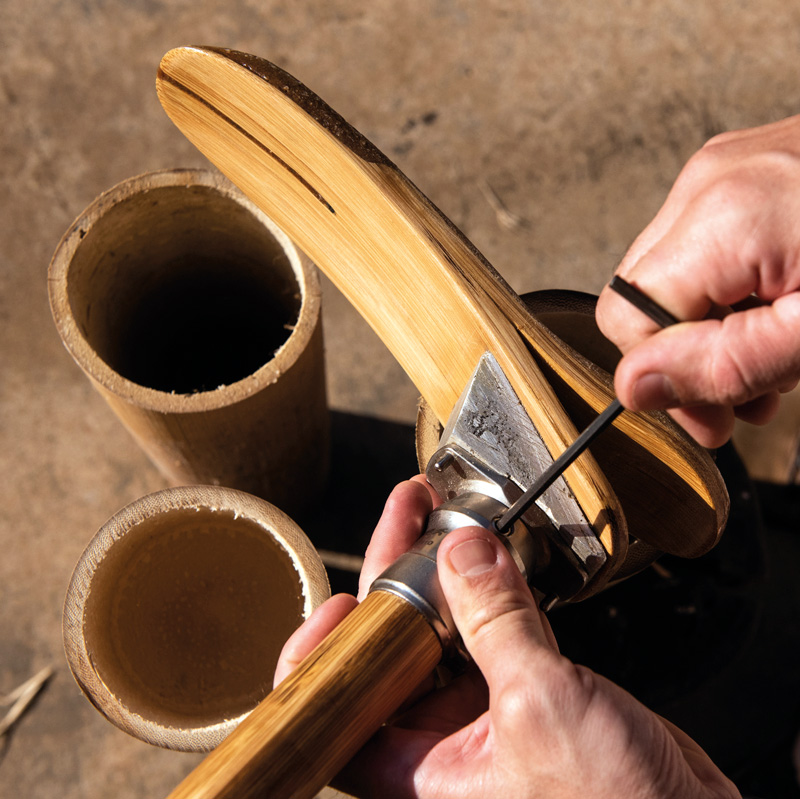
Léo Ramos Chaves / Revista Pesquisa FAPESPA researcher working on a below-the-knee prosthesis developed at UNESPLéo Ramos Chaves / Revista Pesquisa FAPESP
CMDTA, hosted at UNESP’s Bauru campus, brings together 42 researchers from 17 laboratories across UNESP, USP, the Federal University of São Carlos (UFSCar), and the Federal University of ABC (UFABC). The center also collaborates with local institutions such as Sorri-Bauru, a specialized rehabilitation center; the Association of Parents and Friends of Exceptional Children (APAE); and Hospital Amaral Carvalho, with locations in Bauru and Jaú (SP).
“Researchers often work in silos, each focused on their own project,” says physicist Carlos Roberto Grandini of UNESP’s Bauru School of Sciences, who heads CMDTA. “Through this center, we’re collaborating across disciplines to drive innovation.”
The bamboo prosthesis project is an example of the kind of collaboration Grandini envisions. Developed in UNESP’s Ergonomics and Interfaces Laboratory, the project will use CMDTA funding to produce prototypes, which will be tested with patients at Sorri-Bauru.
Several CMDTA-funded projects are currently underway across affiliated labs. One is further developing a transradial prosthesis—for below-the-elbow amputees—created as part of product designer Bruno Borges Silva’s master’s research. Developed within a co-design process where end-users helped create the final product, the prosthesis was built using a rapid prototyping technique combining digital modeling with 3D printing. The device features a myoelectric system in which sensors detect electrical signals from the user’s muscles, capturing their intent to move. These signals are transmitted via Bluetooth, enabling the prosthesis to carry out tasks like gripping a cup or opening a package.
“The sensors pick up electrical signals from muscle activity just above the residual limb—on the user’s upper arm, in this case,” explains Luís Carlos Paschoarelli, a professor of design at FAAC-UNESP. “Theoretically, we could read signals straight from the brain,” he adds, “but that would take significantly more research and investment.” The sensors and Bluetooth system are embedded as an assembly within the prosthesis, Paschoarelli explains.
Co-design, Paschoarelli adds, is an innovative strategy for developing assistive technologies and helps improve user acceptance of prosthetic devices. In a 2020 paper in the journal Educação Gráfica, he explored how the visual design of assistive devices can affect the self-esteem of people with disabilities. “A customized prosthetic not only improves function—it also meets the user’s aesthetic expectations, which helps reduce device rejection or abandonment,” he notes.
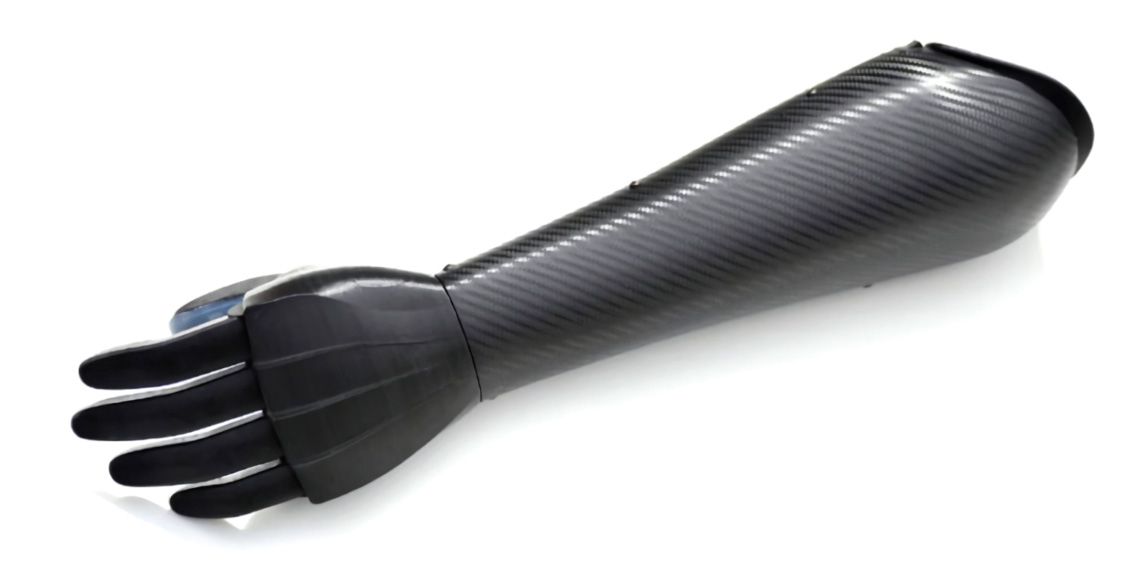
Bruno Borges da Silva / UnespA prototype transradial prosthesis designed for individuals with below-the-elbow arm amputationsBruno Borges da Silva / Unesp
He believes cross-disciplinary collaboration will help advance his project—especially when it comes to identifying better materials for prosthetics and other assistive devices. The team’s first prototype was made with polylactic acid (PLA), a biodegradable thermoplastic made from natural materials. “PLA prints beautifully with 3D printers,” he says, “but turned out to be too heavy for everyday use.”
Mechanical knees and new challenges
Another CMDTA-funded project is a monocentric mechanical knee—one with a single pivot point—that offers functionality not available in prosthetics currently provided by the SUS. One innovative feature is a mechanism that allows users to bend the knee while walking—a feature absent in traditional models, which keep the joint locked straight during walking.
The prototype includes a user-operated lock, letting users choose between a fully extended or flexed knee. “This is a feature typically only available in high-end prosthetic knees made for athletes,” says physical therapist Guilherme Eleutério Alcalde, one of the project’s co-creators.
The device also features a spring-based shock absorber, which softens impacts during walking and helps reduce stump pain. “Combined, these systems deliver more comfort, a smoother gait, and greater walking speed,” Alcalde explains.
In a 2024 master’s thesis, Marcelo Alves de Macedo, one of the project’s co-creators, compared seniors using traditional prosthetics to those fitted with the new UNESP-designed model over a six-month trial. The results were promising: users of the new prototype expended less energy during walking, increasing overall locomotion efficiency. Gait symmetry also improved, which is crucial for lowering fall and injury risks. Participants using the new model also reported less effort and pain when performing everyday tasks.
Carlos Roberto Grandini, who is leading the project, says one strategy for improving quality while keeping costs comparable to conventional models is selecting more cost-effective materials. The standard-issue mechanical knees provided by the SUS are made entirely from stainless steel. The UNESP prototype combines stainless steel with polypropylene, a cheaper alternative. A next-generation version made from a titanium alloy is also in development. The exact composition of the alloy is being kept confidential until a patent application is filed. “We expect our prosthesis to offer outstanding cost-benefit,” says CMDTA director Carlos Roberto Grandini.
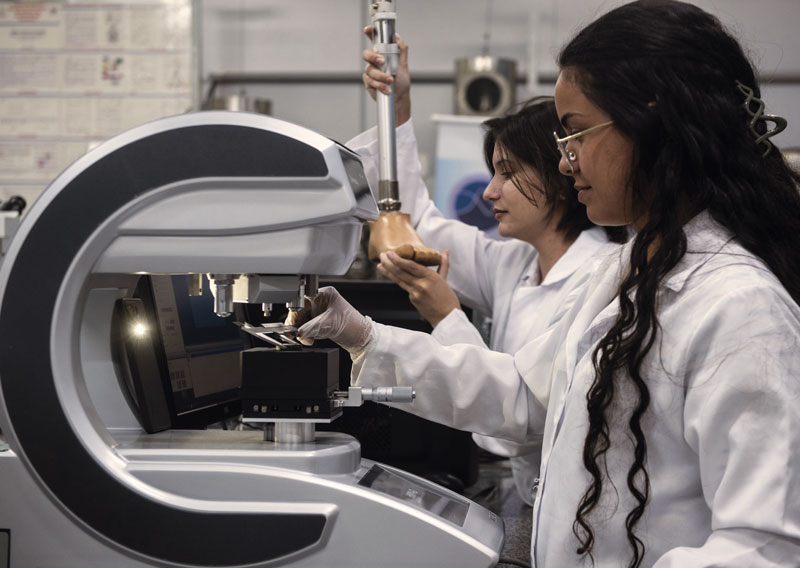
Léo Ramos Chaves / Revista Pesquisa FAPESPStudents at UNESP’s Elasticity and Biomaterials Lab performing mechanical tests on a biomedical alloy used in a monocentric prosthetic kneeLéo Ramos Chaves / Revista Pesquisa FAPESP
The biggest challenge in designing a knee-flexing prosthesis, notes physical therapist Rafael Oliveira, who built the prototype, is replicating the size of a natural knee joint while integrating all the necessary technology to ensure a safe, balanced gait. “Gait control depends mainly on the shock absorption and resistance system to allow proper flexion and extension of the knee,” Oliveira explains. “But every user has different needs, which makes designing a one-size-fits-all mechanical knee particularly challenging.”
As with other research fields, a major challenge for Brazil’s assistive tech developers is going from prototype to mass production. One issue is the limited capabilities of the few prosthetics manufacturers in Brazil. “The sector is dominated by micro and small manufacturers,” says Amanda Amorim Rodrigues, an economist with the Health Technology Innovation Lab at UNIFESP’s São Paulo School of Medicine.
Rodrigues coauthored a 2024 study in Jornal Brasileiro de Economia da Saúde exploring the market potential for assistive technologies in Brazil. In it, she links the limited supply of products to the lack of incentives and funding for R&D and manufacturing in the country.
“Sadly, Brazilian-made assistive technology is still quite limited,” says Linamara Rizzo Battistella, a physiatrist and director of the Physical Therapy and Rehabilitation Institute (IMREA) at the USP School of Medicine’s teaching hospital, and a former state secretary for disability rights.
Battistella believes Brazil has strong innovation hubs and the capabilities to produce and deliver the assistive technologies patients require. At the same time, she sees Brazil’s public healthcare system, with its significant purchasing power, as a major opportunity for domestic suppliers. “And yet we’re still heavily dependent on imports, both for raw materials and components,” she notes.
According to Battistella, Brazilian research centers need to collaborate more closely with industry, so that innovation and development at local labs can become market-ready products offered through the SUS. “Right now, there’s not enough conversation between the public sector and private companies,” Battistella adds.
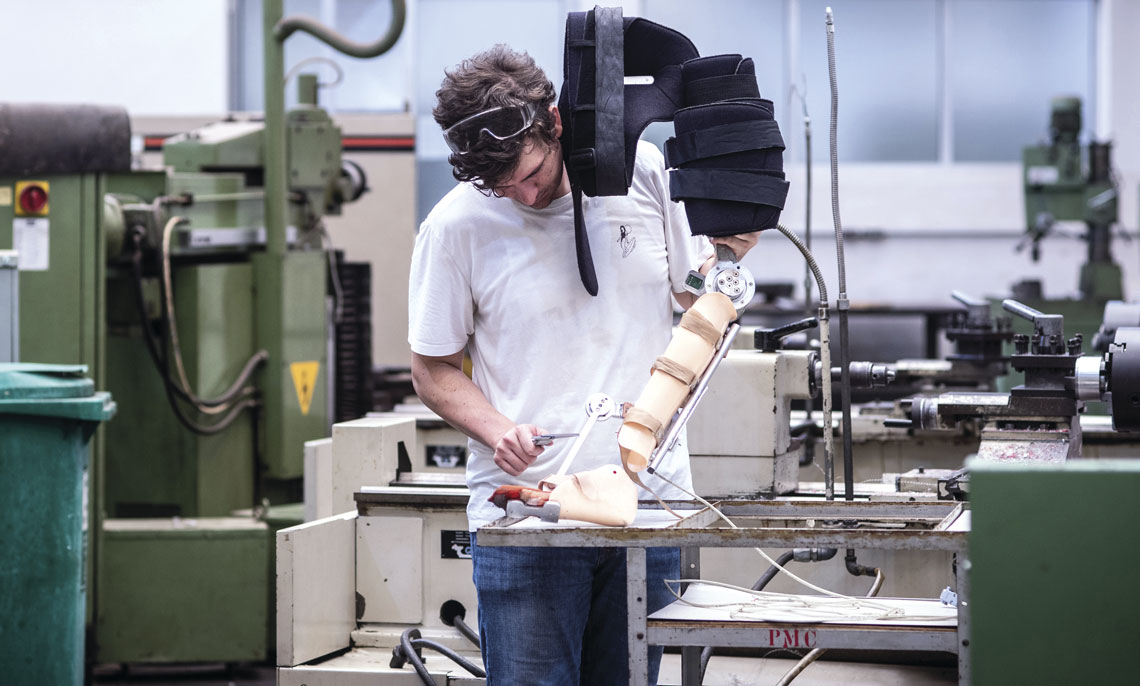
Léo Ramos Chaves / Revista Pesquisa FAPESPA researcher at USP’s Polytechnic School working on a robotic lower-limb exoskeletonLéo Ramos Chaves / Revista Pesquisa FAPESP
Meeting real-world needs
Bridging this divide is one of the core goals of CTecvida, based at USP. “We hope to bring together the right players to make competitive, high-quality assistive tech a reality,” says Arturo Forner-Cordero, an engineer who heads the Biomechatronics Lab at USP’s Polytechnic School (POLI).
CTecvida’s partners include USP’s São Carlos School of Engineering (EESC-USP), the Institute for Technological Research (IPT), the São Paulo State Office for Disability Rights, the inclusion-focused Instituto Mara Gabrilli, and the startup Voltta Fitness. “We’re working to develop technology that truly meets user needs,” says Forner-Cordero. “And we want to bring in manufacturers who can deliver these innovations to the market.”
CTecvida’s current projects at POLI and EESC include two robotic exoskeletons for the lower limbs, designed for people with mobility impairments due to stroke, Parkinson’s disease, or spinal cord injuries. Unlike traditional exoskeletons developed in Europe and the US—large systems that perform all movement for the user—the Brazilian models are compact and designed to combine the user’s effort with mechanical assistance. The key is smart software that interprets the user’s intent to move and activates the system to assist as needed (see Pesquisa FAPESP issue no. 301).
The CTecvida team is now developing modular exoskeletons so users can buy just the components they need—whether that’s support at the knee, ankle, or both—rather than a one-size-fits-all device.
Key to this strategy, says Forner-Cordero, is making sure these modules are interoperable—so components can be mixed and matched across exoskeletons from different manufacturers. To make that happen, the team plans to establish industry-wide standards and technical specifications for the modular parts, ensuring plug-and-play compatibility across brands. Forner-Cordero outlined safety and design requirements for modular exoskeleton systems in papers presented at the 6th IEEE International Conference on Biomedical Robotics and Biomechatronics back in 2016. More recently, test results from the exoskeleton project were published in IEEE Transactions on Medical Robotics and Bionics.
CTecvida is also developing modular wheelchairs designed to improve comfort at a competitive cost. The project is being led by the Lightweight Structures Lab at IPT’s Advanced Materials Unit (LEL-UNMA) in São José dos Campos, in collaboration with IMREA. This project has been structured into three phases.
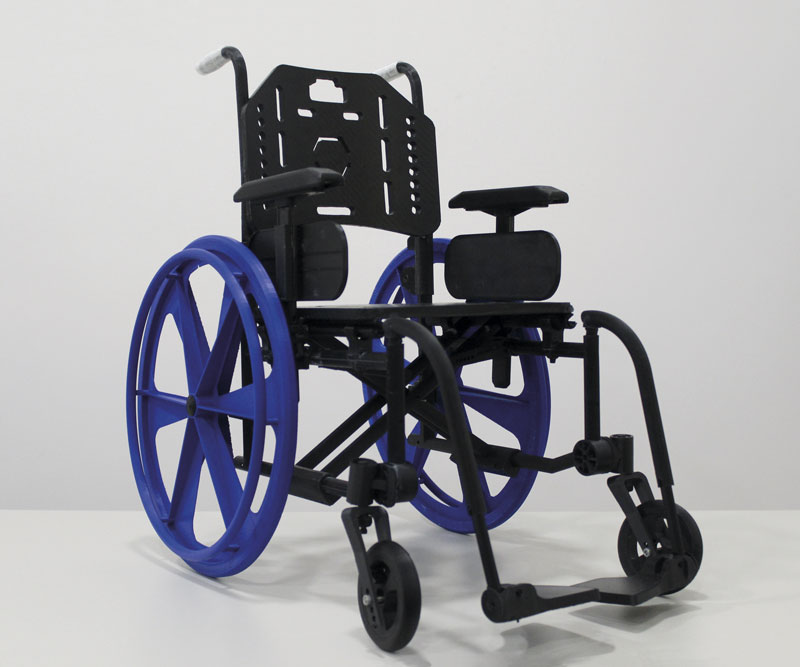
Leandro Aparecido da Silva Albino / IPTA modular wheelchair designed at IPT in São José dos CamposLeandro Aparecido da Silva Albino / IPT
The first, currently underway, is designing a conventional wheelchair that uses more ergonomic materials—yet remains affordable and priced in line with SUS procurement standards. This will include replacing standard polymer components like the seat, backrest, and armrest with anatomically contoured parts made from thermoformable foams—composite polymer materials reinforced with natural or synthetic fibers. “These materials conform to body shape and significantly improve comfort,” says Alessandro Guimarães, an industrial engineer and LEL’s technical lead.
But switching to more advanced materials can raise costs. To work around this, the team is using structural modeling to analyze stress points so only the most critical areas use premium materials, while others are built with cost-saving alternatives. “We’ll reserve the best materials for where they matter most and use more affordable ones elsewhere,” Guimarães explains.
In phase two, the LEL team plans to design a modular wheelchair frame that can accept different parts as the patient’s condition evolves. A single frame could accommodate a growing child over time, helping families cut costs,” Guimarães adds. In the final phase, the wheelchair will be integrated with the modular exoskeletons from POLI and EESC, enabling users to switch between sitting and standing devices on their own. “Users will be able to don their exoskeletons while seated, stand up to move, and then sit back down to remove the device—all on their own,” Forner-Cordero envisions.
The story above was published with the title “Affordable assistive products” in issue in issue 350 of april/2025.
Projects
1. Multidisciplinary Center for the Development of Assistive Technology (CMDTA) (nº 24/01132-2); Grant Mechanism Science Centers for Development (CCD); Principal Investigator Carlos Roberto Grandini (UNESP); Investment R$3,483,566.25.
2. Assistive Technologies Center for Activities in Daily Life (nº 24/01120-4); Grant Mechanism Science Centers for Development (CCD); Principal Investigator Arturo Forner-Cordero (USP); Investment R$4,317,141.84.
Scientific articles
SANTOS, J. V. C. et al. Numerical analysis of a composite leg prosthesis. Irf-2018 Proceedings of the 6th International Conference on Integrity-reliability-failure. pp. 77–84. 2018.
PORSANI, R. N. & PASCHOARELLI, L. C. Emoção e estética: Análise de invólucros customizáveis de próteses transtibiais por meio da ferramenta GEW. Educação Gráfica. Vol. 24, no. 3, pp. 386–402. Dec. 2020.
RODRIGUES, A. A. et al. Perspectiva econômica do mercado de inovação em tecnologia assistiva: Cenário nacional e projeções mundiais. Jornal Brasileiro de Economia da Saúde. Vol. 16 , no. 1, pp. 65–9. Apr. 2024.
SOUZA, R. S. et al. Modular exoskeleton design: Requirement engineering with KAOS. 2016 6th IEEE International Conference on Biomedical Robotics and Biomechatronics. pp. 978–83. July 2016.
SOUIT, C. et al. Design of a lower limb exoskeleton for experimental research on gait control. 2016 6th IEEE International Conference on Biomedical Robotics and Biomechatronics. pp. 1098–103. 2016.
PARIK-AMERICANO, P. et al. Lower limb exoskeleton during gait and posture: Objective and subjective assessment procedures with minimal instrumentation. IEEE Transactions on Medical Robotics and Bionics. Vol. 5, no. 4, pp. 1025–36. 2023.
Master’s dissertation
MACEDO, M. A. O efeito de um novo protótipo de prótese externa de joelho monocêntrico em aço inoxidável e polipropileno na marcha e capacidade funcional de idosos amputados transfemoral. Unesp. 2024.
Book
ARRUDA, A. J. V. et al. Design, Artefato e Sistema Sustentável. Blucher. 2018.