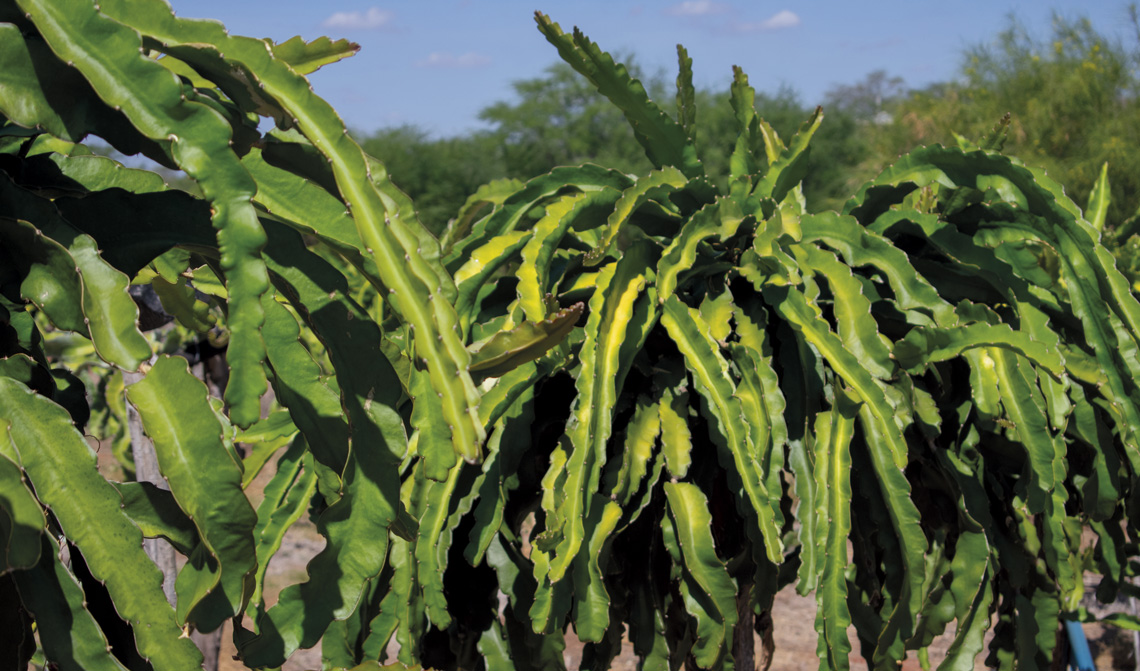
In the fierce, mid-afternoon sunshine of early November, biologist Helder Araujo walks into an orchard with 102 specimens of three types of dragon fruit, also known as pitaya (Hylocereus spp.), two meters (m) high with long, green branches. We are at the experimental farm of the Federal University of Paraíba (UFPB), in São João do Cariri, 200 kilometers (km) from state capital João Pessoa. This is one of the driest areas in the Northeast.
He stops before one of the dragon fruit trees and delicately pulls on the tip of one of the branches. “Look: the floral buds have appeared. It will bear fruit in December, and output will be higher in February and March. That will be our harvest. We found worms in the soil, indicating that it is fertile once again.” The plants are drip-irrigated with water from a nearby well.
With their experimental crops of dragon fruit, sorghum (Sorghum bicolor), cowpeas (Vigna unguiculata), guava (Psidium guajava), passionfruit (Passiflora edulis), and Caatinga passionflower (Passiflora cincinnata), Araujo and other researchers from UFPB working under a program called Nexus Caatinga are demonstrating how Caatinga (semiarid scrubland) vegetation, soil, and productivity can be reconstituted with some simple care. One of the principles is to aerate the soil and keep it covered with dry plants or leaves to enable water infiltration and prevent sediment and nutrient loss. In this region, erosion in exposed areas can entrain some 8 tons (t) of earth per hectare (ha) per year.
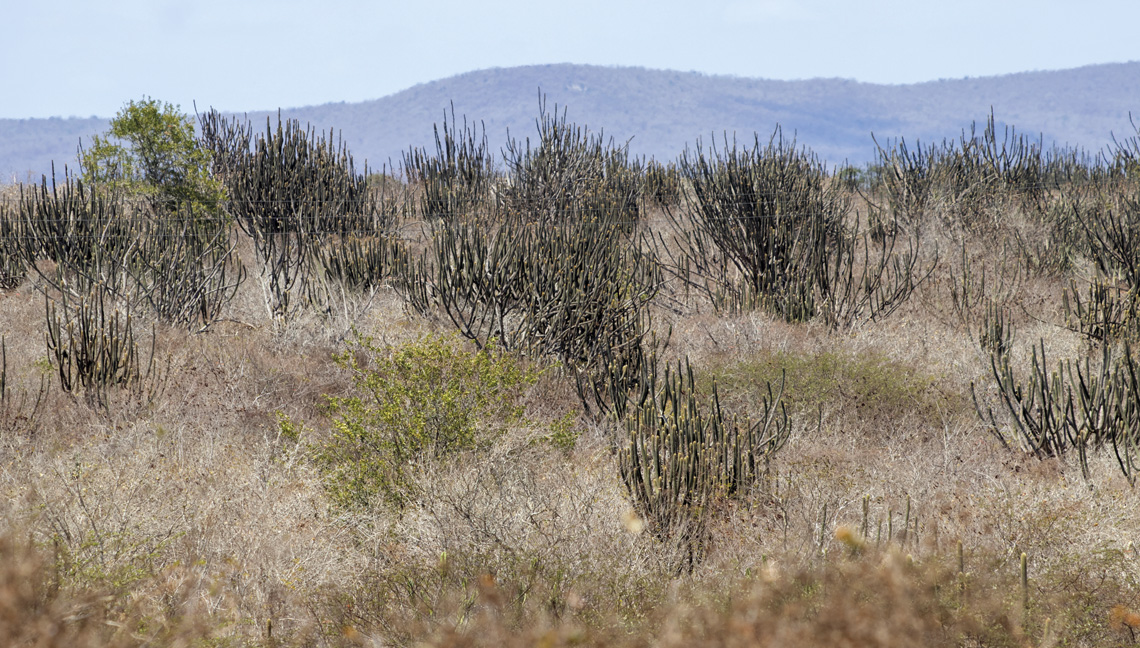
Thiago Zanetti …like this one close to Campina Grande, dominated by facheiros, a typical northeastern cactusThiago Zanetti
“Before planting,” says Araujo, “we take one pass with a tractor fitted with a cutting blade to superficially loosen the soil and let the water seep in.” This measure has also benefited other plants, such as the Brazilian ironwood (Libidibia ferrea) almost 3m in height that now grows at the outer limits of the orchard. “This was a surprise—we didn’t plant it. The seeds must have been here, but could not germinate due to the compacted soil.”
UFPB agronomy engineer Raphael Beirigo, participating in the visit, says: “Caatinga soil is great. One of the main types, luvisol, has a sandy surface layer, and another clayey layer that starts 20 centimeters [cm] below. This is perfect for retaining water for longer. In 2015, the first time I dug in the Paraiban Cariri (Indigenous word widely used nowadays to describe the region), I was surprised to see that the clayey layer was still moist after three months without rain.”
The issue, he adds, is that the soil has been poorly treated and lost water as a result of deforestation. In a study published in October 2023 in Scientific Reports, researchers from UFPB and the Federal University of Pernambuco (UFPE) make the case that the primary cause of alterations in the Caatinga is the loss of native vegetation due to anthropic activity, which leads to desertification, and, with higher average annual temperatures, the formation of arid climate areas (see Pesquisa FAPESP issue nº 338).
“Agriculture in the Northeast region is not very productive because much of the Caatinga has been deforested and the soil is considerably eroded and compacted,” says Beirigo (see infographics). “The widespread notion that agriculture is not fruitful in the region because of the shallow soil is nonsense.” His argument is exemplified by the trees that grow in minimal soil high up on the rock slab formations, common in the region’s landscape.
The Caatinga has a land area of 850,000 km2, of which 89% has been altered by human activity (see Pesquisa FAPESP issue nº 335). Owing to the soil’s significant propensity for erosion, grubbed vegetation does not recompose itself, unlike in the Cerrado (wooded savanna), the Atlantic Forest, and Amazonia. Consequently, in areas neighboring the UFPB farm—deforested since the eighteenth century, as indeed the entire region has been, for livestock ranching and cotton cropping, predominant in the area until the 1980s—what you see most is stunted vegetation, with few species, and a poor growth rate in dryer, stony soils.
This area is the setting for the classic 1963 Brazilian film Vidas secas (Barren Lives), directed by Nelson Pereira dos Santos (1928–2018) and based on the 1938 novel by Graciliano Ramos (1892–1953), very different from the rare examples of preserved Caatinga, one area of which is located at Fazenda Salambaia, in Cabaceiras, also in the Paraiban Cariri. Here you can find ironwood, the jatoba (Hymenaea rubriflora), pink trumpet or pink ipê (Handroanthus impetiginosus), the mulungu, as it is known in Brazil (Erythrina velutina), and other trees standing between 15 and 20 m high, whose canopies are in contact with each other and shade the leaf-covered soil that holds the moisture.
Mindful of the region’s history, Araujo exemplifies another indication that the Caatinga was once very different: documents sent to the Brazilian National Library in 1881 for an issue of the Catálogo geográfico do Brasil (Geographical catalog of Brazil) and published in the National Library Annals in 1991. According to these reports, the municipalities of São João do Cariri and Cabaceiras were home to “different timber species for construction and carpentry,” wild fruits—“jabuticaba (in the uplands of Corredouro and Caturité), umbu, quixaba, sticky nightshade (locally, joá), and the cacti known locally as xiquexique, facheiro, mandacaru, yellow guava, plum, and cumbeba”—and animals, including cougars, raccoons, wild boar, deer, anteaters, rheas, guans, woodpeckers, parakeets, and parrots.
Not everything bears fruit at the experimental farm. The planting of guava trees, for example, did not work out. Brown locusts (Stiphra robusta), which look like dry branches, destroyed 38 of the 48 guava seedlings planted amidst other degraded areas. Although this pest has attacked other plantations with the same number of guava seeds adjacent to a private reserve with native forest, none were lost because the insects had other food sources or were kept in check by birds and other predators. A January 2022 article published in the journal Revista Caatinga recorded the results of this unplanned experiment, demonstrating the importance of native forests close to crop areas.

Thiago Zanetti 20-meter trees grow in the moist soil of a preserved Caatinga on a farm in CabaceirasThiago Zanetti
At the university’s farm, 200 tree specimens from 11 species grow as part of a restoration experiment, such as the ironwood, mulungu, ipê, angico (Anadenanthera colubrina), aroeira (Myracrodruon urundeuva), tamboril (Enterolobium timbouva) and trumpet tree—locally, craibeira—(Tabebuia aurea); some are already 3 m high, among clumps of buffel grass (Cenchrus ciliaris) that is highly drought resistant and has spread and covered the ground.
“To remediate the Caatinga vegetation, we have to remediate the soil,” says biologist Renato Garcia Rodrigues of the Federal University of Vale do São Francisco (UNIVASF), Juazeiro campus in Bahia State. “It’s no use planting in poor, hard, and dry ground, like that of a parking lot.” Rodrigues came into this field of study in 2014 when he assessed a vegetation recovery project in an area in Cabrobó, Pernambuco State, which was a complete failure: all the trees died. “The company that did the work did not know the native species and used a method involving total-area planting in rows, which works in Atlantic Forest areas but doesn’t work very well in the northeastern region because the soil and climate are very different.”
Two years later, as coordinator of the university’s Center for Ecology and Environmental Monitoring (NEMA), Rodrigues accepted a commission from the Ministry for Integration and Regional Development: to develop, test, and implement low-cost methods to remediate degraded areas along 2,000 hectares on the banks of the São Francisco River transposition channels, in collaboration with teams from the Brazilian Institute of the Environment and Renewable Natural Resources (IBAMA).
The first task was to seek out native species that grow spontaneously with little water in degraded areas, have surface roots, produce lots of seeds, and help other plants to develop. The researchers identified 26 native species, described in a 2022 article published in the tree journal Revista Árvore on February 8. Noteworthy among these was the one-leaf senna (Senna uniflora), an herbaceous, yellow-flowered plant that can grow to a height of 1.5 m. “We sowed tons of senna seeds; when it grows, this plant forms a carpet on the soil and enriches it with fungi capable of increasing the plants’ capacity to retain water,” says Rodrigues. The results are detailed in a March 2023 article in the Journal of Applied Ecology.
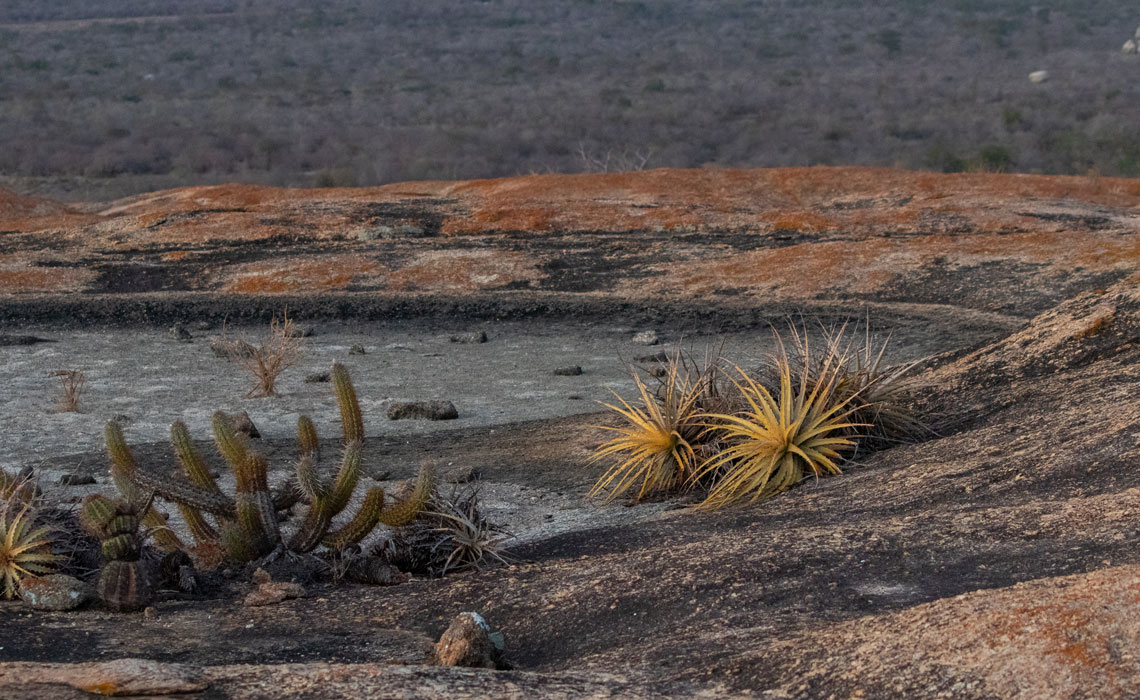
Thiago Zanetti Xiquexique cacti and macambiras spread out on the rock slabsThiago Zanetti
The UNIVASF team then selected tree species capable of surviving without irrigation and planted them in amongst the senna in groups, known as natural regeneration acceleration clusters, each of which can host 13 fast-growing pioneer seedlings, grouped in areas of 36m2, or 13 secondary ceilings—slower to grow—in 16m2 zones. The tree groups are surrounded with branches and trunks from the invasive exotic species algaroba (Prosopis juliflora), which occupies significant areas of the degraded Caatinga at the margins of highways.
On computerized maps, the tree clusters appear as dots along the channels of the São Francisco, and the maps carry information on the species planted and how many have died. Rodrigues clicks on a random dot and, among the 13 in a pioneer cluster, only one has died; he says that the survival rate for seedlings of some species exceeds 90%. The tables associated to the maps report 45,539 trees planted in the pioneer species clusters, and 9,204 in those of secondary species on the eastern axis, with 44,005 and 32,240 in each group respectively along the northern axis. Rodrigues says that the planting is set to be concluded in three years.
Both the UFPB and UNIVASF groups plant long-rooted seedlings, taking advantage of discoveries by a group from the Federal University of Rio Grande do Norte (UFRN) coordinated by biologist Gislene Ganade, who has worked with restoration in the Caatinga since 2010. “We developed the technique of using seedlings with long roots—1m—in 2013, so as not to be dependent on our luck with the rain,” she says. “We grow them in the greenhouse for between six months and one year, and then plant them out in the field. The survival rate increases by 30% for short roots, and 70% for long roots, which make use of the water stored in the clayey soil layer.”
The work has progressed. In 2016, in the Açu National Forest, central region of Rio Grande do Norte State, Ganade tested landscape restoration models, planting 4,704 long-rooted seedlings in 45 combinations of one, two, four, eight, or sixteen native tree species. One of the first discoveries, outlined in April 2018 in Ecology and Evolution, was the identification of tree species that facilitate the growth of others, for which reason they were named for the facilitators, for example the pink ipê, pereiro (Aspidosperma pyrifolium), black jurema (Mimosa tenuiflora), white jurema (Piptadenia stipulacea), and imburana (Commiphora leptophloeos). “The facilitator species retain water, provide shade, and increase the productivity of other plants in the restored areas,” reports Ganade.
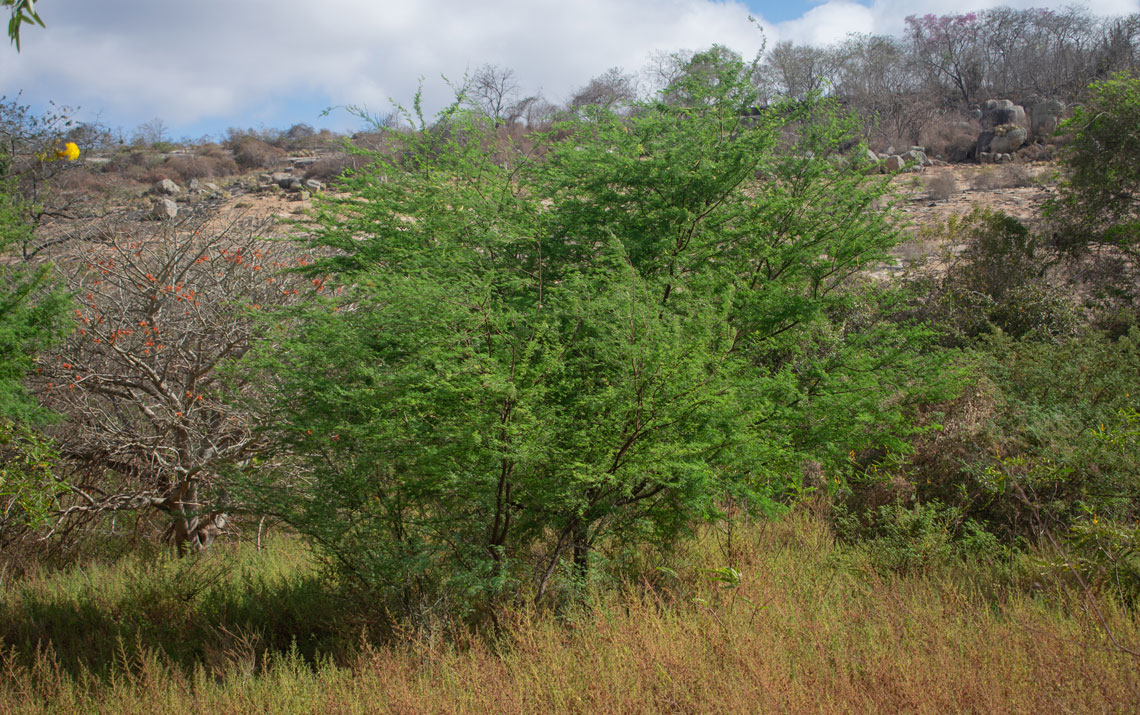
Thiago Zanetti The black jurema prepares the soil and facilitates the development of other tree speciesThiago Zanetti
Another finding, presented in the Journal of Ecology in March 2023, is that this greater diversity of tree species contributes to the growth of those that would grow more slowly if isolated, such as the cumaru (Amburana cearensis), whose leaves are used as raw material for cosmetics. The variety of species also attracts soil insects including ants, which help to spread the seeds.
To widen the range of her discoveries, Ganade set up a training center in the Açu Forest; in a period of three years, this space received 600 people interested in learning new environmental remediation techniques, and another 50 looking to become seed collectors. “We want to encourage action by cooperatives for the production of cosmetics and honey from native Caatinga species during development of the area under restoration,” she says. “The earth is multifunctional here.”
Public administrator Pedro Leitão agrees: “Living as they do in a region with very little rainfall, small-scale farmers have to understand corn, beans, fruits, honey, cotton, timber, goats, cattle, hens, and fish, because they have to produce a little of everything.” Between January 2020 and September 2023, Leitão coordinated the Caatinga Rural Sustainable Project (PRS) with funding from the UK government in cooperation with the Interamerican Development Bank (IDB). The aim was to promote the implementation of low-carbon-emitting agricultural technologies to reduce soil movement, reuse or contain water, and treat animal litter. Through proposals submitted by 20 NGOs, 1,505 families from across 31 municipalities in the states of Piauí, Pernambuco, Bahia, Alagoas, and Sergipe committed to testing the new working options in the field. They received materials to prepare the soil, breed fish, or produce honey, and were accompanied by 700 rural assistance technicians. Among other results, the final project report records an average increase of 15% in the income of rural producer families, 600 ha of crop-forest-livestock integration, 200 ha of restored area, and 1.2 million tons of CO2 emission avoided.
“The techniques used in the Caatinga to keep the soil moist are different from those used in other regions,” observes Leitão, adding weight to Rodrigues’s conclusion. “It’s difficult to conserve the soil in the Caatinga because the rainfall is more concentrated and torrential and resistance to erosion is low, primarily in sloping areas,” comments agronomy engineer José Marques Jr., of São Paulo State University (UNESP), Jaboticabal campus, who did not participate in the experiments. “That’s why it’s important to choose what you plant well, to leave the maximum possible organic plant material on the soil surface.”

Thiago Zanetti A tamboril remains green and lush in early November, in the middle of the dry seasonThiago Zanetti
The Caatinga revitalization experiments, including those of other institutions such as the Araripe Foundation, headquartered in Crato, Ceará State, confirm or update the conceptual basis formulated decades ago by agronomy engineers Carlos Bastos Tigres (1899–1980), author of the Guia para o reflorestamento do Polígono das Secas (Guide for reforestation of the drought polygon) (Brazilian Ministry for Transport and Public Works, 1964), and João de Vasconcelos Sobrinho (1908–1989), who proposed ways of containing desertification in the semiarid Northeast; and Geraldo Barreto, a champion of soil preservation and coauthor of Caminhos para a agricultura sustentável: Princípios conservacionistas para o pequeno produtor rural (Paths to sustainable agriculture: conservationist principles for the small rural producer) (Editora IABS, 2015).
In a debate on biome conservation held on November 4 at the São Paulo State Legislature, agronomy engineer Pedro Brancalion, of the University of São Paulo (USP), commented that the restoration of native vegetation contributes to reducing floods and to the welfare of local people by offering shaded spaces, but still faces high costs—R$30,000 per hectare on average.
Nevertheless, even small rural landowners can surround themselves with thriving plantations and trees in fertile soil. “When I bought this smallholding 16 years ago, the soil was ruined,” says Bonaldo Simões Nilo, 69, telling the story of his 5-hectare property, 14 km from the center of the small municipality of Cabaceiras. The smallholding is now a green oasis surrounded by abandoned land areas occupied by sparse, dry vegetation. “We have planted more than a thousand seedlings of 20 tree species,” says his son Breno, 23. Some, known as the brauna (Schinopsis brasiliensis) and the jurema, now grow—without being seeded—amongst the palm tree plantations, sold to neighbors who breed goats.
Their palms and dry leaves that cover the ground favor soil fertility and the growth of other plants. In the forest under formation, a jatoba planted in January 2024 now stands at 1.5 m; there are also aroeiras, angicos, and the Ceiba glaziovii, known locally as the barriguda, standing almost 2 m high.
Nilo raises turkeys, peacocks, and guineafowl, which are sold to other breeders. His son, a nature photographer, grows and sells cacti and succulents at the side of the house: “Six-banded armadillos, anteaters, foxes, tinamous, quails, and other animals we never saw before now live on the smallholding,” he says. “People come to spot birds, even the migratory ones that stop over here.”
The story above was published with the title “Caatinga fertile again” in issue 346 of December/2024.
Scientific articles
ARAÚJO, H. F. P. et al. Natural cover surrounding the farm field reduces crop damage and pest abundance in Brazilian dryland. Revista Caatinga. Vol. 35, no. 1. Jan–Mar. 2022.
ARAÚJO, H. F. P. et al. Human disturbance is the major driver of vegetation changes in the Caatinga dry forest region. Scientific Reports. Vol. 13, 18440. Oct. 27, 2023.
CARVALHO, J. N. de et al. Espécies nativas da Caatinga para recuperação de áreas degradadas no semiárido brasileiro. Revista Árvore. Vol. 46, e4610. Feb. 21, 2022.
FAGUNDES, M. et al. The role of nurse successional stages on species-specific facilitation in drylands: Nurse traits and facilitation skills. Ecology and Evolution. Vol. 8, no. 10. Apr. 27, 2018.
FAGUNDES, M. V. et al. The role of plant diversity and facilitation during tropical dry forest restoration. Journal of Ecology. Vol. 111, no. 6. Mar. 6, 2023.
Província da Parahyba. Comarca de Campina Grande. Descrição do Município de Cabaceiras. Anais da Biblioteca Nacional. Vol. 111, pp. 194–6. 1991.
MEDEIROS, A. S. et al. Arbuscular mycorrhizal fungi communities shaped by host-plant affect the outcome of plant–soil feedback in dryland restoration. Journal of Applied Ecology. Vol. 60, no. 3. Mar. 2023.
Book
BARRETO, G. & GODOY, O. Caminhos para a agricultura sustentável: Princípios conservacionistas para o pequeno produtor rural. Editora IABS, Brasília-DF, 2015.
Republish