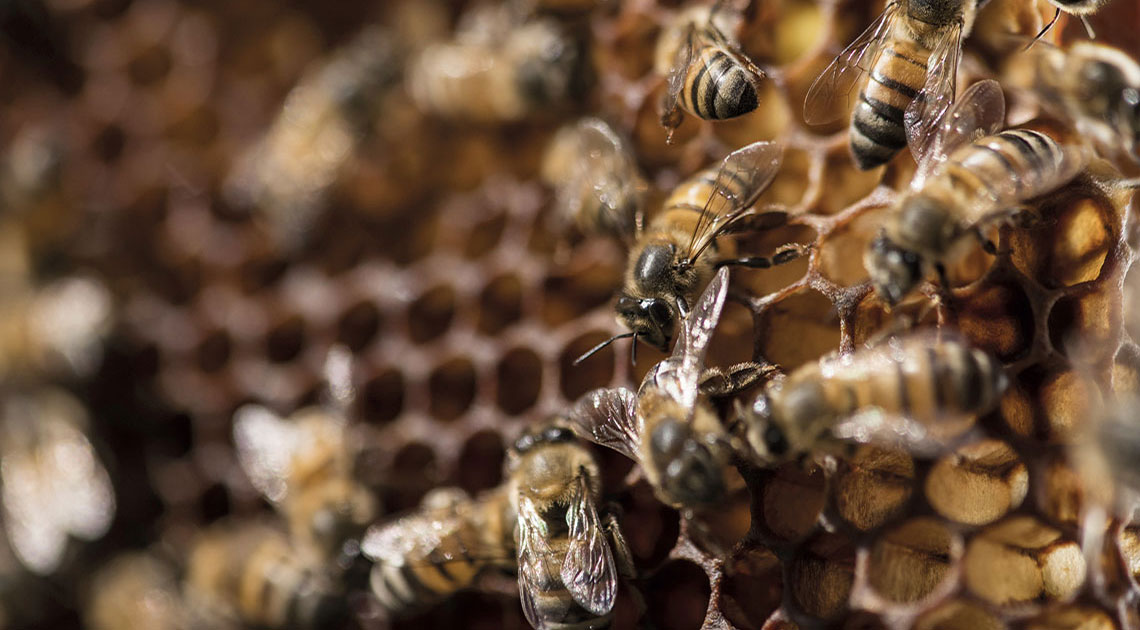
In Vitória da Conquista, Bahia, a 55-year-old man died after suffering more than 100 bee stings. A similar case was reported in Santa Cruz do Rio Pardo, in the interior of São Paulo State. The victim, 84, was also stung more than 100 times. In Bertioga, on the coast of São Paulo, a 58-year-old postman on his rounds was attacked by a swarm of bees and later died. All of these fatal cases occurred within just a few days of each other in February and March of this year.
“In Brazil, there are approximately 30,000 accidents involving Africanized bees every year, resulting in approximately 150 deaths,” says veterinarian Rui Seabra Ferreira Júnior, director of the Research Center for Poisons and Venomous Animals (CEVAP) at São Paulo State University (UNESP), Botucatu campus, citing data from the Brazilian Ministry of Health. He adds that official figures are likely underestimated. “Patients are often admitted to intensive care with acute renal failure due to the venom, and the cause of death, which usually occurs days later, is not recorded as an accident caused by bees,” he explains.
Ferreira is the author of a patent for a new anti–bee sting serum, which, according to clinical studies, could reduce the number of such deaths. Granted by Brazil’s National Institute of Industrial Property (INPI) in November 2023, the patent is the result of research conducted by CEVAP, the Butantan Institute in São Paulo, and Vital Brazil in Niterói, Rio de Janeiro. The INPI’s report attested to the originality, inventiveness, and industrial applicability of the technology.
Phase 1 and 2 clinical trials were carried out on 20 adult patients who suffered between seven and 2,000 bee stings. This stage of testing took three years, from 2016 to 2018, and was performed at Botucatu Hospital in São Paulo and Nossa Senhora da Conceição Hospital in Tubarão, Santa Catarina.
“Like other antivenom serums, ours is administered by an intravenous drip. We created a protocol on the basis of the number of stings the patient suffered,” says Ferreira. He explained that because the venom enters the body acutely, the medication must be administered as quickly as possible to prevent damage.
The results of the clinical trials, led by the CEVAP researcher and coauthor of the patent Dr. Benedito Barraviera, were published in the journal Frontiers in Immunology in 2021, indicating that the serum is safe and effective. All patients improved after receiving the inoculation. Only two patients experienced mild adverse effects, such as skin irritation. Next, the team will test a larger number of patients to statistically confirm its initial observations.
“We are going to carry out the phase 3 clinical trial on a more representative sample of the Brazilian population, with approximately 400 participants, all of whom will have been stung by Africanized bees,” says Ferreira. “The project is ready and awaiting funding from the federal government, as there are no private pharmaceutical companies producing antivenoms in Brazil.” After this stage, which is expected to last approximately two years, if the results are positive, the researchers will be able to request approval of the serum from the Brazilian Health Regulatory Agency (ANVISA).
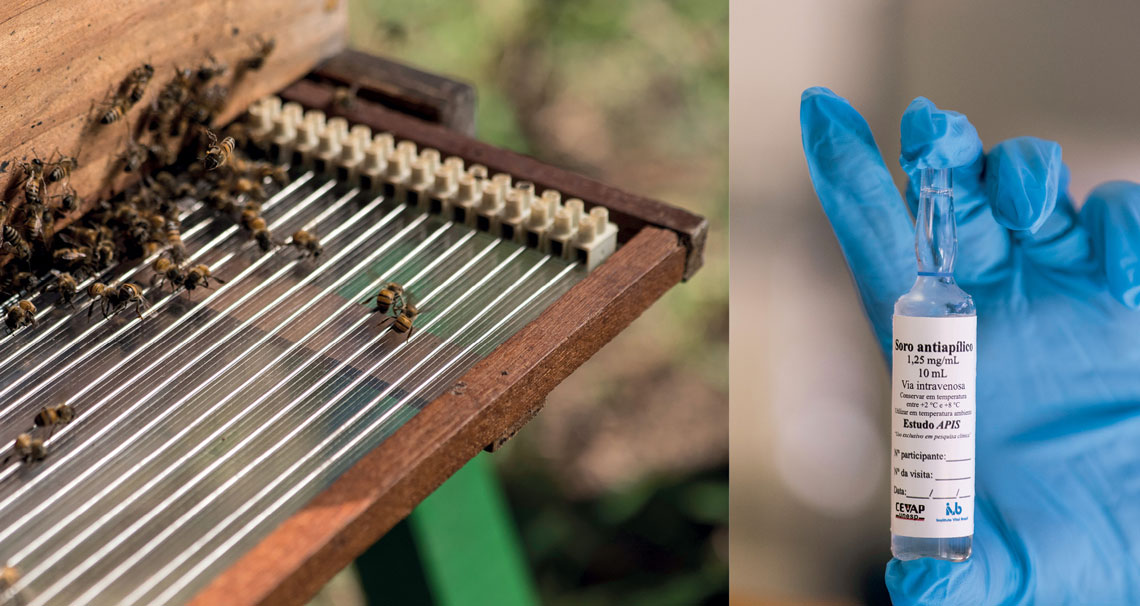
Léo Ramos Chaves / Pesquisa FAPESPA trap created by CEVAP researchers to collect bee venom (left) and a vial containing the developed serumLéo Ramos Chaves / Pesquisa FAPESP
Fatal venom
Two decades of study resulted in a serum that could be the world’s first antidote specifically for stings. Ferreira began researching serotherapy in 2002, during his master’s degree in tropical diseases at UNESP’s School of Medicine and at CEVAP, under the supervision of Barraviera.
His PhD focused on the same topic and was also supervised by Barraviera, who today heads the Center for Translational Science and Biopharmaceutical Development at CEVAP. Funded by FAPESP through the Science for Development Centers (CCD) program, it supports anti-apitoxin serum studies.
“It was in 2006, during my postdoctorate in immunochemistry at Butantan, that I began studies to create the serum,” says Ferreira. Africanized bees are the result of crossbreeding between the European honey bee (Apis mellifera) and the African subspecies Apis mellifera scutellata, which was introduced in Brazil in 1956 because they are more productive and resistant to diseases. In 1957, approximately 25 queen bees escaped from a quarantined apiary in a eucalyptus forest at the Rio Claro School of Philosophy, Sciences, Languages, and Literature in São Paulo, which later became part of UNESP in the 1970s. The escapees crossbred with European subspecies, resulting in an Africanized polyhybrid bee characterized by a strong defensive instinct. Reports of swarm attacks in Brazil and other countries on the American continent came
soon after.
According to Ferreira, there are two distinct types of bee-sting accidents. The most common accident involves only a few stings. In these cases, in individuals who are not allergic, the result is a local inflammatory reaction that resolves itself without the need for medical intervention. People sensitive to the venom, however, can experience a severe allergic reaction, with a risk of anaphylactic shock, requiring immediate treatment with allergy medications.
The second type involves attacks en masse and results in many stings, which can be fatal. “In such large quantities, the venom can cause acute respiratory and renal failure,” explains Ferreira. The damage is caused by two components of the venom, a peptide called melittin and an enzyme called phospholipase A2 (PLA2), which have both a cytotoxic effect (damaging cells) and a hemolytic effect (destroying red blood cells).
To date, the effects of these substances have traditionally been treated with antihistamines and anti-inflammatories, which can reduce symptoms but may not be enough to prevent death. The new serum, which must be stored at a temperature of 2–8 degrees Celsius, is designed to address the root cause of the problem, neutralizing the venom.
To produce serum, scientists have had to overcome several biotechnological hurdles. One is the need to obtain a high quantity of bee venom of standardized quality. To achieve this, they installed devices in hives consisting of copper wires connected to small glass plates. When bees touched the wires, they were subjected to a small electrical shock—not enough to harm them but enough to cause them to deposit a drop of venom on the plate. The study was carried out with another patent author, biologist Ricardo Orsi of UNESP’s School of Veterinary Medicine and Animal Science.
The next challenge was to standardize the purification and isolation process of the venom’s main components—the compounds that cause the death of people and animals who suffer multiple stings. Daniel Pimenta, a biomedical scientist from Butantan, took part in this stage. “The technological secret behind the serum is the fact that it is made only with antibodies to neutralize the destructive action of melittin and phospholipase A2,” says Ferreira. “All the other components, which can cause pain and allergies, are removed.”
This approach resulted in greater well-being and safety for horses inoculated against the venom so that they would produce antibodies for the serum, thus eliminating the risk of allergic shock. The serum was made at the Vital Brazil Institute in conjunction with veterinarian Luís Eduardo da Cunha Ribeiro, coauthor of the patent, by giving horses three or four purified doses of the venom toxins in small concentrations, which triggered an immunological response. A sample of the animals’ blood was taken to separate the part containing the antibodies, which were then isolated and concentrated to form the antivenom.
The UNESP scientist does not yet know how much each dose will ultimately cost. “Manufacturing antivenom serums is expensive because the process includes caring for the animals that produce the venom and for the horses that will be immunized, on top of the cost of the biotechnological production process,” he explains. “Our hope is that the Ministry of Health will negotiate with public laboratories that produce serums so that it can be distributed free of charge through the national health system.”
In parallel with the development of serum, another project involving UNESP scientists is attempting to quickly classify the clinical condition of sting victims by severity. The diagnostic kit for beekeeping accidents, a novel concept, is being developed by the startup Triad for Life, with funding from FAPESP’s Innovative Research in Small Businesses program (PIPE).
The biologist Bruna Cavecci Mendonça, who is part of the Triad for Life team, explained that the standard procedure consists of counting the stingers present in the victim’s skin, performing clinical observations of the patient, and performing nonspecific biochemical tests. “These are currently the only sources of information to assess the degree to which a person has been stung. In addition to being a time-consuming process, the amount of venom injected can vary from one bee to the next. Some stings can even be empty, meaning they inject no venom.”
Using a drop of the patient’s blood, the new kit measures the volume of phospholipase A2 toxin, which is part of the bee venom. The analysis is based on an immunoenzymatic test (a lateral flow immunochromatographic assay) that uses venom antibodies as a reagent. “A result is provided by a color change within 10 minutes, a little like a pregnancy test,” says the researcher.
Because the test measures the concentration of phospholipase in the bloodstream, it can also be used to monitor treatment and assess whether a given approach is working. A patent was filed in 2022. The company is currently producing more antibodies in order to manufacture the first batch of kits, which will be tested in hospitals.
Study confirms that serum for recluse spider bites reduces risk of skin damage
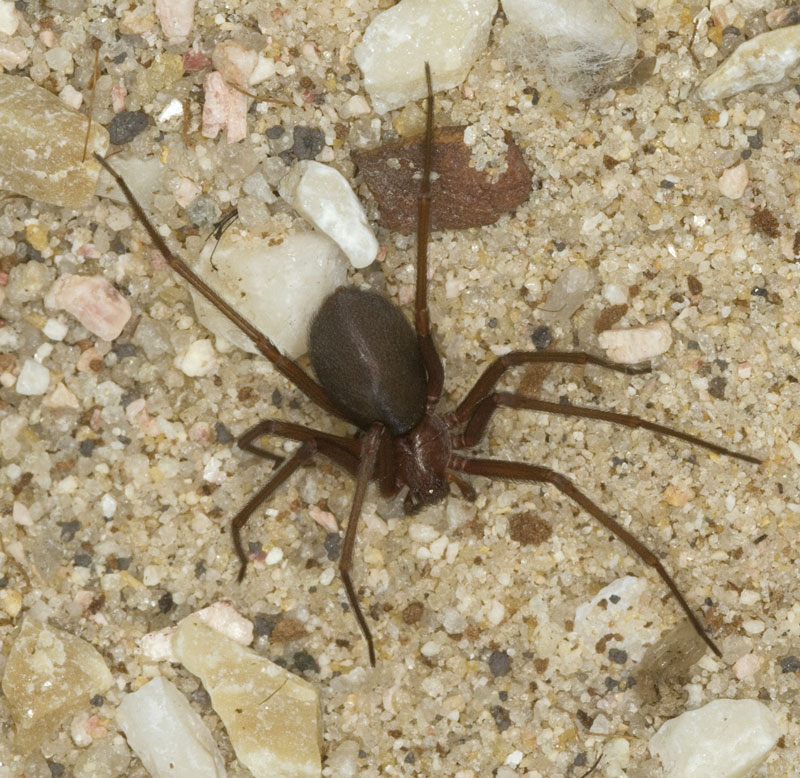
Eduardo Cesar / Pesquisa FAPESP The recluse spider, whose bite can kill the skinEduardo Cesar / Pesquisa FAPESP
The Butantan Institute recently concluded an observational study on the effectiveness of a serum designed to prevent tissue necrosis caused by recluse spider (Loxosceles spp.) bites. For decades, Butantan has manufactured trivalent antiarachnid serum, which is also indicated for accidents involving bites by Brazilian wandering spiders (Phoneutria spp.) and scorpion (Tityus spp.) stings. However, no scientific study has proven its effectiveness at reducing the risk of skin necrosis caused by recluse spider venom. Bites by Brazilian wandering spiders and scorpion stings do not generate necrosis. A recent study published in the journal PLOS Neglected Tropical Diseases in 2022 filled this knowledge gap.
“Since the 1970s, experimental studies with animals have shown that of the treatments available, the one that best prevented necrosis was a serum specifically made to target recluse spider venom,” says Dr. Ceila Malaque, a researcher at Hospital Vital Brazil and coordinator of the scientific study. “However, there was previously no research on humans like the study that was carried out at Butantan.”
Over the course of six years, 146 patients treated at Vital Brazil were evaluated, with 74 patients receiving serum while the remaining patients not receiving serum. The results showed that the antivenom had a protective effect against necrosis, especially when it was administered within the first 48 hours after the bite.
“We wanted to do the same analysis with patients admitted up to 36 hours after the accident, but unfortunately, it was not possible to study this cutoff. Victims of spider bites are often unaware that they were bitten and seek medical care too late, more than two days after the accident,” laments Malaque.
Published in July 2024
Projects
1. Comparative study of the immunization process with Africanized bee (Apis mellifera) venom alone and irradiated with cobalt-60, including the use of nanostructured silica SBA-15 as an adjuvant (nº 06/55545-8); Grant Mechanism Postdoctoral Fellowship; Supervisor Oswaldo Augusto Brazil Esteves Sant´Anna (Instituto Butantan); Beneficiary Rui Seabra Ferreira Junior; Investment R$102,705.12.
2. Center for Translational Science and Biopharmaceutical Development (nº 21/11936-3); Grant Mechanism: Science for Development Centers; Principal Investigator Benedito Barraviera (UNESP); Investment R$6,728,358.07.
3. Development of a novel diagnostic kit for accidents caused by bees (Apis mellifera) (nº 22/02869-3); Grant Mechanism Innovative Research in Small Businesses (PIPE); Principal Investigator Bruna Cavecci Mendonça (Paulo Daniel Leite Research & Development); Investment R$822,550.65.
Scientific articles
BARBOSA, A. N. et al. Single-arm, multicenter phase I/II clinical trial for the treatment of envenomings by massive africanized honey bee stings using the unique apilic antivenom. Frontiers in Immunology. vol. 12. mar. 23, 2021.
EL-KIK, C. Z. et al. Neutralization of Apis mellifera bee venom activities by suramin. Toxicon. vol. 67, pp. 55–62. june 1, 2013.
MALAQUE, C. M. S. et al. Impact of antivenom administration on the evolution of cutaneous lesions in loxoscelism: A prospective observational study. PLOS Neglected Tropical Diseases. oct. 14, 2022.