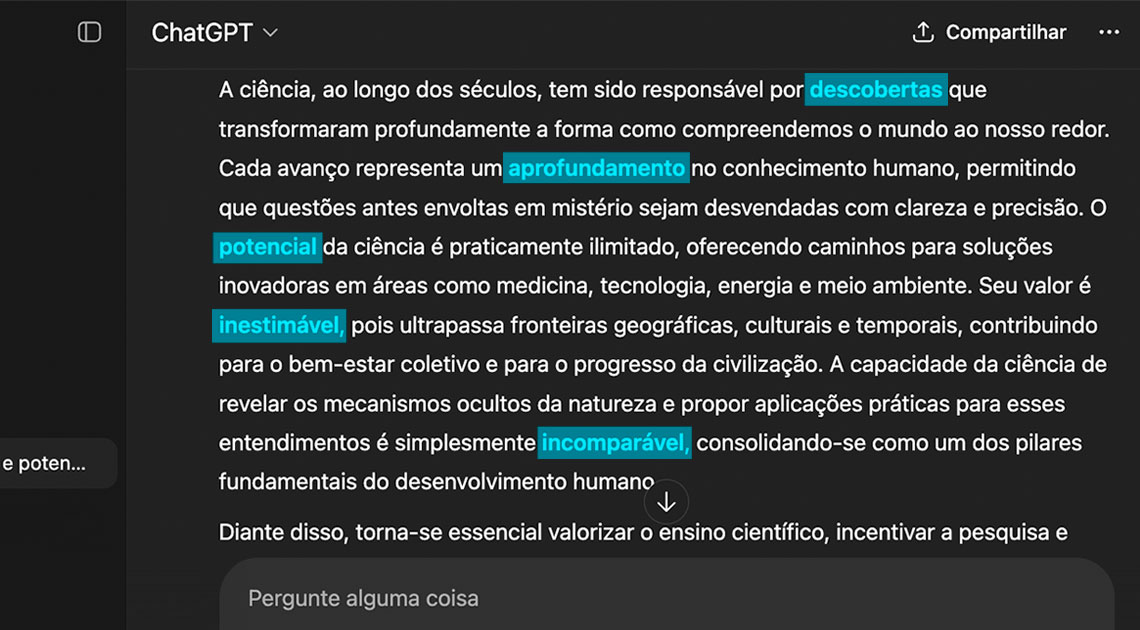
A study published in Science Advances estimated that one in seven biomedical research papers published in 2024 was written or edited with the help of generative AI programs such as ChatGPT. A team led by data scientist Dmitry Kobak of the University of Tübingen, Germany, analyzed more than 15 million abstracts of articles indexed in PubMed since 2010, finding a sudden change in vocabulary in 2024, shortly after the emergence of advanced AI systems capable of understanding and generating human-like text.
The study found that the lexicon adopted in scientific articles has evolved over time. In 2015, there was a rise in the use of the word “Ebola,” and in 2017, “Zika,” as a result of outbreaks of the respective viral diseases and the subsequent increase in related research. During the COVID-19 pandemic, about 190 terms—mostly nouns such as “COVID,” “lockdown,” and “mask”—appeared more frequently in the scientific literature. According to the authors, however, none of these cases involved as many new terms as has been seen since 2023. The researchers identified 454 words that appeared far more often in 2024 (after ChatGPT’s release) than in any other year since 2010. Most were verbs and adjectives associated with a certain writing style rather than being related to the actual research content. Some were common words, such as “findings,” “advancement,” and “potential,” while others were hyperbolic adjectives, like “unparalleled” and “invaluable.”
The increased use of these words was more evident in papers by researchers from certain countries, such as China and South Korea, and in fields such as computer science and bioinformatics—in these cases, one in five papers showed signs of AI use. Kobak and colleagues suggested that the overuse of particular words can serve as markers of the use of AI software and algorithms in scientific writing. Yet this may not be the case for long, as shown by a preprint shared on ArXiv in February. The paper, by Mingmeng Geng of École Normale Supérieure, Paris, and Roberto Trotta of Imperial College London, showed that common AI-generated words such as “advancement” began to decline in late 2024, possibly because authors began instructing the programs to avoid the use of such clichés.
The story above was published with the title “The extent to which artificial intelligence is used in biomedical research articles” in issue 354 of August/2025.
Republish