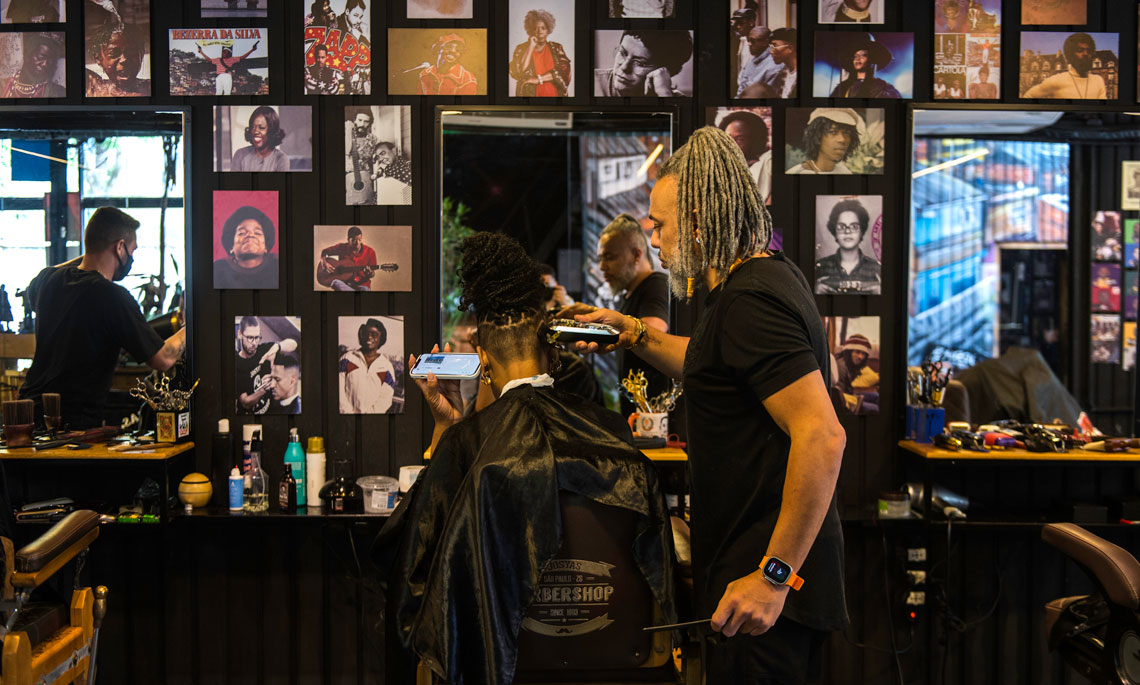
A study is examining the profiles and desires of entrepreneurs in poor neighborhoods of the city of São Paulo. The difficulties of accessing formal employment opportunities have increasingly led people to invest in alternative sources of income through self-employment and small street businesses. At the same time, a growing appreciation of the unique culture of these regions over the last 15 years has encouraged residents to create businesses that combine the pursuit of financial rewards with the desire to have a social impact in their communities.
“The phenomenon of entrepreneurship in low-income areas of the city is complex and diverse,” says sociologist Henrique Costa, who has been studying the relationships between poor regions of São Paulo and the job market since 2015. Costa is currently on a postdoctoral fellowship at the Brazilian Center for Analysis and Planning (CEBRAP), where he is analyzing the motivations, expectations, and frustrations of the people seeking financial autonomy through entrepreneurial activities in neighborhoods and communities in the south of São Paulo, such as Jardim Ângela, Campo Limpo, and Paraisópolis, in addition to popular commerce in Largo 13, Santo Amaro. Partial results of his work, based on interviews and ethnographic observation, were disclosed this year in the scientific journal Revista do Instituto de Estudos Brasileiros, published by the University of São Paulo (USP). In the coming months, the study will be described in a book published by Dutch publisher Brill, provisionally titled In the Remains of Progress – Utopia and Suffering in Brazilian Popular Entrepreneurship.
In his analysis of popular entrepreneurship, Costa uses the concept of “life without a salary.” According to the sociologist, the experience is not limited to an absence of formal employment but represents a form of subsistence that is rooted in Brazilian popular culture, characterized by the pursuit of an income outside the traditional labor system. “This search for alternatives is expressed through the term ‘hustling,’ frequently used by interviewees to describe the ability to adapt and find solutions to deal with financial instability and a lack of opportunities,” says the researcher, who conducted around 50 interviews with entrepreneurs from low-income regions of São Paulo between 2017 and 2022.
One of Costa’s main focuses was the population of Paraisópolis. “This community represents a microcosm of the exhilaration and suffering inherent to popular entrepreneurship in Brazil, where the quest for autonomy and success is rife with struggles and disillusionment,” he explains. According to the researcher, rising incomes and access to microcredit from 2003 onward drove the emergence of a new middle class and a group of entrepreneurs in the neighborhood. “Low-income communities seek to adapt the experiences of the traditional middle class to their own circumstances. This manifests itself in specific forms of consumption and the lifestyles they aspire to.”
Another phenomenon attracting the attention of researchers is the social entrepreneurship of the residents of these communities, which combines economic practices with an aim to have an impact on a local level. Sociologist Leonardo de Oliveira Fontes of the University of Campinas (UNICAMP), who has spent 10 years carrying out studies involving workers from poor neighborhoods, explains that in the 1990s, nongovernmental organizations (NGOs) began to focus more intensely on low-income neighborhoods in the city.

Léo Ramos Chaves / Pesquisa FAPESPResearchers advocate for specific legislation for self-employed workers, such as delivery workers and rideshare app driversLéo Ramos Chaves / Pesquisa FAPESP
On this topic, sociologist Jacob Carlos Lima of the Federal University of São Carlos (UFSCar) highlights that in the 1990s, Brazil was economically opening up, with neoliberal ideas spreading among the various levels of government. Against this backdrop, one increasingly popular idea was to reduce the role of public authorities in the provision of healthcare, education, and cultural services. “NGOs funded by large corporations began to provide this type of service in vulnerable regions, occupying spaces that should have been the responsibility of the State,” he explains. These organizations offered social services and income generation and training programs, encouraging entrepreneurship among young people.
At the same time, cultural movements promoting the value of identities associated with low-income regions were on the rise across the country, such as the hip-hop scene, which encompasses rap, graffiti, and other forms of expression (see Pesquisa FAPESP issue nº 334). At the turn of the century, writers and poets such as Sérgio Vaz and Ferréz (the pseudonym of Reginaldo Ferreira da Silva) began organizing literary gatherings in neighborhoods such as Campo Limpo and Capão Redondo. “These events contributed to the development of a cultural identity in which people feel a sense of community and pride associated with living in and being politically involved in a specific place,” explains Fontes.
Between 2003 and 2015, the federal government offered funding for cultural collectives in poor neighborhoods of the city, stimulating social inclusion initiatives. One example is Pontos de Cultura, which was run by governmental and nongovernmental organizations, with funding and institutional support from Brazil’s Ministry of Culture (MinC).
“The movement went beyond culture. Along with other factors, such as university admission quotas, it helped encourage residents of low-income areas to invest in businesses that also care about social causes and express cultural roots,” says Fontes, who carried out postdoctoral research on the subject with funding from FAPESP between 2019 and 2023. To learn about the situation in Jardim Ângela, he conducted 20 interviews with local entrepreneurs and attended fairs and meetings that they had organized. According to the sociologist, these people see where they live not only as a geographical space, but also as a place of resistance and somewhere to build new identity narratives. Some of the study’s results were published in the International Journal of Urban and Regional Research this year.
“Beauty salons and clothing stores that focus on Afro-Brazilian culture, restaurants that promote healthy eating, and communication agencies focused on community news and affairs have sprung up in poor neighborhoods in the south of São Paulo,” agrees Costa. As an example of the entrepreneurial profile that has emerged in recent years, the researcher names Thiago Vinicius de Paula, a community leader from Campo Limpo who has created a number of initiatives, including cultural spaces, a coworking space, and community radio stations. In 2019, Paula founded the restaurant Organicamente Rango, which uses ingredients sourced from family farms and supplies from local businesses.

Léo Ramos Chaves / Pesquisa FAPESPGrocery store in Jardim São Luís, a low-income neighborhood in São Paulo: small businesses offer alternative sources of incomeLéo Ramos Chaves / Pesquisa FAPESP
A similar case is the story of Adriana Barbosa. “When I was younger, I sold clothes on the street, worked as a secretary, and handed out flyers,” she says. In the 1990s she went to college to study fashion, but she ended up dropping out. In 2002, the São Paulo native founded the Feira Preta Festival, now considered one of the largest cultural and entrepreneurial events for the Black community in Latin America. Later, in 2018, she created PretaHub, which aims to accelerate businesses and has supported more than 5,000 Afro-Brazilian entrepreneurs.
The path is not easy for people from these low-income neighborhoods, according to a 2021 study by the Center for Entrepreneurship and New Businesses at the São Paulo School of Business Administration of the Getulio Vargas Foundation (FGVCENN) and the Arymax Foundation. Interviews with 101 social entrepreneurs from poor areas of Brazilian cities found that most businesses in these regions are started by Black women (70%) and that 60% generate a net income of under R$2,000 per month. Outside these areas, most social entrepreneurs are white, with a monthly net income averaging over R$12,000, highlighting the inequality between entrepreneurs in Brazil. “In addition to this, the average initial capital for businesses outside low-income neighborhoods is R$712,000, which is 37 times higher than the amount allocated to their counterparts in poorer areas,” points out Edgard Barki, a graduate in business administration and head of FGVCENN.
Vânia Maria Jorge Nassif, a psychologist from Nove de Julho University (UNINOVE) in São Paulo, analyzed the impacts of the COVID-19 pandemic on 25 Black female entrepreneurs living in Paraisópolis. The full study, funded by FAPESP and completed in 2022, involved a survey of 65 women from 10 Brazilian states. Nassif points out that female entrepreneurs from poor areas face a series of structural and cultural obstacles. The situation is especially complex for Black women, due to the combination of racial and gender discrimination.
According to the psychologist, before the pandemic, the interviewees had jobs such as nannies and cleaners. “Due to the global health crisis, many people lost their jobs and had to find new ways to support themselves, investing in self-employment and their own businesses as a way of ensuring a source of income,” says the researcher, who is head of research into innovation, entrepreneurship, and sustainable business and of the Center for Studies in Sports Management and Entrepreneurship at FGVCENN. “We need to develop institutional policies and practices to foster a more equal environment that is conducive to female entrepreneurship,” she says.
In relation to these challenges, Barki notes that business models created to support entrepreneurial activities must be adapted to the situations faced in poor areas. He notes, for example, that the vast majority of these entrepreneurs are not financially capable of starting over if their business fails, unlike other people with higher purchasing power. “Business plans must take the language and wisdom of low-income areas into account so as to better adapt to local contexts,” he suggests.
Initial capital for businesses in poor areas is 37 times lower than that allocated in other businesses
Another group of entrepreneurs studied by Henrique Costa during his postdoctoral fellowship at CEBRAP is evangelical Christians. He found that Pentecostal churches strongly encourage financial independence and reject subordination to third parties. These principles are part of what is known as prosperity theology, promoted at services and sermons in these religious spaces. “Followers are encouraged to start their own businesses,” he explains.
Costa notes, however, that there are fewer entrepreneurs committed to social causes and most popular entrepreneurship in low-income neighborhoods encompasses workers who have historically been small-scale, self-employed traders. Furthermore, despite the success stories of people like Thiago Vinicius de Paula and Adriana Barbosa, there is a gap between the expectations and reality of many residents investing in their own businesses in these areas. “Successful examples are the exception, and the promise of social advancement, autonomy, and recognition often does not align with the financial instability faced by the entrepreneurs,” he says.
The entrepreneurial discourse has been absorbed in different ways by workers from poor urban areas in recent years, says UNICAMP’s Fontes. While some began to identify themselves as entrepreneurs, seeing the role as a source of professional pride, others remain critical of entrepreneurship, pointing out that it can obscure situations of instability. The Nossa São Paulo Network’s Inequality Map, published in 2022, identified a high number of individual microentrepreneurs (MEIs) in regions historically marked by a lack of formal employment opportunities. Based on these data, Fontes says that the city of São Paulo has more than one million people registered as MEIs. Jardim Ângela, where he carried out his study, has the second highest number of MEIs in São Paulo, second only to Capão Redondo.
He believes the results back up the theory that entrepreneurship has become a common survival strategy for the populations of poor urban areas. “In many of these neighborhoods, registering as an MEI is the only way to legalize informal businesses and guarantee some degree of legal security. However, in practice, the framework does not do enough to protect workers in crises,” says the researcher. A survey by Central Única de Favelas (CUFA) found that of the 17.9 million residents of favelas in Brazil, 5.2 million self-identify as entrepreneurs. However, only 37% of these people are formally employed, highlighting their precarious situation.
Another data point supporting this issue, says UFSCar’s Lima, is that half of all MEIs in Brazil are in debt. “Despite the fact that an entrepreneurial mindset has become dominant in the poor regions, many of these professionals do not have access to social rights,” stresses the sociologist, who has been researching alternative income generation and work in different sectors of Brazilian society since 2010. In reference to the financial instability experienced by many families in low-income areas of the city, he cites a 2009 study carried out in Sapopemba, a district in the east of São Paulo, by sociologist Gabriel Feltran, then a researcher at UFSCar. The survey identified that even within the same family, there may be some people working under formal contracts, others making a living through various types of self-employment, and others still who choose to make money from criminal activity.

Gleyce Silva / Feira PretaFeira Preta in São Paulo: festival stimulates economic practices and social impactsGleyce Silva / Feira Preta
Mauro Oddo Nogueira of the Institute for Applied Economic Research (IPEA) explains that among MEIs, it is necessary to separate those who are self-employed service providers from those who are entrepreneurs. He points out that many people who register as MEIs work jobs such rideshare app drivers, cleaners, and hairdressers. “They may feel like independent professionals, but in reality, they face limitations that do not align with the concept of entrepreneurship,” says the researcher, who is head of studies on production chains and micro and small businesses at IPEA. According to the Brazilian Support Service for Micro and Small Businesses (SEBRAE), “entrepreneurship is the act of opening a business and creating jobs, operating as a driver of innovation and improving people’s quality of life.”
With this overview in mind, Nogueira states that Brazil needs two distinct instruments to regulate the work of these professionals. The MEI structure is suitable for people who perform business activities, such as crafts, food services, and small stores, where there is potential for growth, hiring of employees, and the opening of new branches. Specific labor legislation is needed for self-employed workers, such as delivery drivers and rideshare app drivers.
Fontes, from UNICAMP, highlights that a series of changes occurred in the Brazilian job market at the turn of the twenty-first century. These transformations, he says, were driven by the country’s increasing deindustrialization—a process that started in the 1990s—and the relaxation of labor laws from 2016 onward. According to the researcher, until the 1970s, formal work, especially in industry, was seen as a gateway to citizenship—a guarantee of rights and a path to financial freedom. Even though this type of work was out of reach for most of the population and was not desired by many workers who preferred informal work due to its flexibility and potential for higher income, work governed by Brazil’s labor code offered a wide array of possibilities. Furthermore, factories served as spaces that fostered solidarity between workers, who came together in pursuit of better working conditions. Fontes states that increasing professional instability and a loss of rights associated with the work led to a decrease in cohesion among workers, lending weight to the individualistic discourse, which placed the responsibility for social advancement on the individual rather than on the collective.
In a study funded by FAPESP and completed in 2022, UFSCar sociologist Maria Carla Corrochano analyzed public policies relating to work and youth created in São Paulo between 2013 and 2020. “In the last 10 years, these measures have started to focus on young entrepreneurship,” she says. In 2023, partial results of the study, obtained in partnership with researchers from the University of São Paulo (USP), the Federal University of São Paulo (UNIFESP), and the São Paulo School of Business Administration (EAESP) at FGV, were published in the journal Cadernos Gestão Pública e Cidadania. Among the initiatives cited by the researchers is a state program created in 2015 called São Paulo Criativo, which provides training for young people seeking to become entrepreneurs in sectors such as gastronomy, design, the audiovisual industry, and tourism. The municipal program Don@ do meu Trampo, created in 2019, provides theoretical and practical entrepreneurship training for people aged 18 to 29 from Cidade Tiradentes, in the east of São Paulo.
According to Corrochano, the economic crisis suffered by Brazil since 2014 has resulted in high unemployment rates, with a particular impact on young people. “In the face of this crisis, measures for stimulating entrepreneurship have emerged as the preferred alternative,” she says. In his assessment, many of the initiatives aimed at entrepreneurship focus exclusively on training, which can lead to young people shouldering all of the responsibility for finding ways to obtain income and financial autonomy.
The story above was published with the title “Survival and idealism” in issue 345 of November/2024.
Projects
1. The crisis seen from the periphery: The fight for social mobility on the frontiers of (il)legality (n° 19/13125-2); Grant Mechanism Postdoctoral Fellowship; Supervisor Bianca Stella Pinheiro de Freire Medeiros (USP); Beneficiary Leonardo de Oliveira Fontes (UNICAMP); Investment R$469,025.60.
2. Young collective: A research and action project to support youth production collectives in poor regions of São Paulo and Buenos Aires (n° 18/12094-3); Grant Mechanism Research Grant ‒ Public Policies; Principal Investigator Maria Carla Corrochano (UFSCar); Investment R$219,438.19.
3. Entrepreneurship among minority groups: Barriers, challenges, and the willpower of Black female entrepreneurs (n° 23/05349-3); Grant Mechanism Fellowship Abroad; Principal Investigator Vânia Maria Jorge Nassif (UNINOVE); Investment R$25,178.21.
Scientific articles
COSTA, H. Empreendedorismo popular e a economia moral da vida sem salário. Revista do Instituto de Estudos Brasileiros, 1(87), 1–19, 2024.
FONTES, L. Between dreams and survival: The (Dis)embeddedness of neoliberalism. International Journal of Urban and Regional Research. Nov. 2023.
BRESCIANI, L. P et al. Mapa de políticas públicas para a juventude e o trabalho na cidade de São Paulo: Uma perspectiva contemporânea. Cadernos Gestão Pública e Cidadania. Escola de Administração de Empresas de São Paulo ‒ Fundação Getulio Vargas (EAESP-FGV). Vol. 28. 2023.
Books
NOGUEIRA, M. O. & ZUCOLOTO, G. F. Um pirilampo no porão: Um pouco de luz nos dilemas da produtividade das pequenas empresas e da informalidade no país. Brasília: Ipea, 2019.
COSTA, H. In the remains of progress ‒ Utopia and suffering in Brazilian popular entrepreneurship. Koninklijke Brill NV. In press.