I was in my early 20s, I had just lost my job as an electrician, and I was doing household electrical repairs on the weekends. I was chatting with some friends at a bar when I saw a sign: “Electrician needed.” It had been posted by a college called the Santamarense Organization of Education and Culture [OSEC], which later changed its name to Santo Amaro University [UNISA]. It was located in the neighborhood of the same name in the south of São Paulo, near where I lived. I thought, “Is this for me?” Then someone at the table told me, “Anyone who works at the college is entitled to a scholarship and can study for free.”
I had already attempted the entrance exams for both philosophy and history at the University of São Paulo [USP]. The first time, in 1989, I failed, as did most students from public schools and low-income areas. We simply could not compete with those from elite private schools. The second time, a year later, my score improved, but I was disqualified for not having written my essay clearly in pen. So I decided to try my luck at OSEC.
But my story begins long before that. I was born in 1970 and grew up in a poor and violent area in the far south of São Paulo. My mother, originally from the countryside of São Paulo State, made coxinhas to sell as a way of helping support the family. As a child, I sold popsicles on the streets with the same goal. My father, from Vitória da Conquista in Bahia, worked as a clerk in a textile factory, but he earned very little.
When I was an adult, he confided in me that his dream had been to study agricultural engineering, but he never had the chance to do so. Maybe that is why he encouraged his eldest son to become an engineer, and pushed me to study to be an electrician at SENAI [the National Service for Industrial Training]. After my technical training, I worked in electrical workshops, general maintenance, anything that came my way.
Joining OSEC as an electrician was a turning point in my life. In a short time I became head of the maintenance department, supervising other electricians, plumbers, and painters. I worked during the day and studied history in the evenings on a full scholarship. My final thesis was about the Epic of Gilgamesh [a Mesopotamian epic poem written in 1800 BC, considered one of the oldest literary works in the world].
Many of my professors were recent PhD graduates from USP, and based on their advice, I took a graduate course as a special student on USP’s History Program. This was in the mid-1990s. The course was called Currency and the Notion of Value in the Ancient World, and was taught by Maria Beatriz Borba Florenzano, a professor of archaeology. When Bia—as she is known to her students—read my thesis, she annotated it heavily in red pen. “It must be terrible,” I thought. But then she said, “This is practically a master’s-level thesis.” I was stunned.
She then offered to supervise me for a master’s degree and suggested the topic of Heracles—a central figure of Greek mythology, later reinterpreted by the Romans as Hercules—and coins from Sicily during the Greek period (fifth to third centuries BCE). I accepted immediately. I began my research in 1996 and three years later traveled to Israel for excavations, at Bia’s invitation. It was my first time on a plane.
I excavated in the ancient city of Apollonia, where there are remains of a sophisticated urban infrastructure developed over more than 2,000 years, especially during the Hellenistic, Roman, and Byzantine periods. The experience sparked my interest in the archaeological richness of Ancient Rome. When I got back to Brazil, I said to my supervisor, “For my PhD, I want to move on from Ancient Greece and study the Roman period.”
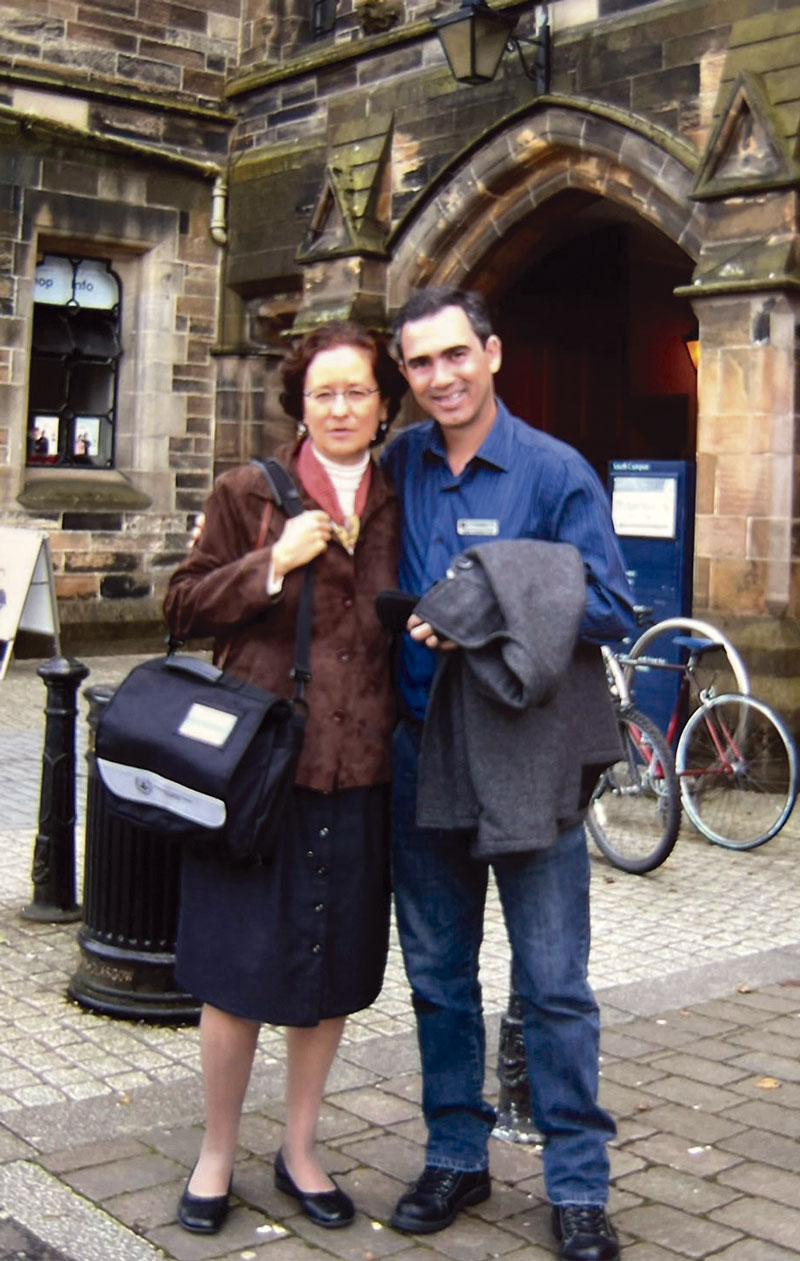
Personal archivePorto with Maria Beatriz Florenzano in Glasgow, Scotland, during a conference in 2009Personal archive
Between 2002 and 2007 I carried out a research project titled “Monetary images in Judea/Palestine under Roman rule.” In my thesis, I cataloged Roman coins and developed a method based on the imagery and text on the obverse [heads] and reverse [tails] sides of the coins, which is now used by other researchers. I took a two-year hiatus from my job as a history teacher to finish the research. I spent some time in Tel Aviv [Israel], did some excavating, read everything I could, and wrote diligently.
It is curious to think that this shift to Ancient Rome changed my life. In 2013, archaeologist Maria Isabel D’Agostino Fleming, a professor at USP’s Museum of Archaeology and Ethnology [MAE] who researched Roman archaeology, retired. That same year, I passed the competitive selection process to succeed her. If I had not chosen that topic for my doctorate, I might never have become a professor at USP.
The path to teaching at USP was an arduous one. During my master’s and PhD, I taught in public schools, municipal schools, and at a private school in Jardim Europa [an upscale neighborhood of São Paulo]. In 2002, Paulo Eduardo Dias de Mello, then director of the history course at the Metropolitan University Center of São Paulo [FIG-UNIMESP] in Guarulhos, offered me a job as a professor at the university—which I accepted.
Paulo Eduardo was also a professor at UNISA. I told him I wanted to teach there—not only because it was close to home, but also because of the emotional connection and the personal challenge of returning to the institution where I graduated and once worked as an electrician. He introduced me to the coordinator, Professor Nely Robles Bacellar, and in 2005 I was hired as a professor at the college.
I think there is a kind of symbolic barrier when someone transitions from an operational role to a teaching one, especially within the same institution. Sometimes it is just a feeling, other times it is more than that. Having been head of the maintenance department at UNISA, I felt like maybe people would not see me as someone fit to be a university professor there. But I was welcomed and stayed there for eight years, often juggling three or even four teaching positions at once.
When I successfully applied to work at USP, I put everything aside to dedicate myself fully to my new job. It was worth it. I recently had the honor of being elected as a corresponding member of the German Archaeological Institute (DAI), a distinction granted to very few researchers outside Europe and of enormous relevance in my field.
I still do research and fieldwork at the Tel Dor archaeological site and I am one of the leaders of the Brazilian team on the international project “Cultural Contacts in Judaea-Palaestina during the Roman Period: Coin Circulation and Urbanization Studies in Tel Dor,” funded by FAPESP. The group also involves researchers from Israel, the UK, Australia, and the US.
I am very proud of my career. It is based on my blood, sweat, and tears, as well as a lot of reading. If today I could speak to the Vagner of 1990, I would say, “Keep calm, everything will work out in the end. You are going to make it.”
The story above was published with the title “Connective wires” in issue 355 of September/2025.
Republish