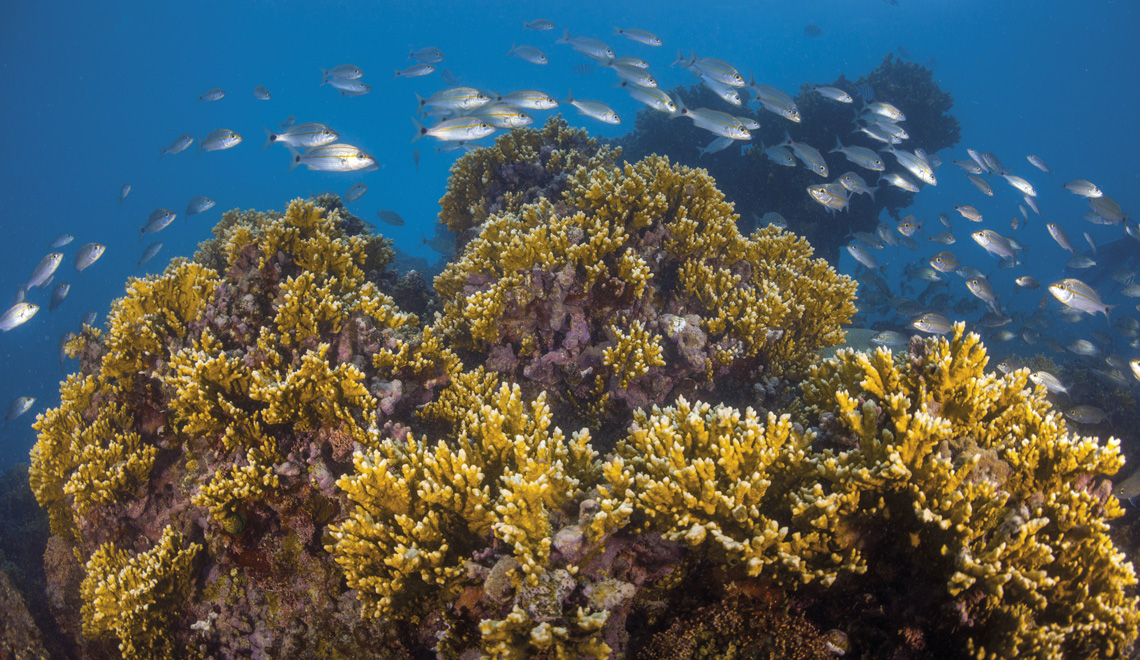
Coral loss in Brazilian reefs could have even greater consequences than previously thought. A study published in August in Global Change Biology suggests that the Brazilian coast is at risk of losing a quarter of its coral species. As a result, a cascade effect could wipe out half of the country’s fish species that depend on this type of marine ecosystem.
Brazilian reefs are unlike those found in the Caribbean and Indo-Pacific, which are rich in color and diversity. “They don’t have that ‘underwater forest’ look, with intricate coral species branching out like trees, for example,” explains biologist Mariana Bender, from the Federal University of Santa Maria (UFSM) and coauthor of the study. Because they are less extensive than reefs found elsewhere, Brazilian corals have been underestimated, she explains. “Our study proves that the corals along our coast are very important to the fish that interact with them.”
The issue is that these corals are disappearing, according to long-term monitoring, and this affects other animals. Using computer simulations, the study followed eight species and analyzed how more than a hundred fish—and their ecological roles—would be affected in three different scenarios. In the first scenario, researchers simulated what would happen in a reef environment if the corals with the highest number of interactions with fish species—or in marine biology jargon, those with the highest centrality—were removed first. In the second scenario, the team simulated removing coral species most vulnerable to death by bleaching and, in the third scenario, the team randomly removed species from the reef.
Although the marine environment was affected to some degree in all three scenarios tested, the ecosystem’s fish diversity and ecological function suffered most in the first scenario. In the simulation, removing two species of coral with high centrality directly affected four out of ten fish species that have a direct relationship with the reefs. One in five species that interact with these fish—and therefore have an indirect relationship with the reefs—were also affected. Hence the cascade effect. In total, more than half of all the fish species studied in the simulation were affected.
According to oceanographer Miguel Mies, from São Paulo State University’s Oceanographic Institute (IO-USP), the study is robust because it has high statistical rigor. “And it uses an ecosystem approach, integrating different organisms in the reef to see how the effects on one species interfere with others,” says the researcher, who was not involved in the study.
The research is alarming because it deals with the loss of coral species that are more resilient than those in other parts of the world, where marine habitats have crystal-clear water. According to Mies, this is because the Brazilian coast is not a favorable environment for coral formation. “There are many rivers flowing into the continental shelf, bringing with them a lot of sediment and turbidity,” he explains. This turbidity reduces the amount of sunlight in the marine environment, which is essential for coral development. “Similarly, these rivers introduce a lot of nitrogen, phosphorus, and other nutrients that act as filters for selecting the strongest species.” As a result, only the most resilient corals have settled on the Brazilian coast. On the other hand, diversity is relatively lacking: “There are hundreds of species in the Indo-Pacific, while we have about 20 here in Brazil,” estimates Mies. “But they are special, more tolerant to climate change.”
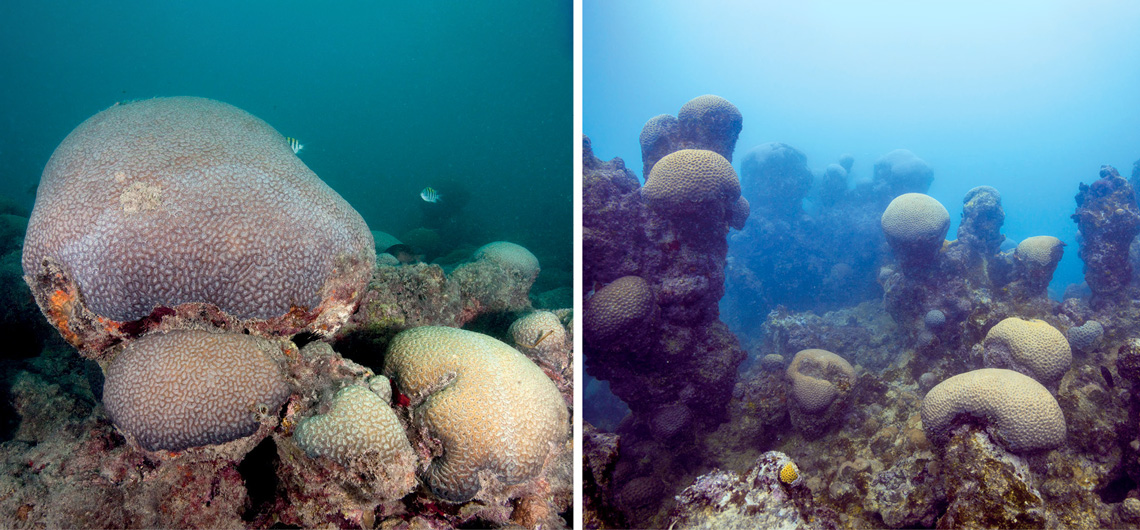
João Paulo KrajewskiUnderwater environment in Boqueirão, in Abrolhos, has seen a decline in key speciesJoão Paulo Krajewski
Losing these species will impact life under the sea, but also above, says marine ecologist and coauthor of the study Guilherme Longo, from the Federal University of Rio Grande do Norte. Coral suppression off the Brazilian coast results in a less healthy marine environment. “And it impacts human populations in terms of nutrition, fishing, and tourism, which has a significant socioeconomic effect,” he notes.
In order to more effectively monitor coral reduction along the Brazilian coast, a baseline must be established so that the loss can be measured, say the researchers. Losing 10 species in a population of 100 is quite different from losing 10 in a population of 20.
This effort resulted in the doctoral thesis written by biologist Carine Fogliarini, from UFSM. The study, published in August in Ocean & Coastal Management, gathered historical data on corals off the Brazilian coast over 150 years, referencing materials ranging from manuscripts by nineteenth-century naturalists to museum data and publications from recent decades.
Fogliarini noted that the number of coral records has increased over time, especially after the 1960s. Advancements in technology that allowed for better mapping of marine environments played a crucial role, she says. Until 1960, there were coral records from 13 sites along the Brazilian coast, from Ceará to São Paulo, covering a total of 20 species. Between 1997 and 2019, she found eight more coral sites, bringing the total to 21.
While records have increased over the last 150 years, Fogliarini has observed the decline of two key coral species on the Abrolhos Bank, south of Bahia: Millepora alcicornis and Mussismilia braziliensis. “These species are reef builders, and as their numbers decline, important benefits are being lost, such as shelter for smaller fish,” she says.
According to Longo, who also took part in this study, analysis is important because it provides a reference point for what a healthy environment would have looked like in the past. And it has fundamental value for conservation policy. “You can’t tell if a species is threatened with extinction within the parameters of the International Union for Conservation of Nature [which produces lists of animals classified by conservation status and risk of extinction] if you don’t have historical data for comparison.”
“By combining both studies with evidence from other studies working towards piecing together the puzzle, we see that together they predict and explain well what is happening at the ecosystem level,” says Mies.
The story above was published with the title “As the coral disappears, so do the fish” in issue 345 of November/2024.
Scientific articles
LUZA, A. L. et al. Coping with collapse: Functional robustness of coral-reef fish network to simulated cascade extinction. Global Change Biology. Vol. 30, no. 9, e17513. Sept. 2024.
FOGLIARINI, C. O. et al. Revisiting 150 years of coral studies to assess changes in species records, distribution, and functional structure of corals in the Brazilian Province. Ocean & Coastal Management. Vol. 257, 107340. Nov. 1, 2024.