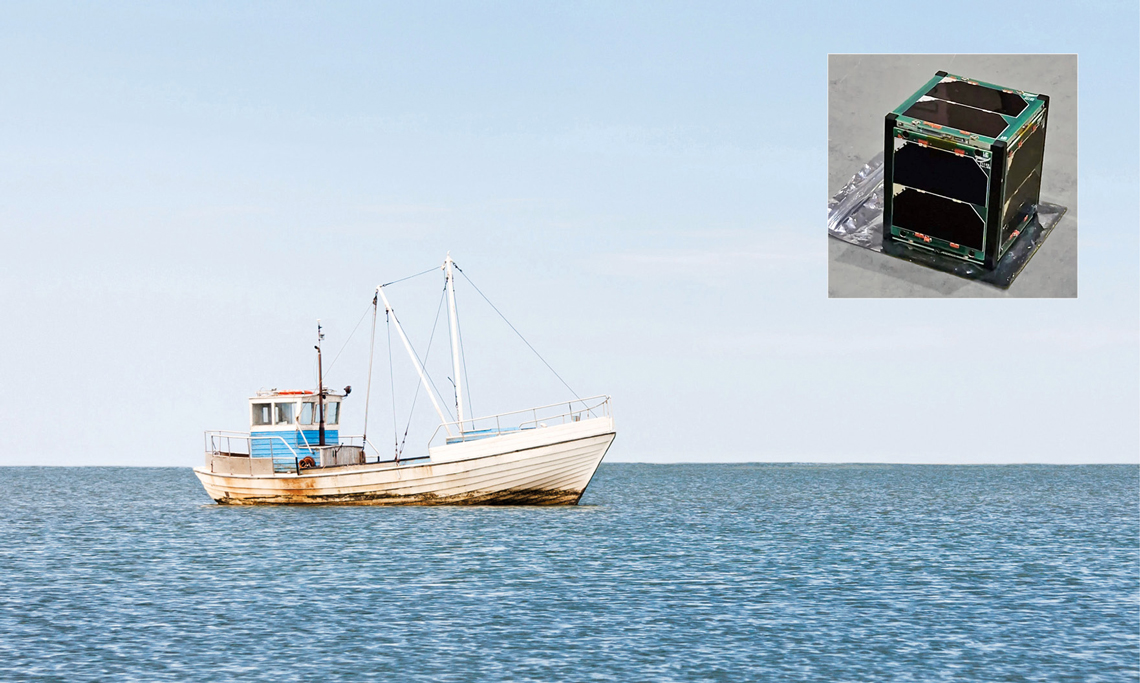
A nanosatellite developed at the Federal University of Maranhão (UFMA), with support from the Brazilian Space Agency (AEB), may assist coastal authorities in search and rescue operations for small fishing boats in distress. The device, a standard 1U CubeSat with a cubic shape measuring 10 centimeters (cm) per side, will also be used to detect wildfires.
Five years after the project began, the satellite—named Aldebaran-I—underwent final testing in January. “One of the key tests was vibration, which ensures the satellite can withstand the extreme launch conditions,” says aeronautical engineer Carlos Alberto Brito Rios Junior, professor of aerospace engineering at UFMA and the project’s coordinator. “The satellite is now ready to be shipped to India, where it will be launched into orbit.” The launch is scheduled for June.
The name Aldebaran-I refers to the brightest star in the constellation Taurus. “The word has Arabic roots and means ‘the follower,’ which relates to the satellite’s mission. At the same time, some say Aldebaran is the star that sits on the forehead of the ox—the central figure in Maranhão State’s most traditional festival, Bumba Meu Boi,” explains Brito.
The project is part of an initiative under the National Space Activities Program, which focuses on developing academic nanosatellites—low-cost devices with shorter development cycles. “We have several satellite projects underway in Brazil, some led by government research centers, others by private companies, and a group being developed by universities,” says Rodrigo Leonardi, Portfolio Management Director at AEB. In addition to advancing technological development, Leonardi notes that the nanosatellite program is also intended to train skilled professionals for the space sector and to build technical capacity within Brazilian universities.
These nanosatellites serve a range of purposes, including Earth observation, scientific research, and the development of new space technologies. “Nanosatellites and CubeSats were originally created for educational purposes,” notes a 2020 article by researchers from the National Institute for Space Research (INPE), published in the journal Ambiente & Água. “Although still in the early stages, nanosatellite applications and proposed missions are expanding.”
UFMA’s nanosatellite serves as a proof of concept. Its mission is to validate a new technology. Small fishing boats will be equipped with a transmission system that sends their location data to the satellite. “These signals will be relayed to a ground station, which will then dispatch an emergency alert to rescue services,” explains Dr. Luís Claudio de Oliveira Silva, an engineer and head of UFMA’s Laboratory of Electronics and Embedded Space Systems (LABESEE), where the project was developed.
For fire prevention, data collection platforms installed in forested areas will transmit information to the satellite, which will then forward it to a ground station. “An AI-based system will analyze the data to detect potential fire indicators,” explains Silva.
If Aldebaran-I proves successful, building a constellation of nanosatellites will be essential to fully implement rescue and fire monitoring services. “Only with a constellation can we ensure continuous satellite coverage over Brazil,” says Leonardi. “We’re exploring the development of small satellite constellations. If this proof of concept succeeds, it could lead to a system of this kind.”
Scientific article
NAGEL, G. W. et al. Nanosatellites applied to optical Earth observation: A review. Revista Ambiente & Água. June 19, 2020.