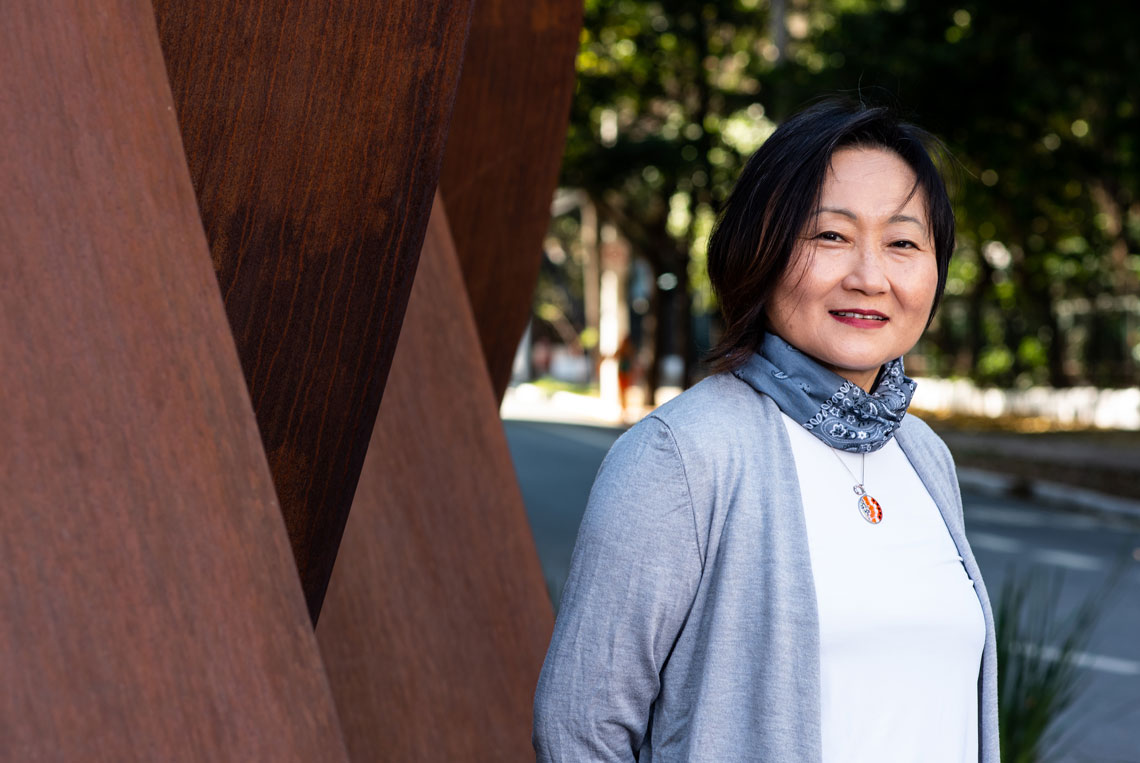
I was born in the 1960s in Pohang, a port city on the southeast coast of Korea. When I was seven years old, my family moved to Seoul so I could study. I had barely started fourth grade when my parents decided we would emigrate to Brazil.
During the Korean War (1950–1953), part of the North Korean population migrated to the South, causing a population surge. In response, the South Korean government launched a strong emigration policy in the early 1960s to alleviate internal pressure. In 1963, Brazil was the first country in the program to officially receive Koreans.
My family arrived later, in 1973, when the Brazilian government was no longer participating in the initiative. Entering the country was difficult, even for people who had valid visas, like we did. It was a difficult and uncertain time: my parents were deported to Paraguay while my younger brother and I stayed in São Paulo with an aunt. Our visa issue was only resolved a few months later, with the help of an acquaintance who went to the embassy to sort it all out.
I had always wanted to study literature because I was an avid reader, but I was afraid to do so because I thought I would never truly master Portuguese. And I could not forget the words of my father when I mentioned, aged 10, that I wanted to be a writer: “Darling, being a writer means going cold and hungry.” So I decided to study chemistry at the University of São Paulo [USP], perhaps the least exact of the exact sciences. I completed my degree in 1986, partly because I was never brave enough to quit.
During my undergraduate studies, I often carpooled with a classmate, Ivan Pérsio de Arruda Campos [1962–2022]. We shared fuel costs and in-depth conversations about books and music. Ivan was the only son of the poet Haroldo de Campos [1929–2003], who he introduced me to after a conversation about the Korean edition of the novel Ulysses, by James Joyce [1882–1941]. Haroldo asked me to read the monologue of Molly Bloom, a character in the book. From then on, I started translating Korean poetry for him.
Encouraged by Haroldo, I took the entrance exam to do a literature degree, also at USP, during my final year of chemistry. I spent a year studying both degrees. In my second year of literature, the Korean government announced a scholarship program for the children of Koreans living abroad. I put my studies on hold and went to Seoul in 1987 to do a master’s degree in modern literature at Yonsei University. This was possible because I had a degree in chemistry.
Modern Korean literature emerged in the twentieth century and was already a well-developed field. I chose to research the work of a lesser-known author, Joo Yo-seop [1902–1972], who wrote short stories. While pursuing my master’s degree, I translated the news for KBS radio, which broadcast content in several languages.
I finished my master’s degree in 1990 and returned to Brazil determined to resume my bachelor’s degree in literature. Two months after I got back, at Haroldo’s retirement party from the Pontifical Catholic University of São Paulo [PUC-SP], he dissuaded me from the idea. “I am a lawyer, Boris Schnaiderman [a translator who helped found the Russian language and literature course at USP] is an engineer, there is no reason for you to resume your undergraduate degree.”
So instead I did a PhD in literature at PUC-SP between 1991 and 1995, for which I wrote the thesis “Cultural translation of poetry: A look at the Far East”. The cultural translation of poetry seeks to emphasize the cultural aspects of the source language, in contrast with structuralism and semiotics—both in vogue at the time—which focus more on form.

Personal archiveIm with poet Haroldo de Campos at Casa das Rosas in the city of São Paulo in 1999Personal archive
Finishing my PhD was a struggle because I was working at the same time. Between 1991 and 1994, I taught an extracurricular course in Korean at USP, funded by the government-linked Korean Culture and Arts Foundation. It was open to the general public, but mainly drew children of Korean immigrants and Brazilians in relationships with Koreans.
At the end of 2004, the president of the Korean foundation visited USP and suggested the idea of a Korean language course at the university to then-dean Adolpho José Melfi. Having already visited Korea, the dean was interested in the idea.
Initially, the extracurricular course was an elective class with academic credit, offered by the School of Philosophy, Languages and Literature, and Human Sciences [FFLCH]. It was Professor Antonio Menezes, who taught Chinese at FFLCH, who pushed for the establishment of a regular Korean program at USP, which would be the school’s first new course in forty years.
It was approved in mid-2012 and classes began the following year with fifteen openings, thirteen of which were filled. Most of the students were fans of South Korean pop culture, especially K-pop, a music genre that was becoming a worldwide success story. The hallyu [Korean wave] started in Brazil around 2012, so the timing was perfect. In 2018, I became a full-time faculty member. Today, the program is a four-year course with 25 places.
Beyond K-pop, the hallyu also encompasses K-drama—television series produced in South Korea that have captured a wider audience. To give you an idea of the impact, there are now no Korean students enrolled on the course. In 2023, Korean was the most competitive program of all the courses in the literature and languages department, with a cutoff score of 9.2, even higher than English. It is the only Korean language bachelor’s degree in South America.
Artificial intelligence [AI] is increasingly influential in our field. Translators working with the Korean-English language pair are likely already feeling some of the impact of this, including financially. Fortunately for me, the Portuguese-Korean pair is more complicated. Portuguese is a very difficult language, even for native speakers. Machines can help with certain translations—if I cannot remember an exact word in Portuguese, I use AI to check. But its responses are often so absurd that good translators may actually be more valued in the future. In Brazil, literary translators do not receive the recognition that they should. Publishers usually pay a fixed amount per page, regardless of whether the book sells 10 copies or 10,000.
I am very proud of the translation I did of the book The Vegetarian by Han Kang [winner of the Nobel Prize for Literature last year]. I produced the first Portuguese version of the book, published by Devir in 2013, before the hype around the book and the author. At the time, I signed a translation contract that included royalty payments. For my work, I received the Literature Translation Award from the Literature Translation Institute of Korea the following year. When the book won the Man Booker International Prize in the United Kingdom in 2016, Han’s literary agent transferred the Brazilian rights to another publisher, Todavia, which did not want to pay me royalties and commissioned a new translation.
I am now starting to prepare my thesis for my postdoctoral teaching degree. In recent years, I have studied topics such as the hallyu and the concentration of Korean immigrants in São Paulo’s Bom Retiro neighborhood. Next, I want to return to the cultural translation of poetry, a subject I studied during my PhD. It promises to be a rewarding exploration.
The story above was published with the title “Riding the K-pop wave” in issue 356 of October/2025.
Republish