Since January 20, when President Donald Trump began his second term and signed a series of executive orders mandating budget and staffing cuts—including at federal agencies that fund and conduct scientific research—scientists in the United States have been living in a climate of uncertainty and apprehension, with ripple effects extending to other countries. With the termination of programs and delays in grant renewals, the disruption has reached laboratories and universities. While some of these measures have been temporarily blocked by court rulings, the sense of instability remains. “There are many uncertainties. Restrictions have been imposed not only on how much of the federal research and development budget we can use, but also on how we can use it,” said Joanne Carney, Chief Government Relations Officer for the American Association for the Advancement of Science (AAAS), which publishes the journal Science and is one of the world’s oldest and largest scientific societies. The administration has scaled back funding for research areas including climate, inclusion, and gender.
Just a week into the new term, federal grants and funding were frozen, ostensibly to reduce government expenditures and workforce size. The decision caused confusion within the country’s primary research funding agencies, the National Science Foundation (NSF) and the National Institutes of Health (NIH), a consortium of biomedical research centers. A report in Nature noted that research payments were halted and peer-review panels were canceled—an order that was later temporarily blocked by a federal judge. Other major agencies have also been impacted by the cuts, including the National Oceanic and Atmospheric Administration (NOAA), NASA, and the Environmental Protection Agency (EPA), which, according to The New York Times, is considering laying off up to 75% of its scientists and shutting down its Office of Research and Development, eliminating 1,155 lab positions.
“Our daily work is now split between continuing research and seeking alternative funding sources, from university grants to donations from philanthropic organizations, to secure resources that would normally be guaranteed,” said Brazilian physicist Rafael Lopes. Lopes is developing mathematical and statistical models for dengue epidemiology during his postdoctoral fellowship at Yale University, a project funded by the NIH. “There’s a good chance my supervisor Nathan Grubaugh’s grant, which covers half my salary, won’t be renewed in September,” Lopes added. The renewal process was supposed to begin in March, but due to the agency’s unstable situation, it has been delayed.
He notes that Yale, like many other universities, could be significantly impacted by cuts to administrative expenses known as indirect costs—an additional percentage that institutions charge, and the NIH pays, to cover infrastructure needs such as water, electricity, telecommunications, internet, security, and laboratory maintenance. On February 7, the NIH announced it would cap this rate at 15% of a project’s total value. Currently, at leading institutions such as Harvard, Johns Hopkins, and Yale, this rate exceeds 60%. According to the federal agency, the cap would generate “immediate” savings of US$4 billion.
“Each institution negotiates its own rate with the NIH, and that’s one of the reasons the research system in this country is so advanced. Here at Yale, the indirect cost rate is 67.5%,” the physicist explained. “If the cap is implemented, it would mean a 75% reduction in the revenue needed to cover these expenses—translating into a budget shortfall of nearly US$200 million for the university this year alone.”
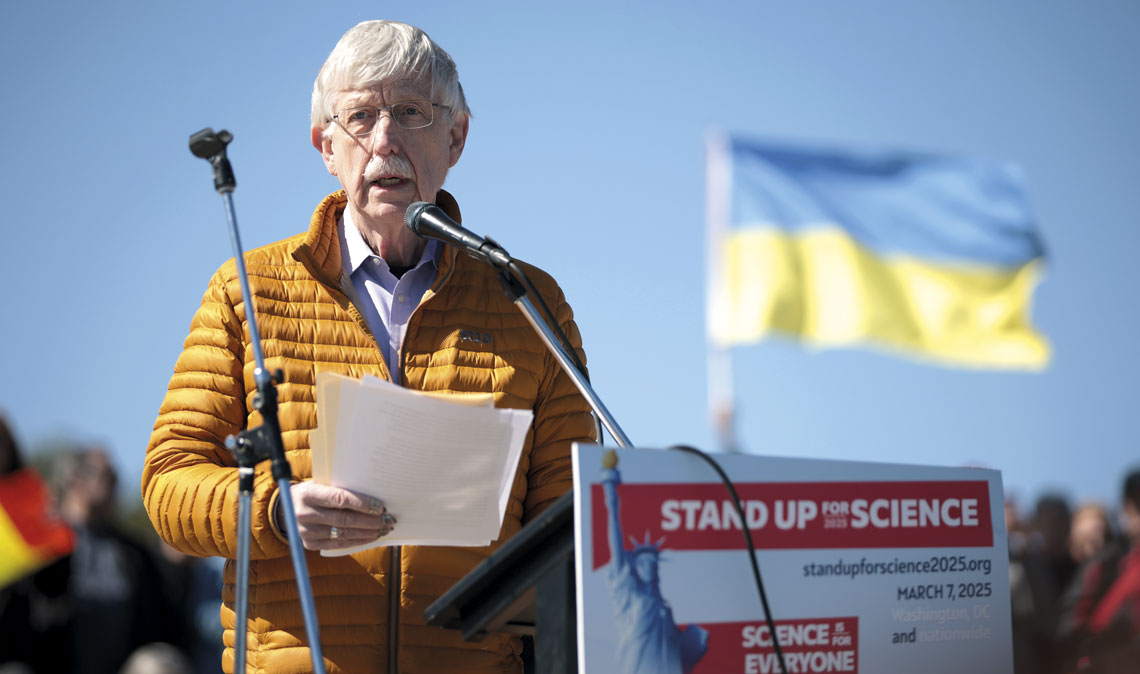
Alex Wong / Getty ImagesFrancis Collins, former director of the NIH, speaking at a demonstration in the US capital, expressed his deep concern for the countryAlex Wong / Getty Images
In early March, a federal injunction temporarily blocked the change after a lawsuit was filed by 22 states and a coalition of research organizations. While the government still has the option to appeal, life sciences attorney Kate Heffernan told Science that the White House’s chances of success are slim. The administration, she said, failed to follow required legal procedures, such as holding public consultations and providing a clear justification for the change, and did not honor existing agreements. Still, the government may continue seeking ways to revise how federal health agencies develop new policies.
In February, the NIH laid off approximately 1,200 employees as part of a broader federal effort to cut recently hired probationary staff. By early March, around 250 of those employees had been rehired, according to Science.
The full extent of the cuts to research programs across the country remains unclear, as the situation continues to evolve. “Some of this is in litigation, such as the proposed reductions in NIH indirect costs, and we still don’t know what other changes may be on the horizon,” said Joanne Carney of the AAAS in an interview with Pesquisa FAPESP. “Part of the challenge is that our fiscal year doesn’t end until September. Until then, we won’t fully understand the impact of these cuts—whether in terms of total dollars or the number of grants affected.”
Although working in Brazil, US Doctor Ester Sabino, based at the Institute of Tropical Medicine (IMT) of the University of São Paulo’s School of Medicine (FM-USP), has also been affected by the funding freeze. Sabino coordinates an NIH-funded project focused on developing new methods for diagnosing and treating Chagas disease, part of a program supporting research on neglected tropical diseases. In January, she was surprised to find that funding for that month had not been disbursed, despite expenses already incurred—including patient examinations and diagnostics—as well as a US$23,000 research grant. “I submitted a payment request, as I usually do, and received no payment or clear explanation. I spent about 20 days feeling extremely anxious, unsure of how to resolve the issue,” she recalled.
Sabino was forced to suspend her research activities. Then she saw media reports that US courts had suspended the freeze. “I resubmitted the request and, this time, they paid for both January and February,” she said. Still, she remains concerned about the future of the project, which has just completed its third year of a planned five-year term. The annual budget ranges between US$300,000 and US$400,000. “I haven’t received confirmation that the funding for the fourth year, which was set to begin in April, will be released,” she explained. So far, the project has already suffered a 20% budget cut due to NIH funding constraints. “We managed to reorganize, and the research hasn’t stopped. The problem is not knowing what is going to happen,” said Sabino, who is now exploring alternative sources of funding.
The measures have caused confusion within US funding agencies
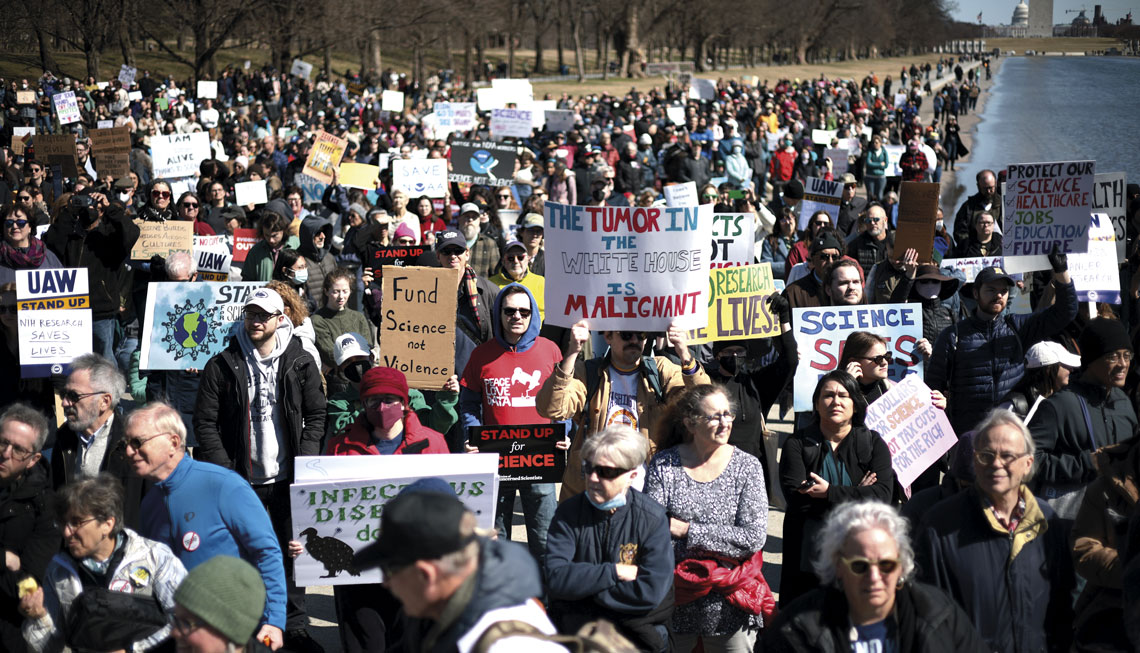
In response to this scenario, demonstrations on March 7 brought together thousands of people in cities across the United States and Europe—including Paris and Vienna—in protest against the budget cuts and layoffs, as part of the Stand Up for Science movement. Similar protests had also taken place during the US president’s previous term, between 2017 and 2021. Science magazine reported around 30 demonstrations across the United States, with more than 150 expected in other countries.
“It’s not something that can be solved with a single event,” Samantha Goldstein of the University of Florida, one of the organizers of Stand Up for Science, told Nature. The goal of the protests is to convince legislators to halt the government cuts. Geneticist Francis Collins, former director of the NIH, was among those who spoke at the demonstration in the US capital. “I’m worried about my country right now,” said Collins, according to Science. He led the NIH for over a decade and recently retired after 32 years of service.
Earlier, in February, hundreds of people had already gathered in front of the Department of Health and Human Services to protest against the funding cuts and mass layoffs. According to Science, 47 scientific societies, associations, and organizations representing nearly 100,000 researchers across various disciplines signed a letter to Congress organized by the Union of Concerned Scientists (UCS). The letter called for the restoration of federal research funding, the rehiring of scientific agency staff, and emphasized the need for “government scientists to communicate freely with the public and international colleagues,” while also demanding an end to “attacks on diversity, equity and inclusion initiatives in science.”

Joe Buglewicz / Bloomberg via Getty ImagesYale University is one of the institutions that could be significantly impacted by cuts to the indirect costs paid by the NIHJoe Buglewicz / Bloomberg via Getty Images
Diversity and inclusion
On another front, government-funded studies addressing inclusion and gender identity—particularly those referencing the LGBT+ community—are being targeted for termination. According to documents and an audio recording obtained by Nature, NIH officials have been instructed to identify and cancel funding for projects that focus on transgender populations, gender identity, diversity, equity and inclusion (DEI) in the scientific workforce, environmental justice, and any research based on race or ethnicity. Grants awarded to universities in China and research related to climate change are also under review.
“For me, the first shock is going to be in the classroom, feeling how the students are, and what you can and can’t talk about,” says Brazilian professor Michelle Morais, who has taught in the Department of International and Regional Studies at the University of Oklahoma since 2017. “I teach public policy, human rights, and international development. Everything that is happening directly affects what I teach. I’m in direct contact with my colleagues, who are afraid,” she adds. Morais is currently completing a sabbatical in Brazil and is scheduled to return to the United States in July.
In some US states, topics related to diversity and inclusion, as well as racial and gender issues, had already been excluded from state-funded education and public funding since 2022. What is happening now, Morais notes, is the expansion of this approach to the federal level. “We had to dissolve the department’s diversity and inclusion committee even before the Trump administration,” she says.
Regarding the current wave of science cuts, she sees a shift in strategy compared to the president’s first term. “Back then, institutions resisted. The tactic now is to intensify actions and implement them quickly.” This, she explains, has the effect of paralyzing potential responses. “The justice system and opposition are struggling to keep up, because there are so many changes happening at once—and the legal costs are high.” In her view, the situation is unprecedented. “Universities weren’t hit this hard in the first term. This is a dismantling of public policy like we’ve never seen before.”
The government has also canceled US$400 million in research grants at Columbia University, citing the institution’s failure to protect Jewish students during pro-Palestinian protests on campus following the onset of the Gaza conflict. Most of the cuts affect NIH-funded scientists, with over 400 research grants at the university suspended, totaling US$250 million. The Department of Education has sent letters to 60 universities, warning of potential sanctions if they do not ensure the safety of Jewish students. Columbia, where the protests were most intense, was the first to be affected. Additionally, the federal administration canceled US$800 million in grants from Johns Hopkins University, which supported international health and humanitarian aid programs. As a result, the university announced plans to cut 2,000 jobs.
Joanne Carney of AAAS notes that it is still too early to determine whether there will be a structural shift in US science policy. “We are hopeful that decision-makers will recognize the detrimental impacts that some of these reductions are already having, and will continue to have, on our ability to innovate and compete with China. I hope they will refocus on prioritizing investments in critical technologies across different disciplines,” she says. She also points out that other countries see the current situation as an opportunity to attract scientists working in the United States to their universities and industries. “I’ve seen announcements and calls for proposals from countries like Ireland, France, Germany, and China,” she adds. However, Carney believes the cuts to US research will have global ramifications. “Many countries will be impacted—not only by the loss of funding, but also by the reduction in opportunities for collaboration with US colleagues,” she concludes.
The story above was published with the title “The uncertain landscape of funding for science” in issue in issue 350 of april/2025.
Republish