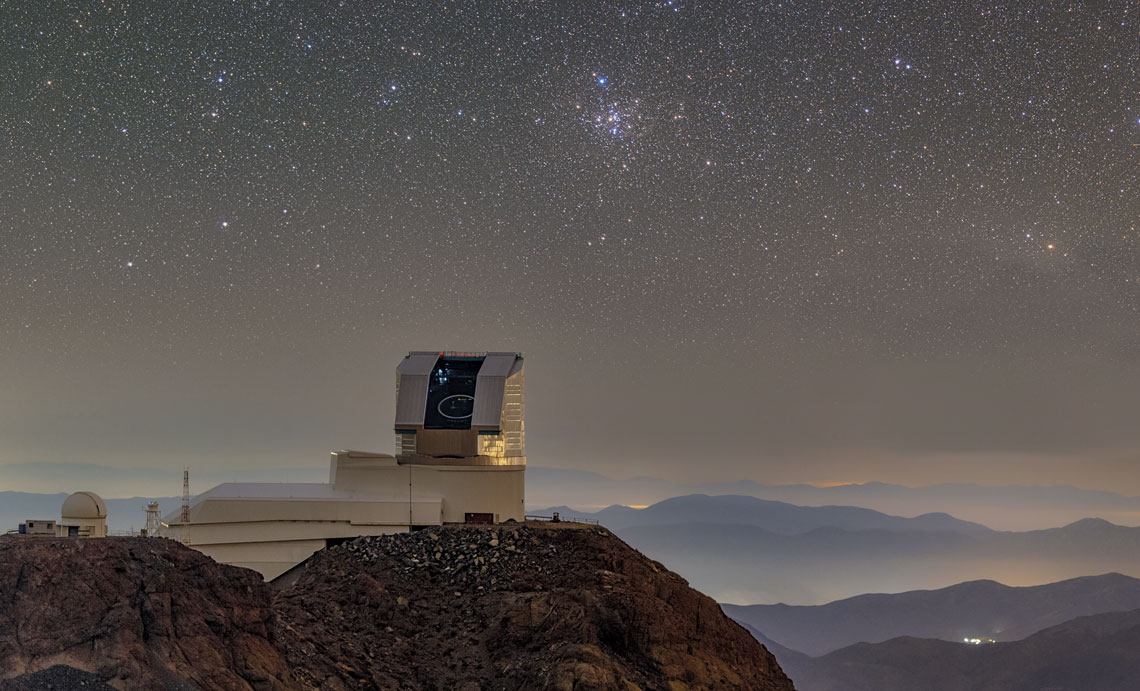
On June 23, the biggest digital camera ever built provided the first samples of its capacity to scan vast areas of the night sky, with an unprecedented wealth of detail. A dozen images produced by the LSST (Large Synoptic Survey Telescope) Camera, the formal name for this powerful optical instrument installed at the Vera Rubin Observatory, were released. Located on Cerro Pachón, a mountain in the Chilean Andes at an altitude of 2,700 meters (m), this new, US-built land telescope was recently inaugurated and is in its final testing phase; it is set to begin regular operations in this second semester of 2025. The camera functions in concert with a sophisticated system of three combined telescope mirrors, the largest of which being 8.4 m in diameter.
Most of the initial images from Vera Rubin show panoramic views made up of hundreds of images, and close-ups of sectors of the Virgo Cluster, a giant structure of some 1,500 galaxies, including the Milky Way. Another set focuses on the Lagoon and Trifid nebulae, two dust and gas clouds situated in the space between the stars of the Sagittarius constellation, around 5,000 light years from Earth. Videos were also released, produced by superimposing images of the same sky area captured over time, and in one, asteroids can be seen moving among galaxies. Each individual image generated by Vera Rubin is so big that it would need 400 extremely high resolution televisions, or projection onto the walls of a 12-story building, to see it in its original size.
A venture of US$810 million funded by the US National Science Foundation (NSF) and Department of Energy (DOE), Vera Rubin’s conception began more than 25 years ago, with construction beginning in 2015. Up until early 2020, the observatory was denominated Large Synoptic Survey Telescope. Its name was later changed in honor of American astrophysicist Vera Rubin (1928–2016), who came up with the first reliable evidence of the existence of dark matter (see Pesquisa FAPESP issue n° 338).
“Vera Rubin will map the southern night sky over the next 10 years with unprecedented resolution quality, enabling the discovery of billions of new objects,” says physicist Rogério Rosenfeld, of the Institute for Theoretical Physics at São Paulo State University (IFT-UNESP), one of the Brazilian researchers set to study the accelerated expansion of the universe with data from the new observatory.
Though essentially a US initiative, Vera Rubin will be used by 3,000 researchers from across 30 countries. Brazil, through international agreements, obtained the right to nominate 170 researchers to participate in projects undertaken using data captured by the observatory, 34 of which will have the status of principal investigator (PI); the others are assistant investigators and graduate students. Currently, at least 10 PIs are from São Paulo institutions. Five of them, four from the University of São Paulo (USP) and one from UNESP, are funded by FAPESP to conduct research projects using data from Vera Rubin.
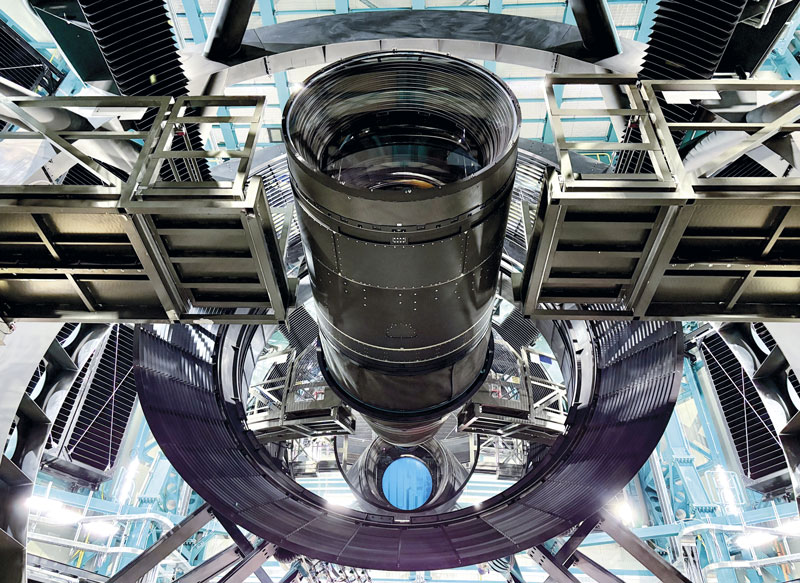
RubinObs / NSF / DOE / NOIRLAB / SLAC / AURA /T. LangeThe LSST Camera—the world’s biggest—with resolution of 3200 megapixelsRubinObs / NSF / DOE / NOIRLAB / SLAC / AURA /T. Lange
Physicist Raul Abramo, from the Institute of Physics at the University of São Paulo (IF-USP), will observe quasars (active galactic nuclei) to map the deep and distant universe and compare data from galaxies and supernovas (colossal explosions of dying stars) with gravitational wave observations. “In this second line of research, my plan is to use these data to test a new technique for measuring the universe expansion rate—the Hubble Constant,” explains Abramo. Riccardo Sturani, a physicist at IFT-UNESP, will also combine data from gravitational wave observations and images from the Vera Rubin catalogs to refine measurements of cosmological expansion. “The observatory will provide the deepest, most comprehensive map of the galaxies that we’ve ever had,” Sturani adds.
Astrophysicist Claudia Mendes de Oliveira, of the USP Institute of Astronomy, Geophysics, and Atmospheric Sciences (IAG-USP) will seek out anomalous objects such as quasars and asteroids, and classify galaxies based on data from Vera Rubin and other night sky mapping, using machine- and deep-learning techniques. Her colleague astrophysicist Eduardo Cypriano will use weak gravitational lensing to study galaxy clusters. “This type of research requires the observation of vast areas using significantly deep images with excellent optical properties. Vera Rubin was designed with that in mind,” says Cypriano. Using the powerful camera at the new observatory, Alex Cavaliére Carsiofi, of IAG-USP, intends to identify and study the population of Be stars in the Milky Way, which have a correlation between low metallicity and high rotation.
In its first year of operation, the new observatory is expected to generate more data than all existing telescopes have produced to date. “Mapping by Vera Rubin will digitalize the entire visible southern night sky. It will be a revolution of cosmology,” says physicist Luiz Nicolaci, director of the Inter-Institutional e-Astronomy Laboratory (LINEA), through which he coordinated Brazilian participation in mapping which came before, and inspired the creation of, Vera Rubin, such as the Dark Energy Survey (DES) and the Sloan Digital Sky Survey (SDSS); he is also the lead liaison for the country’s involvement in the new observatory. “Without counting the United States, we are the fifth country among international partners with most researchers involved in Vera Rubin,” he says.
Brazil did not invest directly in the construction of Vera Rubin—the country’s contribution is through participation in the process of transmitting information obtained by the observatory in Chile to Brazil, and then on to the United States, and in establishing a center in Rio de Janeiro to process, analyze, and distribute data from Vera Rubin. This unit, which received funding of R$7 million from the Brazilian Funding Authority for Studies and Projects (FINEP), is housed at the National Laboratory of Scientific Computing [LNCC] in Petrópolis, upstate Rio de Janeiro, although it is administered by LIneA. A further nine similar data centers are under construction around the globe to receive data from Vera Rubin.
In partnership with the US academic network Lauren/AmLight, the Research and Education Network at São Paulo (REDNESP), funded by FAPESP, connects dozens of education and research institutes from São Paulo State to each other and abroad, and will be used to transmit data generated by Vera Rubin in Cerro Pachón to Miami, Florida. The data will be processed in the US and then distributed around the globe. Approximately US$60 million has been allocated to REDNESP over the last 15 years, and the network is currently working to renew the agreement with Lauren/AmLight.
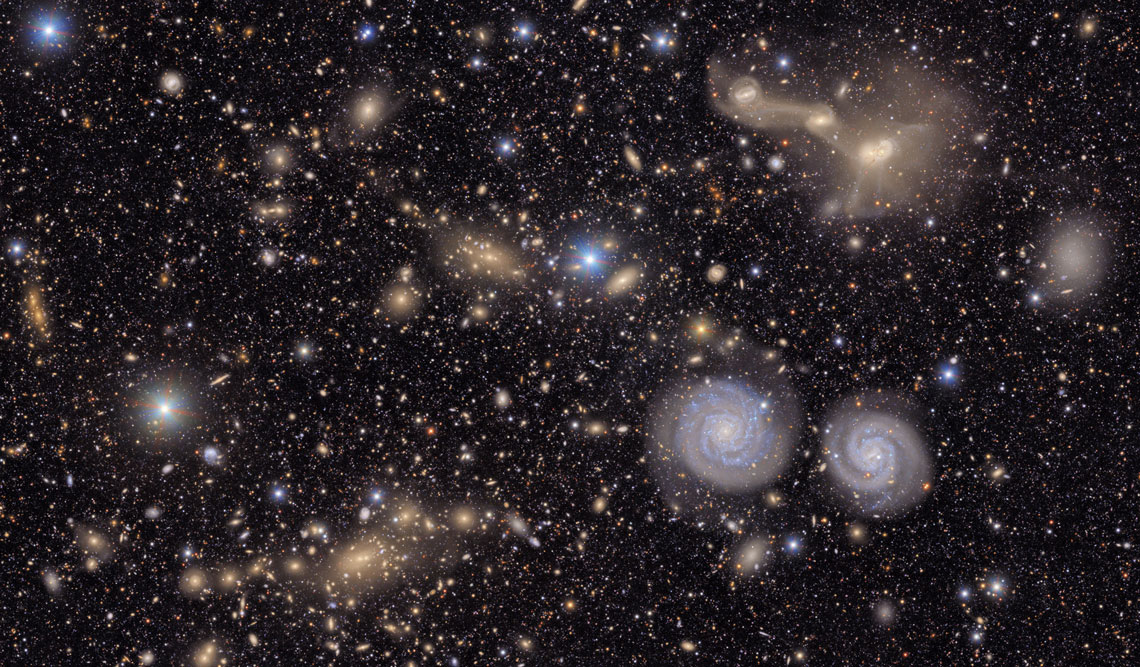
NSF–DOE Observatório Vera C. RubinRegion of the Virgo Cluster, structure concentrating 1,500 galaxies, captured by the Vera Rubin ObservatoryNSF–DOE Observatório Vera C. Rubin
The Vera Rubin camera weighs three metric tonnes, is the size of a compact car, and has a resolution of 3,200 megapixels, equal to the capacity of 260 modern smart phones with optical sensors. When pointed towards the firmament, it can capture an area equivalent to 45 full moons. In that area of Chile, every night with good observation conditions—around 270 per year—will produce a thousand images. Very responsive despite its weight and size, the camera moves quickly and can capture the entire visible sky every three or four days; the same point in the sky will be observed around 800 times by Vera Rubin during this sweep of the cosmos.
“The sequence of images will generate a 10-year film of the universe,” says astrophysicist Thaisa Storchi-Bergmann of the Federal University of Rio Grande do Sul (UFRGS). “As successive images from the same object accumulate, it will be possible to observe brightness variations, and different sources will have different variability signatures.” Storchi-Bergmann will coordinate a project at Vera Rubin to study the variability produced by the capture of material by supermassive black holes in the center of galaxies.
The science produced with data from the Vera Rubin will be done by research groups across eight large-scale international collaborations, and each initiative will have a central focus. “The topics of interest for studies using data from the observatory will be dark matter, dark energy, transient sources of all types [cataclysmic events such as explosions or huge variations in brightness], formation of large structures in the universe, and the mapping of the solar system and Milky Way,” says physicist Luiz Vitor de Souza Filho, of the São Carlos Institute of Physics at USP (IFSC-USP), general coordinator of Strategic Programs and Infrastructure at FAPESP. Of unknown composition, dark matter and dark energy represent some 95% of the known universe (the remainder is made up of conventional, visible matter).
Early test images captured by the new observatory in Chile provide an idea of its huge capacity for generating new data on the universe. It took just ten hours of observation to record 2,104 asteroids in the solar system that had never been seen, seven of them relatively close to Earth (but with no collision risk). The number of rocky bodies in orbit around the sun registered by Vera Rubin in this short testing period is equivalent to 10% of the asteroids discovered annually by all land and space telescopes in operation.
Over ten years of mapping the southern night sky, the observatory is set to detect 38 billion objects, including 20 billion galaxies and 17 billion stars, in addition to 10 million stellar explosions known as supernovas, and 6 million celestial bodies within the solar system. It is estimated that every night of operation, Vera Rubin will send out 10 million alert messages to space research centers and other telescopes, advising that it may have observed new comets, asteroids, planets, or stars. It’s not going to be easy to work with this plethora of data and alerts. Big data in cosmology is here to stay.
The story above was published with the title “Digitalized sky” in issue 355 of September/2025.
Republish