
“The first thing about an accent is that it does not exist when you are with your own people. It comes from the other—or when you are the other. And you notice. The first time I realized there was such a thing as another accent was when I moved from rural Bahia to the state capital of Salvador: the Bahian country accent, from the outback, is quite different to the coastal Bahian accent,” says screenwriter Tetel Queiroz, a white man in his 40s. Now living in São Paulo, he also highlights the pre-judgments people in the city make based on the way he speaks. “People believe certain things about Bahians: whether it is that they like going to the beach, or they are only interested in happy hour at five in the afternoon.”
Queiroz’s testimony was part of a conversation between 12 people from various parts of Brazil who discussed how different accents are perceived. The discussion is being displayed on large screens at the Fala falar falares (Talk talks talking) exhibition at the Museum of the Portuguese Language, in the center of São Paulo, until September 14. Curated by set designer Daniela Thomas and linguist Caetano W. Galindo of the Federal University of Paraná (UFPR), the exhibition explores both the mechanics of speaking, such as breathing, and the social and political dimensions of language.
Linguistic variation has real impacts on people’s lives, says Livia Oushiro, a linguist from the University of Campinas (UNICAMP). In recent years, with funding from FAPESP, Oushiro has been investigating the speech patterns of migrants from the Northeast of Brazil, especially from Alagoas and Paraíba, living in the metropolitan areas of Campinas and São Paulo. The majority are adults (aged between 20 and 60) from rural areas that have only a basic education. In her studies, the researcher has been trying to answer whether these people acquire linguistic traits from their new environment.
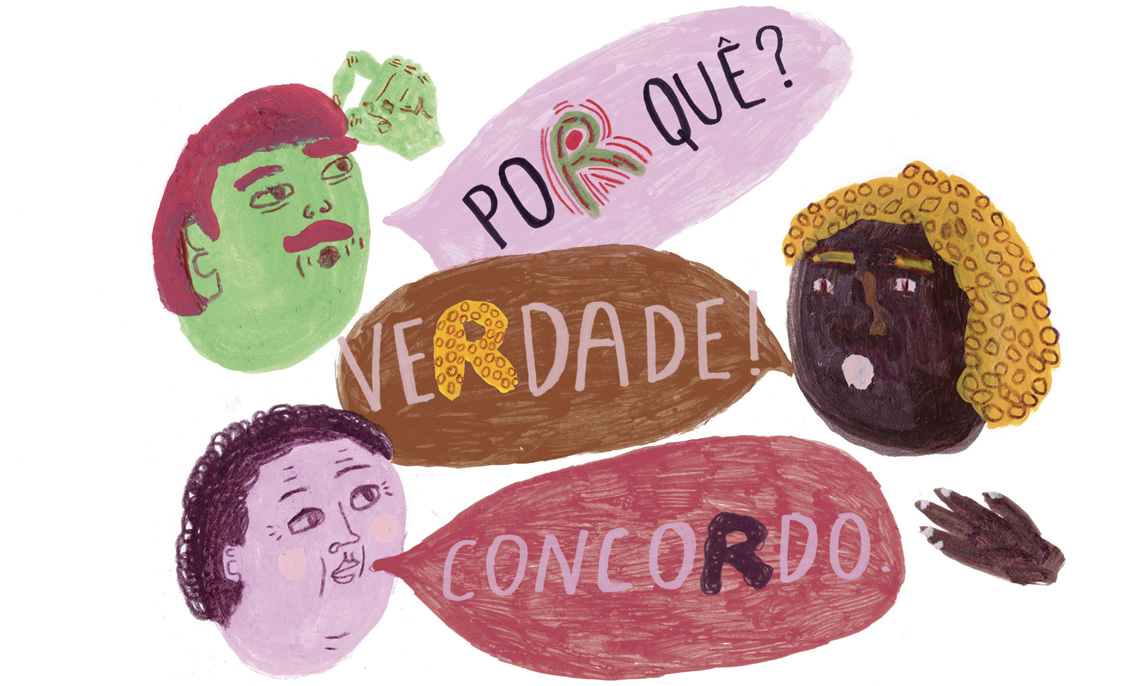
She analyzed the terms used by these migrants and the way they pronounce R at the end of a syllable, which in a São Paulo accent can be a retroflex R, sometimes described as a “country R.” This trait occurs at the end of the syllable, whether in the middle of the word, as in “corda,” meaning rope, or at the end, as in “amor,” meaning love. “This sound does not appear in the northeastern accent, which generally uses an aspirated R,” says the researcher.
The linguist also evaluated other variables, such as the T and D sound before an I, nominal agreement, and preferences in structuring negative sentences. “For example, in Portuguese we can say, ‘Não vi,’ ‘Não vi, não,’ or ‘Vi não’ [loosely translated as ‘didn’t see,’ ‘didn’t see, no’ or ‘see didn’t’]. How each term is used varies significantly between the Southeast and the Northeast, with the first example being relatively more frequent in the Southeast region and the other two more used in the Northeast,” says Oushiro.
The researcher found that pronunciations do tend to change, such as with the R or the T or D before an I, but her findings also revealed two other important points. One is that changes are less noticeable at the morphosyntactic level, such as double negation. The other is that gradual changes do not directly correlate with length of residence or the age at which a person moved.
“A migrant may live in Campinas for 30 or 40 years without necessarily adopting more features of the local accent or undergoing a process of adaptation,” Oushiro notes. “We did see this correlation with the retroflex R, but not with other variables. That is why it is so important to look in detail at each person’s journey and consider other factors that influence their linguistic trajectory, such as social networks composed of interactions with neighbors and colleagues, for example.”
One of the members of the Laboratory for Variation, Identity, Style, and Change (VARIEM), which is headed by Oushiro, is Emerson Santos de Souza, a linguist from the Federal University of Bahia (UFBA). For his PhD research, defended at UNICAMP in 2023, Souza sought to understand how Bahians behave linguistically in the Metropolitan Region of São Paulo and whether they begin to speak like the locals in phonological, syntactic, and lexical aspects.
 Mariana Zanetti
Souza, who is from Bahia himself, analyzed the speech of 50 fellow Bahians using a process called social network sampling. He chose three “anchors”—a 37-year-old beautician, a 47-year-old businesswoman, and a 42-year-old school monitor, none of whom knew each other—and mapped their contacts.
During his research, Souza realized that existing theoretical models of linguistic adaptation in migration were unable to explain his data. He thus created the concept of “dialectal plasticity” to describe people’s ability to adapt linguistically to a host community.
The term “plasticity” was borrowed from biology and physics, where it is used to describe the ability of a material or organism to change in response to external influences. In linguistics, it could help explain why migrant groups sometimes develop different speech patterns, even when exposed to the same contact environment.
In his thesis, Souza analyzed six linguistic phenomena, including the pronunciation of R as a final syllable, which is absent in the Bahian accent. He also observed the use of double negatives and different terms, such as using mexerica instead of tangerina (both meaning “tangerine”) or serviço instead of trabalho (“work”).
His work revealed that linguistic adaptation is associated with two types of phenomena. Regular phenomena occur when both dialects share certain features but use them at different rates—double negation, for example. Irregular phenomena, meanwhile, involve the adoption of a new trait, such as the retroflex R among Bahians.
Souza also identified expansions and reductions in meaning, context, and usage. “The word ‘mandioca’ [cassava], for example, expands in meaning in São Paulo, where it refers to both the root used for flour and the one cooked and eaten. In Bahia, there is a difference between the two: the root vegetable used to make flour is called mandioca, but the edible kind is known as aipim,” says the researcher.
Leila Tesch, a linguist from the Federal University of Espírito Santo (UFES), has been studying the perception of the Espírito Santo accent both within and outside the state. “It is common to hear people, locally and elsewhere in Brazil, claim that capixabas [people from Espírito Santo] have no accent—people even joke about it on social media,” she says.
To investigate the topic, Tesch conducted a perception study in 2021 with nearly 1,500 participants across Brazil (excluding Acre, Sergipe, and Tocantins), plus 23 Brazilians living abroad in countries like Portugal and Peru.
The survey found that 56% of respondents believe capixabas do have an accent, 30% disagree, and 14% are unsure. Among capixabas themselves, responses were split almost evenly: just over half said they have an accent, while the rest believe they do not. “Even among those who believe there is an accent, they do not usually identify it based on phonetic characteristics, but on expressions typical of the region, such as the term pocar [to burst],” she explains.
 Mariana Zanetti
According to Tesch, linguistic traits considered typically capixaba are indeed difficult to define. “It is possible to identify some markers, such as diphthongs in words like três [three] and dez [ten], which end up sounding more like ‘treis’ and ‘deiz,’ but such phenomena also appear in other accents, such as the Rio de Janeiro accent.”
In the second part of the questionnaire, Tesch asked respondents to assess the accents of the four southeastern state capitals based on four criteria: prestige, beauty, correctness, and pleasantness. The results showed that the accents of Rio de Janeiro and São Paulo were most associated with prestige, while Belo Horizonte was identified as the southeastern capital with the most beautiful and pleasant accent, followed by Vitória. In terms of correctness, Vitória stood out as the city whose Portuguese sounds closest to grammatical norms. “These are not purely linguistic judgments—they reflect broader constructions of social identity,” points out Tesch. “For instance, Minas Gerais’s reputation for hospitality may help explain why the state’s accent is seen as more pleasant.”
The way people perceive language, accents, and social markers is the basis of the book Variação linguística: Diversidade e cotidiano (Linguistic variations: Diversity and the day-to-day; Editora Contexto, 2025), by linguist Raquel Freitag of the Federal University of Sergipe (UFS). “In sociolinguistics we study what is concrete and measurable. For example, we often look at aspects such as variants linked to migrants, the LGBTQ+ community, or certain education levels,” says Freitag. “But everyday perception works differently. People do not perform a technical analysis. They perceive things as a whole and make assumptions about the person speaking, even without knowing exactly which linguistic feature is involved.”
Judging people by the way they talk is nothing new. Freitag notes that such behavior even appears in biblical texts. One passage from the Old Testament describes how soldiers led by Jephthah identified members of a rival army who had infiltrated their ranks by their inability to pronounce the Hebrew word shibboleth (originally meaning an ear of grain)—people from other regions pronounced it as sibboleth. Today, the word shibboleth refers to any trait that quickly reveals a person’s identity.
“Judging by language is part of how human cognition functions. We do this all the time; it is how we organize and interpret the world and make quick decisions,” continues the researcher. Thus, Freitag suggests that broadening our linguistic repertoires is one of the most effective strategies for mitigating the negative effects of this mechanism. “If I have contact with just one group, my perception of the language is more uniform. But by expanding my networks through migration, travel, or digital media, I begin to see that there are many legitimate ways of speaking,” she observes.
Ronald Beline Mendes, a linguist from the University of São Paulo (USP), agrees. Since the 2010s, he has been investigating how certain speech traits are socially perceived and associated with the identity of male homosexuals. “The notion of a ‘gay way of speaking’ is problematic in itself. It suggests that being gay necessarily implies a certain way of talking, which is not the case,” he says. “A gay man may not sound ‘gay’ and some straight men can speak in that way.”
In one 2017 study, he recorded five men reading the same text and invited a group of people to listen to and evaluate the recordings. The listeners were then asked to indicate which voices sounded ‘gay,’ among other things. One of the responses stated that one of the speakers “spoke very correctly,” while another claimed that “gay men use a lot of diminutives.” Both comments reflect social stereotypes, since all participants read the same text, which contained no diminutives.
Since then, Mendes’s research has focused on two linguistic variables: nominal agreement and pronunciation of the nasal E. After hearing four male voices in different recordings, the participants consistently and unanimously reported that those using nominal agreement in the standard form sounded “more gay.” Male listeners made this association more often than female listeners, suggesting that men hold stronger stereotypes of what a male voice should sound like.
For Mendes, these results illustrate how linguistic aspects participate in the construction of social meaning. “That is part of how language works. The problem arises when this perception turns into prejudice and becomes a way of hurting people,” he concludes.
The story above was published with the title “Ways of speaking” in issue 354 of August/2025.
Projects
1. Cohesion and dispersion: Sociophonetic analysis of idiolectal variation based on contact between dialects (n° 23/00968-7); Grant Mechanism Regular Research Grant; Principal Investigator Livia Oushiro (UNICAMP); Investment R$125,424.34.
2. Dialectal accommodation processes in the speech of northeasterners living in São Paulo (n° 16/04960-7); Grant Mechanism Regular Research Grant; Principal Investigator Livia Oushiro (UNICAMP); Investment R$53,996.23.
Scientific articles
OUSHIRO, L. et al. Estudos sociolinguísticos sobre contato dialetal: Contribuições do VARIEM e agenda de pesquisa. Caderno de Estudos Linguísticos. Campinas, Vol. 65. 2023.
TESCH, L. O sotaque capixaba: Um estudo de percepção. (Con)Textos Linguísticos. Vitória, Vol. 16. 2022.
Book chapters
OUSHIRO, L. “Interaction, confounding effect, and collinearity in the analysis of Brazilian internal migrants’ speech.” In: FERNÁNDEZ-MALLAT, V. & NYCZ, J. (ed.). Dialect Contact: From speaker to community-based perspectives. Washington: Georgetown University Press, 2024.
MENDES, R. B. “Nonstandard plural noun phrase agreement as an index of masculinity.” In: LEVON, E. & MENDES, R. B. Language, sexuality and power: Studies in intersectional sociolinguistics. Washington Oxford University Press, 2016.
Book
FREITAG, R. Variação linguística: Diversidade e cotidiano. São Paulo: Editora Contexto, 2025.