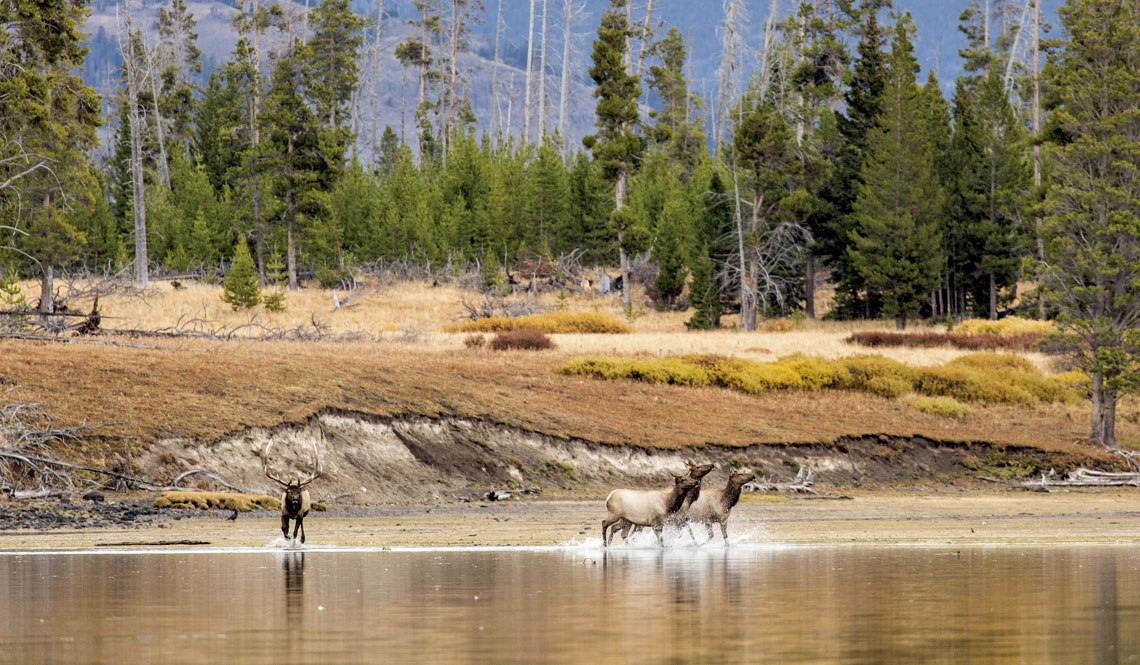
NPS / Neal Herbert / Wikimedia Commons There are now fewer elk eating aspen leaves and branchesNPS / Neal Herbert / Wikimedia Commons
As the gray wolf (Canis lupus) population in Yellowstone National Park has increased, the quaking aspen (Populus tremuloides) has started to grow back. The two are linked. Gray wolves were hunted until they were completely eliminated from the park in the 1930s. Without these predators, the moose (Cervus canadensis) population quickly grew. At the peak, there were 18,000 elk in the park, devouring the leaves and branches of trees such as the quaking aspen. By the 1990s, there were no quaking aspen saplings left. When gray wolves were reintroduced in 1995 with the aim of controlling the moose population, the situation began to change. The number of moose has since dropped to about 2,000. In 2020 and 2021, a group from Oregon State University (OSU) examined 87 aspen stands and found that for the first time, the density of quaking aspen trees taller than 2 meters had increased more than 152-fold between 1998 and 2021. “Aspen are a key species for biodiversity,” Luke Painter of OSU told the website Live Science. “The canopy is more open than it is with conifers and you get filtering light that creates a habitat that supports a lot of diversity of plants.” However, the aspen are not completely out of danger yet—another herbivorous species, the bison (Bison bison) are not as easily preyed upon by wolves (Forest Ecology and Management, July 23).
Republish