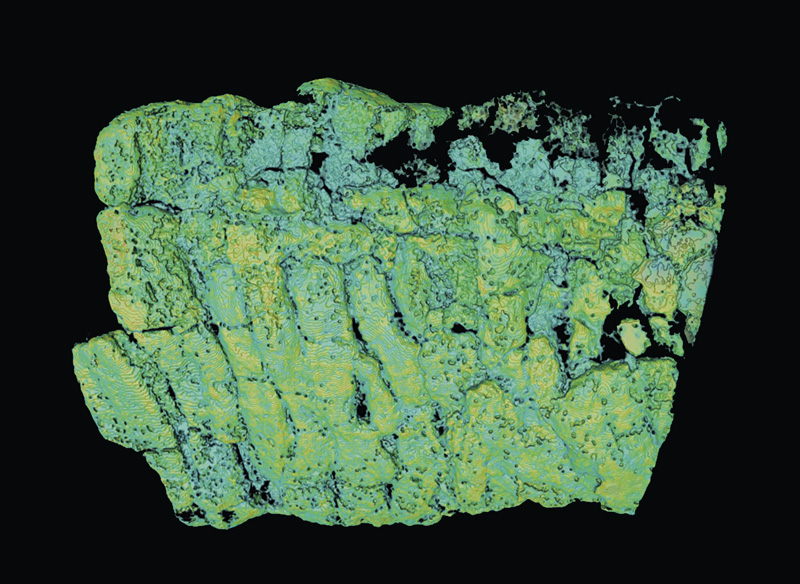
BECKER-KERBER, B. et al. Royal Society Open Science. 2025 Close-up of the external walls of Corumbella, reconstructed from X-ray imagesBECKER-KERBER, B. et al. Royal Society Open Science. 2025
The earliest animals with skeletons, which lived between 550 and 539 million years ago in what is now Corumbá, in the Brazilian state of Mato Grosso do Sul, were elongated and contrary to earlier research, did not have square outlines (see Pesquisa FAPESP issue n° 199). According to X-ray analyses carried out at the Sirius synchrotron light accelerator in Campinas, fossil skeletons of Corumbella werneri preserved at the Federal University of Mato Grosso do Sul (UFMS) were formed of cone-shaped cylindrical tubes and walls with a single layer of ring-shaped elements. Similar to other tubular animals from the era—such as Costatubus, Hyolithellus, and Byronia—Corumbella could reach up to 10 centimeters (cm) in length, twice the size of organisms from the same genus later unearthed in northern Paraguay. It also was not a cnidarian (the group that includes jellyfish and corals) as previously thought, and no descendants have been identified (Royal Society Open Science, May 21).
Republish