Umass Chan Medical School | Stephanie Mitchell / Harvard UniversityVictor Ambros and Gary Ruvkun, who discovered microRNAUmass Chan Medical School | Stephanie Mitchell / Harvard University
Of the 10 winners of this year’s Nobel Prize in the categories of Physiology or Medicine, Physics, Chemistry, and Economics, none were female or Black. Only the Nobel Prize in Literature was awarded to a woman. The Peace Prize was awarded to a group of Japanese atomic bomb survivors. But it was not the representation of gender or race that dominated the discussion surrounding this year’s winners of the Nobel Prize, each of which includes 11 million Swedish crowns in cash (roughly one million US dollars).
One question raised about the Physics and Chemistry awards was whether the work of the winners, who developed techniques in the field of computer science, represented advances in the discipline represented by the prize, or if the contributions were more related to artificial intelligence (AI). Some people criticized the choices, arguing that the Nobel Prize had given in to the AI hype. Another point of contention was that three of the winners are or were employed by Google.
Physiology or Medicine
Two American biologists won the prize for a discovery based on studies with the roundworm Caenorhabditis elegans that began in the 1990s. Victor Ambros, 70, from the University of Massachusetts, and Gary Ruvkun, 72, from Harvard Medical School, discovered microRNA, a family of shorter RNA (ribonucleic acid) molecules, and identified their role in activating and controlling genes in living beings. In their research, Ambros and Ruvkun “revealed a new and unexpected mechanism of regulation of gene expression,” said endocrinologist Olle Kämpe, vice president of the Nobel Assembly.
“They showed that microRNAs are a biological phenomenon preserved in different species, indicating that they play an important role in the development and functioning of organisms and have therefore been maintained throughout the evolution of living beings,” says Marcelo Mori, a biomedical scientist from the University of Campinas (UNICAMP) who investigates the role of microRNAs in aging and the emergence of chronic diseases, such as diabetes and obesity.
No women won a Nobel Prize in science this year
“MicroRNA regulates approximately 60% of our genes and is fundamental to controlling various processes in the human body, such as development and physiological functions, including embryogenesis and cell death, as well as differentiation, proliferation, and cell growth,” explains Edilamar Menezes de Oliveira, a biochemist from the University of São Paulo (USP) who studies the effects of physical training on noncoding RNA, including microRNA, in the cardiovascular system.
This is the second year in a row that the prize has been awarded for research into RNA, which also functions as a chemical messenger inside cells. In 2023, it was won by Hungarian biochemist Katalin Karikó and US physician Drew Weissman for their work on the use of messenger RNA in vaccines, including some of the COVID-19 vaccines.

Personal archiveJohn Hopfield and Geoffrey Hinton won the Nobel Prize in Physics for their work in artificial intelligencePersonal archive
Physics
“For foundational discoveries and inventions that enable machine learning with artificial neural networks,” American physicist John Hopfield, from Princeton University, USA, and British physicist Geoffrey Hinton, from the University of Toronto, Canada, shared the honor.
Generative AI tools like ChatGPT use this type of machine learning, inspired by the human brain and the interaction between neurons. The foundations of these systems also share similarities with statistical physics models used to study spin—an intrinsic quantum property of electrons and other subatomic particles that influences how they interact with magnetic fields.
Hopfield, now 91, is a theoretical physicist with an interest in molecular biology. In the early 1980s, he formulated a type of network that established an associative memory capable of storing and reconstructing patterns of information. His work, done at the California Institute of Technology (Caltech), became known as a Hopfield network.
A cash prize of US$1 million is divided among the winners of each category
“In 1982, Hopfield was working alone at Caltech on neural networks, a field of study he was just starting in,” says Brazilian physicist José Nelson Onuchic of Rice University, USA, who was supervised by Hopfield at Caltech in the 1980s during his doctorate on protein chemistry.
Hinton, now 76, used Hopfield’s model to take things a step further in the 1980s. With a degree in experimental psychology and a PhD in AI, he created a method that autonomously searches for certain properties in a data set. This type of neural network, called a Boltzmann machine in reference to the statistical physics research carried out by Austrian physicist Ludwig Eduard Boltzmann (1844–1906), forms the basis of generative AI.
In parallel with his academic work, Hinton was also vice president of engineering at Google for 10 years, between 2013 and 2023. He chose to leave the company last year because he wanted more freedom to criticize the risks of using AI.

Milltown Partners / Google Deepmind | Lan C. Haydon / UW MedicineThe Chemistry Prize was awarded to Demis Hassabis, David Baker, and John JumperMilltown Partners / Google Deepmind | Lan C. Haydon / UW Medicine
Chemistry
Half of the prize money was awarded to American biochemist David Baker of the University of Washington, Seattle, for his advances in computational protein design. The other half went to British computer scientist Demis Hassabis and American physicist John Jumper, both from AI company Google DeepMind, which was founded in 2010. The company developed a new program in 2020 called AlphaFold2, which uses machine learning and neural networks to predict the three-dimensional structure of a protein based on a sequence of amino acids (chemical compounds that combine to form proteins). Reflecting just how quickly their work has been recognized, the age range of the laureates is younger than the average for Nobel Prize winners: Baker, Hassabis, and Jumper are 62, 48, and 39 respectively.
In 2003, Baker successfully used amino acids to design a new protein that was unlike any other known. He developed open-source software for the test, called Rosetta. Since then, his research group has produced many types of proteins, including some for use in pharmaceuticals, vaccines, nanomaterials, and tiny sensors.
Hassabis is a cofounder of DeepMind, having developed video games as a teenager. He studied computer science and has a PhD in cognitive neuroscience. The startup was acquired in 2014, becoming Google’s AI division, of which he is now chief executive. Google’s exceptional computing capacity, far greater than that of any research laboratory, is key to DeepMind’s work.
“We need computation to solve the problems of biology, and I can’t believe we’re getting recognition this fast for it,” Jumper said in a telephone interview with Adam Smith, from the Nobel website. He is the youngest winner of the Chemistry Prize in 70 years. A physicist by training, he saw a certain humor in the fact that he received the prize in chemistry.

MIT Sloan School of Management | Jared Charney / Massachusetts Institute of Technology | University of ChicagoSimon Johnson, Daron Acemoglu, and James A. Robinson, winners of the 2024 Nobel Prize in EconomicsMIT Sloan School of Management | Jared Charney / Massachusetts Institute of Technology | University of Chicago
Economics
Economists Daron Acemoglu and Simon Johnson of the Massachusetts Institute of Technology (MIT) and James Robinson, from the University of Chicago, shared the prize for their contribution to our understanding of the differences between poor and rich countries and the role played by institutions in the process of economic development. While announcing the honor, the Royal Swedish Academy of Sciences highlighted the importance of democracy for societies seeking to sustain prosperity in the long term, one of the ideas defended by the trio of laureates.
Born in Turkey and of Armenian descent, Acemoglu, 57, is an American citizen. His two colleagues, both British, also built their careers in the US. Johnson is 61 and Robinson is 64. In the trio’s opinion, the political and economic institutions created by different societies help to explain why some have become prosperous and others have not yet managed to overcome poverty. Inclusive institutions in countries with laws protecting property rights and regular elections stimulate sustainable growth. Institutions classified by the economists as extractive, on the other hand, are those that have helped enrich a small group of elites at the expense of the broader population, contributing to poverty and a lack of development.
The three economists have become active participants in public debates in recent years. Acemoglu and Robinson wrote Why Nations Fail: The Origins of Power, Prosperity, and Poverty, released in 2012. In 2019, the pair published The Narrow Corridor: States, Societies, and the Fate of Liberty, in which they discuss the crisis of contemporary democracies. Then, in 2023, Acemoglu and Johnson released Power and Progress: Our Thousand-Year Struggle over Technology and Prosperity, in which they examine the contribution of technological innovation to societal development.

Lee Chunhee / Natur & KulturWriter and poet Han Kang, the first South Korean to win the Nobel Prize in LiteratureLee Chunhee / Natur & Kultur
Literature
Writer and poet Han Kang, born in the city of Gwangju in 1970, is the first South Korean to win the Nobel Prize for Literature. The author, who writes about themes such as historical trauma and the fragility of life, is well-known in her native country, having received numerous awards. In the announcement, the Swedish Academy highlighted Kang’s unique way of describing the connections between body and soul, as well as her ability to innovate in contemporary prose.
Her best-known work is The Vegetarian, first published in South Korea in 2007 and translated into English in 2015. In 2009, the novel was adapted into a film directed by Lim Woo-seong. In the book, Kang addresses themes of isolation and resistance to normativity through the story of Yeong-hye, a woman who stops eating meat after a series of nightmares. Other titles by the author include Human Acts, The White Book, and Greek Lessons.

STR / Jiji Press / AFP via Getty ImagesToshiyuki Mimaki, from Japanese organization Nihon HidankyoSTR / Jiji Press / AFP via Getty Images
Peace
The Peace Prize was awarded to the Japanese organization Nihon Hidankyo, created 68 years ago by survivors of the atomic bombs dropped on the cities of Hiroshima and Nagasaki in 1945. Officially called the Japan Confederation of A- and H-Bomb Sufferers Organizations, the group was recognized by the Nobel committee “for its efforts to achieve a world free of nuclear weapons and for demonstrating through witness testimony that nuclear weapons must never be used again.”
According to the Norwegian committee, the work of the Hibakusha, as the approximately 100,000 still-living victims of the explosions represented by the organization are known, played an important role in maintaining awareness of the horror caused by atomic weapons alive and helping establish a nuclear taboo in recent decades. “The Hibakusha help us to describe the indescribable, to think the unthinkable, and to somehow grasp the incomprehensible pain and suffering caused by nuclear weapons,” said Jorgen Watne Frydnes, chairman of the committee, when announcing the award.
Ig Nobel Prize highlights work by Brazilian botanist on climbing plants whose leaves emulate the leaf shapes of nearby artificial plants
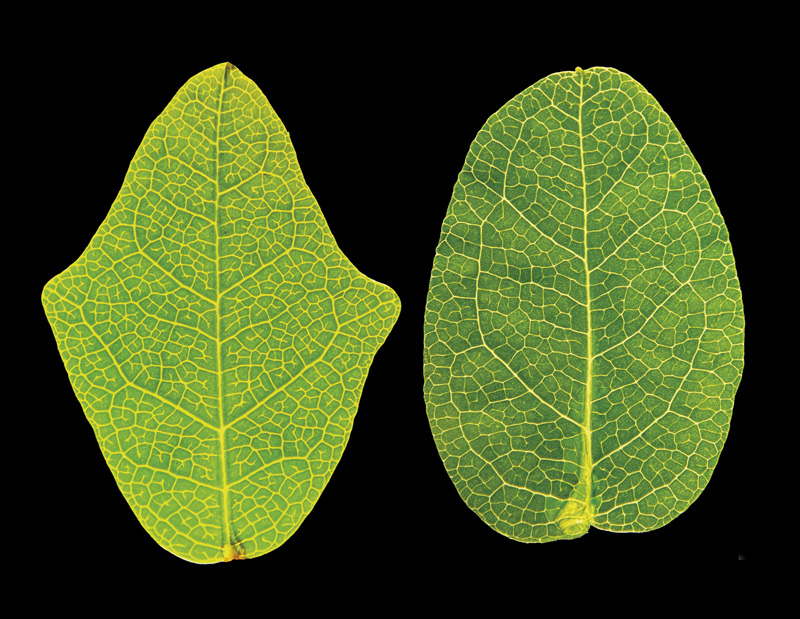
Felipe YamashitaTwo leaves of the creeper: one original (left) and the other after it changed shape Felipe Yamashita
The creeper Boquila trifoliolata, native to Chile and Argentina, is capable of changing the shape of its leaves so that they resemble those of the host plant—even if these neighboring leaves are made of plastic. The discovery of this ability to emulate artificial life earned Brazilian botanist Felipe Yamashita the satirical Ig Nobel Prize. The study was carried out during his doctorate at the University of Bonn, Germany, in partnership with independent American researcher Jacob White. The article describing how the plant’s leaves lose their lobes when placed next to more rounded artificial leaves was published in the scientific journal Plant Signaling & Behavior in 2022.
“I have no idea how the plant does this,” said the Brazilian during the not-so-solemn awards ceremony at the Massachusetts Institute of Technology (MIT) on September 12. “I have finished my PhD, I need a job to continue my research,” he joked, in line with the tone of the event, which promises to “make you laugh and then think” by selecting serious research that seems unusual. The use of an artificial plant in the experiments eliminated the possibility that the vine received information from the host plant through chemical compounds exhaled into the air or genes transferred through other organisms.
Yamashita’s favorite hypothesis for the phenomenon is that the plant has lenses or ocelli—a group of cells that receive light and are often compared to primitive eyes. “The light rays would pass through the epidermis and converge on a photoreceptor, perhaps chlorophyll,” suggested the Brazilian in an interview with the podcast Pesquisa Brasil. It would be a kind of vision, although obviously not as sophisticated or detailed as that of animals.
The story above was published with the title “The year of artificial intelligence” in issue 345 of November/2024.
Republish