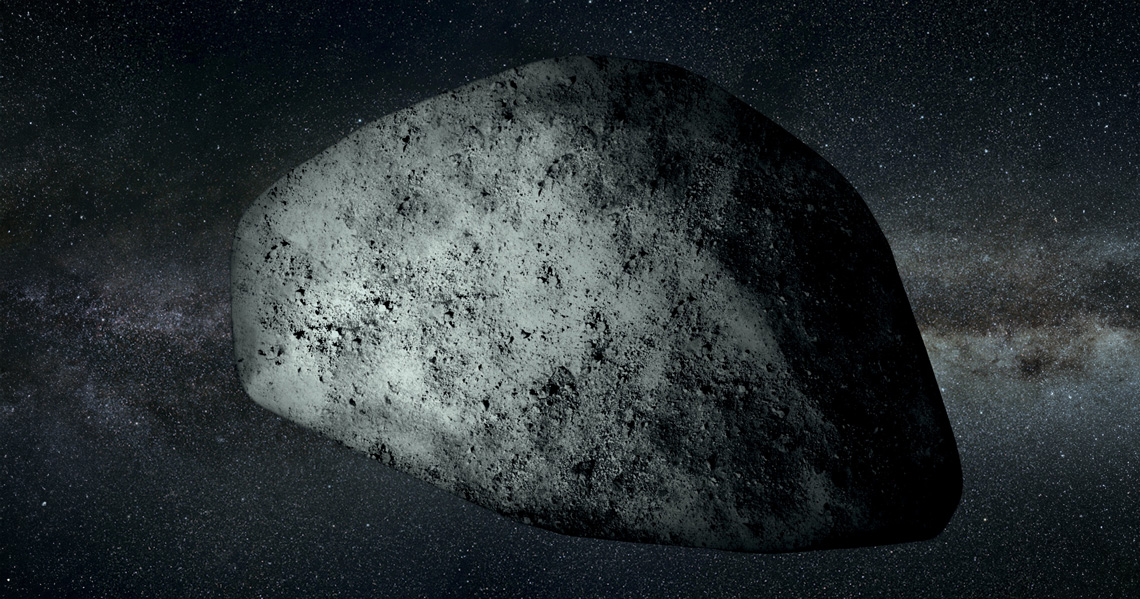
On April 13, 2029, an asteroid known as 99942 Apophis, a 340-meter (m) rock that weighs at least 20 million tons, will be at the closest point to Earth in its current orbit. The two celestial objects will be separated by just 32,000 kilometers (km), 12 times less than the average distance between the Earth and the Moon. Some artificial satellites orbit the planet at this altitude. When it was discovered in June 2004, Apophis caused apprehension among astronomers and concern in the media. It was considered the largest known asteroid on a potential collision course with Earth. The frightening name seemed a logical choice: in Egyptian mythology, Apophis was a deity associated with chaos and darkness, represented by a giant serpent.
Initial data obtained from incomplete observations of its orbit indicated a 2.7% chance that Apophis would collide with the Earth in April 2029—a Friday the 13th, as noted by the more superstitious observers. It would not be a global cataclysm, like the impact of the much larger 10 km asteroid that caused the extinction of the dinosaurs and much of life on the planet 66 million years ago. But a space collision with Apophis, which is traveling at an average speed slightly faster than Earth, could theoretically destroy an area of a few hundred kilometers. However, later studies, which used more detailed information about the asteroid’s trajectory, suggested that the celestial body did not live up to its catastrophic nickname. The risk of a collision with Earth in the next 100 years has been completely eliminated.
In addition to ruling out the chance of a collision, a recent study by the Orbital Dynamics and Planetology Group at São Paulo State University’s Guaratinguetá campus analyzed another possible consequence of Apophis’s flyby in April 2029. If the asteroid is surrounded by smaller rocks, passing so close to the Earth could cause them to be pulled away by the planet’s gravitational force, resulting in a meteor shower.
According to the study, described in the journal Monthly Notices of the Royal Astronomical Society (MNRAS) in May, computer simulations have ruled out the probability that any fragments of rock expelled from the asteroid will hit Earth until at least 2229. “But there is a small chance of this meteor shower falling on the Moon after 2129,” says physicist Othon Winter, head of the UNESP team and one of the authors of the article. The potential event would probably not have any major repercussions for Earth’s natural satellite, but it could create small craters on the Moon’s surface. The simulations took into account the gravitational interactions between the asteroid’s orbit and the main bodies around the Sun—essentially the planets in the Solar System.
In a previous article published in MNRAS at the end of 2021, Winter’s group calculated that Apophis’s extreme proximity to Earth could lead to changes in the asteroid’s shape, mass, and orbit. The planet’s gravitational force could cause small rockslides on the asteroid’s surface, deformations, or ejections of mass. “If this were to happen, the asteroid would gain momentum like a rocket,” says Antônio Bertachini, a physicist and aerospace engineer from the Brazilian National Institute for Space Research (INPE) who specializes in celestial mechanics and has studied Apophis.
The expelled matter could form what astronomers call a particle disk around the asteroid. The particles in this case would actually be small rocks of a few centimeters or meters in diameter. Initially, they would spin around the asteroid, attracted by the gravitational force of the larger body. Over time, some would escape the disk, change direction, and eventually be thrown off their normal trajectory and toward Earth.
Asteroid Apophis will pass within 32,000 km of Earth on April 13, 2029
According to the 2021 study, if Apophis is surrounded by a disk of 15,000 particles, 80% of them could escape the asteroid’s gravitational field at its closest point to Earth, resulting in a meteor shower. “The assumption that there is a disk of particles around Apophis is plausible,” says Winter. “The same thing has been seen in other asteroids.”
Apophis is considered an S-type asteroid, formed of siliceous rock mixed with iron and nickel. Instead of being made up of a single, large, finished block, this type of celestial body can be composed of an incomplete unison of several smaller solid fragments. Gravity pulls these pieces of rock together to create a larger object, even if the parts do not completely fuse together. “If this is the case with Apophis, Earth’s gravitational field has an even greater chance of ripping pieces off the asteroid, even without a collision,” says Winter.
There are no images with a high enough resolution to determine the shape of Apophis. All that can be seen in the basic records of the asteroid is a tiny dot in space, which becomes a shapeless blur when magnified. What little information we have suggests that it has an elongated shape, something like a peanut. “When the DART probe deliberately hit Dimorphos, a moon that orbits the asteroid Didymos, in 2022, it changed the orbit of the natural satellite and caused material to be ejected,” recalls Bertachini. The experiment was carried out by NASA to test whether it would be possible to divert an asteroid on a collision course with the Earth. And it worked. The DART probe, weighing about 600 kilograms, collided with Dimorphos, which is 170 meters long and weighs 5.5 million tons, and changed its course.
No recent studies have suggested that a collision between Apophis and Earth is likely within the next 100 years. “The current margin of error for Apophis’s trajectory is less than 1 km,” says Winter. The only exception is an article written alone by astrophysicist Paul Wiegert of the University of Western Ontario, Canada, published in The Planetary Science Journal at the end of August. Wiegert simulated a highly unlikely scenario—bordering on science fiction—that according to his calculations, could put the asteroid on a collision course with the planet.
If a smaller, unknown asteroid roughly 3 meters across were to collide with Apophis before April 2029, the collision could deflect the space rock’s orbit by 340 m, potentially nudging it toward the Earth. “Calculations to date have not yet considered the effect of a possible small asteroid impact on Apophis, an impact of the type which is frequently observed on Earth as a meteor or shooting star,” Wiegert posted on his website when his article was published.
According to the Canadian astronomer, the probability of a small, never-before-observed asteroid hitting Apophis and altering its orbit is less than one in a million. The chance of the hypothetical change in trajectory then posing any danger to Earth is even smaller, at just one in a billion. “This scenario is essentially ruled out,” says Winter. “For it to occur, a succession of extraordinary events would need to occur.” As it passes in April 2029, the asteroid will be visible to the naked eye, similarly to the planet Venus before dawn and dusk.
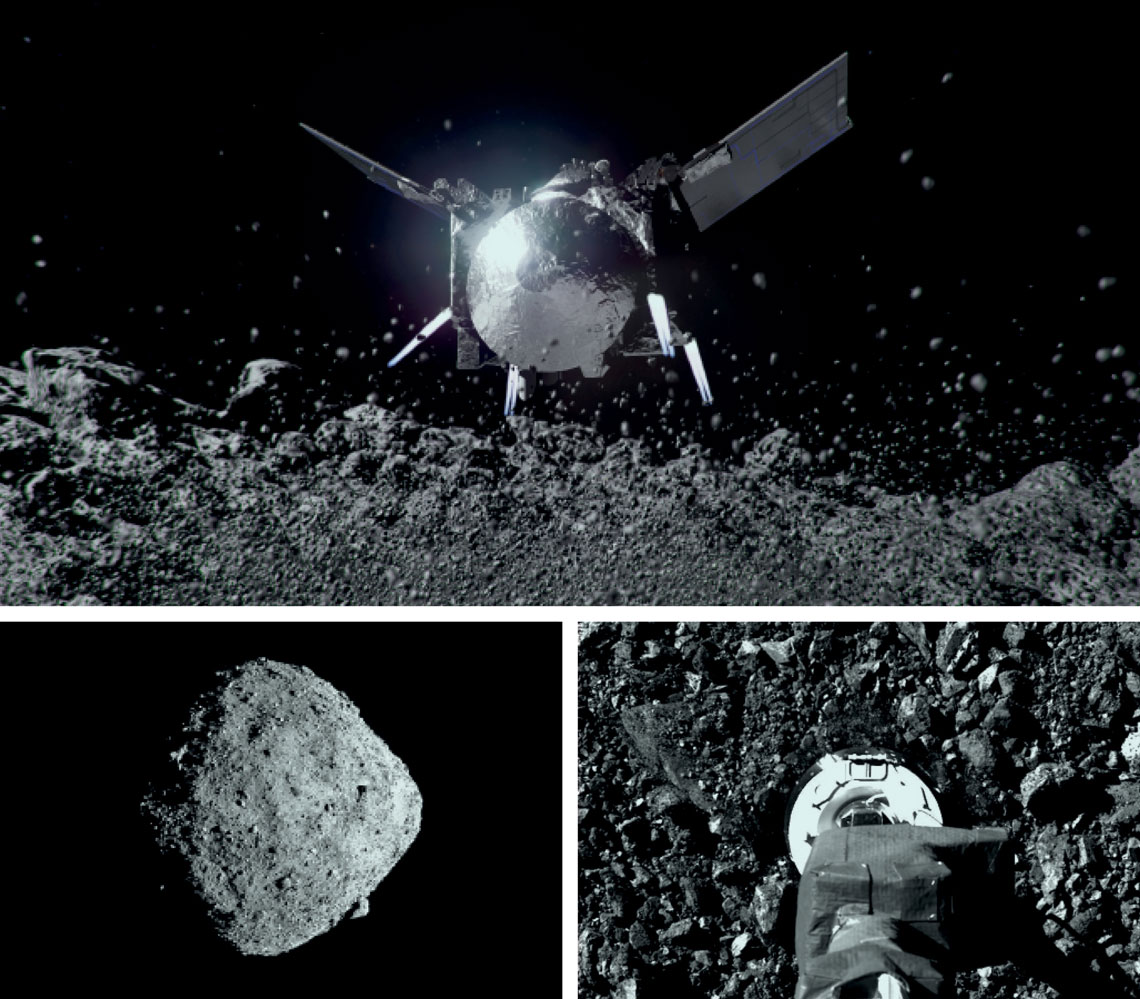
NASA Goddard's Scientific Visualization | NASA / Goddard / University of ArizonaImage of the asteroid Bennu (above, to the left) and equipment from the Osiris probe taking a sample of its soil (above, to the right). On top, illustration shows how the spacecraft will explore the asteroid ApophisNASA Goddard's Scientific Visualization | NASA / Goddard / University of Arizona
Apophis has the same origin as the millions of rocky bodies that form the asteroid belt that orbits the Sun between Mars and Venus, remnants of the formation of the Solar System 4.6 billion years ago. Most of the asteroids stay in the belt. Sometimes, due to gravitational interactions—especially with Jupiter, the largest planet in the system—their trajectories are altered over time, pushing them closer to Earth.
This is the case with Apophis, which, in its new orbit free of the belt, passes closer to Earth every seven or eight years. The most recent was in March 2021, when it passed by 17 million km away, about 500 times further from the planet than it will be in April 2029.
In the days after the asteroid passes the Earth in April 2029, NASA’s OSIRIS-APEX spacecraft will begin following it closely for a year and a half. Its mission is to obtain detailed images of Apophis and collect samples from its surface. To succeed in this second objective, it will fly almost alongside the asteroid and aim its engines directly at the asteroid. The disturbance should be enough to cause small loose rocks and dust from Apophis to rise from the ground, at which point the spacecraft will capture them. In September last year, the probe, then called OSIRIS-REx, did exactly that with another asteroid relatively close to Earth called Bennu, which has a diameter of approximately 500 meters.
There are also plans for another space mission to study Apophis before it passes near Earth in April 2029. Astronomer Daniel Scheeres of the University of Colorado Boulder, USA, wants to redirect the Janus mission, which NASA canceled in the middle of last year, to pursue this new objective. The two Janus satellites, which were initially designed to study a system with two asteroids, are ready but in storage, with no apparent purpose.
“The cost of building and operating the original mission was less than US$55 million. Since the satellites were not launched, not all the money was spent,” explains Scheeres, principal investigator on the canceled Janus mission, in an interview with Pesquisa FAPESP. “I am now working with several research groups with the aim of sending Janus to perform a flyby in the vicinity of Apophis. We are still formulating the plans and NASA still needs to agree to our proposal.”
Winter, from UNESP, believes it is very important to send a space mission to study Apophis before April 13, 2029. Monitoring of the asteroid after that date will be taken care of by the OSIRIS-APEX mission. “With observations before and after Apophis’s exceptionally close flyby, we would have more detailed data on the impacts of this event,” says the researcher. Europe also plans to launch a probe, called Ramses, to record Apophis before its close encounter with Earth. It could be a unique opportunity. Astronomers estimate that an asteroid of this size only comes this close to the planet once every 5,000 to 10,000 years.
The story above was published with the title “Future threat” in issue 345 of November/2024.
Project
On the relevance of small bodies in orbital dynamics (n° 16/24561-0); Grant Mechanism Thematic Project; Principal Investigator Othon Winter (Unesp); Investment R$ 5.088.073,95.
Scientific articles
VALVANO, G. et al. Apophis: may a meteor activity happen on Earth after the 2029 closest approach? Monthly Notices of the Royal Astronomical Society. May 7th, 2024.
VALVANO, G. et al. APOPHIS – effects of the 2029 Earth’s encounter on the surface and nearby dynamics. Monthly Notices of the Royal Astronomical Society. November 13, 2021.
WIEGERT, P. On the Sensitivity of Apophis’s 2029 Earth Approach to Small Asteroid Impacts. The Planetary Science Journal. August 26, 2024.