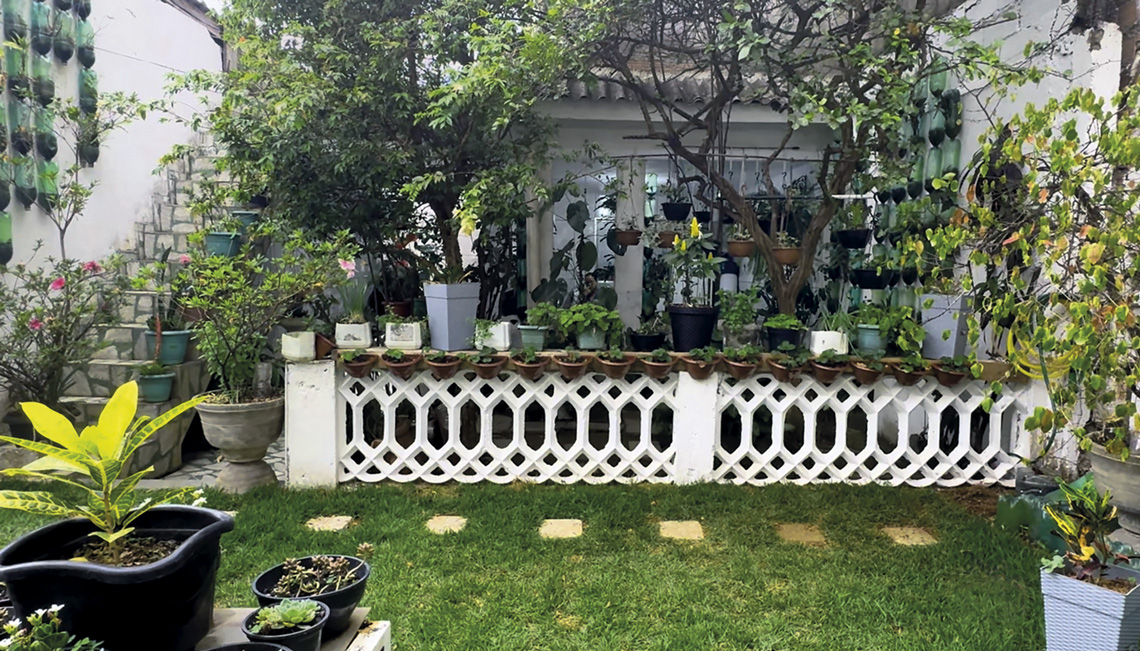
Born in the countryside of São Paulo State, Nilcéa got married at 17 and brought a potted plant with her when she moved to the state capital. The zebra plant (Calathea zebrina), which she brought with her 70 years ago as part of her wedding trousseau, now grows in the backyard of her home, on land she has cultivated for over five decades in the Vila Regente Feijó neighborhood, in São Paulo’s east zone. Over time, the neighborhood has grown around the 500-square-meter (m²) space, which, according to her, once housed chickens, ducks, rabbits, and even a horse. Today, among the fruit trees, medicinal herbs, and ornamental plants, two tortoises remain that arrived more than 40 years ago, when her children were small.
Nilcéa was one of the subjects interviewed by anthropologist Andréa Barbosa from the Federal University of São Paulo (UNIFESP) during a study conducted between 2022 and 2024. In the FAPESP-funded study, Barbosa visited around 20 backyards in the Pimentas neighborhood, located in Guarulhos (São Paulo), as well as areas in São Paulo’s east zone, to understand the role these domestic spaces play in the residents’ lives and how they withstand the rapid urbanization of cities. “In the places I visited, the backyard is a source of healing, of homemade remedy production, and a place for socializing, parties, and games,” says the researcher. “I didn’t see a single backyard that looked like another, and they tend to mirror their owner’s personality. For those interviewed, the backyard has to be beautiful, but it is a dynamic kind of beauty, full of diversity.”
Most of those interviewed are migrants from rural backgrounds. “When they came to São Paulo, they brought seeds, cuttings, and cultivation techniques,” says Barbosa. “By growing plants and raising small animals, the residents maintain their connection to a rural way of life. This stems from their own experience or from that of their parents and relatives with whom they had contact.
According to the anthropologist, the role of backyards in the areas visited is not limited to the domestic environment. “Through these spaces, the residents create or strengthen their network of relationships within the community,” she adds. “Items such as fruit, leaves, cuttings, and seeds circulate among friends and relatives in the neighborhood, and are often eagerly awaited by them.”
It is what happens with Eliane, born in the countryside of the state of Rio de Janeiro, and her husband Toninho, from Minas Gerais, who have lived in the Pimentas neighborhood since the land was first divided into lots, in the 1990s. “Every summer they distribute grapes around the neighborhood,” says Barbosa. “The 100 m2 area which today is their backyard is enclosed by the walls of the neighbors behind and on both sides. There, they grow grapevines and around 20 fruit trees, along with a garden of edible and medicinal plants, mostly in pots,” says the researcher.
The transformation of the place into a backyard, in the 2010s required a lot of work. “It was a space between the lots where a stream ran, which functioned as an open sewer,” says Barbosa. With the help of their children and some neighbors, the couple channeled the stream and with eight truckloads of soil leveled the ground. “Conflict among neighbors, although still present in everyday life, improved considerably after the backyard was built. The other residents stopped throwing trash behind Eliane and Toninho’s house,” says the anthropologist.
Some species, such as Saint George’s sword (Dracaena trifasciata), lemongrass (Cymbopogon citratus), amaranth (Amaranthus spp.), aloe vera (Aloe vera), and guaco (Mikania glomerata), are recurrent features in the backyards visited by the researcher. “Great knowledge of biodiversity and healthcare practices circulate in these spaces, which is often not valued by younger generations,” says Barbosa.
Environmental manager Guilherme Reis Ranieri had a similar feeling during the research for his master’s, defended in 2019, at the School of Arts, Sciences, and Humanities of the University of São Paulo (EACH-USP). At the time, he visited cities such as Areias and São José do Barreiro, in the Paraíba Valley region of São Paulo State, to investigate how urban backyards maintained—or were beginning to lose—knowledge related to domestic cultivation.
The researcher mapped around 200 species, some overlooked by large supermarket chains, greengrocers, and even street markets. It is the case of tannia (Xanthosoma sagittifolium), with its large leaves and rich in iron and calcium, Barbados gooseberry (Pereskia aculeata), a protein-rich creeper, and fameflower (Talinum paniculatum), a leafy green known for its diuretic properties. “Many elderly people said: ‘This knowledge of identifying, cultivating, and using these plants will die with me.’ Younger generations associate cultivation with poverty or with being behind the times,” states the researcher, who is currently finishing his PhD research at the School of Medicine at USP. The study analyzes the introduction of some of these edible plants into school dinners at public schools in Jundiaí (São Paulo).
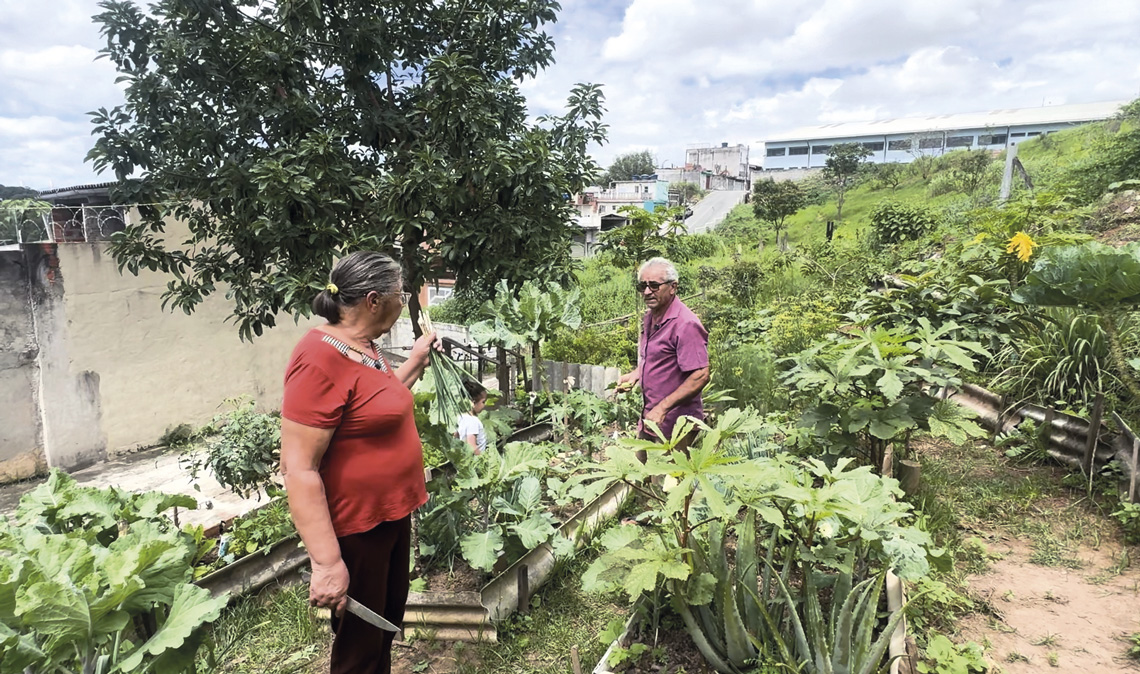
Tatiane VeschIone and Manoel, who live in the Pimentas neighborhood and were interviewed by anthropologist Andréa BarbosaTatiane Vesch
According to the 2022 Demographic Census, by the Brazilian Institute of Geography and Statistics (IBGE), 171.3 million people in Brazil, or 84.4% of the population, live in houses. “The backyard is a recurring feature in Brazilian homes and strongly reflects our cultural diversity, bringing together, in a single space, the Portuguese farmhouses, the medicinal plants of the Indigenous peoples, and the samba gatherings inherited from African traditions, among other influences,” lists architect Sonia Wagner de Ferrer who defended her doctoral thesis in 2023 at Fluminense Federal University (UFF) about urban backyards in Jacarepaguá, in Rio de Janeiro’s west zone. “In poorer households, they have historically played a subsistence role, not only through vegetable gardens and raising animals, but also for setting up small businesses or for renting makeshift structures, for example.”
In Jacarepaguá, houses still make up the majority, despite the growing number of apartment buildings. In the absence of a backyard, many residents end up adapting other areas of the home to fulfill the role of this space. This is the case for those living in apartments. “They create what I call ‘imaginary backyards’ in my research, within their homes, such as transforming balconies into gardens and vertical vegetable patches in the kitchen,” explains Ferrer.
During the field survey, the architect encountered several types of backyard: from luxury backyards with swimming pools, gourmet areas, and landscaped gardens, to rooftop backyards in favela houses, with plastic swimming pools or water tanks, where kites are flown and the women sunbathe. “Unlike rooms like the kitchen and bathroom, the backyard does not have a preestablished function,” says the researcher. “It provides total freedom for a wide range of uses, which are determined by the needs and wishes of those who use it.”
In her research, Barbosa, from UNIFESP, also investigated the community vegetable gardens created by collectives known as “okupas” (occupants) in Barcelona, in Spain. “It is a movement with strong political ties and since the 1980s has fought against the housing crisis and gentrification that expels traditional residents from their neighborhoods, transforming the city into an object of exploitation by the real estate and international tourism markets,” says the anthropologist.
An example of this is the Spanish group Desenruna, which operates in Vallcarca, a region disputed by the real estate market because of its proximity to one of the country’s biggest tourist attractions, Park Güell, designed by Antoni Gaudi (1852–1926). There, activists occupy private land belonging to construction companies that demolished the houses of the local residents, in a process of gentrification. “The movement argues that such areas should be part of the right to the city,” explains the researcher. “Its objective is to ensure the permanence of the neighborhood, and the vegetable garden is the focal point of this initiative, because producing its own food strengthens community ties.”
The story above was published with the title “Private world” in issue 352 of April/2025.
Project
Plants in circulation, producing the life of the city: How backyards, gardens, and vegetable plots function as a tactic for building relationships and social connections (n° 21/10075-4); Grant Mechanism Regular Research Grant; Principal Investigator Andréa Claudia Miguel Marques Barbosa (UNIFESP); Investment R$101,909.84.
Scientific article
BARBOSA, A. C. M. M. Quintais, roças e hortas: Práticas urbanas e ruralização nas periferias. Iluminuras. Vol. 24, no. 56, pp. 217–44. 2023.
Book
RODRIGUES, E. et al. (ed.). Canteiros medicinais periféricos. São Paulo: Glac Edições, 2025.