The history of leprosy in the Americas runs deeper than once thought, according to research published this May in Science. Well over a millennium ago—before European colonization—the bacterium Mycobacterium lepromatosis likely spanned the entire continent.
That’s a notable new finding: before the bacterium was first described in 2008, scientists recognized only one main cause of the disease, M. leprae, which still accounts for roughly 200,000 new cases globally each year. This well-known species is believed to have reached the Americas in the late 1400s, carried by Europeans and enslaved Africans. That part of the story hasn’t changed.
But a new layer was added in 2018, when Argentine geneticist and bioinformatician Nicolás Rascovan—now at France’s Pasteur Institute—detected M. lepromatosis in ancient DNA from a human sample excavated in Canada and stored at the Canadian Museum of History. More recently, Rascovan examined samples housed in Argentina’s Museum of La Plata, taken from two Patagonian archaeological sites. With the consent of local Indigenous communities, he sequenced them and again found genetic traces of the same bacterium. Put together, the evidence suggests that a thousand years ago, M. lepromatosis was present in both the far north and the far south of the Americas. Which makes it hard to imagine it didn’t also exist across the 6,000 miles in between.
“We also found M. lepromatosis in a modern sample from Brazil using PCR,” Rascovan said in an email to Pesquisa FAPESP, “though we couldn’t recover full genomic sequences. Both the new study and existing evidence from Brazilian patients hint that the bacterium’s reach—past and present—may be far broader than thought.” To close those knowledge gaps, Rascovan is calling for wide-scale mapping to chart the bacterium’s genetic diversity over time. “We hope our work encourages dermatologists, hospitals, and research groups to invest more in tracking and detecting this pathogen—not just in people, but in animals as well.”
For now, the data is insufficient to reconstruct the pathogen’s migration history through the continent. The bacterium may have crossed over from Siberia with the first human settlers more than 10,000 years ago, moving south from North America. Or it may have jumped to those early Americans from animals already living here. Outside the Americas, M. lepromatosis has only been found in red squirrels in the UK. One speculative theory is that it arrived within the last three centuries via a different squirrel species introduced from the US. “Or through some other host—humans included,” Rascovan says.
The team analyzed 389 ancient samples—some newly sequenced, others drawn from public genomic databases—plus 408 modern samples from leprosy patients in the US, Mexico, French Guiana, Brazil, and Paraguay. In 36 of those modern cases—most from Mexico—the pathogen was M. lepromatosis. One was from Brazil’s Pernambuco State.
Most of the Brazilian cases were from Pará and Amazonas, where dermatologist and leprosy specialist Claudio Salgado heads a research team at the Federal University of Pará. Salgado stresses that ongoing surveillance is key—without it, they would not be able to contribute data to continent-wide studies like Rascovan’s. Brazil ranks second only to India in leprosy cases. In 2023, according to the Ministry of Health, the country logged nearly 23,000 new diagnoses—a 16% jump from 2022. Most cases cluster in Brazil’s North and Midwest. The disease first shows itself on the skin—patches, nodules, and numb areas—but it can also attack the nervous system, causing overall fatigue and physical disabilities.
Salgado says it’s urgent to adjust diagnostic protocols so they also search for M. lepromatosis. Scientists still don’t know how symptoms might differ from those of leprosy caused by its far more common cousin, M. leprae. For Salgado, different bacterial species could help explain why the disease looks different from patient to patient—and why standard treatments sometimes fall short. He also points out that the main antibiotic regimen hasn’t changed in decades. “Bacteria evolve. They develop resistance,” Salgado warns.
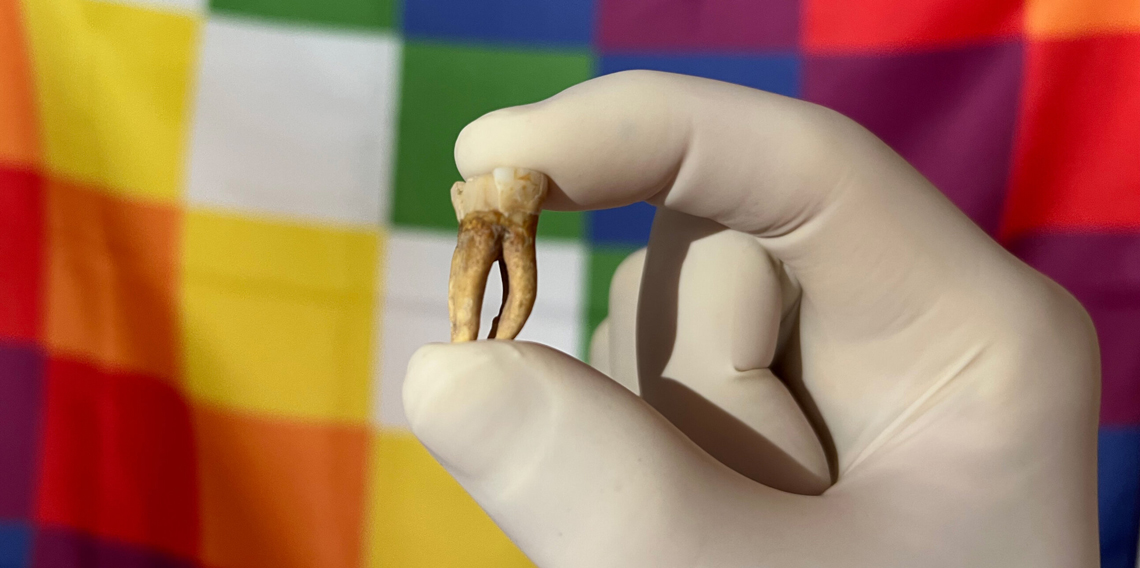
Nicolás Rascovan / PasteurA tooth unearthed from an archaeological site in Argentina, used to extract ancient DNANicolás Rascovan / Pasteur
Leprosy remains very much a neglected disease, with the burden falling largely on people living in poverty and social exclusion, says veterinarian Patricia Rosa of the Lauro de Souza Lima Institute in Bauru, São Paulo State, a coauthor of the study and collaborator with Salgado’s team. “Leprosy doesn’t kill, but it’s wrapped in stigma—which may be why it draws so little funding,” Rosa explains. “The problem is that the damage it causes to the body can become chronic.”
Rosa’s team investigates Mycobacterium leprae by infecting laboratory mice to determine how the disease progresses and how the body responds to treatment, and also to cultivate bacterial strains that can’t be grown in artificial media.
Animal studies like these also shed light on how the disease circulates. “If we don’t know which other hosts are out there, we can’t break the chain of transmission,” Rosa notes. Across Brazil, research teams are hunting for animal reservoirs of both Mycobacterium species. One such effort is led by epidemiologist Rita Donalisio at the University of Campinas (UNICAMP), who was not involved in the Science paper. In a 2024 Acta Tropica article, Donalisio’s team reported on 78 armadillos collected as roadkill during a 40,000-kilometer trek across every Brazilian biome. “Armadillos are a well-known leprosy reservoir,” Donalisio says. She was disappointed not to find M. lepromatosis, though M. leprae turned up frequently in the animals. “That matters,” she adds, “because in many regions people have close contact with armadillos—whether for food or to use their shells.”
Donalisio notes that Brazil has made little effort to test specifically for M. lepromatosis. Because its symptoms mirror those of M. leprae, she says, wider use of molecular diagnostics is essential. For her, the finding that M. lepromatosis was already in the Americas before Columbus not only deepens scientific understanding of the bacterium but also strengthens the case that animal reservoirs exist and must be identified. “From a One Health perspective, using sentinel animals in disease surveillance is a useful way to flag when a pathogen is active in a given region,” she says.
More than just filling in knowledge gaps, the Science article reveals how much there is still to discover. Rascovan, of the Pasteur Institute, suspects there may be undiscovered Mycobacterium species still circulating. “In our study we found extremely ancient and rare M. lepromatosis lineages,” he says, “which hints that other, unidentified species could be circulating on the continent—perhaps hidden in animal hosts or in places where genetic testing isn’t routinely done.”
His team also uncovered an evolutionary split of nearly a million years between M. leprae—likely originating in Eurasia—and M. lepromatosis, which appears to have arisen in the Americas. “That forces us to rethink when and where this divergence happened, whether other species or subspecies have split off since, and where they might be hiding today.” Rascovan closes with a reminder: this research confirms earlier evidence that M. leprae arrived with Europeans and had a significant impact on Indigenous peoples.
The story above was published with the title “Pre-Columbian leprosy” in issue 353 of July/2025.
Scientific articles
LOPOPOLO, M. et al. Pre-European contact leprosy in the Americas and its current persistence. Science. Online. May 29, 2025.
MONSALVE-LARA, J. et al. Prevalence of Mycobacterium leprae and Mycobacterium lepromatosis in roadkill armadillos in Brazil. Acta Tropica. Vol. 258, 107333. Oct. 2024.