


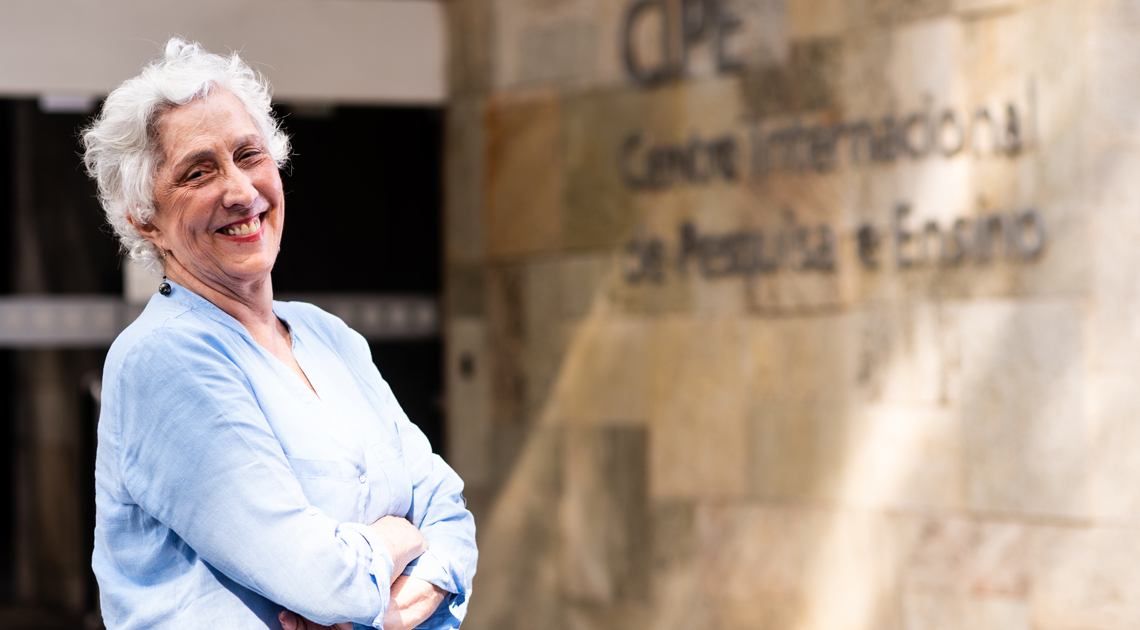
Maria Paula Curado quickly realized that operating on head and neck tumors was not the best way to undertake a large-scale fight against cancer. She swapped surgery for epidemiology and united research institutions in project Headspace, an international consortium that researches the genetic and epidemiological characteristics of head and neck cancers and counts on funding from Europe and FAPESP. In August, at the age of 73, her comprehensive and resolute career earned her the tribute of Outstanding Personality at the Octavio Frias de Oliveira Award, sponsored by the São Paulo State Cancer Institute (ICESP) and the newspaper Folha de S.Paulo.
A graduate of the Federal University of Goiás (UFG), she completed a specialization at A.C.Camargo Cancer Center, established in São Paulo in the 1950s (see article on page 90), where she later completed her PhD and now heads the Epidemiology and Statistics in Cancer Group (GEECAN) at the International Research Center (CIPE). Her population-based perspective on the disease began in the 1980s, when she proposed creating a registry of all cancer cases in Goiânia, where she began her career.
Cancer epidemiology
Institution
A.C.Camargo Cancer Center and the Antônio Prudente Foundation (FAP)
Educational background
Undergraduate in medicine at the Federal University of Goiás (UFG), master’s degree in surgery of the head and neck at Hospital Heliópolis, and a PhD in oncology at FAP
Curado was the first female president of the Brazilian Society of Head and Neck Surgery (SBCCP). After becoming a leading authority in the field in Brazil, she lived in France for 10 years: first as head of the department of Descriptive Epidemiology at the International Agency for Research on Cancer (IARC) of the World Health Organization (WHO), and later as a researcher at the International Prevention Research Institute (IPRI).
She comes from a family of distinguished doctors from the municipality of Goiás Velho and currently lives with her 30-year-old son. In mid-August, she spoke with Pesquisa FAPESP at CIPE about the incidence of head and neck cancer, treatments, and functional cure. Read the main excerpts of the interview.
Is Brazil notable for its incidence of head and neck cancers?
The country with the greatest incidence of head and neck cancers is India. About 50% of the cases occur there because they chew a lot of betel leaf, a vine, with areca nut, a type of palm. We have a high rate that varies according to the region and age group. Here, the incidence increases sharply from age 45. Cancer of the oral cavity is more common among the elderly, while oropharyngeal cancer linked to HPV [human papillomavirus] affects more people between 50 and 59 years old.
In which regions is it more frequent?
Espírito Santo has a high rate, for both oral cavity and oropharyngeal tumors. Minas Gerais as well.
Is it related to diet?
Mainly to tobacco use, vaping, alcohol consumption, and HPV transmission through oral sex. In studies we conducted, we found that former smokers need to wait at least 10 years for their risk of developing cancer to decrease. If they drink alcohol, it takes even longer.
In the past, head and neck cancers were more common after the age of 50, and more recently, their incidence has started to increase among those under 50 in Brazil. Is that correct?
That happened in cases resulting from HPV infection. The proportion of women with head and neck cancer has also increased, with the disease appearing at a slightly younger age. Previously, the ratio was four men for every woman. Now it has reached two to one. Women left the home, they smoke and drink. They have lifestyles more similar to men.
Which organs are you referring to when you say head and neck?
The oral cavity, comprising the lips, tongue, gums, and hard palate (roof of the mouth); the oropharynx, which includes the soft palate, the uvula, tonsils, and the posterior wall of the throat; the nose and paranasal sinuses; and the salivary and thyroid glands. Today there is an avalanche of thyroid tumor diagnoses, because every woman who goes for a gynecological appointment requests an ultrasound. And any nodule is sent for pathological analysis to determine the diagnosis.
Why is that a problem?
Thyroid cancer is the most common in the world, but most of the time, it is inactive. The nodule doesn’t turn into cancer. To avoid removing the gland, which can cause problems, the technique of burning the nodules was developed. A similar effect occured with prostate cancer. When the PSA [a protein released by the prostate] detection test was introduced, all men went to get tested because it eliminated the need for the digital rectal exam. The detection of very early-stage cancers led to more unnecessary surgeries, and what happened? Mortality increased. In countries such as Japan, where they don’t do PSA tests, mortality did not increase.
In terms of head and neck tumors, what symptoms should people look out for?
Cancer of the mouth deserves more attention because it progresses rapidly. People frequently see doctors and dentists, yet nobody examines the mouth. Maybe these professionals don’t even know how to diagnose it. It is the doctor or the dentist who should be looking for the problem. Patients need to be educated to stay up to date with their health check-ups.
How has the treatment of these types of cancer evolved?
It has changed a little. In the past, we treated based on the cancer stage. We would examine the patient and look at the size, appearance, and location of the tumor. The new international TNM classification, proposed in 2018, also classifies cancer based on biomarkers. It is not just the size of the tumor, but whether it has high concentrations of the P16 protein. This factor influences the prognosis, or the chance of a cure, and leads to more precise treatment.
Is a genetic test of the tumor performed?
An immunohistochemistry test, which uses antibodies to detect the presence of the protein. If the tumor is P16 positive, it means that HPV is present. In Brazil and the USA, we have adequate treatment options for patients with the virus. If it is negative, we use the standard treatment. Molecular markers are now part of cancer staging and, for some cancers, they are prognostic factors associated with cure. This has allowed treatment to be better tailored and has increased survival. The disease can become stable, allowing the patient to live with it. There are many oral drugs today; they were all intravenous in the past. The concept of cure has also changed. It no longer involves only the complete elimination of the cancer. A patient can have functional survival, with ability and quality of life, even if the tumor persists.
A patient can have functional survival, with ability and quality of life, even if the tumor persists
Cure has come to mean living with the disease with quality of life.
Exactly. In the past, treatment had to kill the cancer, but it killed the person too. Today, we are seeing a balance. For example, a woman has a large breast tumor, and at the time of the mastectomy a lung metastasis is discovered. When I was a surgeon, that was synonymous with death. Now, the nodules are removed and the woman keeps on living. The new focus is on giving life to the patient. Cure is relative, not definitive. There is also a range of new drugs: immunosuppressive agents, monoclonal antibodies, and CAR-T cell therapy for treating hematological tumors. The pharmaceutical industry is investing heavily and transforming treatment.
Are the more advanced treatments available to everyone in Brazil?
Something extremely necessary, but lacking in Brazil, is guidelines that help make treatment universal. We don’t have any for head and neck cancer. A physician in the countryside of the state of Mato Grosso, for example, sees a patient with a tumor on the edge of their tongue and notices one or two enlarged lymph nodes. What should their approach be? If guidelines exist, they can access them, make a decision, and justify that approach to the patient. I raised this issue two years ago in a meeting with regional leaders, and we were able to create such guidelines for Latin America. They have been published, but not yet implemented. When there is a suspected head and neck tumor, the recommendation is to do a biopsy: remove a small piece, place it in a container, and send it for laboratory analysis. One problem is that this process can take one or two months in the public health system. In the meantime, the patient waits, and the tumor grows.
Is early diagnosis important?
Here at A.C.Camargo, around 40% of oral tumors are at an early stage. In the SUS [the Brazilian Public Health System], which serves 75% of the population, 76% of the cases already arrive at an advanced stage. In these situations, we cannot know where the tumor began. To create public policy, we have to know where most tumors are at early stages, so we know how to act. We need to carry out this mapping because it influences prognosis. When a patient arrives with an advanced-stage tumor, even here at A.C.Camargo, with access to technological exams and treatment, it makes no difference. They die. If treatment begins in the early stages, they have more chance of cure.
Do you still attend patients?
I was a head and neck surgeon until 2007. In Goiânia, I didn’t have the money to do research, so I operated. I joke that I went from a rich surgeon to a poor epidemiologist. I came to finish my training and proposed to Luiz Paulo Kowalski, who was my friend, that we do an epidemiological study. We gathered data from Goiânia, Curitiba, and from A.C.Camargo. We began recruiting patients in 1991 to understand their habits and find out why they developed cancer. I insisted on including wood-burning stoves in the analysis. The smoke was indeed one of the risk factors for oral cancer in Curitiba, where they were widely used. We managed to publish it in the Journal of the National Cancer Institute. It was our first article. It was myself, Kowalski, and Benedito Valdecir de Oliveira, from Hospital Erasto Gaertner, in Curitiba. Afterwards, we joined the group at USP. I wanted to do epidemiology because I think it is important to investigate factors associated with the disease, to change behavior.
You already had experience with epidemiology before that, didn’t you?
I set up the Goiânia population-based cancer registry. It started because I lost a 37-year-old patient with oral cancer. I had performed an excellent surgery, I was all proud, like a big-headed surgeon. A few months later, he came back with a recurrence. I thought: “I already know how to do surgery, but it makes no difference.” So I went to take a course at the National Cancer Institute in Rio de Janeiro. There, I had a Colombian professor who had lived in the USA. When classes ended, everyone would leave, and I used to stay behind. Then she came to speak with me. I told her that I wanted to learn how to make an epidemiological registry, and she taught me many things. She worked at the Pan-American Health Organization and even sent me a computer.
And did you create the registry in Goiânia?
I started. It is necessary to gather all the cancer cases in the city, go to all the hospitals, and convince the directors to send the information. I had already mobilized the sources, but I still needed authorization from the Ministry of Health. One day I went to São Paulo, and Eduardo Franco and Humberto Torloni (1924–2017) called me for a meeting in Brasília. They told me that, at the ministry, they would ask where it was necessary to create a registry in the country, and that I should answer Goiânia. I took the opportunity to invite them to visit the hospital where I worked. It was nothing in comparison to what already existed here at A.C.Camargo.
How did the registry work?
We collected age, gender, topography [location of the tumor], staging. We did that 24 hours a day.
Did the registry already exist when the cesium accident occurred in 1987?
We had set it up just before. We worked a lot. The governor asked me to help the victims, and I went to attend them on the condition that, by law, the registry be transferred to the Goiânia Cancer Hospital, where I worked. We performed preventive treatments and surgeries to remove early lesions and stop them from becoming malignant. The situation caused many mental health problems among the population; people were really shaken up. I learned a lot, especially about communication, and giving correct, trustworthy information.
Were there changes in the pattern of cancer after the accident?
We created a protocol to follow up with the victims and found no spike in cancer cases. One woman had breast cancer, but we don’t know whether it was related to the accident. I don’t think so. Among the exposed group of 249 people, one employee had myelodysplasia, a precancerous condition in which there are defects in the production of blood cells in the bone marrow.
In Goiânia, we have seen changes in the incidence of breast and cervical cancer, which are currently appearing in younger patients
Is the registry still active in Goiânia? What has it revealed in this time?
It is still active today. It was the first in the Midwest; Brasília now has one too. Over these 30 years, we have been able to show the state of cancer in Goiânia and use it as a reference for other places. We have seen changes in the incidence of breast and cervical cancer, which are currently appearing in younger patients. Melanoma is also on the rise. We have also seen the impact of preventive measures. Now I’m convinced that we have to study the rare tumors. People live longer, so the chances of these tumors appearing have increased. Doctors need training to suspect these cases and make accurate diagnoses.
How does Headspace work?
It’s an international consortium that brings together research centers from 15 countries to investigate the genetic and epidemiological characteristics of head and neck cancers. When I went to France in 2007, we did a second head and neck cancer project, with collaborators from several Brazilian states and some South American countries. We recruited around 4,000 patients and analyzed the occurrence and risk factors that predisposed them to these tumors. Based on this work, a friend, British epidemiologist Paul Brennan, suggested that we create Headspace. He came here, we gathered the groups, discussed it, and prepared the proposal that he presented to the European Community. We got the funding. Afterwards, we made an agreement, sent it to FAPESP, and secured funding for the project that finished in August, which sought to understand the reasons for delays in head and neck cancer diagnosis. It began with researchers from Goiânia, São Paulo, Argentina, Uruguay, and the USA. Along the way, Iran and India joined in. Today, we are 15 centers. We work with communication, diagnosis, and genome analyses. We wanted to find out which mutations are most frequent in these 15 countries, how the health systems worked, and why head and neck cancers were diagnosed late.
Is the situation similar in the 15 countries?
It is very different. In South America—Uruguay, Colombia, Argentina, and Brazil—we are more or less the same, but there is a significant difference between the public and private systems. Here, the SUS provides diagnosis and treatment at no cost, but patients who can afford health insurance or private care get seen faster. In Italy, for example, the system is public, but there are waiting lists. We produced an article based on questionnaires, and it was clear that there are differences in diagnosis times. In the UK, there is a maximum period of 60 days to start treatment.
We also have legislation in Brazil that establishes this time frame, don’t we?
We do. Once diagnosed, treatment must begin within 60 days. But there are no mechanisms to ensure this deadline is met. The British system works because there is very strict monitoring.
Even so, do tumors there still appear at more advanced stages?
Yes, I don’t know why. Breast cancer survival in England is the lowest in Europe because of the NHS [National Health Service] waiting list.
Waiting lists seem to be a common problem in public health systems. What is the solution?
I think there is a lack of regionalization. In Goiânia, the SUS works one way; in the Northeast of Brazil, local management works differently. There is no single model that works everywhere. The equipment available at the SUS in Barretos, in the countryside of the state of São Paulo, is not the same as what is available in Goiânia or in Aracaju. This difference needs to be regulated.
What did you observe during your time at IARC, in France?
I learned a lot. It is a well-established and very European institution, different from what I am used to. They had me work on one of the CI5 volumes, a book published every four years about cancer incidence across the five continents.
Did you want to change something?
Yes, two things. The records were poor and not digitized. If you wanted access, you had to buy the software. We created a program called CanReg5, open to everyone, with no license fee. Today it is more advanced, with different versions. The other thing I wanted to change was that, in CI5, only topography was used to describe cases: cancer in the nose, for example. But morphology is more important for treatment than location. For the first time, we began compiling the international cancer incidence registry with information on morphology. I made lots of friends during this time, we still have projects together today. But I wanted to come back. There is so much to be done here.
When you returned, did you want to do something different from what you had been doing?
I wanted to do cancer epidemiology, because it didn’t exist in Brazil. This is a cancer hospital and it is important for students to learn more about epidemiology. A new mindset needed to be created, and that takes time.
When the Europeans came, they brought the habits of drinking, smoking, and using snuff, associated with head cancer
What is this mindset?
Looking at cancer not just as a number. There is always a person behind it, and a social impact. When they say that 50 women in every group of 100,000 develop cancer in a year, I ask the students: “What does that mean? What age group? How are these women dying? What is access like to the health system for Black and mixed-race people?” The incidence of head and neck tumors is increasing, and Black people are dying more than mixed-race people, without even being diagnosed. Mixed-race people are starting to gain access to the system for diagnosis and treatment, so mortality has decreased. That’s not yet the case for Black people.
You took part in an article in 2024 about the impact of colonialism on cancer in Brazil. Can you explain?
When the Europeans came, they brought habits of drinking, smoking, and using snuff. Head cancer, especially of the mouth, is associated with these habits. Colonialism was not only the conquest of the land, but also the introduction of new cultural habits.
How did you become interested in oncological surgery?
I’m an Oedipal type—my father was a doctor. He was an ear, nose, and throat specialist and he used to take me to assist with surgeries when I was 11 years old. That influenced me to go into surgery and got me interested in caring for people and rushing to help them. For epidemiology, my influence was my mother, who was an opinionated woman. She was involved in political campaigning and went out into the streets. She was an avid reader and made us read. I read a lot about Marie Curie. My grandfather had the biggest library in Goiás Velho. I used to imagine that woman, out there in the cold, eating carrots without light, and discovering so many things. She performed X-rays and took them to the war. That really impressed me and awakened my passion for science.
What was it like coming to São Paulo to finish your training in oncological surgery, a male-dominated field?
I came from Goiânia in my Beetle, my father had arranged for a guy to help me drive here. When I arrived, I found a resident and asked for guidance. I didn’t know where I was supposed to go. “Figure it out yourself,” he said. I had to discover where my room was. They bet on how long I would last.
Why?
Because I was the only woman in surgery, a male specialty. In the first head and neck surgery I participated in, they made me stand just holding the retractor, for 12 hours. Usually, the junior resident performs the tracheostomy, but on that occasion, I didn’t do it. When it was over, I went and said: “That was the first and last time that you’ll do my tracheostomy.” I am the woman who has performed the most tracheostomies in this hospital.
You faced two stigmas, being a woman and not being from São Paulo.
Once, there was a meeting with a superior, and everyone just said “Yes, sir.” When it ended, I took my notes and contested several points. The following day, he sent for me: “Who are you?” “I’m Maria Paula, from Goiânia,” I answered. “And do they have a medical school there?” This was the kind of thing I used to hear for being from another part of Brazil.
What was it like presiding over the Brazilian Society of Head and Neck Surgery?
There was a division between São Paulo and Rio de Janeiro. In one meeting, I said we needed to move beyond the Rio–São Paulo axis. It was put to a vote, and we lost. I warned that next time we wouldn’t lose; we needed to mobilize the members. We gathered people from the Northeast, voted, and held the meeting in Natal. It was the first time in 25 years that it took place outside the Rio–São Paulo axis. The next one was in Goiânia.
It opened the way for more people.
I am really happy about that. It wasn’t easy, but, in the end, they also enjoyed seeing Brazil. I had to fight; it seemed as if the bigwigs had already decided who the next president would be. But I won the election. Over time, things changed. Fátima de Matos is now the second woman, nearly 20 years later.
All of that earned you the tribute at the Octavio Frias de Oliveira Award.
Yes, I think so. At the ceremony, I said that Brazil has great inequality and that São Paulo should collaborate more with other states, get to know the country, and show what is possible to achieve. FAPESP can contribute to this.
We need to inform more and listen to patients, like the one whose problem was not being able to kiss his wife after surgery
What is your role in training new physicians?
I’m very active. I’ve already told my students that there’s a presidential suite in heaven with my name on it. I love the students, but it’s difficult. They are very young and have a very different way of viewing scientific research compared to how it was in my time. I learn from them. This generation has no commitment; they do things when they want to. I try to make them think and see people as more than just numbers and a paycheck.
What made you see the need for social media for Headspace?
We need to expand. Why has the identification and monitoring of breast cancer improved? Because of communication. When that blue target was created, it raised awareness. We are in a different moment, which is one of investing in social media. As specialists, we have a habit of speaking in code, “squamous cell carcinoma.” We need to decode and inform more, listen to patients, like the one who told us the biggest problem was not being able to kiss his wife after surgery because his mouth was lopsided. We need to do less fear-mongering and speak more about health, and the importance of looking after yourself.
You also had cancer. What did you learn as a patient?
As a doctor, I learned that it is important to properly inform patients. It was not an easy time, I was undergoing chemotherapy and still going to work. What was I going to do at home?
The above interview was published with the title “Maria Paula Curado: An eye on cancer trends” in issue 356 of October/2025.
Republish