


Those in Brazil whose first language is Portuguese have likely never stopped to think about their linguistic rights. They exist indeed, and have been set out in the Universal Declaration of Linguistic Rights, a document signed by the United Nations Educational, Scientific and Cultural Organization (UNESCO) and a number of NGOs in 1996 in Barcelona, Spain. The text recognizes the individual and collective right to use and maintain a language and provides on the protection of endangered languages.
In addition to Portuguese, more than 200 languages are spoken in Brazil (see Pesquisa FAPESP issue n° 335), including Indigenous, sign language, and Afro-Brazilian. Portuguese is the country’s only official language nationally. However, the National Institute for Historical and Artistic Heritage (IPHAN) and the Brazilian Ministry of Culture (MinC) recognize seven languages as Brazilian Cultural References, of which six are Indigenous, including Kuikuro, this year registered in a dictionary published as part of a partnership between the Emílio Goeldi Museum of Pará (MPEG), located in the state’s capital Belém, and the National Museum of the Federal University of Rio de Janeiro (MN-UFRJ). The research was supported by the Brazilian National Council for Scientific and Technological Development (CNPq), the Rio de Janeiro Research Foundation (FAPERJ), and the Volkswagen Foundation’s Program for Documentation of Threatened Languages (DoBeS).
Encyclopedic in style, the Kuikuro-Portuguese dictionary was formulated to register the material culture of the Kuikuro people. Arranged by anthropologists Bruna Franchetto and Thiago Braga Sá (both of the National Museum) and linguist Gélsama Mara dos Santos of the Federal University of Amapá (UNIFAP), the dictionary was produced with the participation of the Kuikuro community and teachers. “The edition is primarily geared toward the community itself,” says Franchetto. Work on arranging the next volume, a compendium of the flora in the Alto Xingu region of Mato Grosso State, home to the Kuikuro villages, will begin this year.
The product of documentation work commenced by Franchetto and Santos more than 20 years ago, the dictionary has also been circulated among researchers and the community in countless digital versions. Creation of alphabetic writing of the language, used in the volume, began in the 1990s and was led by Indigenous professors under Franchetto’s guidance.
According to Braga Sá, one of the main difficulties in this type of work is the complexity involved. “The dictionary is a means of standardizing the language, but in this case we are dealing with Indigenous culture, underpinned by multiple perspectives,” he says.
Active participation from the community is, thus, a determining factor. According to Braga Sá, the professors from Kuikuro schools were of paramount importance during the research process. “Right from the start, the initial versions of the dictionary were incorporated into education across the villages,” he recalls. “The idea is for it to be another instrument to bolster the Kuikuro language. Indigenous languages are frequently associated to day-to-day life in the villages, but we cannot forget that, more than anything, in recent years they have also circulated around universities, producing and registering knowledge.”
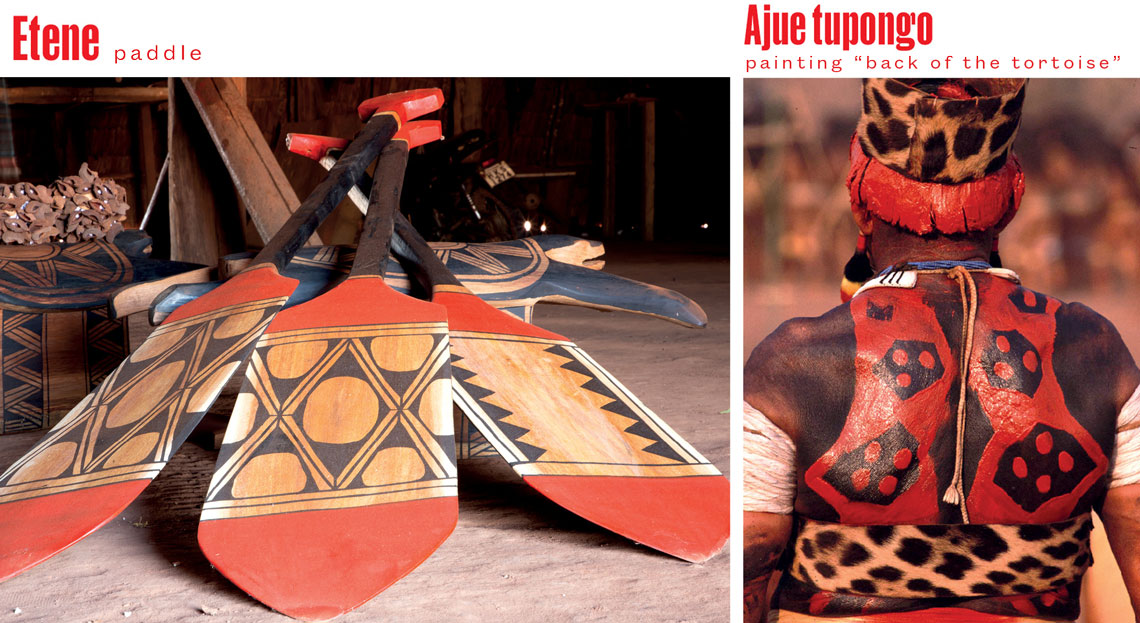
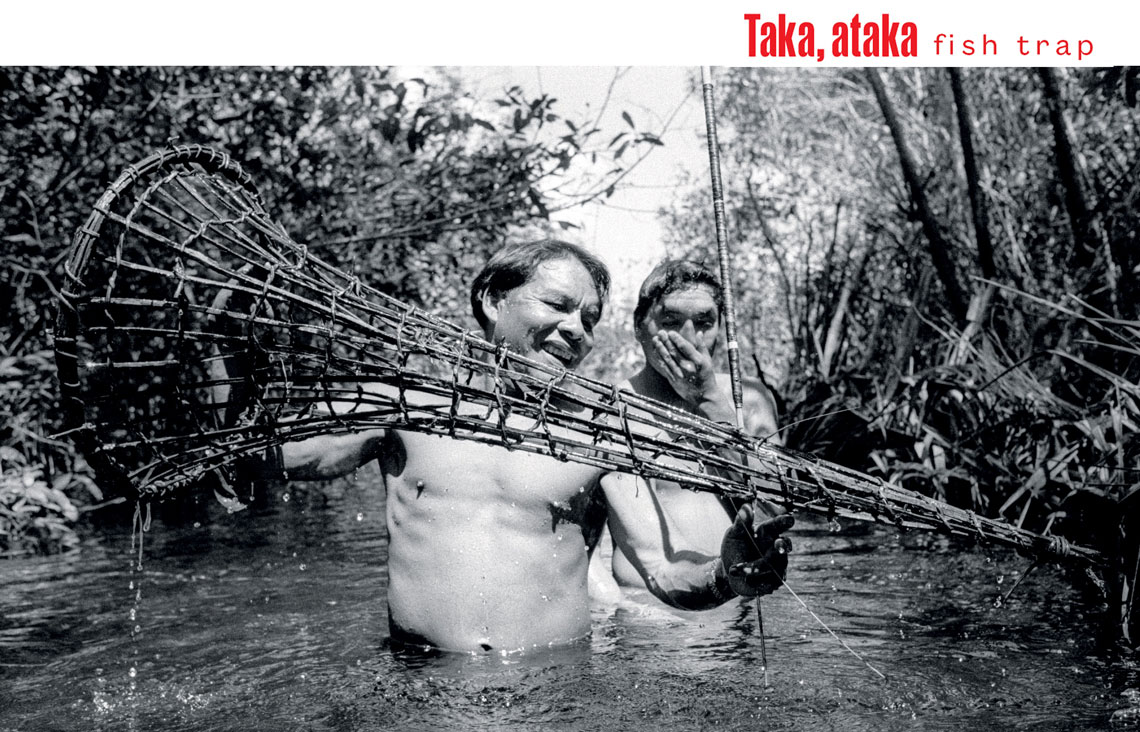
Kuikuro-Portuguese dictionary teamEntries from the first volume of the Kuikuro-Portuguese dictionary, whose title is Inhanhigü, meaning “made by hand” or “artefact”Kuikuro-Portuguese dictionary team
The first volume of the dictionary bears the title Inhanhigü, meaning “made by hand” or “artefact.” There are 363 entries divided among five thematic sections: “Kengikogu” (objects), “Kengikõdohogu” (adornments), “Tühatinhü” (materials), “Iku” (paintings or graphics), and “Üne” (home). As well as the translation of the word into Portuguese, each entry comes with usage examples and images, and in the foreword Franchetto explains the structuring phonological and syntax aspects of the Kuikuro language.
The Kuikuro are among the most populous Indigenous peoples of the Alto Xingu, currently with 1,200 people in nine villages. “Our students are first taught to read in their native language, and then in Portuguese,” says Sepé Ragati Kuikuro, professor and leader of the Ipatse village, who participated in drafting the content.
In addition to supporting the publication of the Kuikuro-Portuguese dictionary, the Goeldi Museum runs other projects to document Indigenous languages, including free-to-access multimedia dictionaries hosted on the institution’s website. To date, seven languages from the Amazon region are thus registered: Kanoé, Oro Win, Puruborá, Sakurabiat, Salamãi, Wanyam, and a dictionary of sacred sites of the Medzeniakonai people.
The project began in 2019 after a request by José Augusto Kanoé, chief of the Kanoé community in the Rio Guaporé Indigenous Reserve in Rondônia State. “He asked researchers from the museum for a language study tool that included the option to hear the sound of the words. That’s where the idea of multimedia records comes from,” explains Ana Vilacy, a researcher at the Goeldi and one of the project coordinators. The dictionaries, which can be downloaded in PDF and HTML formats or accessed online, provide the option to listen to the sound and see the images associated to the words.
For Lidia Sakurabiat, who lives in the Koopi village on the Rio Mequéns Indigenous Reservation in Rondônia State and helped to formulate the Sakurabiat-Portuguese dictionary, the possibility of accessing sounds and images enables the material to be used not only by those attending Indigenous schools, but also by their families: “As well as the teachers, older parents and siblings teach the children,” she says. She worked for seven years as an Indigenous healthcare agent in her own community, and today uses the multimedia dictionary to pass the language along to her son, her siblings, and anyone else interested in learning it.
According to Vilacy, the Goeldi multimedia dictionaries are seen as social technology, developed in dialogue with the communities to help meet local requirements. The methodology of researchers at the institution also includes the writing of open-source software. A manual with scripts or semiautomated steps is available to anyone wishing to replicate the model, so there’s no need for advanced knowledge of programming.
In April this year, a group of Indigenous students reading intercultural Indigenous affairs at the Federal University of Maranhão (UFMA) approached the museum to use the methodology in producing their own dictionaries. The researchers at the Goeldi also work on this front: training members of Indigenous communities to document their own languages. Through the partnership with UFMA, a workshop was offered to professors of the text production discipline so that they can advise the students on reproducing the methodology for formulating the dictionaries.

Collection from the Makurap language & culture documentation project | Collection from the Puruborá language documentation projectsDocumentation of the languages of the Makurap (left) and Puruborá peoples in Rondônia by the Goeldi MuseumCollection from the Makurap language & culture documentation project | Collection from the Puruborá language documentation projects
According to Brazilian linguist Joshua Birchall of the University of New Mexico in the US, who co-coordinates the multimedia dictionary project with Vilacy, the documentation of oral languages frequently involves the creation of an alphabet, a process which evolved over centuries in languages such as Portuguese and English. “In this case, we need to reproduce this historical transformation in just a few years, which involves a lot of joint work by linguists, anthropologists, professors, and the whole community,” says Birchall in an interview for Pesquisa FAPESP.
Despite the efforts of researchers, the preservation of Indigenous languages in Brazil faces challenges. According to linguist Altaci Kokama, head of the Office for Promotion of Linguistic Policy at the Brazilian Ministry of Indigenous Peoples (CPPL-MPI), in addition to recognition and symbolic value, it is essential to progress the implementation of structuring, continuous, and regionalized public policies. Among key measures, he emphasizes the co-officialization of Indigenous languages in municipalities with native peoples, and the hiring of bilingual agents for accessibility purposes. Such initiatives are essential for guaranteeing access to the legal system, healthcare, and education for these peoples.
Kokama sits on the advisory board of the Antônio Kanajó Center for Documentation of Indigenous Languages and Cultures, inaugurated this May in the city of São Paulo. The institution was created through a partnership between the University of São Paulo’s Museum of Archaeology and Ethnology (MAE-USP) and the Portuguese Language Museum (MLP), with the support of FAPESP. The idea was conceived by the foundation itself as part of the International Decade of Indigenous Languages instituted in 2022 by the UN.
The aim is for the center to act along three lines: research and documentation; construction of a free-to-access digital repository; and intercultural mediation and dissemination actions. According to anthropologist Maria Luísa Lucas, a professor at MAE and head of the center’s anthropology department, liaison with Indigenous communities and researchers has been the watchword through all stages of the institution’s creation, from formation of the advisory board to calls for master’s and PhD scholarship entries, with Indigenous candidates to be prioritized.
The first year of work will be focused on building the digital repository, but an international seminar will take place in November at the Portuguese Language Museum, as part of Brazil-France Cultural Year 2025. “The preservation of Indigenous languages is not only a technical action, but an ethical and political commitment,” says Kokama.
The above interview was published with the title “In writing” in issue 353 of July/2025.
Project
Funding for creation of the Indigenous Documentation Center ‒ Actions of the Museum of Archaeology and Ethnology (n° 24/17181-2); Grant Mechanism Research Grant ‒ Special Projects; Principal Investigator Eduardo Goes Neves (USP); Investment R$3,398,673.52.
Book
FRANCHETTO, B. et al. Dicionário Kuikuro-Português. volume temático I: Inhanhigü. Belém: Museu Paraense Emílio Goeldi, 2025.
