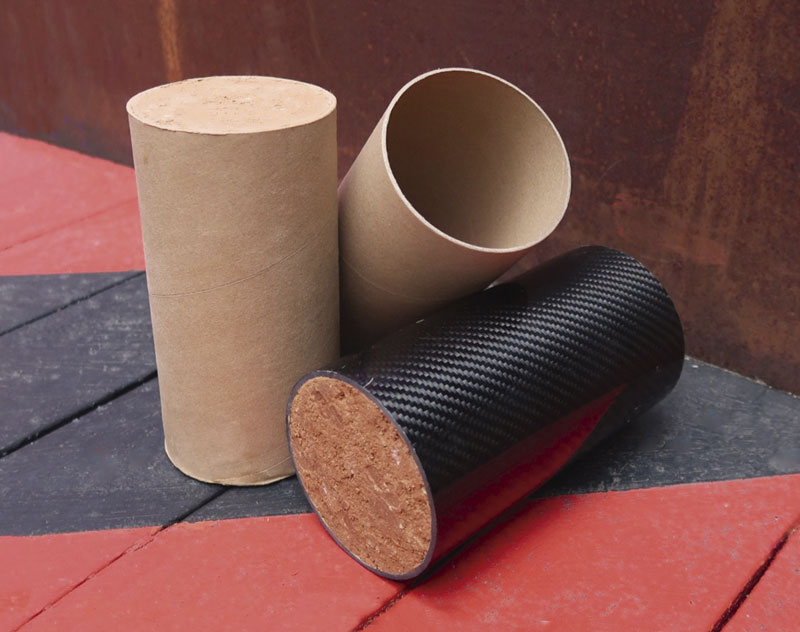
RMIT University An empty cardboard tube and another filled with rammed-earth and coated with a carbon-fiber-reinforced polymerRMIT University
A team from RMIT University, Australia, combined the durability of rammed earth—a construction technique used to make walls from compressed soil within a lattice of sticks or bamboo—with the versatility of cardboard, creating a reusable material made from cardboard, water, and soil. According to the researchers, the new material, called cardboard-confined rammed earth, eliminates the need for cement, has one-quarter of the carbon footprint of concrete, and comes at less than one-third of the cost. “By simply using cardboard, soil, and water, we can make walls robust enough to support low-rise buildings,” said RMIT’s Jiaming Ma in a university statement. A cardboard-confined rammed earth wall could be produced on-site by compacting the soil and water mixture inside the cardboard formwork, either manually or with machines. According to Ma, this could be an effective solution for construction in remote areas where red soils—ideal for rammed earth construction, a technique still widely used around the world—are plentiful. The mechanical strength of the novel building material varies according to the thickness of the cardboard tubes (Structures, October).
Republish