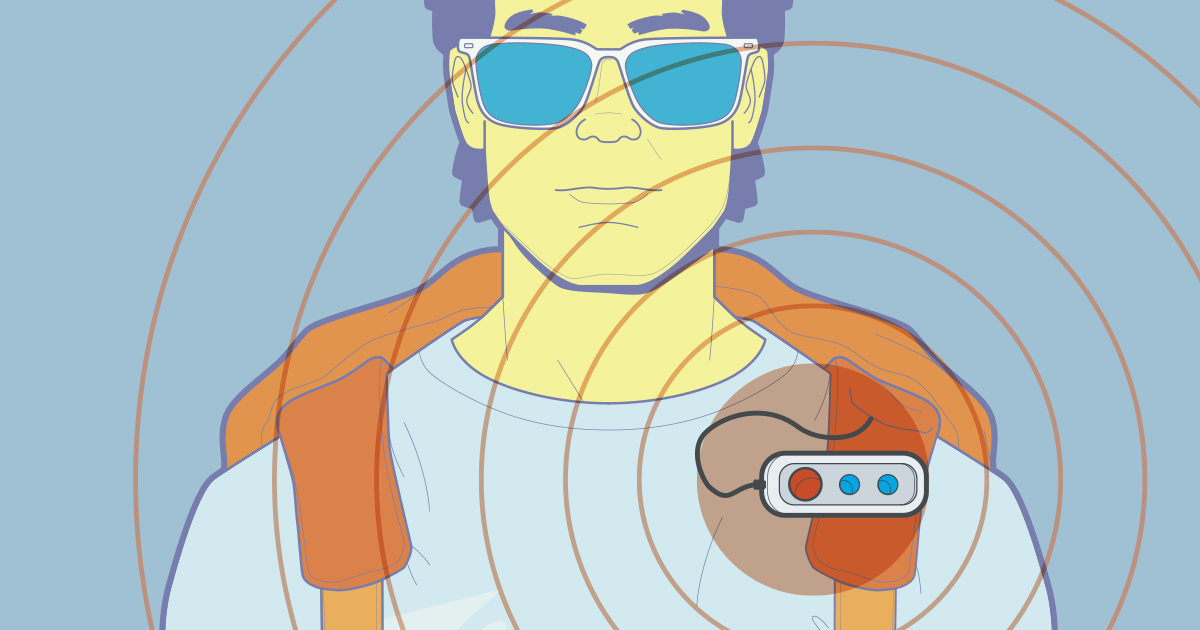
Keeping the user experience in mind is an ongoing concern for Aline Darc, of the School of Architecture & Urban Planning and Design at the at University of São Paulo (FAU-USP). As part of her doctorate, concluded in July 2023 at São Paulo State University (UNESP), Bauru campus, Darc prospected client devices that detect objects above waist height to help people with limited or no eyesight avoid collisions and falls during their walks. The canes normally used by the visually impaired only alert them to obstacles close to the ground.
Darc did not like what she saw, such as the prototype helmets that detect obstacles, which she found uncomfortable, and embarked upon some action research, interviewing students at the Santa Luzia School for the Blind in Bauru (São Paulo). She then defined the design specifications and created a backpack with a sensor camera linked to motors that vibrate, alerting the carrier to the proximity of obstacles above waist height.
The camera is attached to one of the shoulder straps, with the other components in a small box inside the backpack, which can also be used to carry other objects (see infographic). According to the 2019 Brazilian National Health Survey (PNS), 3.4% of the country’s population, equivalent to 7 million people, are visually impaired, with 2.2 billion low- or zero-sighted globally.

Built by a team of electrical engineers from the Federal University of Espírito Santo (UFES), the first prototype, known as NavWear, weighs 418 grams (g), as detailed in an article published in March this year in the scientific journal Disability and Rehabilitation: Assistive Technology. In a preliminary trial at UFES, ten people were blindfolded and wore the backpack while walking with the aid of a cane through a corridor with boxes. When the test was concluded they considered the innovation effective in avoiding collisions along the route.
The trial received financial support from FAPESP, the Brazilian National Council for Scientific and Technological Development (CNPq), and the Espírito Santo State Research Foundation (FAPES), and is still ongoing. “We plan to build another prototype using smaller components that were launched in the market after we started our work,” says Darc. “As well as the tactile alert, we are looking to create a version with an audible signal, so people can choose between the two.”
At the request of Pesquisa FAPESP, personnel from the Orientation and Mobility (O&M) team of the São Paulo-based Dorina Nowill Foundation for the Blind evaluated the proposal, and issued an opinion considering it suitable for the visually impaired who have the confidence and independence to use technological resources. “As the device is intended for use in outdoor environments, a practical study with visually impaired people would be needed in locations with high foot traffic, differences in each person’s perception, objects, uneven surfaces, and other practical questions,” the group stated.
“Although an emerging technology, navigation systems such as this backpack provide solutions to real-life issues,” says Vinicius Ramos, of the Institute for Physical Medicine and Rehabilitation at the USP School of Medicine’s Hospital das Clínicas, who did not take part in the study. “We need to bear in mind, however, that mobility for people with visual impairments does not depend solely on technology. We also need better sidewalks.”
50 new technologies
An international relations graduate, Ramos is a member of the World Health Organization’s Global Cooperation on Assistive Technology (GATE), which brings together regulators, users, companies, and other stakeholders to find innovative solutions for people with all types of disability. He says that with the support of this group, the WHO will soon be publishing an updated list of 50 priority assistive products, with the recommendation that they be incorporated into public health systems.
Wearable devices for the visually impaired are still very few and far between. In July 2021, in the journal JAMA Ophthalmology, a team from Harvard University presented a prototype featuring a large angular camera connected to a central processing unit (CPU). The device is capable of capturing images and analyzing collision risks based on the relative movement of objects to which users approximate, and around their field of vision.
Similar to the Brazilian model, the camera was fixed to the user’s chest using a strap of the backpack, inside which the CPU was carried. In turn, the CPU was connected via Bluetooth to two bracelets, one on each of the user’s wrists. If imminent collision is detected on the left or right, the corresponding bracelet vibrates, and both will vibrate if the obstacle is ahead.
Used for one month by 31 visually impaired adults who use a long cane, a guide dog, or both, the device when activated reduced collisions by 37% compared to when on silent mode (switched off); participants were unaware of the mode during the trial. In a statement from the university, the project team said they were planning to create another prototype with smaller, faster components, to test and submit it for approval by the regulators.
A group of students from the Ramaiah Institute of Technology in Bengaluru (Bangalore), India, working with students and professors from the country’s National Association for the Blind (NAB), adopted a similar approach: a pair of eyeglasses connected by wire to a processor that can be stowed in a pocket, with embedded AI programs. Presented in July 2023, this optical device describes close objects and reads the text of posters, traffic signs, and books aloud. The team received a grant of US$4,400 to refine the prototype—which has now been used by some 100 students at NAB—from an engineering project support program run by Purdue University in the US. Similar to the Indian devices, intelligent eye glasses are currently produced in the US and the UK, and cost the equivalent of R$30,000.
As advances are made, optical devices for walking will provide a welcome boost to the resources that facilitate everyday life for the visually challenged. More options have come to market at lower prices in recent years, for example computer screen and cell phone screen readers, printers, and keyboards in Braille for those with low vision, and a robotic guide dog for the blind (see Pesquisa FAPESP issues 314 and 348).
Other innovations are forthcoming. Darc, who developed a toy for blind children as part of her final graduation thesis at UNESP, has worked to develop educational materials for use in the classroom in collaboration with other professors from FAU-USP, which hired her in July 2024.
The story above was published with the title “Electronic eyes” in issue 356 of October/2025.
Project
Design applied to mobility for visually impaired people: A research and innovation proposal (n° 19/14438-4); Grant Mechanism Doctoral Fellowship; Supervisor Fausto Orsi Medola (UNESP); Beneficiary Aline Darc Piculo dos Santos; Investment R$184,881.97.
Scientific articles
PUNDLIK, S. et al. Home-use evaluation of a wearable collision warning device for individuals with severe vision impairments: A randomized clinical trial. JAMA Ophthalmology. Vol. 139, no. 9. July 22, 2021.
SANTOS, A. D. P. dos et al. NavWear: design and evaluation of a wearable device for obstacle detection for blind and visually impaired people. Disability and Rehabilitation: Assistive Technology. 1–15. Mar. 18, 2025.