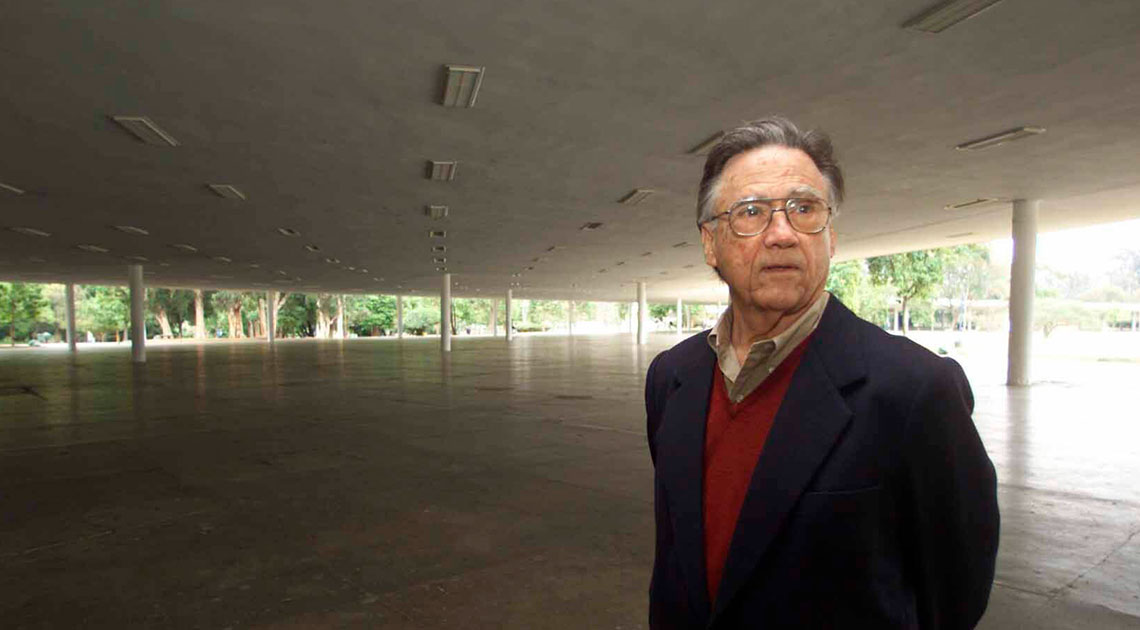
“There’s no rush. Gather a variety of material together and we’ll have a party with it.” With this phrase, Carlos Lemos brings to a close his handwritten letter sent on July 31, 1995, to architect Guilah Naslavsky, his master’s mentee, now a professor at the Federal University of Pernambuco (UFPE). As most master’s and doctoral students advised by Lemos lived in São Paulo, this is a rare record over his 58 years on the faculty staff at the School of Architecture and Urban Design of the University of São Paulo (FAU-USP). In fact almost all his students received in-person guidance from the professor. Naslavsky, however, had returned to her birth city Recife, and the two communicated about her research on the theme of modernism by letter or telephone. In just fifteen lines, written on headed paper with his full name at the top, São Paulo architect Carlos Alberto Cerqueira Lemos, then 70 years of age, expressed the manner in which he conducted his research and indeed his life: patient, thorough, and enthusiastic.
According to Naslavsky, these qualities are reflected in the many achievements chalked up by Lemos, who passed away at the age of 100 on August 6 in São Paulo. Before even graduating from the first architecture course at Mackenzie Presbyterian University (UPM) in 1950, he already had a firm in partnership with other practitioners. Two years later he received a call from famed architect Oscar Niemeyer (1907–2012), who was looking for someone to run his office in the São Paulo state capital. Among other tasks, Lemos was asked to participate in the city’s Ibirapuera Park project and coordinate works on the iconic 38-story Copan residential building, an experience he recalled in the book A história do Copan (The story of Copan), published in 2014 by the São Paulo State Official Press. He also recalled his friendship with the architect from Rio in his autobiography Viagem pela carne (A journey of the flesh) (Edusp, 2005).
“He was a tireless researcher and a great writer who cultivated the written word like few others,” says architect José Lira, a professor at FAU-USP and current director of the Museum of Contemporaneous Art (MAC) at the same university. Lira arranged more than 50 chronicles and essays by Lemos in the book Da taipa ao concreto (From stucco to concrete), released in 2013 by Três Estrelas. Many of these texts had circulated in the prominent newspaper Folha de S.Paulo, demonstrating the veteran’s efforts to highlight the importance of preserving the city’s historical heritage for a wider audience.
Lemos also contributed with two pieces in the collection Primeiros Passos (First steps), a celebrated series from the Brasiliense publishing house aimed at concisely explaining a variety of themes. In his books, he wrote of the subjects to which he dedicated his life: O que é arquitetura? (What is architecture?) (1980), and O que é patrimônio histórico? (What is historical heritage?) (1981).
His work to popularize architecture also includes the vast body of research referenced in the Dicionário de arquitetura brasileira (Dictionary of Brazilian architecture) (Edart, 1972), penned in partnership with architect Eduardo Corona (1921–2001), for whom Lemos was an assistant at FAU-USP. “It was the first publication in Brazil to bring together, over more than 500 pages, entries related to the practice of architecture, construction materials, and housing,” says Lira.
The theoretical production, which brings together almost three dozen titles and helps to systematize the history of Brazilian architecture, led students such as Nivaldo Andrade, from Bahia State, to travel the country and attend conferences featuring Lemos. “He was an inspiration because he combined research skills, professional practice, and work through agencies such as CONDEPHAAT [São Paulo State Council for the Defense of Historic, Archaeological, Artistic, and Tourist Heritage] and IPHAN [Brazilian National Institute for Historical and Artistic Heritage],” says Andrade, currently a professor at the Federal University of Bahia (UFBA) and vice president of the International Union of Architects (UIA).
Heritage listing is done for the objects of the rich. Nobody lists a poor person’s house, said Lemos
According to architect Hugo Segawa, of FAU-USP, Lemos’s professional practices involved not only the coordination of works by Niemeyer in the 1950s, but also his own projects, little known to the layperson, including Casa de Ibiúna (São Paulo), designed in 1964 for sociologist and former Brazilian president Fernando Henrique Cardoso (1995–2002) and the Maria Della Costa Theater in the state capital.
Historian Paulo Garcez, director of USP’s Paulista Museum, says that Lemos never constrained himself to a formal history of architecture. “His perspective covered agents, social processes, and materialities. In short, architectonic practice itself,” says Garcez, a former architecture graduate student of Lemos.
In his doctoral thesis defended in 1973 at FAU-USP, published in book form by Perspectiva in 1976 under the title Cozinhas, etc.: Um estudo sobre as zonas de serviço da casa paulista (Kitchens, etc.: A study into the service areas of São Paulo houses), Lemos shone an academic light on modest housing, the anxieties of the working classes in relation to comfort, and the life of housewives in lower-income residential areas. In a video recorded for the McKenzie architecture course in 2017, he spoke of the difficulties in proposing the preservation of this type of construction, saying: “Listing [official heritage protection] is done for the objects of the dominant classes. Nobody lists a poor person’s house.”
Although heritage preservation is not as widespread in Brazil as Lemos would have liked, his work at CONDEPHAAT between 1968 and 1989 ensured the permanence of constructions such as the Caetano de Campos school in downtown São Paulo. The building, inaugurated in 1894, ran the risk of being replaced by the República metro station. “In 1975, with architect Benedito Lima de Toledo [1934–2019], he made the first official list of properties to be protected in the city,” recalls architect Silvia Wolff, of UPM, guided by Lemos during her master’s and doctoral work between 1988 and 1997. “The procedures and methods structured by professor Lemos at the outset of CONDEPHAAT, and presented in his classes, are the cornerstone of cultural heritage preservation developed in São Paulo,” adds Wolff, who worked at CONDEPHAAT for 41 years.
Eclecticism—a popular style in the city of São Paulo between the end of the nineteenth and beginning of the twentieth centuries, the greatest proponent of which was Ramos de Azevedo (1851–1928), who conceived the Municipal Theater of São Paulo—was, at the time, considered by academia to be lacking in architectonic value and not very Brazilian. Many buildings would have been destined for obscurity, but Lemos helped to change this with his technical opinions for preservation agencies. In 1993, he published Ramos de Azevedo e seu escritório (Ramos de Azevedo and his office) (Editora Pini), for which he won the Jabuti Award in the Essay category the following year.
In addition to being an architect and researcher, Lemos was a draughtsman and visual artist. “I draw while listening to music, from the classics of Bach [1685–1750] and Mozart [1756–1791] to the jazz of Thelonious Monk [1917–1982] and Charles Mingus [1922–1979],” he said in a 1970s interview with journalist and museologist Luiz Ernesto Kawall (1927–2024), one of the founders of the São Paulo Museum of Image and Sound (MIS).
Over the course of his almost 60 years uninterrupted on the faculty staff at FAU-USP, dedicated to teaching the history of architecture, Lemos donated iconographic materials from the Copan building to the institution’s library, with more than 4,000 photos, and the preliminary project for the 1983 MAC-USP building, based on the campus of the Butantã Institute. Along the way, he also helped to consolidate the Brazilian House Museum, open between 1970 and 2023 at the Solar Fábio Prado in São Paulo, donating thousands of research notes on furniture, fixtures and fittings written by Lemos and his students between 1970 and 1980.
One of the last tributes to Lemos was conferral of the title of emeritus professor at FAU-USP in 2022. This past June, in the week in which he celebrated a century of life, he released the book Cidade sem vestígio (City without trace) (Instituto Sarará), about the preservation of historical heritage based on the Marquess of Santos’s grand house, the last remaining stucco construction from the colonial period in São Paulo.
Lemos is survived by his wife, architect Clara Correia d’Alambert, daughter Maria Isabel Cerqueira Lemos (from his first marriage), and grandchildren João and Alice.
The story above was published with the title “Build, reflect, and preserve” in issue 355 of September/2025.
Republish