


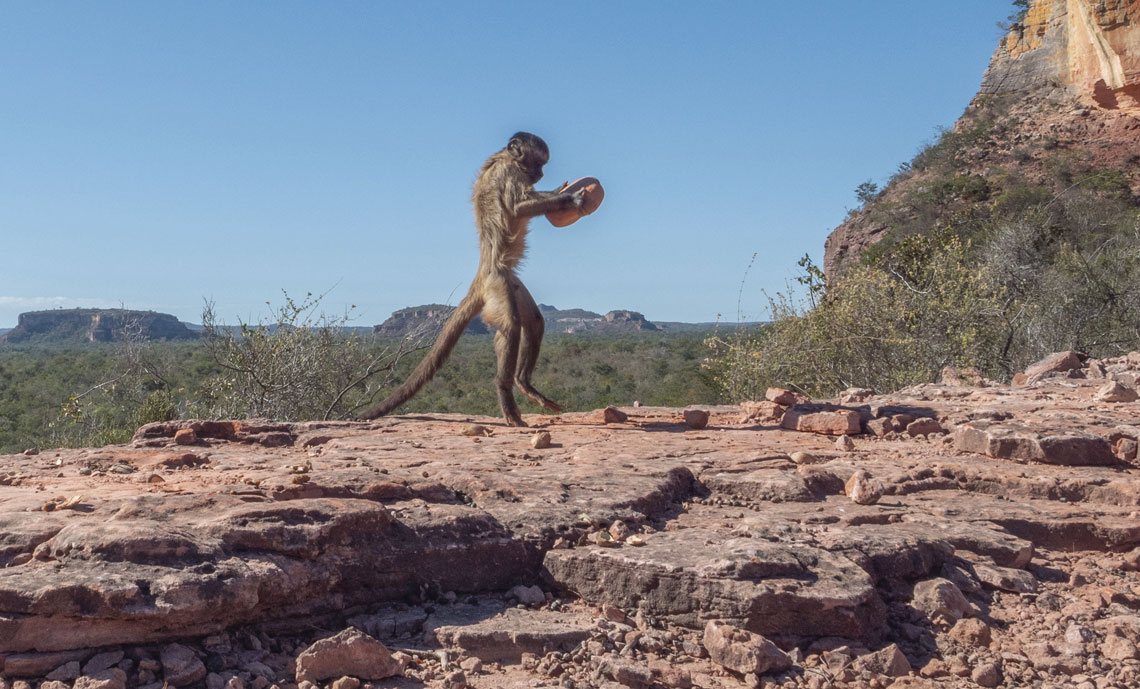
Cultural traditions among primates, cetaceans, and other animals should be taken into account when formulating strategies to conserve these species, say Brazilian researchers. Identified with increasing frequency, these nonhuman cultures are at risk due to the impacts caused by humans, and may form the basis of an important argument for the protection of these species’ habitats.
“Much of the behavioral diversity we observe in primates such as the capuchin, which use tools, originates from social transmission,” explains biologist Patrícia Izar, of the University of São Paulo’s Institute of Psychology (IP-USP). “In other words, it depends on the particular conditions for development of the organisms, which in turn are associated to habitat characteristics, contact with foods, foraging possibilities and raw materials in danger of disappearing, depending on the impact suffered by these animals’ environment.”
Izar coauthored one of the special-edition articles published in May in the scientific journal Philosophical Transactions of the Royal Society B on the theme. The Brazilian biologist and her colleagues Erica van de Waal, of Switzerland’s University of Lausanne, and Martha Robbins of the Max Planck Institute for Evolutionary Anthropology in Germany, addressed the issue based on what is known about nonhuman primates. In the same edition, other studies involving Brazilians provide an overview of the two largest cetacean groups: Odontoceti (toothed cetaceans such as dolphins, orcas, and sperm whales) and Mysticeti (baleen cetaceans, including blue and humpback whales).
Cultural traditions among primates are commonly transmitted from one generation to the next, and involve the fabrication and use of tools. Both chimpanzees (Pan troglodytes), which live in Central Africa, and capuchin monkeys of the species Sapajus libidinosus, found in Cerrado (wooded savanna) and Caatinga (semiarid scrubland) areas, use a combination of instruments that scientists classify as hammers and anvils, respectively a rock held by the animal and another bigger one, or a large, hard tree root on the ground, used in conjunction as an apparatus to break small coconuts or other hard fruits. The young observe and learn this from the older animals.
With no hands or thumbs, cetaceans are not as capable of manipulating instruments, but there are similar cases among them—certain bottlenosed dolphins (Tursiops aduncus) hold sponges in their beaks to probe the seabed more safely when in search of prey. Cultural traditions not necessarily involving physical tools, however, are also being documented among different species in the group.
In the waters off Maine on the US eastern seaboard, humpback whales (Megaptera novaeangliae) use specialized hunting techniques, such as a combination of tail slaps on the water’s surface and a ‘bubble net’ to confuse their prey. Off the coast of southern Brazilian state Santa Catarina, vigorous head movements and leaps by bottlenose dolphins (known locally as mullet dolphins) tell fishers the best moment to catch mullet and other similar fish. Marine mammals benefit from this combined attack, a cultural tradition which in this case appears to have evolved through cooperation between humans and cetaceans.

Fabio G. Daura-Jorge / UFSC Dolphins collaborating with fishers to catch mullet in Santa CatarinaFabio G. Daura-Jorge / UFSC
Brazilian biologist Mauricio Cantor, of the Marine Mammal Institute at Oregon State University (OSU), says it is not yet clear how these dolphins learn to collaborate with fishers in Santa Catarina. Studies in the town of Laguna by researchers from the Federal University of Santa Catarina (UFSC) have produced data suggesting that the technique is learned in a vertical manner—passed down from mother to young.
“We do suspect that horizontal learning—between individuals of the same generation—also has a key role. It would appear that competition also plays a part, limiting access to the behavioral side,” he says, because there is not enough room for all the dolphins of Laguna to ‘partner’ with fishers. “We have observed that certain individuals monopolize locations and opportunities for interaction, hindering the wider spread of the technique among the whole population,” explains Cantor, who coauthored one of the articles in Philosophical Transactions.
Finally, complex sound communication systems between cetaceans also carry an element of cultural transmission, such as the emergence of “dialects” among humpback whales in the different oceanic subregions. The song of these whales may also undergo abrupt changes, rather like the spread of new human musical styles, with significant changes in note sequences and rhythms, as demonstrated in an article by marine biologist Maria Isabel Gonçalves of Santa Cruz State University (UESC) in Bahia State, and collaborators, published in Marine Mammal Science in 2024.
“We saw this type of transition among the Brazilian humpback whale population between 2017 and 2018,” says Gonçalves, leader of the Baleias na Serra Project and coauthor of a special-edition article with colleagues from the Federal University of Rio Grande do Norte (UFRN). “The whales’ song will evolve year-on-year, sometimes more quickly, sometimes more slowly, but no abrupt change has been recorded here. As yet we have been unable to identify whether this originates from contact with other populations of the species in Antarctica, which makes for cultural exchanges and alterations in dialects.”
Cultural erosion
While the partnership between dolphins and fishing communities is a mutually beneficial interaction originating from a centuries-old tradition on the Brazilian coast, certain changes in the cultural traditions of the species are linked to recent environmental degradation.
Studies into howler monkeys (Alouatta genus) conducted almost a decade ago by Mexican primatologist Ariadna Rangel Negrín of Universidad Veracruzana, revealed that the behavioral repertoire of these monkeys loses half of its diversity when populations are restricted to small areas of forest. In light of deforestation, although exclusively herbivores under normal conditions, the monkeys may turn to hunting birds’ eggs or even meat discarded by humans, with potentially serious consequences for their digestive systems; in recent years, a case was recorded in which howler monkeys ate barbecue leftovers in the state of Rio Grande do Sul (see Pesquisa FAPESP issue n° 334).
Studies into bearded capuchin monkeys (S. libidinosus) by Izar and colleagues from USP reveal that their habitats are dwindling due to agricultural use, which increased by 300% between 1987 and 2017, while climate alterations in one of the locations monitored by the team have led to reduced production of hard palm fruits, favored in the hammer-and-anvil tradition.

Evelyn Froes / Baleias na Serra Project archiveHumpback whale dialects may change abruptlyEvelyn Froes / Baleias na Serra Project archive
A more uniform and therefore less complex environment limits the behavioral repertoire of monkeys and leads to competition for the available resources. “Immature animals may come to have fewer opportunities for exposure to the long-term learning process that enables them to master local traditions,” Izar explains. Moreover, there is an increased risk of direct contact with humans, who may not resist the temptation of offering food to seemingly harmless monkeys. “If they start to see humans as providers of food, this may lead to conflicts and aggressive interactions.”
Avoiding the worst
The USP researcher believes that preventing this deterioration process requires an acknowledgement that the relationship between cultural characteristics, environmental conditions, and each and every one of the species, needs to be protected.
“Sapajus libidinosus, for example, is not an endangered species—yet,” she says. “In other words, finding resources to protect their habitat following the current logic is not a simple task. Nevertheless, when we demonstrate that the species transmits its culture, unique practices may become a banner for the preservation of that area, with arguments that go beyond conserving the genetic diversity of the species.”
On the other hand, understanding cultural transmission patterns also helps identify strategic resources to promote the health of animal populations. “When we understand the evolution of humpback whale song, for example, we can understand how exchanges between populations occur, whether they use feeding and reproduction sites beyond the traditional, and what their migratory routes are,” says Maria Isabel Gonçalves. The opposite is true for cetaceans: there are indications that the loss of cultural traditions on migratory routes, likely caused by the population reduction during predatory whaling activity in the twentieth century, has resulted in some whale species “forgetting” that a certain region would be favorable for finding food or reproducing.
A better understanding of how these patterns are related to the long-term feasibility of populations, and indeed entire species, partly depends on a study of cultural transmission processes, such as those occurring with the Santa Catarina dolphins. Different species may end up adopting very distinct patterns—among cetaceans, certain orca communities appear to follow a very strict system of cultural transmission from mother to offspring, with stable, relatively closed societies, while trends are more fluid among groups of dolphins.
While monkeys and whales are considered to be charismatic, very little is known about their diversity. Izar and her coauthors estimate that less than 3% of primate species identified to date have been studied for their cultural traditions. The survey conducted by Mauricio Cantor and his collaborators indicates that according to scientific literature, 70% of studies into the foraging tactics of odontocetes cover only three species (orcas and two types of bottlenosed dolphin). “Logistics is the main reason behind this concentration of studies—these (cetaceans) are abundant, charismatic, cosmopolitan species that live relatively close to the coast,” he says.
“The imbalance is partly due to research traditions,” says Izar. “In the case of neotropical monkeys [in the Americas], there is a tradition of ecology and conservation studies, with behavioral studies falling by the wayside somewhat.” According to the researcher, cultural practices such as the use of tools have been observed in the Cerrado and Caatinga biomes, where primatology studies began much later. “Everything is being destroyed and changing very quickly,” she laments.
The story above was published with the title “XYZ” in issue 357 of November/2025.
Project
Phenotypic plasticity of capuchin monkeys (genus Sapajus) phase 2: Investigation into the effects of human-induced environmental changes (n° 2021/11269-7); Grant Mechanism Thematic Project; Program Biota; Principal Investigator Patrícia Izar Mauro (USP); Investment R$2,159,685.54.
Scientific articles
IZAR, P. et al. Integrating culture into primate conservation. Philosophical Transactions of the Royal Society B. Vol. 380, 20240135. May 1, 2025.
HERSH, T. A. et al. Ecology and conservation of socially learned foraging tactics in odontocetes. Philosophical Transactions of the Royal Society B. Vol. 380, 20240134. May 1, 2025.
GONÇALVES, M. I. C. et al. Abrupt change in humpback whale song from Brazil suggests cultural revolutions may occur in the South Atlantic. Marine Mammal Science. Vol. 40, no. 2, e13093. Apr. 2024.
GARLAND, E. C. et al. Culture and conservation in baleen whales. Philosophical Transactions of the Royal Society B. Vol. 380, 20240133. May 1, 2025.
