A reactor loaded with an innovative ceramic material capable of capturing carbon dioxide (CO2) has the potential to reduce the environmental impact of diesel engines, which power trucks, buses, tractors, industrial machinery, and power generators. The innovation is the fruit of a partnership between the Federal University of Minas Gerais (UFMG), the National Institute of Technology (INT), a research unit of the Ministry of Science, Technology, and Innovation (MCTI) based in Rio de Janeiro, and a car manufacturer that prefers to remain anonymous. A patent application for the material was filed at the National Institute of Industrial Property (INPI) in January this year.
In tests performed in late 2024, when a prototype of the reactor was installed in a truck, the technology was capable of adsorbing 7.7% of the CO2 emitted throughout the route—adsorption is the process by which molecules or ions are retained on the surface of a material by means of chemical or physical interactions. The trial used the Real Driving Emissions (RDE) methodology, standardized by the Brazilian Institute of the Environment and Renewable Natural Resources (IBAMA), which measures pollutant emissions from vehicles under real driving conditions. The truck traveled 170 kilometers (km) passing through urban and rural areas and a stretch of highway. Considering only the urban route, the performance was even better, with the retention of 17.2% of the gases.
“We were pleased with the result. Now, we are working to increase the level of capture to 30% on any type of route,” says chemist Jadson Cláudio Belchior, of the Chemistry Department at UFMG and coordinator of the project.
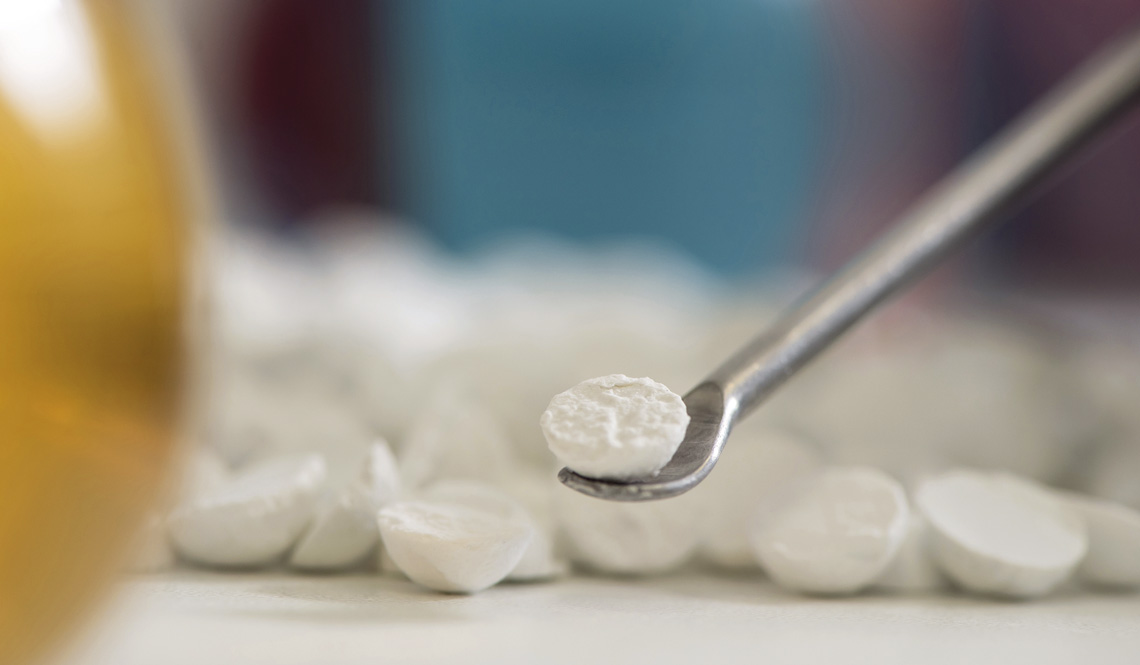
The ceramic CO2-adsorbing material created by Belchoir’s team is produced from a set of mostly inorganic and naturally abundant chemical reagents—the composition of which is being kept secret until the patent is granted. When mixed together, they form a paste-like material that is then molded into hemispherical pellets measuring 1 centimeter (cm) in diameter. “The material is microscopically porous, which allows CO2 to enter and react with the chemical substances,” describes the researcher.
The pellets are placed in a metallic, cylinder-shaped reactor, the final size of which is still being defined. This, in turn, is installed in the exhaust system—the set of parts that sends combustion gas from the engine to the outside of the vehicle or machine. The ceramic material retains only CO2, which means that the exhaust system continues to require a catalytic converter, a component that reacts with the other pollutant gases (see infographic).
Temperature control
In order for the ceramic pellets to retain carbon dioxide, the gas must be at a temperature below 110 degrees Celsius (ºC). “Above this level, the material is inert in relation to CO2,” informs Belchior. One of the challenges is cooling the gas. Diesel combustion in the engine occurs at approximately 600 ºC. “This temperature drops rapidly and reaches the exhaust system at around 250 ºC, still too high to make adsorption viable,” explains the chemist. He also notes that the gas does not reach the reactor at a uniform temperature, which means the portion above 110 ºC does not react with the material. The carbon dioxide that is not captured by the pellets is released into the environment, without generating waste.
The solution found to cool the gas was to install an expansion pipe with a larger diameter in the exhaust system, between the engine and the reactor. “It’s a common mechanism for increasing heat exchange and accelerating cooling. It works like a radiator pipe,” explains mechanical engineer Valéria Said de Barros Pimentel, a researcher from INT. The teams from INT and the car manufacturer were responsible for developing the reactor and the exhaust system, as well as for establishing the RDE methodology used in the field tests.
To improve the system’s performance and reach the desired target of 30% CO2 capture, it will be necessary to further reduce the temperature at which the combustion gas reaches the reactor. The researchers inform that improving the heat exchange in the expansion pipe is one of the study’s priorities. The team from INT is looking at improvements both in the design of the part and in the metallic material used. Another possibility, according to Pimentel, is seeking greater efficiency of the ceramic pellets to reduce the space they occupy and allow the use of smaller reactors, thus extending the cooling circuit before reaching the reactor.
Lowering the temperature of the gas in the reactor also has a second function: reducing the cost of regenerating the ceramic material. To separate the captured CO2, the pellets undergo a simple heating process. “What happens is that the higher the temperature at which CO2 is captured, the higher the temperature of the heat source used in the regeneration process must be, resulting in greater energy consumption and a higher process cost,” explains Belchior.
In an article published in the journal Fuel in 2019, the team from UFMG presented details of the regenerative process of the ceramic material, which is essential for its reuse. Still at a preliminary stage, the studies were conducted in a laboratory. “When the captured gas is at 100 ºC, the pellets need to be heated to temperatures of approximately 340 ºC to be regenerated,” says Belchior. “We plan to reduce the temperature of the captured gas to something between 80 ºC and 90 ºC in order to reduce the energy consumption of the regeneration process.” In the article from Fuel, the authors report that thermogravimetric analysis of the ceramic pellets concluded they can be reused for ten CO2 adsorption cycles. Thermogravimetry is a technique that assesses the physical and chemical properties of materials subjected to temperature changes.
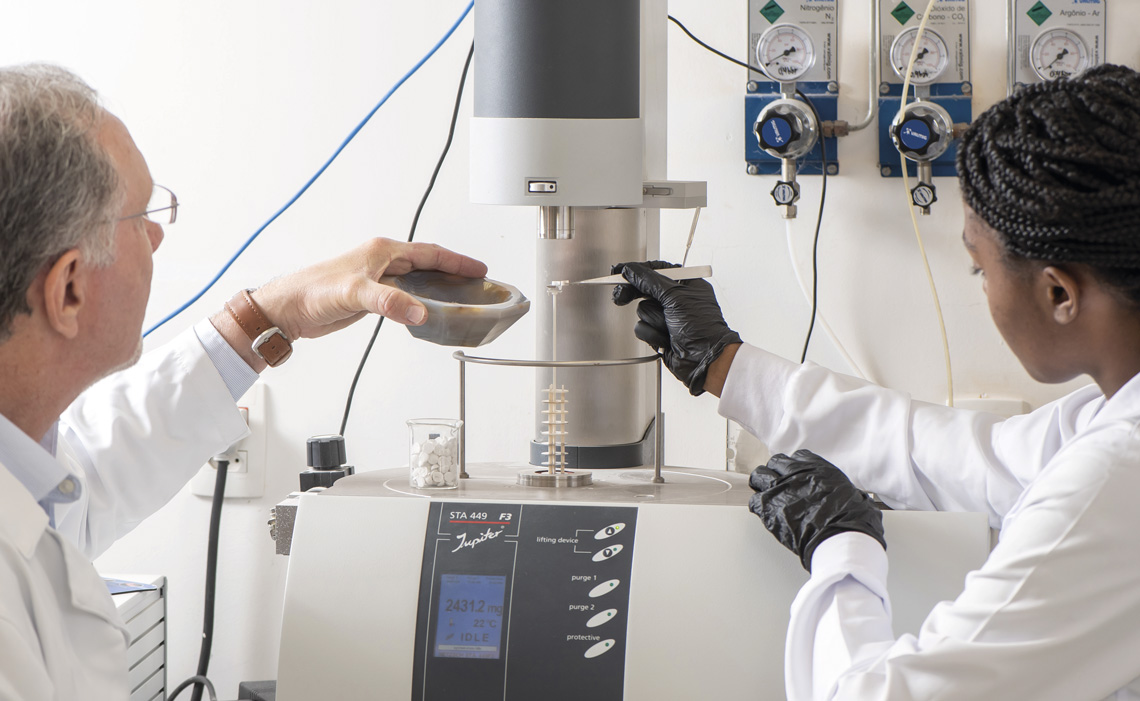
João Marcos Rosa / NitroResearch coordinator Jadson Belchior and student Daniele Leal prepare a sample of the ceramic material to evaluate its effectiveness in capturing CO2João Marcos Rosa / Nitro
The proposal by the researchers is to promote a circular economy, in other words to find a productive end use for the CO2 captured in the reactors. The idea is to bottle the gas in cylinders and then sell it to food and beverage industries and synthetic fuel manufacturers, where CO2 is used as raw material.
Another challenge for the teams from UFMG and INT to overcome is creating a “reactor kit” that is easy to install in the vehicle exhaust systems. “The system must allow for easy replacement of the pellets in the reactor,” says the researcher from UFMG. He estimates that a heavily used truck will need to replace the material every day, but new rounds of testing with the finished product will be required to determine a replacement schedule.
In addition to all the technological solutions that need to be found for the innovation to reach users, the economic feasibility study of the process has yet to be developed. The scientists expect the system to have a low final cost, since the chemical substances and the metal parts used are readily available and inexpensive.
The CO2 adsorber project was submitted to the Rota 2030 – Mobility and Logistics Program, a Federal Government program that supports technological development in the automotive sector. In 2024, Rota 2030 was replaced by the Green Mobility and Innovation Program (MOVER). Among the targets established by the successor program is the need for participating automakers to reduce carbon emissions from their vehicles by 50% by 2030, compared to emissions in 2011.
However, greenhouse gas emissions from the transport sector are growing. According to the Climate Observatory’s Greenhouse Gas Emissions and Removals Estimating System (SEEG), the emissions from this activity in Brazil increased 3.2% in 2023 and reached a record of 223.9 million tons of CO2 equivalent—an international measurement that establishes the equivalence between all greenhouse gases (methane, nitrous oxide, and others) and CO2. Cargo transport was the main contributor to the increase. That year, Brazil emitted 2.67 billion tons of CO2 equivalent.
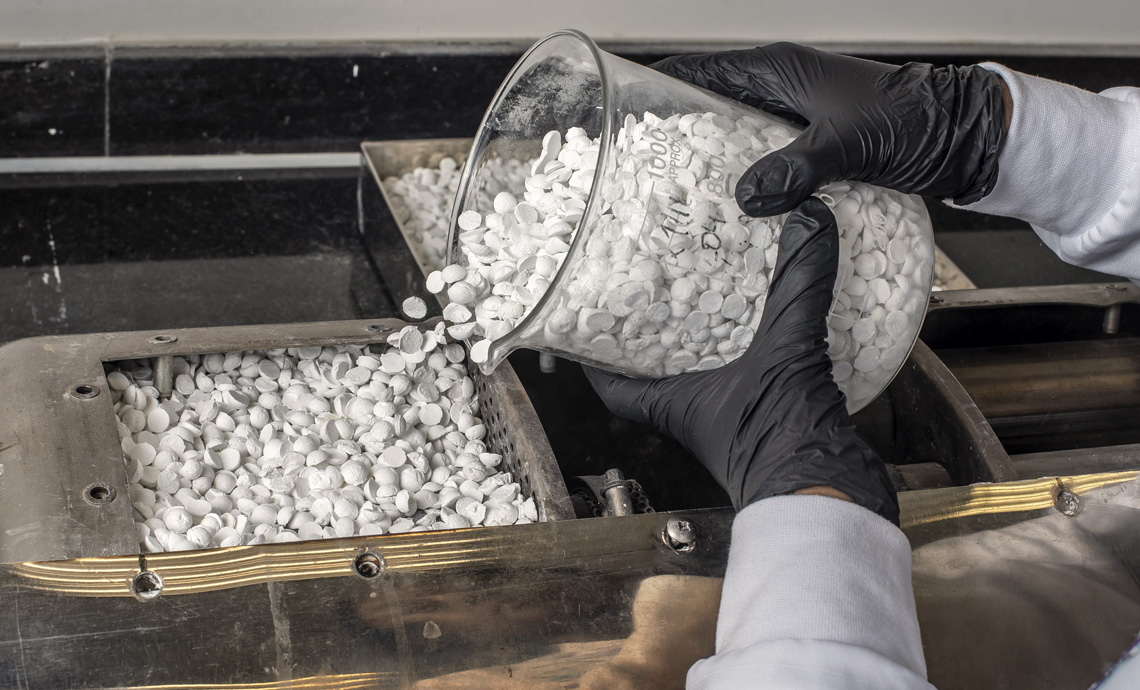
João Marcos Rosa / NitroThe pellets are deposited in the prototype reactor installed in the exhaust of a truckJoão Marcos Rosa / Nitro
“The development of technologies capable of capturing CO2 directly from moving sources, such as trucks, is of great importance given the current challenges of decarbonizing the transportation sector,” says chemist Pedro Vidinha of the University of São Paulo (USP) and researcher at the Research Center for Innovation in Greenhouse Gases (RCGI), supported by FAPESP.
In Vidinha’s assessment, the work carried out by UFMG and INT is promising, as it proposes an innovative and potentially adaptable solution to the reality in Brazil. “The possibility of capturing up to 17% of the CO2 emissions directly from a vehicle’s exhaust represents significant progress,” he says.
Belchior’s team began developing ceramic materials capable of capturing CO2 in 2007. The group has already filed 21 patent applications, including the current project. Of these, 11 patents have been granted, seven of them in the USA. The first was filed when the team managed to capture the gas at a temperature of 600 ºC. It was more of a feasibility test, since CO2 captured at that temperature makes the regeneration process of the ceramic material inviable.
A second phase of the project took place between 2015 and 2018, funded by Petrobras, Fiat (now Stellantis), and the Minas Gerais State Research Foundation (FAPEMIG). During this time, the team managed to lower the process temperature to 300 ºC, which is still too hot to make the process viable. At the time, calcium oxide (CaO) was the main chemical substance used to produce the ceramic material, as described in an article published in International Nano Letters in 2020. The UFMG group’s experience earned them the 2019 Petrobras Inventor Award. The focus of the project, on this occasion, was the capture of CO2 resulting from the combustion of gasoline and ethanol.
The current project, which aims to capture CO2 in diesel engines, required the group to carry out new research on suitable chemical substances for the process. Focusing on capturing diesel emissions aligns with the interests of the initiative’s partner automaker. Belchoir’s personal goal is to give a practical presentation of the system, already with the necessary improvements, during the 2025 United Nations Climate Change Conference, COP30, to be held in Belém, Pará State, at the end of year.
The story above was published with the title “Capturing CO2” in issue 351 of May/2025.
Scientific articles
PINTO, P. C. C. et al. CO2 capture performance and mechanical properties of Ca(OH)2-based sorbent modified with MgO and (NH4)2HPO4 for calcium looping cycle. Fuel. Vol. 256. Nov. 2019.
OLIVEIRA, H. et al. Improvement on CO2 capture by CaO pellet modified with carbon nanotubes. International NanoLetters. Vol. 10, pp. 141–9. June 2020.
PINTO, P. C. C. et al. Chemical absorption of CO2 enhanced by solutions of alkali hydroxides and alkoxides at room temperature. Chemistry Select. Vol. 7, pp. 1–11. Nov. 2022.
Republish