I was born in Campina Grande, Paraíba, in 1983. My father worked odd jobs as a bricklayer and my mother was a housekeeper. Neither of them had an education. We had no books, magazines, or even newspapers at home. In fact, for some of my childhood, I did not even have a home. We lived with my grandmother for a while, but as my family grew—I am the third of 10 children—my parents were unable to afford the rent. My father built a shack in Serrotão, which until 2012 was one of the largest open-air dumps in Brazil’s Northeast.
I was six years old when we moved there. The conditions were tough, but I still remember how almost every night, my siblings and I would sit around my mother as she told us stories from memory, such as Hansel and Gretel or Cinderella. It was my favorite time of the day.
When I started school at age seven, my life changed. It was a turning point for me—school became my refuge. For the first time I had access to books and I was able to read. I still remember the name of my teacher: Rosa. She made a point of greeting each student with a hug and a smile. Even in those early years, I began dreaming of becoming a teacher.
To stay in school, I split my time between studying and working. Until I was nine, I collected animal bones from the garbage dump and sold them to a soap factory. As I grew older I worked in vegetable gardens, as a cleaning assistant at a slaughterhouse, and as a babysitter. Shortly before finishing elementary school, we moved into informal housing that was later legalized by the city government and is now the Nossa Senhora Aparecida Community, in the Catolé neighborhood of Campina Grande.
At age 18, I gave my first lesson as a teacher to young elementary school students. This was before I finished my high school teaching diploma in 2002, which I studied at a public school near where I lived.
Working with children and young people in situations of social vulnerability has been a recurring choice throughout my 22-year professional career as a teacher in the municipal and state education systems. I have always chosen to teach at schools in poor and rural areas, as well as in adult education programs for people who did not complete their studies within the traditional timeframes. My aim was (and still is) to welcome them as I was welcomed as a child, to show students the impact education can have on their lives, as it did on mine.
My decision to pursue a degree in languages and literature was also a result of this desire. I started at the State University of Paraíba [UEPB], Campina Grande, in 2003. I was the first person in my family to study at university. I faced many challenges, including an hour-and-a-half walk to campus each day and the same long journey home.
But it was also a time of great learning that profoundly influenced my approach to teaching. At university, I discovered the work of Mikhail Bakhtin [1895–1975], a philosopher of language who theorized that communication only occurs through genuine interaction between different voices and perspectives. And of course I became familiar with the ideas of the educator Paulo Freire [1921–1997], who recognized the importance of students’ prior knowledge and emancipatory education.
I believe in the transformative power of reading and writing. These tools allow us to understand the world, but more than that, they help us to tell our own stories. But for students to succeed in these practices, it is crucial to give them a sense of purpose and a connection that lasts outside the classroom. It frustrates me when people see writing merely as a means to pass their exams.
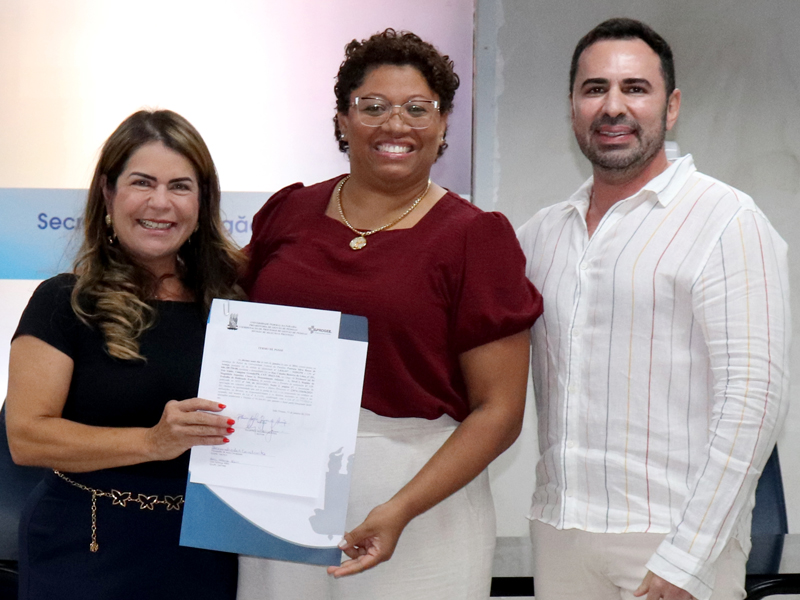
Vinícius Vieira / UFPB / PublicityAt her formal appointment as a university professor in 2024Vinícius Vieira / UFPB / Publicity
It was based on these concerns that for my master’s degree, I chose to investigate the teaching and learning process of writing among students in the “Acelera Brasil” program, run by the Ayrton Senna Institute, which was aimed at students who were two or more years behind in their schooling. My research, which I did at the Federal University of Campina Grande [UFCG] and completed in 2010, highlighted the need to create a link between the student’s real-life experiences and their writing.
For my doctoral studies in linguistics at the Federal University of Paraíba [UFPB], I changed my focus. My idea originated from a comment made by Pope Benedict XVI [1927–2022], who called second marriages a “social plague” in 2007. In my research, I analyzed online comments responding to that statement, looking at them from a Bakhtinian perspective.
Shortly after completing my doctorate in 2017, I made a proposal to the students at Tertuliano Maciel Municipal School in Queimadas, Paraíba: What if you wrote a text that could be read by your classmates, your parents, and maybe even a wider audience? What if we created a magazine to publish these texts? That is how the “Unleash my text” project was born, to encourage reading and writing among middle school students. One of the outcomes was an online and print magazine titled Tertúlia. The following year we obtained funding from the Carlos Chagas Foundation and Itaú Social, which allowed us to expand the initiative to five more schools in Campina Grande, in partnership with the state education system.
In 2019, the project won a competition organized by the National Foundation for Children’s Books; the prize was a selection of books for the Tertuliano Maciel school library. We then began organizing reading clubs for students and their families at participating school libraries.
During the pandemic, we held meetings online and books were delivered to participants at their homes via an app called Literary Delivery. For this initiative, we were named as finalists for the Jabuti Prize in 2018, 2019, and 2021. In 2022, I won in the Basic Education category of the Light in Education (LED) Award—a joint initiative by Rede Globo and the Roberto Marinho Foundation. Some 4,000 children in Campina Grande have benefited from the Unleashed project since 2017.
Last year I moved to João Pessoa to take up a teaching position at UFPB’s Department of Educational Methodology, so unfortunately I had to discontinue the project. After many years in basic education, my mission now is to train new teachers. Among so many changes, I remain committed to promoting reading, writing, and the circulation of knowledge. This has culminated in the publication of three books—chronicles, memoirs, and accounts cowritten with my university students—and the organization of literary gatherings at the university campus.
I recently had a proposal approved for a grant on academic literacy practices, in which I intend to apply the Unleashed methodology. My goal is to use reading and writing to prepare future teachers to think and act.
The story above was published with the title “Unleashing dreams” in issue 357 of November/2025.
Republish