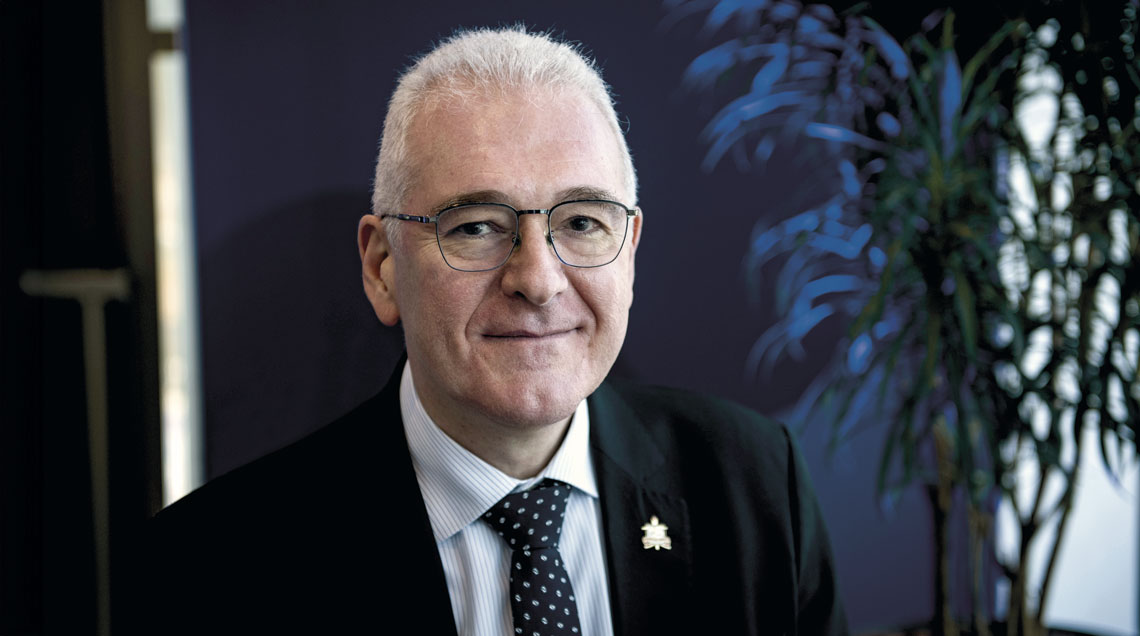
One of the most powerful presentations at the 5th National Conference on Science, Technology, and Innovation, held in Brasília, came from the dean of the Federal University of Pará (UFPA), Emmanuel Zagury Tourinho. In a plenary session on July 31 on the opportunities and challenges of sustainable development, one of the conference themes, Tourinho stated categorically that there are no development projects in the Amazon that can be defined as sustainable. He also stated that the degradation of the way of life of traditional populations that help preserve the rainforest is reaching a point of no return, jeopardizing the biome.
With a degree in psychology from UFPA and a PhD from the University of São Paulo (USP), Tourinho specializes in psychology applied to cultural processes and is a connoisseur of the Amazonian research environment—in addition to being dean of the region’s largest university, he has served on the scientific councils of institutions such as the Emílio Goeldi Museum (MPEG) in Belém, and the National Institute of Amazonian Research (INPA) in Manaus. He was also president of the National Association of Directors of Federal Institutions of Higher Education (ANDIFES) from 2017 to 2018. The day after his presentation at the conference, he gave the following interview.
You have said that the Amazon is reaching a point of no return through the degradation of the social fabric of its traditional populations, in a situation comparable to that of deforestation. What is this process?
Large economic groups are interested in parts of the Amazon and some of the traditional populations are being displaced from these areas, migrating to the outskirts of impoverished cities that don’t offer adequate conditions for survival. All of this threatens a way of life that until now has guaranteed the rainforest’s survival. If the Amazon is occupied in a different way, without these populations, there’s no telling what will happen to the forest. We need to take advantage of global interest in rainforest conservation to show that we must safeguard these populations that have protected the forest. I am talking about all of the traditional populations—Indigenous peoples, quilombola communities, traditional extractivist families, and river dwellers. All of these populations are now exposed to many types of violence, and the absence of demarcated land boundaries makes Indigenous populations even more vulnerable.
In what way is this degradation occurring?
I’ll give the example of the rice farmers who were evicted from the Raposa Serra do Sol Indigenous land, in Roraima, by Federal Court order. Some of them moved to the island of Marajó. Their transformation of large swaths of Marajó for rice production has displaced traditional populations. It had a direct impact on the landscape and the population, which, while they were there, ensured to some extent that the forest remained and that the agroforestry projects were sustainable. There’s also the açaí production chain. Today, the fruit is consumed all over the world, and part of the Amazonian territory that was not occupied by açaí groves is being taken over. The riverine populations that depend on açaí for their livelihoods have been affected by this new economy, and not necessarily in a positive way. There has been an increase in Chagas disease in the region because the barber bug, which transmits the disease and used to live in other types of vegetation, is now found in açaí groves. And there is pressure from illegal loggers and illegal mining. There is no system in place to protect these populations.
You have said that there are no sustainable development projects in the Amazon. Why is that?
The basic reason is that these projects do not promote the social development of the people in the Amazon, but rather create wealth for large economic groups and, ultimately, international income for the country. They neglect the living conditions of the traditional populations and create social and environmental liabilities. Each new project promises more jobs and more infrastructure for the cities, but we never see that materialize. There are occasional benefits here and there, but nothing comparable to the amount of wealth extracted and damage caused. This is not to say that it isn’t possible to develop the economy through the sustainable use of natural resources.
You have said that bureaucrats are incapable of developing inclusive projects. What type of governance should there be?
When I mentioned bureaucrats, I was thinking of the financial managers who are unaware of the realities in the Amazon and who design projects based on the logic: “How can we take advantage of all this wealth in the Amazon?” The government must be vigilant and only allow projects that protect the rights of the local population. This can be done, but we have to change the logic. We must listen to the people and give them the power to make decisions. This can be achieved if these populations are made the direct economic beneficiaries.
You criticized clean energy projects in the Amazon, asking: “Clean, for whom?” Why?
There is a misconception that any clean energy project is sustainable or positive for everyone. Some of these projects compromise the living conditions of the people living where they are implemented. Some hydroelectric dams in the Amazon have a history of disrupting the lives of large communities and degrading their living conditions. Case in point: Belo Monte. Irreparable damage has been caused to these populations. But an outsider would say: “Oh, good, we’re producing more clean energy!” Renewable energy is not synonymous with sustainable if it doesn’t include a social dimension.
How can researchers help tackle this issue?
There is no way to tackle this issue without drawing on scientific intelligence and local traditional knowledge. In projects for the Amazon, the principle of emptiness prevails. They’re designed as if there are no people familiar with the local reality and who can tell us how to design them. We have very well-structured scientific and technological institutions in the Amazon that do research that involves daily interaction with the population. We need to listen to this scientific intelligence.
In the Amazon+10 Initiative, which unites researchers from 25 states and abroad, one of the goals is to attract more scientists from the Amazon. This is so as not to repeat what happened when research networks were formed in the Amazon led by scientists from other regions who then returned to their home states. Is this a necessity?
There must be cooperation between those who do science in the Amazon and those who do science outside of the Amazon. It turns out that Amazonian institutions want to overcome colonialist logic, a practice that used to be common: Amazonian researchers were sought out solely to collect data for colleagues from abroad. We don’t want to be data collectors anymore. We want to develop a research agenda based on the reality of the Amazon and establish a cooperative relationship with anyone who wants to collaborate. The research agenda must be related to the frontiers of knowledge, but also to the social reality, and must empower the population with scientific knowledge, so that they can participate in the debate on policies for the region. UFPA leads the Integrated Center for Socio-Biodiversity in the Amazon (CISAM), with researchers from 13 federal universities located in the Amazon. Guided by this scientific vision, CISAM recognizes the complexity of the problems faced in the Amazon and adopts an interdisciplinary approach.