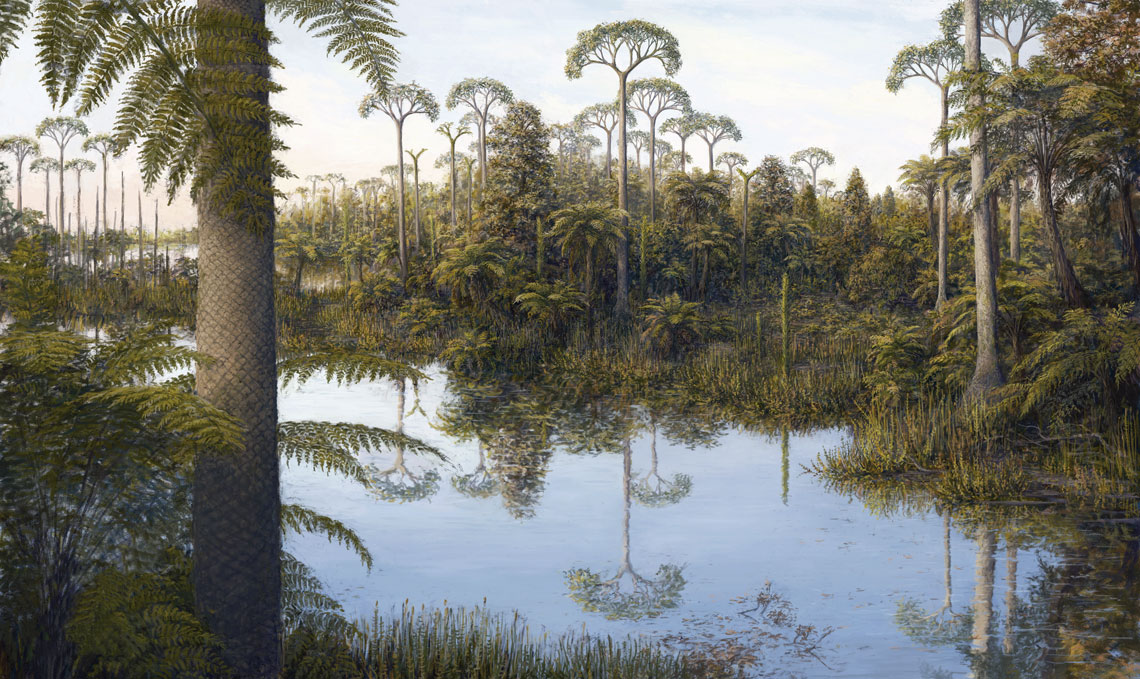
A forest on swampy soil, with trees, ferns, and lakes inhabited by fish and aquatic mollusks, thrived in what is now the southwest of Rio Grande do Sul, on the border with Uruguay, from 273 to 260 million years ago. This was in the middle of the geological period known as the Permian, a time of intense environmental and climatic change.
Located in a region that was becoming increasingly arid, the oasis protected the plants and the few groups of aquatic animals that already existed before the extinctions that wiped out around 90% of living species at the end of the Permian. This mass extinction was the result of climate change and intense volcanic activity during the period.
“It was a great surprise to find such a diversity of plant fossils in a period when these continental areas were becoming more and more arid,” says paleobotanist Joseane Salau Ferraz, from the Federal University of Pampa (UNIPAMPA), lead author of the article published in June in the Journal of South American Earth Sciences. The researchers collected 200 fossils and, in the 103 best-preserved specimens, identified plants that grew in a humid environment. The remains of fish and mollusk scales confirmed that there were lakes in the region surrounded by diverse and abundant vegetation.
During the same period, two species of mollusks (Pinzonella neotropica and Jacquesia brasiliensis), which lived in a large lake in the region corresponding to present-day southern Goiás, survived one of the Permian extinctions. This suggests that large, continental-scale lakes, isolated in the interior of the continent, may have protected some living creatures from mass extinction, according to another study, published in December 2024 in the Journal of South American Earth Sciences. However, the same did not occur in the marine environment: the combination of the rising temperatures, volcanic ash, and falling sea levels caused the extinction of most bivalve mollusk species.
Ferraz and her colleagues began excavations in 2020 at the paleontology site known as Cerro Chato, in the municipality of Dom Pedrito, in southwestern Rio Grande do Sul. “At the beginning of the excavations, dozens of fossils emerged from the rocks, with a level of preservation and diversity that surprised us,” reports paleobotanist Joseline Manfroi, of the Research and Advancement Corporation for Atacama’s Paleontology and Natural History (CIAHN) and a collaborator at the University of São Paulo (USP), coauthor of the article.
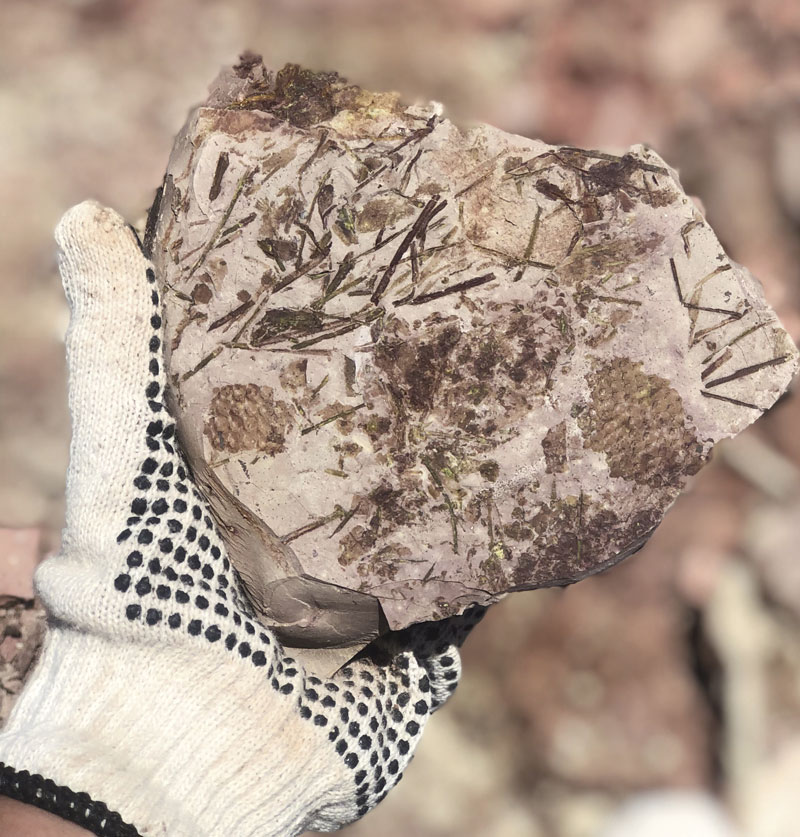
Joseline ManfroiA rock with fragments of plant fossilsJoseline Manfroi
The leaves maintained the lines, known as veins, and the stems, seen under the microscope, showed the sap-conducting vessels. “One of the plants was almost complete, with the leaves attached to the stem and the roots connected to the trunk,” says Ferraz. The research had funding from the Brazilian Federal Agency for Support and Evaluation of Graduate Education (CAPES), the Rio Grande do Sul Research Foundation (FAPERGS), and the Brazilian National Council for Scientific and Technological Development (CNPq).
The forest, of an uncertain size, was highly diversified, despite 73% of the plant fossils belonging to the group of lycophytes, with species such as Lycopodiopsis derbyi, which grew up to 30 meters (m) in height and had a slender trunk and rounded crown. Here, large conifers and Glossopteris, a species of tree that disappeared 252 million years ago, grew. There were also 15 cm tall plants with slender trunks, the sphenophytes, a distant relative of the horsetail (Equisetum spp.) which today reaches 2 m. In this period, in what today are the states of São Paulo and Tocantins, tree ferns grew, to heights of up to 15 m, similar to the modern day giant tree fern (Dicksonia sellowiana) in the Atlantic Forest (see Pesquisa FAPESP issue no. 210).
The discovery challenges established concepts, according to USP paleobiologist Paulo Eduardo de Oliveira: “In general, paleontologists argue that throughout Earth’s history, scarcely any forests existed during very dry periods.” Dinosaurs that lived around 90 million years ago in what is now the municipality of General Salgado, in the northwest of the state of São Paulo, likely fed in wooded areas. “The forest in Rio Grande do Sul is a striking demonstration that a humid region with a variety of living organisms existed during an arid period,” he says.
Climate pressure
“The oasis represents a remnant of the great forests that covered the southern part of the continent 299 million years ago and developed while the glaciers were retreating, after a glacial period, when nearly the entire planet was covered by ice,” says Manfroi.
Traces of one of these fossil forests were also found in the central region of the present-day state of Paraná. In this region, a group from the federal universities of Paraná (UFPR) and Rio Grande do Sul (UFRGS) collected dozens of fragments of another species of lycophyte, estimated to be 10 m tall, in the positions where they likely lived. “As aridity increased, the areas of vegetation diminished, leaving only isolated patches of forest,” she says.
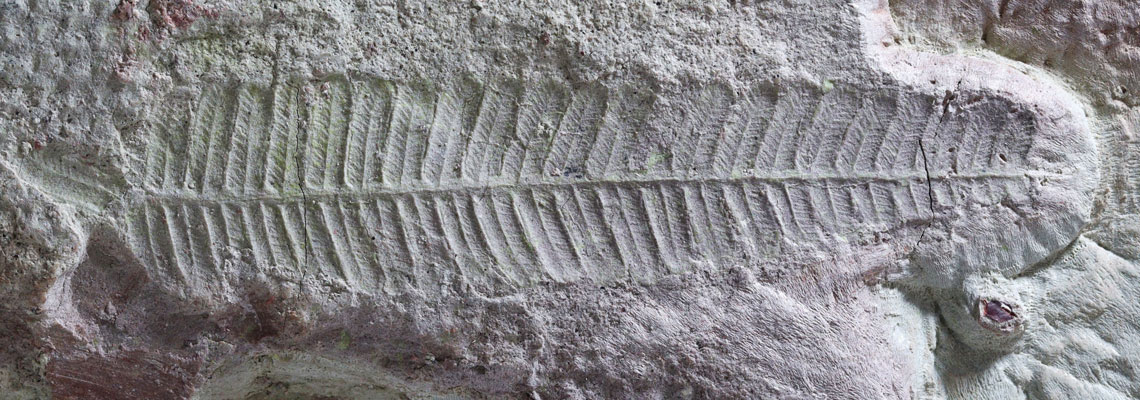
Joseline ManfroiA detail of a species from the group that today includes fernsJoseline Manfroi
One of the causes of the lack of rain in the future lands of Rio Grande do Sul was the formation of the Pangaea supercontinent, which was completed around 252 million years ago, joining the planet’s continental masses. “As Pangaea formed, the areas further from the sea became dryer, leading to increased aridity in many regions across the globe,” says UNIPAMPA paleontologist Felipe Pinheiro, coauthor of the article.
In another study, also with funding from the CNPq and CAPES, biologist Júlia Siqueira Carniere, of the University of Vale do Taquari (UNIVATES), explored the Quitéria outcrop, in the municipality of Pântano Grande, in Rio Grande do Sul, 300 km northeast of Dom Pedrito, and found traces of even older trees, shrubs, and herbs, dating back 296 million years.
“The lower layers of the outcrop were considered swampy environments and were part of a large forest, with a milder and more humid climate.” she states. Carniere identified a new genus of herbaceous lycophyte, Franscinella riograndensis, detailed in an article published in June in the journal Review of Palaeobotany and Palynology.
The abundance of Glossopteris fossils at the site reinforces the idea that South America and Africa were already joined during this period, because they have been found on both continents. A forest with more species than in the South of Brazil grew in this same period in the south of current South Africa, before succumbing to an almost identical fate and practically disappearing.
The story above was published with the title “A forest surrounded by dessert” in issue 357 of November/2025.
Scientific articles
FERRAZ, J. S. et al. An oasis in Western Gondwana: A diverse Guadalupian paleoflora from South America. Journal of South American Earth Sciences. Vol. 158, no. 105508. June 1, 2025.
CARNIERE, J. S. et al. Franscinella riograndensis (Salvi et al.) gen. nov. et comb. nov.: The first record of a lycopsid with in situ spores for the Permian strata of the Paraná Basin, Brazil. Review of Palaeobotany and Palynology. Vol. 342, 105401. Nov. 2025.
CHRISTOFOLETTI, B. et al. Rising mollusk bivalves from the ashes: Geologic, biostratigraphic and evolutionary implications from tuff data in the Permian Corumbataí Formation, Paraná Basin, Brazil. Journal of South American Earth Sciences. Vol. 134, no. 104750. Feb. 2024.