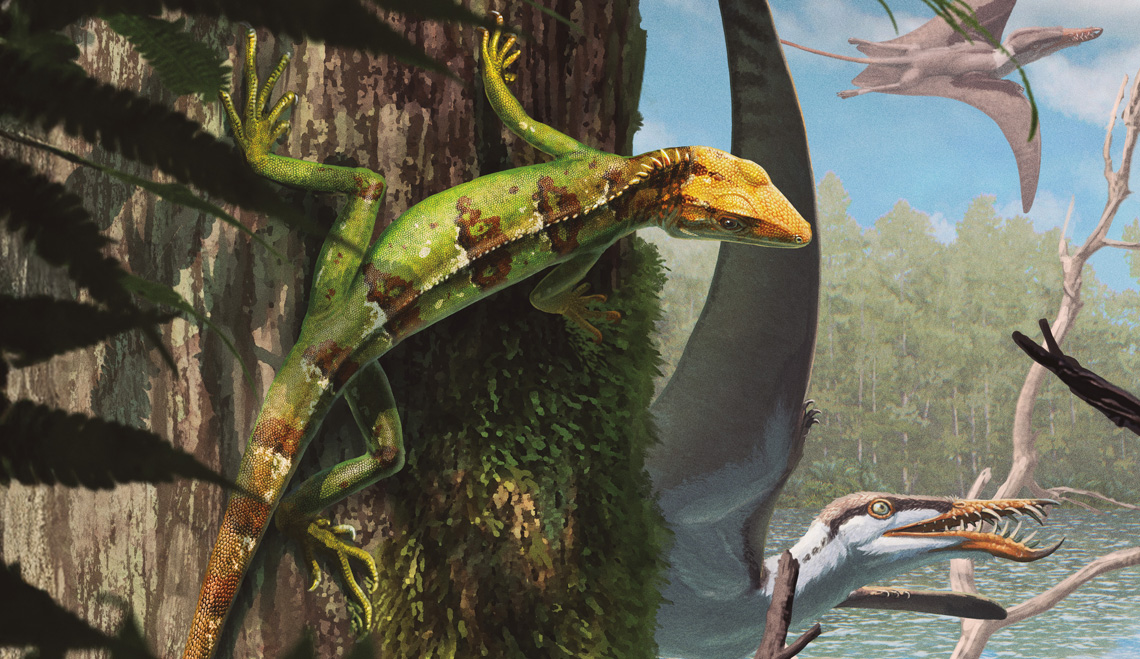
“I’ve seen that pose before,” said Brazilian paleontologist Victor Beccari, a scientific assistant for the Bavarian State Collection for Paleontology and Geology in Germany, to himself when he saw a fossil of a reptile in the drawers of research material of the Natural History Museum in London, UK. The researcher thought that the outstretched reptile with an angled neck, in the specimen that preserves several bones, reminded him of a fossil he had previously examined at the Senckenberg Natural History Museum in Frankfurt, Germany. In fact, they were two parts of the same fossil—the mold and the complete skeleton, like two sides of a sandwich: one with the filling, the other with its imprint—and they both belonged to a reptile from the Jurassic period. The species, Sphenodraco scandentis was described at the time by Beccari and colleagues in an article published in July in the Zoological Journal of the Linnean Society.
The new species has only just been described, based on the specimen collected in 1930. “It is likely that the parts of this fossil have been separated for almost a century and were sold independently to the museums where they are now housed. The connection between them was lost, and only the Frankfurt half was known until know,” says Beccari.
At the time when they were found, the fossil from Frankfurt was classified as Homoeosaurus, an extinct genus of rhynchocephalian—a group close to lizards, whose sole living species today is the tuatara, a reptile from New Zealand. “For this reason, I didn’t pay much attention at the time and didn’t identify it as a new species. I made a note and continued with the research,” says Beccari, who during his PhD—which is now complete, with only the defense pending—examined fossils of these reptiles in museums in Germany, England, the Netherlands, France, Argentina, and the USA. During this process, he ended up noticing the coincidence. It finally clicked when he analyzed the animal’s limbs to better understand its lifestyle and noticed that they were very long, indicative of a tree-dwelling existence, unlike the land-dwelling Homoeosaurus.
There are other conflicting characteristics. “The head is triangular, the teeth face backward, and the humerus has a distinctive kind of crest for muscle attachment,” says the paleontologist. Homoeosaurus has a round head. This led him to compare it with other species that are also different. Kallimodon, a Jurassic rhynchocephalian that lived in what is now Germany, has vertical teeth. Additionally, one of the hip bones, the ilium, of S. scandentis, is smaller than in both of the other species.
To ensure a precise comparison, Beccari and colleagues used geometric morphometrics, a statistical method that quantifies the shape of organisms based on anatomical coordinates, such as reference points on bones. In this comparison, they marked points on key bones such as the humerus, femur, and skull in modern species of rhynchocephalian and lizards.
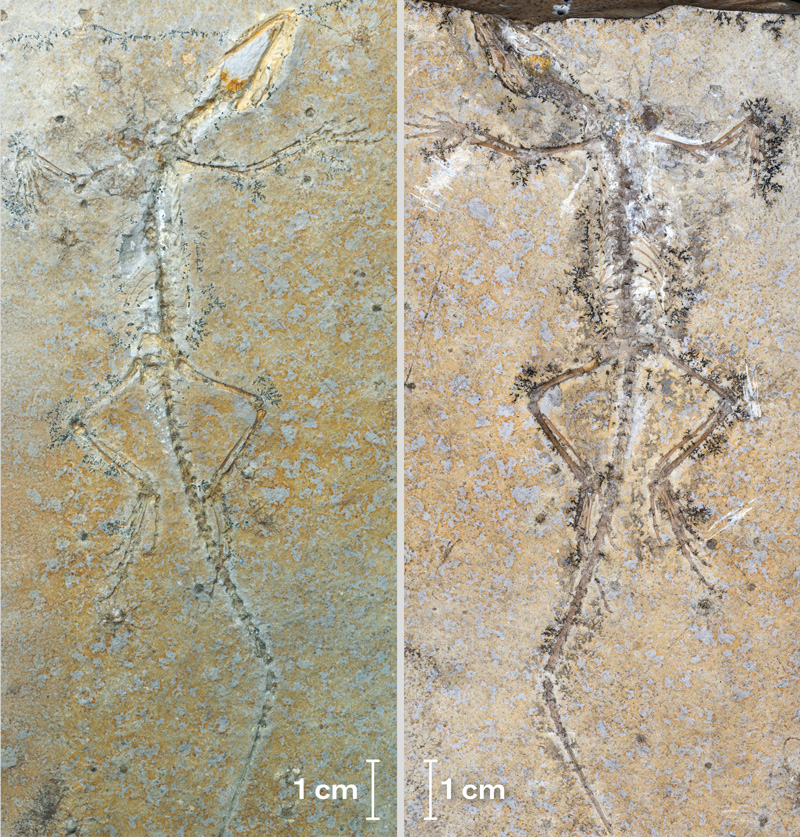
Victor BeccariThe two sides of the fossil: the mold (left), and the countermold, with the majority of the bones, found in different museumsVictor Beccari
These points are plotted on a chart, where the closer they are to one another, the more similar the organisms are. Paleontologist Annie Hsiou, from the University of São Paulo’s Ribeirão Preto School of Philosophy, Sciences, and Languages and Literature (FFCLRP-USP), who did not take part in the study, highlights the importance of both the method and the results of the research. “We see in the comparisons that, in several characteristics, the new species described stands out from the others, indicating a big difference,” says the specialist in lepidosaur reptiles, the group to which the recently described species belongs.
For Beccari, the discovery is important for the evolutionary history of the group because there is this idea that rhynchocephalians had little morphological diversity, which never changed. “It’s as if only lizards were ecologically diverse, which is not true,” he states. “Before lizards appeared, the rhynchocephalians prevailed in various lifestyles, including marine, terrestrial, and arboreal,”
“It was a very varied group, that lived across all the continents,” Hsiou corroborates. Rhynchocephalians went into decline and near total extinction toward the end of the Cretaceous, approximately 66 million years ago, with only the tuatara remaining today. Paleontologists are still studying why this group has come so close to disappearing, while lizards, which are closely related, have not. “Something we have really taken into consideration is that rhynchocephalians already occupied different habitats, while lizards were smaller, had begun to disperse, and had a different reproductive cycle from what we see in the modern tuatara,” says Hsiou.
S. scandentis lived on an archipelago that, by its very nature, encompassed a mosaic of habitats with multiple islands separated by a marine environment and barrier reefs. The islands were dominated by relatively small trees and inhabited by a fauna composed of pterosaurs, birds, and small dinosaurs.
The group was also successful in South America. “In Brazil, we described three species of rhynchocephalians from the Triassic period in Rio Grande do Sul alone: Lanceirosphenodon ferigoloi, Clevosaurus brasiliensis, and Clevosaurus hadroprodon,” says Hsiou, who participated in their description (see Pesquisa FAPESP issue n° 283).
Until 180 million years ago, South America, Africa, Australia, India, and Antarctica were joined together as part of the Gondwana supercontinent. At that time, Antarctica had a temperate to subtropical climate and may have acted as a continental bridge that aided the group’s dispersal to Oceania. After the separation of Gondwana, New Zealand became isolated and may have served as a refuge for species of the group that lived there, such as the surviving tuatara.
The story above was published with the title “A fossil in two halves” in issue 355 of September/2025.
Scientific article
BECCARI, V. et al. An arboreal rhynchocephalian from the Late Jurassic of Germany, and the importance of the appendicular skeleton for ecomorphology in lepidosaurs. Zoological Journal of the Linnean Society. Vol. 204, no. 3. July 2, 2025.