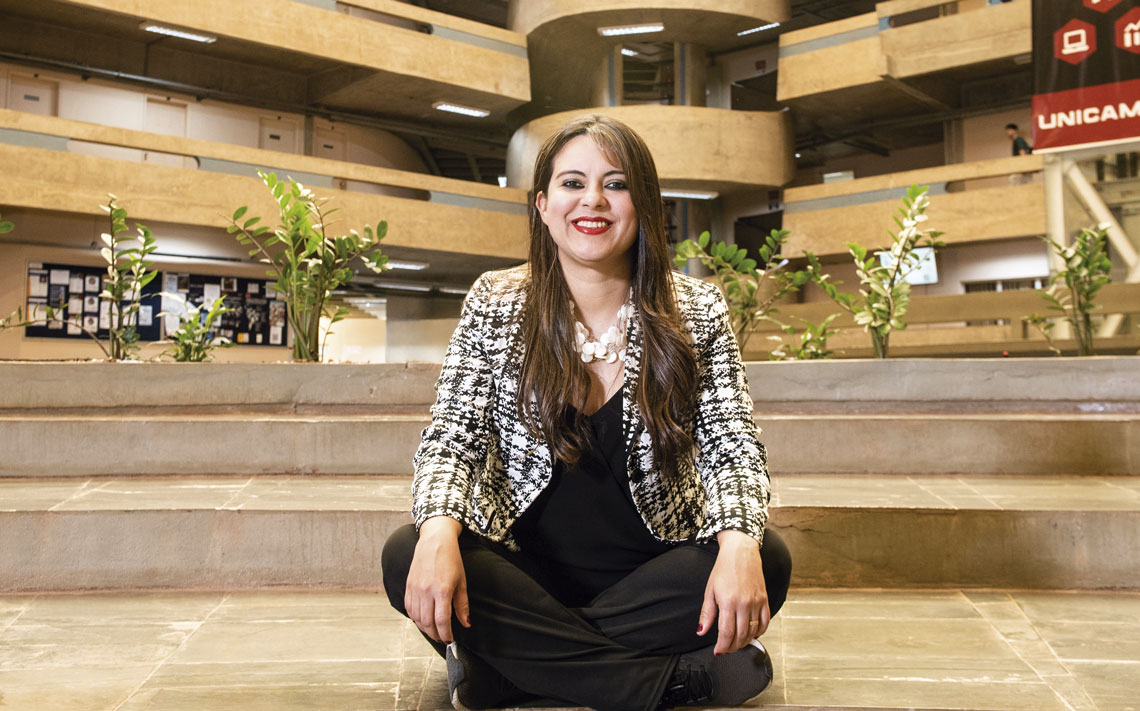
In 2023, at the age of 37, mathematician Jaqueline Godoy Mesquita became the youngest person (and the third woman) to assume the presidency of the Brazilian Mathematical Society (SBM), a position to which she has just been reappointed for a second term. In April this year, she set another record when she was named head of the Mathematical Association of Latin America and the Caribbean (UMALCA). She is the youngest mathematician (and the first from Brazil) to lead the organization.
Changes and challenges have marked her relatively short career. Mesquita was born in Boa Vista, the state capital of Roraima, but moved to Brasília at the age of 5. She faced resistance from her family—who wanted her to be a doctor—when she decided to study mathematics at the University of Brasília (UnB) and then pursue an academic career. After graduating, she never hesitated to move to new places for career opportunities or interesting work.
She earned her master’s and PhD at the Institute of Mathematical and Computer Sciences of the University of São Paulo (ICMC-USP), São Carlos. She was a professor at USP, Ribeirão Preto, between 2013 and 2015, and spent a decade teaching at UnB. In June this year, she took up her current post as a professor at the University of Campinas (UNICAMP).
In this interview, the mathematician talks about her career, her area of expertise (delay differential equations), and the challenges of being a female researcher in a field historically dominated by men. “I have always faced prejudice [for being a woman], ever since I was an undergraduate,” she says. Mesquita also reflects on the paradox of Brazil being considered part of the global elite in mathematical research while its elementary and high school students consistently perform among the worst in international mathematics exams.
Why did you want to be president of SBM and now UMALCA?
In 2017, I started as regional secretary for the Central-West under Professor Paolo Piccione of USP’s Institute of Mathematics and Statistics [IME] during his first term as SBM president. In his last term, from 2021 to 2023, he invited me to be vice president. At the time, I was very hesitant. I was young and lacked experience at this kind of organization. But I accepted the invitation. At the end of my two-year term as vice president, Piccione told me that I was ready and should be the next president of the society. I felt well prepared after two years as vice president and I was elected president in 2023. Now I have just been reelected as head of the SBM for a second term. It’s a very time-consuming role, but it allows me to contribute more directly to change in the mathematical community. In March this year, I also became president of UMALCA.
What does the president of the SBM do?
We support several math competitions, such as the Brazilian Public School Mathematics Olympiad [OBMEP] and the Brazilian Mathematics Olympiad [OBM], which includes students from both public and private schools. Right now, for example, we are organizing the Pan-American Mathematics Olympiad for Girls, which Brazil is hosting for the first time. It will take place in Fortaleza in late October and early November this year. The Brazilian team won the event in 2024, when it was held in Mexico. The SBM also supports the Girls’ Mathematics Tournament, launched in 2019 for middle and high school students. In addition to promoting these competitions, the SBM also publishes books. We offer mathematics works in Portuguese at very affordable prices, including books on the history of mathematics, Olympiads, university texts, and more.
How does Profmat, the nationwide professional master’s program in mathematics launched by the SBM in 2011, work?
It is a blended master’s program for school math teachers. The course, offered in 105 cities and taught by different institutions, has trained 8,070 teachers across the country. But it is a unified master’s degree, coordinated by us. The entrance and qualifying exams are held nationwide and we produce all the course material. We designed the program and currently have a vice dean overseeing it at the SBM.
Have you ever faced prejudice as a woman in mathematics?
I have always faced prejudice, ever since I was an undergraduate. I have had a lot of problems, from comments by colleagues to more serious situations. There are very few women in mathematics. I never felt represented. I had almost no female teachers during my undergraduate studies. I often felt like I did not belong, and it only got worse during my master’s, doctorate, and throughout my career. Even today, I am the only woman among 10 professors at UNICAMP’s Department of Applied Mathematics.
What kind of comments have you heard?
I will give you some examples. The first time I registered my interest in supervising a student at UnB, a colleague of mine asked if I had supervised anyone before. I told him I knew of a student who was very interested in my field. He then asked if the student was interested in the field or the supervisor. I was so embarrassed. Another time, I was chairing a meeting and no one was listening to me. It was only when a male colleague intervened that anyone began paying attention. People also frequently interfere in my personal life. They point out that I travel a lot and ask about my relationship with my husband. My male colleagues also travel a lot, but they do not hear these kinds of remarks.
From your international experience, does this also occur in other countries?
In most places I have been, it is very similar—sometimes even worse. I felt a lot of prejudice in Japan. In Germany, where I lived for a while with my husband, a professor picked us up when we arrived. On my first day at the university, he asked if my husband would be staying home. When I said yes, he asked if I had made his lunch for him before I left. But there are also countries where things are better. In the Netherlands, there are strong incentives, even positions specifically for women. In France, doctoral defense committees must include a minimum number of women. Here in Brazil, we constantly have to remind people of the need to include women in committees and math events. I have also faced a lot of prejudice for being young. People have said that the positions I have taken require more gray hair.
How do you react in these situations?
I wish I had come up with sharp replies in every situation where I felt prejudice. But sometimes the situation is so shocking that I am left speechless. As I get older, I am learning to deal with these situations better.
In mathematics research, we are at the top. But in basic education, we are at the bottom
What is the scale of women’s participation in Brazilian mathematics research?
We do not have complete data, even at the SBM. We have a gender and diversity committee, which did a study attempting to understand at what point women disappear from mathematics. It focused primarily on undergraduate studies, but it needs to be expanded. At every career stage, things get worse for women. The Brazilian Academy of Sciences conducted a nationwide survey on racial diversity and the presence of women and young researchers across all fields, not just mathematics. But more math-specific data is needed. At the SBM, we created a data committee to gather this information in order to propose public policies. My feeling is that the number of women in mathematics is declining, despite all our efforts. But we need concrete data to know for sure.
Is there any estimate of women’s presence in mathematics departments and faculties in Brazil?
We estimate around 15% to 30% of professors. But the numbers diminish at the top of the career ladder.
How many members does the SBM have?
We currently have 1,996 active members, 403 of which are women.
You have won a few awards in your career, including the L’Oréal Award in 2019 and the Order of the Star of Italy in 2023. Does this kind of recognition attract more women to research?
After I won the L’Oréal Award, people from different fields learned about my work and wanted to collaborate. The award gives visibility to the science being done by women. Inspired by this, the SBM created the biannual Elas na Matemática (“Women in Mathematics”) award in 2024, in partnership with the Institute for Pure and Applied Mathematics [IMPA] and Brazil’s Ministry of Science, Technology, and Innovation [MCTI]. The award has three categories: one for senior women at the top of their careers; one for younger researchers aged under 45; and a third for women whose work encourages more women to enter mathematics.
Brazil has produced a Fields Medalist, is among the international elite in mathematics research, and its math Olympiads attract millions of students. Despite all this, Brazilian school students still perform poorly in mathematics. Why?
In mathematics research, we are at the top. But in basic education, we are at the bottom. There are several problems. On issues within the SBM’s scope, we are trying to help improve the situation, but many things depend on funding bodies. We need more investment in education, better salaries, and better working conditions for school teachers. Last year, federal deputy Tabata Amaral [PSB-SP] allocated funding for a meeting at USP Ribeirão Preto on mathematics teacher training in the state of São Paulo. Teachers came from across the entire country. We are going to start distributing the SBM’s journal Revista do Professor de Matemática at all public schools in São Paulo and offering free online courses for math teachers in the state—and anyone else interested in the topic. We also took over organizing the Brazilian High School Mathematics Teachers’ Olympiad [OPMbr] this year.
How did that initiative begin?
It started with alumni from the 1989 class at the Technological Institute of Aeronautics [ITA], who created the competition during the pandemic to identify talented teachers and encourage good teaching practices. They organized the first edition last year. The 10 teachers who won gold medals traveled to Shanghai, China, for an academic and cultural exchange. Chinese students consistently rank top in the international PISA exam, which includes questions on mathematics, science, and reading. The winning teachers visited Chinese schools to see how their education system works and which aspects could be applied here. When they got back to Brazil, they gave workshops across the country on what they learned in China. This year, the SBM is officially organizing the second OPMbr, with the support of several sponsors.
How did you first become interested in mathematics?
I loved it when I was at school. I spent hours solving math problems, but I did not know what career to pursue. It is always a difficult phase for young people. My parents wanted me to study medicine. They dreamed of one of their daughters being a doctor, and since my older sister had a gift for drawing, she became the artist of the family and medicine was left to me. But I did not identify with medicine or even biology. I had many doubts and I took several aptitude tests. One day around 2002, I had a thought—what if I could study mathematics? I did not even know if a course existed. Around the same time, I discovered that my aunt Cleide, who was an engineer, actually had two degrees: one in chemical engineering and the other in mathematics. So I asked her about studying mathematics.
What did she say?
That her dream had been a career in mathematics, but that she went into engineering for financial reasons. She was really supportive and even helped me talk to my parents—they were very apprehensive about my decision.
I have always faced prejudice, ever since I was an undergraduate. I have had a lot of problems, from comments by colleagues to more serious situations
What are their professions?
My mother does not have any specific education. She’s done a variety of jobs. My father is a doctor. He thought choosing mathematics over medicine was absurd. Even after I started studying, my parents told me that after I finished the degree I would need to study computer science, engineering, something that would offer me a “real” future.
Why did you choose to do your graduate studies at USP in São Carlos after graduating from UnB?
One of my professors at UnB, Maria Terezinha Jesus Gaspar, who did her PhD at UNESP, Rio Claro, suggested I take a summer course in São Carlos. She wrote me a letter of recommendation and I took the course—and did very well. At the time, it had never even crossed my mind to pursue an academic career. I was thinking about being a school teacher. When I returned to Brasília, Professor Gaspar told me that because I had done so well on the summer course, I had been pre-accepted to do a master’s degree in São Carlos, with a scholarship. I was shocked—I had not been expecting it. My parents, who are separated, were both opposed to me moving to study in the interior of São Paulo. My father said it would only bury me deeper in mathematics. Against their wishes, I went to São Carlos. My professor supported me a lot. She said it would be a unique opportunity.
What did you study for your master’s degree and PhD?
I studied delay differential equations, which are used to model the time between the cause and effect of a phenomenon. It is a field with many applications. Take the recent pandemic, for example. When someone is infected with the virus that causes COVID-19, they remain asymptomatic for the first few days. During the virus’s incubation period, we cannot know for sure whether the person is infected, so they are not quarantined and may transmit the virus to others. Delay differential equations allow us to consider the delay between infection [the cause] and the onset of symptoms [the effect]. In this case, the delay time is the incubation period.
In what other situations can these equations be used?
I have also used them to study the exchange rate fluctuation of the dollar. Many variables can cause the value of the dollar to rise or fall, but the financial market takes time to react. This reaction time can be studied with delay differential equations. The progression of cancer can also be modeled with these equations. Depending on the stage of the cancer, it takes a varying amount of time to develop. Another example from medicine is diabetes management. Patients usually need to be periodically monitored to know when they should take insulin, which then takes a certain amount of time for the body to react to its application. This response time can be mathematically modeled with delay differential equations, providing more accuracy and understanding of the phenomena than other approaches.
Is the objective of these equations to calculate the delay time between a cause and effect of a phenomenon, or to model how the cause and effect are associated with a known delay time?
Both are possible. The approach can be used to determine the delay time—something that we call inverse problems. Or it can be used to model a situation according to a known delay time.
What have you been working on recently?
I did a study with a colleague from the University of Miami—which has not yet been published—on how the chikungunya virus spread to the US via flights from Brazil. We used data from FIOCRUZ [Oswaldo Cruz Foundation] to create the model. But most of my papers are more theoretical than applied.
The story above was published with the title “Jaqueline Mesquita: A difficult equation” in issue 355 of September/2025.
Republish