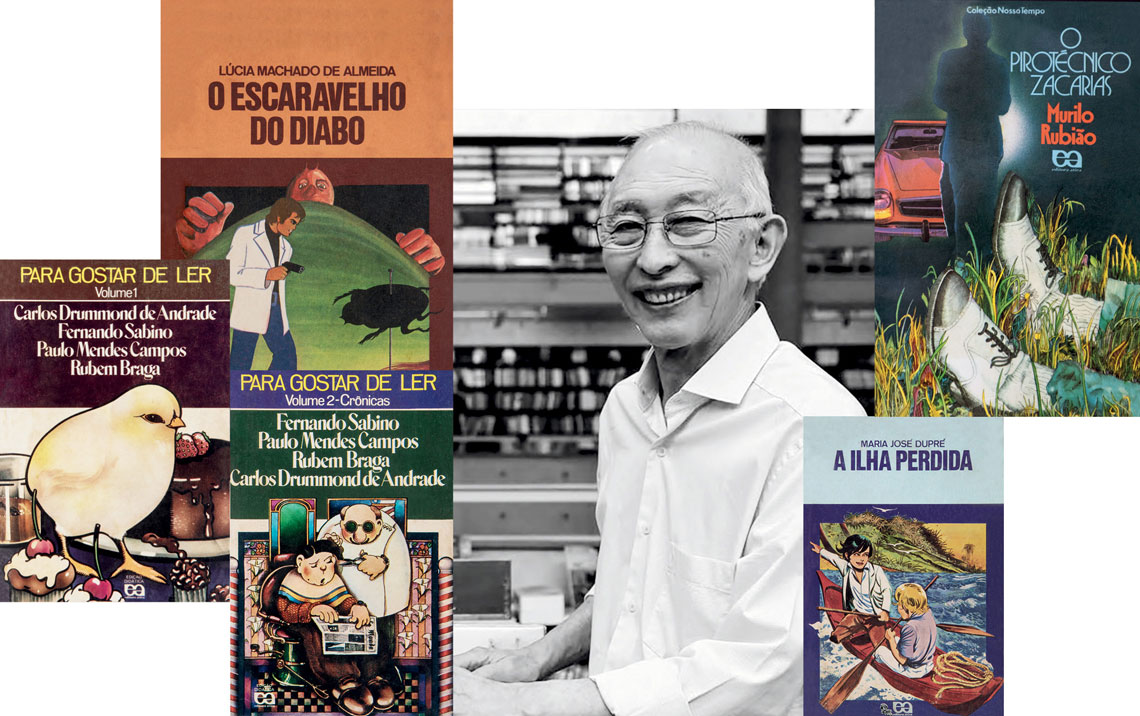
“Why did the victims get a scarab before dying? How is the killer finally unmasked? And who will be the hero? Pretty far out getting to dig into this mystery, huh?” Decked out in 1970s slang and hippie garb, a cartoon figure chatted with readers from the back covers of Editora Ática’s biggest bestsellers. The mascot embodied both the editorial intuition and the command of literary theory that defined Jiro Takahashi, the creator of the Vaga-lume series—which sold at least 120,000 copies with every new title. “In 1973 he was just 26, yet he already knew how to spot what readers wanted and bring to editing the literary knowledge he’d gained as a teacher,” says Thiago Mio Salla, a professor in the Publishing Department at the School of Communications and Arts, University of São Paulo (ECA-USP).
Salla coauthored the book Jiro Takahashi with independent researcher Ana Claudia Almeida; the book was published this year by Com-Arte and Edusp. Part of the Editando o Editor series, the volume presents Takahashi’s first-person account of nearly six decades in Brazilian publishing. “His story sheds light on the inner workings of Brazil’s publishing market,” Salla says. Born in 1947 in Duartina, São Paulo, Takahashi moved to the state capital in the 1960s and entered publishing in 1966 as a typist at the newly founded Editora Ática—a publishing house he would help turn into an industry powerhouse. Over his career he also worked at other major Brazilian publishers, including Nova Fronteira, Rocco, and Global. He later ventured into independent publishing, founding Estação Liberdade in 1990 with Maria Antônia Lobo. Six years later he stepped away from the company, which continues to operate today under different owners. “But as he writes in the book, if he’s remembered for any one achievement, it will almost certainly be his work at Ática,” Salla notes.
According to Takahashi, the Vaga-lume series was created against the backdrop of Brazil’s 1971 Law No. 5,692, an education reform introduced during the military dictatorship (1964–1985). The new rules encouraged teachers to prioritize literature by Brazilian authors. The reform also made middle school—today’s lower secondary level—mandatory in public schools. Takahashi experienced these developments up close. While working at Ática, he also taught Portuguese at the National Service for Industrial Training (SENAI), starting in 1970. “Students started asking for different kinds of reading. They weren’t engaged by books like Iracema (1865) or The Little Brunette (1844), and began exploring other authors. No longer were they interested in books like Cazuza (1938), by Viriato Correia [1884–1967]. In 1969, they discovered O gênio do crime (The genius of crime), by João Carlos Marinho [1935–2019]—a runaway hit. Most teachers avoided recommending it because it might not be politically correct. And maybe that was exactly why kids loved it. That set off a lightbulb for us at Ática,” he recalls in the book.
The Vaga-lume series launched in 1973 with A ilha perdida (Lost island), written by Maria José Dupré (1898–1984). In its early years, Takahashi scouted additional authors for the series, recommending revisions to their manuscripts when needed. A case in point was O escaravelho do diabo (The devil’s scarab), published the following year. Authored by Lúcia Machado de Almeida (1910–2005), the detective novel had originally appeared as a serialized story in the magazine O Cruzeiro during the 1950s. In the original version, characters spoke using the literary pluperfect. At Takahashi’s suggestion, the author agreed to update the dialogue to a more contemporary, colloquial style. “To me, that’s what an editor’s job is about: if you’re not talking with your authors and with your readers, you can’t refine the work,” Takahashi says.
In 1978, taking up a suggestion from writer Affonso Romano de Sant’Anna (1937–2025), Takahashi launched what became another major hit: the Para gostar de ler series. Aimed at middle-grade students, the anthology began as a collection of short stories by four writers already familiar to students through Brazil’s textbooks: Carlos Drummond de Andrade (1902–1987), Fernando Sabino (1923–2004), Paulo Mendes Campos (1922–1991), and Rubem Braga (1913–1990). In its first six months, the series sold 200,000 copies.
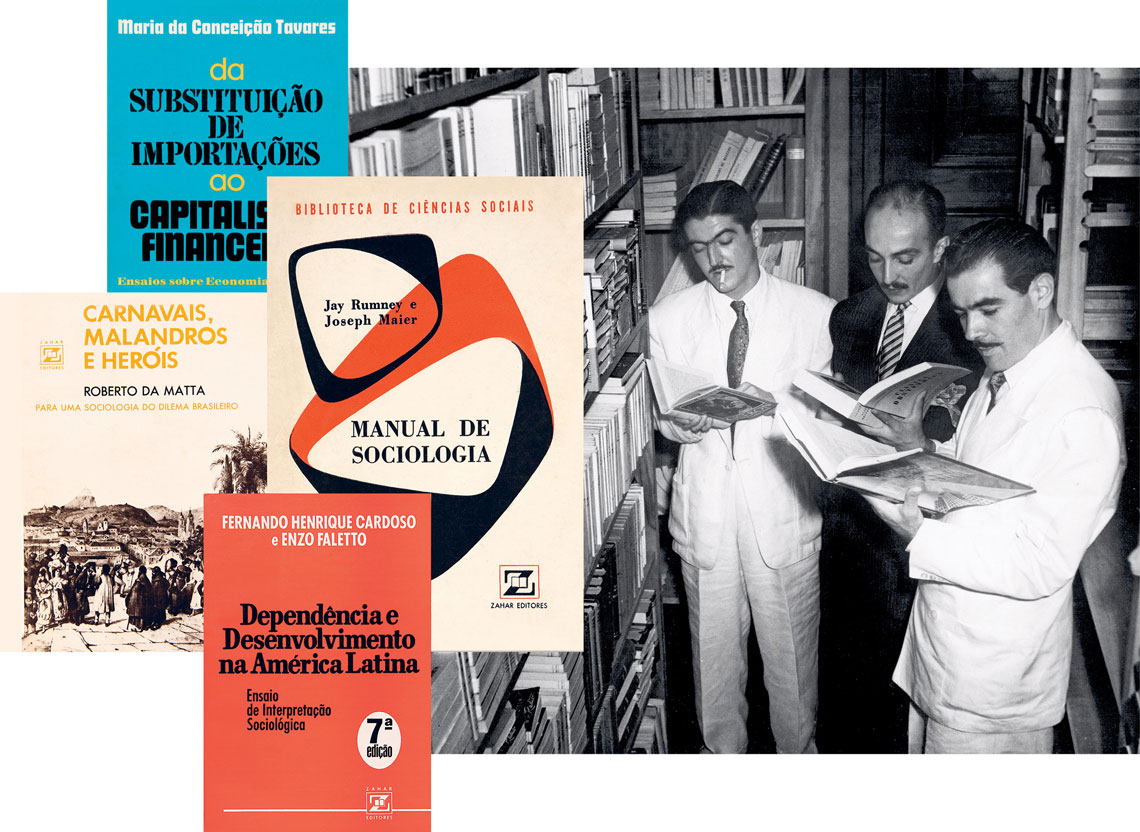
Jorge Zahar archive | ReproducedCovers from several titles published by Zahar Editores. In the photo, from left, brothers Jorge and Ernesto Zahar (both in white) with bookseller Newton Feitosa inside the stockroom at the Ler bookstore in the 1940sJorge Zahar archive | Reproduced
Takahashi also developed the Nosso Tempo collection, targeted at high-school and university readers. The collection debuted in 1974 with O pirotécnico Zacarias (Zacarias the pyrotechnician), by Murilo Rubião (1916–1991). Rubião was recommended to Takahashi by three scholars from USP’s School of Philosophy, Languages and Literature, and Human Sciences: the literary critics Antonio Candido (1918–2017), Davi Arrigucci Jr., and then-graduate student Jorge Schwartz, whose master’s thesis explored Rubião’s fiction. Rubião would soon be joined by other major figures, including Clarice Lispector (1920–1977), who published A legião estrangeira (The foreign legion; 1977) under the imprint.
In August, Takahashi returned to FFLCH-USP for the event “Centenary of Marcos Rey: The Legacy of the Vaga-lume Series.” Rey (1925–1999), a major name in Brazilian young-adult fiction, eventually became a close friend of Takahashi. “I still have a sizable collection of our correspondence in my personal files,” Takahashi relates in the book. But many documents from Ática’s archives were lost after the company was sold in 1999. Not even editor Paulo Verano—who relaunched the Vaga-lume series in 2014 under Ática Scipione—was able to recover those historical records.
Precisely because there are so few surviving records of Brazil’s publishing history, it was surprising to encounter the substantial archive of Jorge Zahar (1920–1998), who, along with his brothers Ernesto and Lucien, founded Zahar Editores in Rio de Janeiro in 1956. The archive contains 2,771 items, including letters, catalogs, and editorial reports on submitted manuscripts. When journalist Marco Aurélio Fiochi, an alumnus of ECA-USP, learned that the family had donated the archive in 2020 to the Fundação Getulio Vargas Center for Research and Documentation of Contemporary Brazilian History (FGV CPDOC) in Rio de Janeiro, he decided to pore through the materials.
In his doctoral dissertation, defended at FGV CPDOC in 2025, Fiochi examined the editor’s correspondence with prominent figures, including sociologist and former president Fernando Henrique Cardoso and philologist Antônio Houaiss (1915–1999). His analysis was compiled into the book Os papéis do editor – Conversas sobre livros e amizade nas cartas do arquivo de Jorge Zahar (The editor’s papers: Conversations on books and friendship in letters from the Jorge Zahar archive; independently published, 2025). “Zahar used to make copies of his outgoing letters before sending them, and he kept those copies at the publishing house,” Fiochi says, noting that the documents span from the 1950s until Zahar’s death in 1998.
Zahar also preserved internal documents, such as the launch memo for Sociology: The science of society, authored by Rutgers University professors Jay Rumney (1905–1957) and Joseph Maier (1911–2002). Published in 1957, the volume was the company’s first release. In that memo, Zahar outlined the publisher’s mission: to produce translations of academic works that combined methodological rigor with language accessible to lay readers. To meet that goal, he reserved the right to modify original titles. “He often added words like ‘manual’ or ‘dictionary’ to signal that these were broad-interest reference works,” says Fiochi.

ReproducedClockwise: titles from the Difel collections História geral da civilização brasileira, Corpo e alma do Brasil, and Saber atualReproduced
Zahar’s knack for anticipating what intellectuals wanted to read stemmed from his years as a bookseller. He started out importing books in 1940 and, in 1946, became co-owner—with his brothers—of the bookstore Ler. Located near the National School of Philosophy—the precursor to the present-day Institute of Philosophy and Social Sciences at the Federal University of Rio de Janeiro—the downtown shop drew a steady stream of university readers. “At the time, most social science books were imported. That began to change in the 1950s under president Juscelino Kubitschek (1902–1976), who pushed for broad-based industrial development in Brazil. The founding of Zahar must be understood within this context of Brazil’s modernization,” says Fiochi.
Though Zahar initially focused on translations, by the late 1960s they began publishing Brazilian authors as well. Among the titles published in this period was the first book by economist Maria da Conceição Tavares (1930–2024), Da substituição de importações ao capitalismo financeiro (From import-substitution policies to financial capitalism; 1972). Zahar often remarked that “an editor is defined by his catalog,” and that he prized coherence in his publishing choices. “The correspondence in the archive reveals his wide social network within academic circles. Those exchanges helped him assemble an impressive body of scholarly works for Brazilian universities,” Fiochi notes.
Zahar was not the only publisher shaping the academic publishing landscape at the time, notes historian Fabiana Marchetti. “Alongside Zahar, publishers like Civilização Brasileira—founded in 1929 in Rio de Janeiro and later transformed in the late 1950s under Ênio Silveira (1925–1996)—and São Paulo’s Difel, directed by the French engineer Paul Monteil (1907–1973), were producing reference works that helped educate generations of intellectuals,” says Marchetti, who completed her 2023 doctoral dissertation “Livraria Francesa e Difel: Economia do livro, sociabilidade literária e pensamento universitário em São Paulo (Livraria Francesa and Difel: The book economy, literary networking, and academic thought in São Paulo; 1947–1982)” at FFLCH-USP. With grant funding from FAPESP, her dissertation won the History category of the 2024 CAPES Award, presented by Brazil’s Federal Agency for Support and Evaluation of Graduate Education (CAPES).
Marchetti’s research traces the history of the two companies Monteil founded in São Paulo. One of them, Livraria Francesa, opened in 1947 in downtown São Paulo as a partnership between Monteil and his wife, Juliette Monteil (1908–1997). Two years later, the shop relocated to Barão de Itapetininga Street—also in the city center—where it specialized in books by French authors, particularly in the humanities and in French-language instruction. In 1951, Monteil founded the publishing house Difel—short for Difusão Europeia de Livros (European Book Distribution). “At first, the goal was to publish translations of French books coming through Portugal, acting as the Brazilian representative of the publishing house Bertrand. The venture, which started as a partnership between the Monteils and French booksellers Marcel Didier and Georges Lucas, had support from France’s Ministry of Foreign Affairs,” Marchetti explains. “But before long, Monteil launched a publishing program that paired Brazilian-made translations with curated works by Brazilian scholars.”
Among Difel’s major collections were Corpo e alma do Brasil (The body and soul of Brazil; 1957) and História geral da civilização brasileira (A general history of Brazilian civilization; 1960). The first, created as an outlet for São Paulo’s expanding academic output, was directed by Fernando Henrique Cardoso beginning in 1960. The second collection—initially directed by historian Sérgio Buarque de Holanda (1902–1982)—was modeled on the French Histoire générale des civilisations, published by Presses Universitaires de France (PUF). “Corpo e alma do Brasil established Difel as a publisher aligned with intellectual currents critical of the military dictatorship,” says Marchetti.
In the DOPS archives—the files of Brazil’s former political police—Marchetti located Monteil’s dossier. He had been active in the Communist Party’s underground network in the 1940s and stayed close to the group for decades afterward. “Monteil went into hiding for a time after the 1964 military coup, yet Difel’s publishing profile stayed consistent up until his death in 1973,” she says. Three years later, the company was sold to Civilização Brasileira, which itself was acquired by Record in 1982. Livraria Francesa stayed at the same address for seventy years. In 2021, it relocated to a smaller storefront in São Paulo’s Moema district. Today, the bookstore operates exclusively online.
The story above was published with the title “Paper trails” in issue 356 of October/2025.
Project
Paul Monteil and Difel: Publishing and dissemination of Brazilian academic thought (1947–1982) (n° 17/20206-3); Grant Mechanism Doctoral Fellowship; Supervisor Marisa Midore Deaecto (USP); Beneficiary Fabiana Marchetti; Investment R$158,979.77.
Books
FIOCHI, Marco Aurélio. Os papéis do editor: Conversas sobre livros e amizade nas cartas do arquivo de Jorge Zahar. Rio de Janeiro: Edição independente, 2025.
SALLA, T. M. & ALMEIDA, A. C. Editando o editor: Jiro Takahashi. São Paulo: Com-Arte Editora Laboratório / Edusp, 2025.