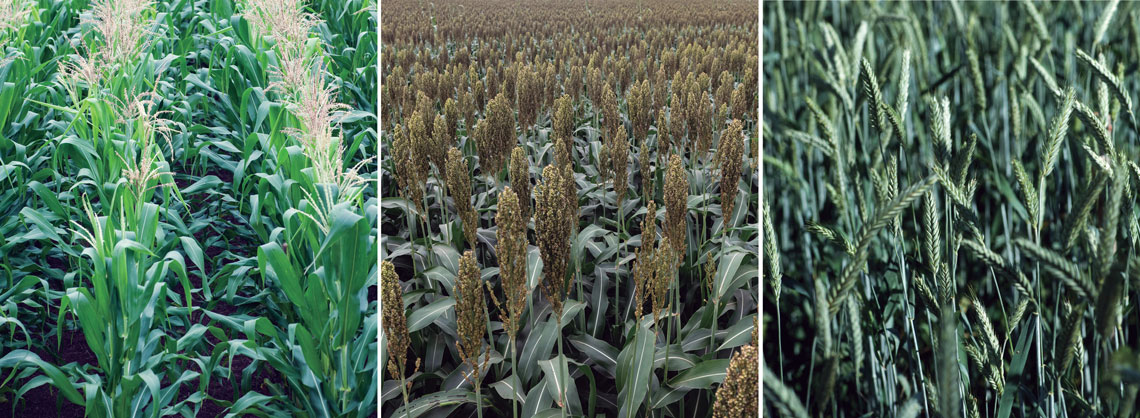
For 50 years, since the National Alcohol Program (PROÁLCOOL) was created in 1975, sugarcane has been Brazil’s predominant ethanol feedstock. Recent developments suggest that other raw materials are beginning to gain importance in biofuel generation. In 2024, corn accounted for around a fifth of Brazil’s ethanol production. The first commercial plants using sorghum and wheat are expected to start operating later this year. Agave, meanwhile, shows potential to become a national ethanol feedstock. A genus of succulents typical of semiarid regions, it is used to make tequila in Mexico and sisal fiber in Bahia (see box).
Brazilian ethanol production in 2024, the greatest recorded, was 36.8 billion liters (L), according to data from the Brazilian Sugarcane Industry Association (UNICA). According to the 2035 10-Year Energy Expansion Plan written by the Brazilian Energy Research Company (EPE), affiliated with the Ministry of Mines and Energy, the total demand for biofuels is expected to grow to 48.2 billion L by the end of the ten-year period.
The EPE study also concludes that there will be a significant increase in the supply of corn ethanol over the next decade. It is currently the main alternative to sugarcane and is expected to increase from the 7.4 billion L recorded in 2024 to around 16.3 billion L in 2035, representing 30% of national production. The National Corn Ethanol Union (UNEM) lists 24 ethanol plants in operation in the country that use the cereal and 38 construction projects for new establishments, with 19 of them already authorized by Brazil’s National Agency for Petroleum, Natural Gas, and Biofuels (ANP) (see infographic). Sinop, in the state of Mato Grosso, is home to the world’s largest plant dedicated to corn ethanol production. Operated by Inpasa, it has a capacity to process 4.6 million tons (t) of corn and produces 2.1 billion L of ethanol per year.
One of the major advantages of corn as an ethanol feedstock is that the cereal can be stored and processed at any time of the year. Sugarcane needs to be processed within 48 hours of harvesting, before the sugar starts to degrade. Additionally, due to its growth and maturation cycle, sugarcane is not ready for harvest all year round. This means that sugarcane plants shut down during the off-season, between November and March.
Corn used for ethanol production last year, according to the EPE, represented just 15% of the harvest collected in 2023/2024. In Brazil, over 75% of corn production occurs during what is known as the safrinha, the soybean off-season, which occurs in the autumn and winter. Another cereal cultivated during the safrinha is sorghum, which is used in animal feed.
Besides ethanol, facilities that process corn and other cereals produce a byproduct mainly destined for animal feed, known by the acronym DDGS, which stands for dried distillers grains with solubles. According to agronomist Flávio Dessaune Tardin, from EMBRAPA (Brazilian Agricultural Research Corporation) Corn and Sorghum, because it costs between 15% and 25% less than corn while providing an almost equivalent yield of ethanol and DDGS, sorghum has been incorporated into the feedstock mix of corn-ethanol plants since 2024. “Those in the industry are already talking about processing 50% corn and 50% sorghum,” says the agronomist.
In 2025, the first ethanol plants designed to operate specifically with sorghum were announced in the states of Maranhão, Mato Grosso do Sul, and Alagoas. “In drier regions and microregions, sorghum, which has a lower water requirement, performs better than corn,” notes Tardin. The soybean producing area of Matopiba, a region including parts of Maranhão, Tocantins, Piauí, and Bahia, and municipalities in eastern Mato Grosso, known as the Araguaia Valley, appears to be the most suitable for investment in sorghum ethanol plants, according to the researcher from EMBRAPA Corn and Sorghum.
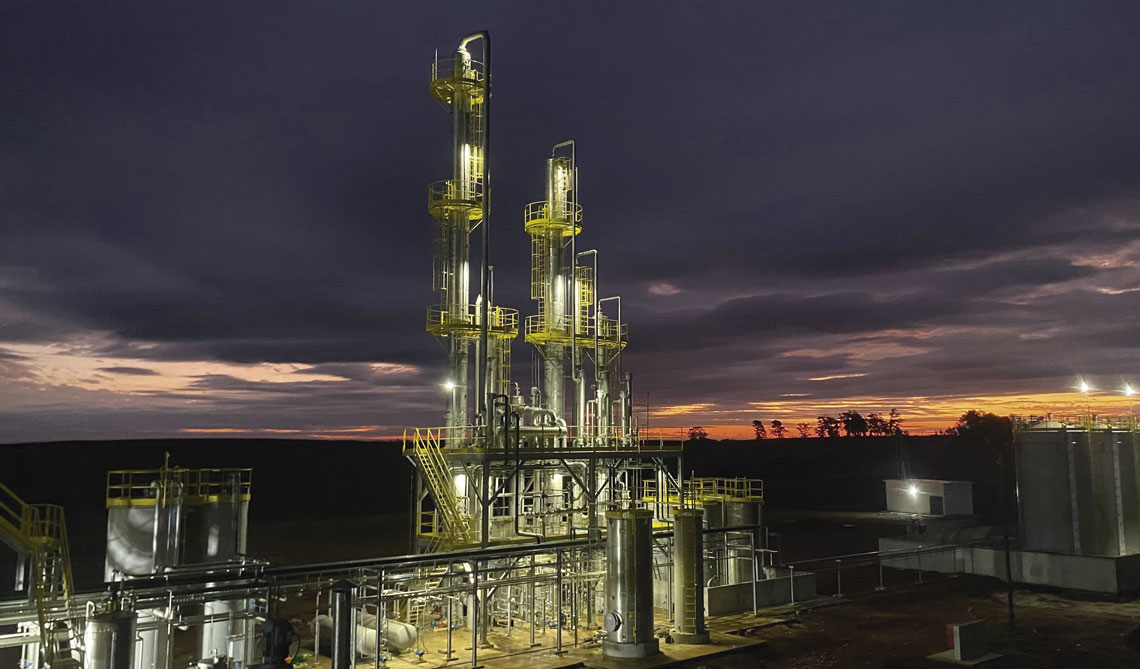
CB BioenergiaThe wheat ethanol production unit of CB Bioenergia, in Santiago (Rio Grande do Sul)CB Bioenergia
Bet on wheat
For biologist Glaucia Mendes Souza, from the Institute of Chemistry of the University of São Paulo (IQ-USP) and leader of the Biofuels Task Force for the Decarbonization of Transportation of the International Energy Agency (IEA), diversifying raw material sources ensures a more reliable supply of ethanol. “It is not good to rely on a single biomass, the supply and price of which can be affected by climatic conditions, crop diseases, and fluctuations in international agricultural commodity prices,” she argues.
In the South of Brazil, wheat has started to be used for ethanol production. The first plant was built in Santiago, in Rio Grande do Sul. It will have the capacity to produce over 13 million L per year once its operating permit is approved, which is still expected this year. The state produces almost no sugarcane, and ethanol, acquired mainly from Brazil’s Southeast, is not competitive with gasoline due to high logistical costs. The plant in Santiago will use low-quality wheat that is not suitable for human consumption.
“It is a wheat that, due to climatic conditions, does not reach the required quality standard. As a result, it loses value and ends up destined for animal feed,” explains Tiago Lacerda, director of CB Bioenergia, the company that has invested R$110 million in installing the plant. In addition to wheat, the plant will be able to process ethanol from rice, corn, sorghum, triticale, barley, and rye.
A second plant producing ethanol from wheat and other cereals with a capacity for 210 million L per year starting at the end of 2026 is also under construction in Rio Grande do Sul by the company Be8, with announced investments of R$1.2 billion.
The use of corn and sorghum predominates in the USA, the world’s largest biofuel producer, while wheat is more common in Europe. Brazilian plants producing ethanol from cereals primarily rely on foreign technology suppliers. The main energy component in cereals is starch. The ethanol production process involves grinding the grain and mixing it with heated water to form a highly viscous mash.
The enzyme alfa-amylase (or a-amylase) is then added to this mash. As explained by biologist Amanda de Souza, application leader for the grain processing department at IFF Latin America, one of the main suppliers of technology for the cereal ethanol production in Brazil, the enzyme breaks down the starch’s molecular structure into smaller chains. This stage is known as cooking and liquefaction. Next, a second set of enzymes, called glucoamylases, “nibble” at the smaller chains releasing glucose, a type of sugar, enabling it to be processed by the yeasts. This second phase is known as simultaneous saccharification and fermentation.
From this point, the biofuel production process is identical to that of sugarcane. The resulting liquid is sent for distillation, where the separation of ethanol occurs. “One of the tasks of the IFF is to supply the combination of enzymes and yeasts, from our collection, best suited to the characteristics of the feedstock being processed in each stage of the harvest, and increasing the yield of the production process,” says Souza.
A trend gaining traction among sugarcane-ethanol producers, notes Tardin, from EMBRAPA, is the investment in flex facilities. These units are traditional sugarcane plants that incorporate the enzymatic processing steps used for cereals. As a result, their production infrastructure can be used year-round, during the sugarcane harvest and in the off-season for producing ethanol from corn, wheat, or sorghum.
The potential of agave Brazil has a program aimed at developing a biofuel production pathway from agave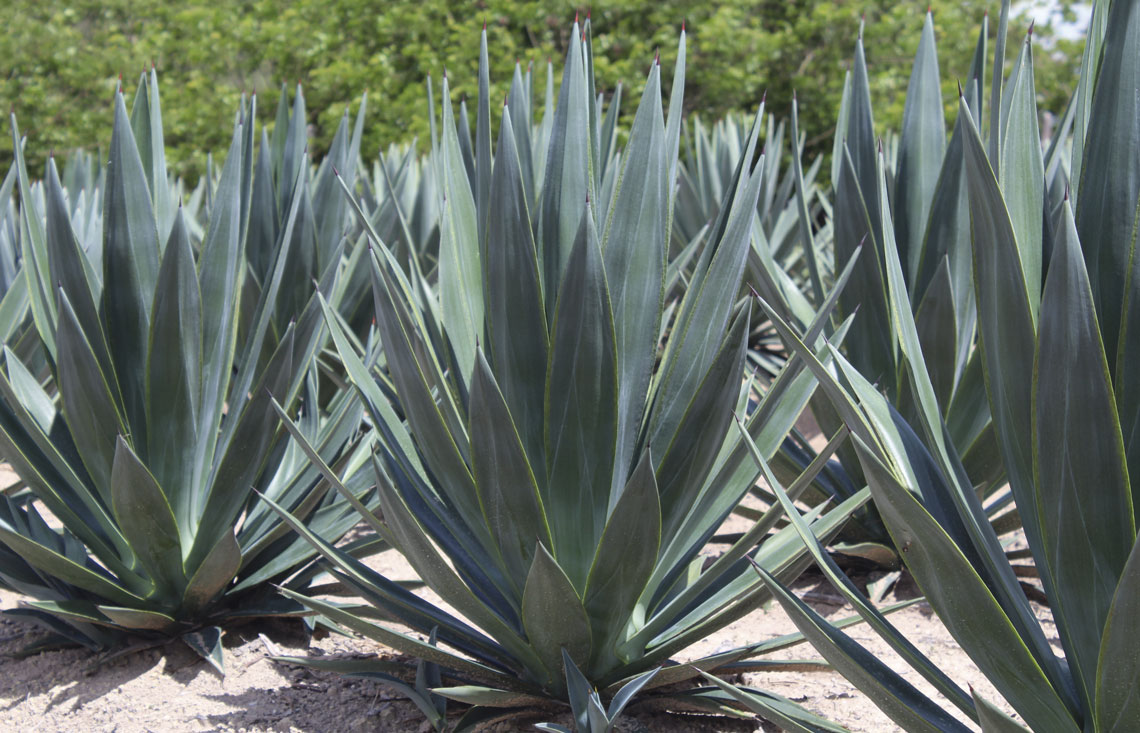
Fábio Raya Agave: one hectare of the plant could provide 7,400 liters of ethanol per yearFábio Raya
Agave could become an alternative for ethanol production in Brazil in a few years. One initiative in this direction is the Brazil Agave Development (BRAVE) program. Its objective is to develop solutions to increase agave productivity and create processing pathways for the different types of biofuels.
Led by agricultural engineer Gonçalo Pereira and physicist Marcelo Falsarella Carazzolle, both from the Institute of Biology at the University of Campinas (IB-UNICAMP), BRAVE originated in a FAPESP funded project and a R$110 million investment from British-Dutch energy company Shell and the Brazilian Agency for Industrial Research and Innovation (EMBRAPII). The National Service for Industrial Training (SENAI) and the Integrated Manufacturing and Technology Center (CIMATEC) also participated in the initiative.
There is not yet any agave ethanol production in Brazil, or in any other country. The first experimental plantation began this year in an area of 1,400 hectares (ha) of CIMATEC Sertão, in Ourolândia (Bahia). The plant takes between five and seven weeks to reach maturity. In this period, it gains 100 tons (t) of biomass per year, outperforming sugarcane, which generates 80 t per ha a year on average.
A study conducted by British and Australian researchers, published in the Journal of Cleaner Production, in 2020, pointed out that 1 hectare (ha) of agave could provide 7,400 liters (L) of ethanol per year, a lower yield than sugarcane (9,900 L/ha/year) and greater than corn (3,800 L/ha/year).
The production process of agave ethanol is similar to sugarcane, but obstacles still need to be overcome. The biofuel is generated from the juice extracted from the leaves and heart of the agave, rich in inulin, a fructan-type sugar. One of the problems is that the yeast Saccharomyces cerevisiae, used to convert the sugars in sugarcane juice into ethanol, is unable to metabolize inulin.
To overcome this obstacle, the UNICAMP team sequenced the genome of the fungus Aspergillus welwitschiae, which feeds on agave, and successfully obtained an enzyme capable of metabolizing inulin. The sequencing was the topic of an article published in Genomics, in 2022. With this enzyme, they developed a genetically modified strain of S. cerevisiae.
Brazilian scientists also researched which species of agave, among the more than 200 existing ones, are best suited for ethanol production, and looked to develop solutions aimed at mechanizing planting, harvesting, and ethanol processing.
Brazil is the world’s largest producer of Agave sisalana, the plant used to produce sisal fiber. The state of Bahia accounts for 90% of Brazil’s fiber production, estimated at 93 million t, according to the Brazilian Institute of Geography and Statistics (IBGE).
The story above was published with the title “New sources for ethanol” in issue 357 of November/2025.
Projects
1. Bioelectric fermentation applied to Saccharomyces cerevisiae: Understanding metabolism and its effects on ethanol production (n° 19/10254-6); Grant Mechanism Bioen Program; Principal Investigator Marcelo Falsarella Carazzolle (UNICAMP); Investment R$168,454.72.
2. Structuring a new biogas production chain based on agave (n° 20/02524-0); Grant Mechanism Regular Research Grant; Principal Investigator Gonçalo Amarante Guimarães Pereira (UNICAMP); Investment R$155,639.46.
Scientific articles
YAN, X. et al. Agave: A promising feedstock for biofuels in the water-energy-food-environment (WEFE) nexus. Journal of Cleaner Production. July 10, 2020.
QUINTANILHA-PEIXOTO, G. et al. Phylogenomics and gene selection in Aspergillus welwitschiae: Possible implications in the pathogenicity in Agave sisalana. Genomics. Nov. 6, 2022.
RAYA, F. T. et al. Rescuing the Brazilian Agave Breeding Program: Morphophysiological and molecular characterization of a new germplasm. Frontiers in Chemical Engineering. Sept. 20, 2023.
Republish