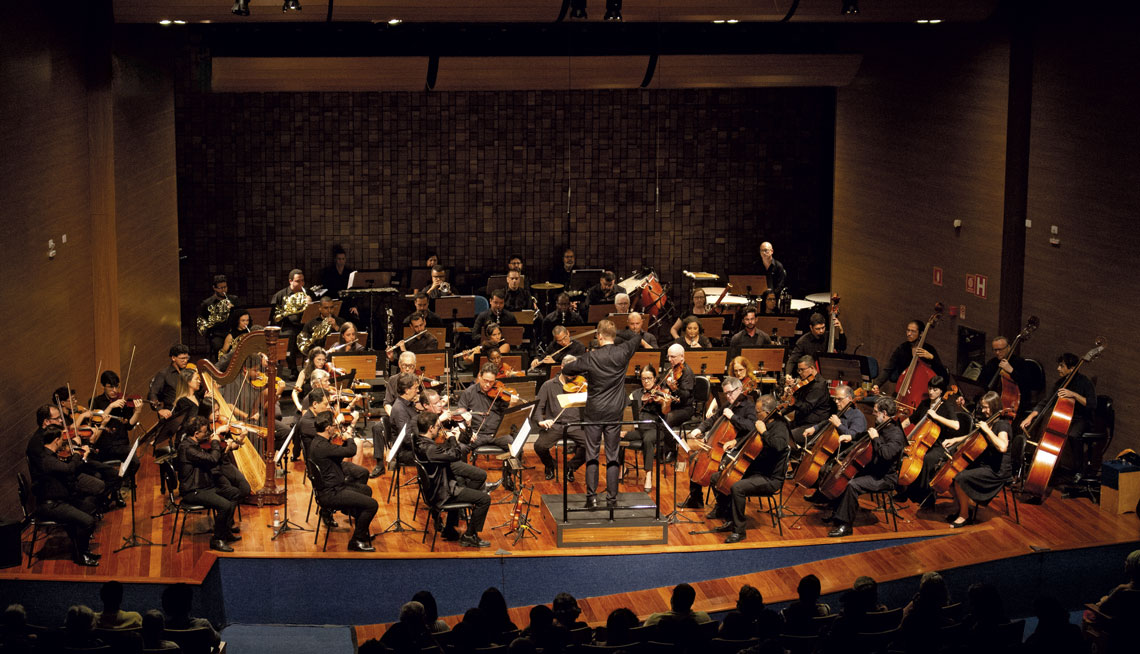
The University of São Paulo Symphony Orchestra (OSUSP) celebrates its 50th birthday in 2025 as one of the busiest university ensembles in Brazil. In 2024, the orchestra played to 55,000 people at the Clocktower on the campus of renowned biomedical research center the Butantã Institute to celebrate 90 years of USP, performing alongside well-known singer Marisa Monte, bringing the total audience for the year to 70,000, seven times higher than in 2023.
Not counting the crowd for this birthday presentation, attendance at concerts grew by 20% last year against 2023, despite a slight fall in the number of presentations—from 42 to 39. “Our main goals are to spread concert music to the wider public,” says flautist Cássia Carrascoza Bomfim, director of OSUSP and professor at the Music Department of the USP School of Communications and Arts (ECA-USP).
The orchestra currently comprises 39 professional musicians, all on fixed contracts. Music undergraduates are allocated to the USP Chamber Orchestra, which is geared toward their instruction. Founded in 1975 by composer and maestro Camargo Guarnieri (1907–1993), with aspirations to be a 90-piece symphony orchestra, OSUSP never grew to this size. The orchestra maintains a strong link with the Brazilian national identity, according to Bomfim. “It’s a legacy of Guarnieri. He was one of Brazil’s key names in the movement known as Musical Nationalism, and would incorporate elements of the country’s folklore into his classical compositions,” she adds.
The survey “OSUSP in numbers,” commenced in 2021 and coordinated by musicians Fábio Cury (director of the orchestra between 2018 and 2022 and professor at ECA-USP) and João Batista de Brito Cruz, demonstrates that in 465 concerts, around 30% of the repertoire between 1976 and 2019 included Brazilian classical music. “There is a significant presence of Brazilian music in the schedule, though the European canon still predominates,” says Cruz, who is not associated to OSUSP; he completed his doctorate in musicology last year at the university.
On balance, according to Cruz, the proportion of Brazilian music in the OSUSP repertoire differs from other orchestras in the country, who tend not to allow much space for the works of national composers. “This may happen for various reasons: the personal tastes of the musicians, scheduling costs, availability of sheet music, and at times the audiences’ demand for more well-known European pieces,” he says.
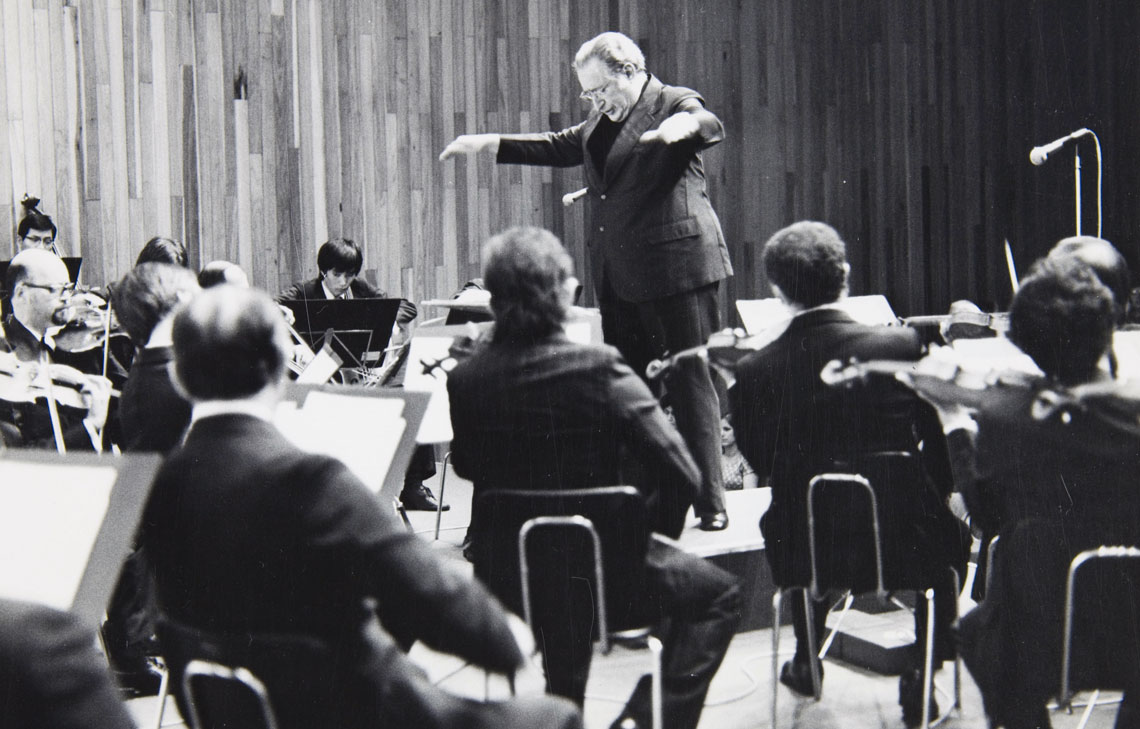
Brazilian Studies Institute at the University of São Paulo (IEB-USP)OSUSP with its creator, composer and conductor Camargo Guarnieri, undatedBrazilian Studies Institute at the University of São Paulo (IEB-USP)
“Being university-based, OSUSP has more freedom to try out other repertoires beyond the European canons,” says Tobias Volkmann, standing maestro of the orchestra since 2024. The conductor is also artistic director of the Cuyo Symphony Orchestra, associated to the Cuyo National University Symphony Orchestra in Mendoza, Argentina. As he points out, higher education institutions have been important hosts for prominent orchestras in Latin America since the beginning of the last century.
One of the current experimental stages for OSUSP is the “Torre do relógio” (Clocktower) project, initiated in 2023 by Gil Jardim, then the orchestra’s lead conductor and now a retired ECA-USP professor. The cycle of concerts is aimed at creating dialogue between the arts and the sciences with themed performances. “The repertoire is selected based on the chosen topic, for example the climate crisis, and brings together different knowledge areas,” explains linguist Marli Quadros Leite, who currently heads the Office of the Associate Dean for Culture and University Extension (PRCEU) at USP which, in addition to OSUSP, encompasses nine other initiatives, such as Estação Ciência (Science Station).
On these occasions, researchers from the university with links to the theme in question help the maestro to put the program together, and talk to the audience about the subject during the show. With no defined frequency, the concerts are usually held in the 435-seat Camargo Guarnieri Amphitheater at the USP campus in the São Paulo state capital. “They are always sold out,” says Volkmann.
According to Cássia Bomfim, other projects have been helping to widen and retain audiences, exemplified by Memórias Sonoras (Sound Memories), created this year by OSUSP and integrating the USP 60+ program, a PRCEU initiative with academic, sporting, and cultural activities aimed at older adults. “A lot of these people are attending a classical music concert for the first time in their lives,” says musician Lucas Coelho, assistant artistic director of the orchestra.
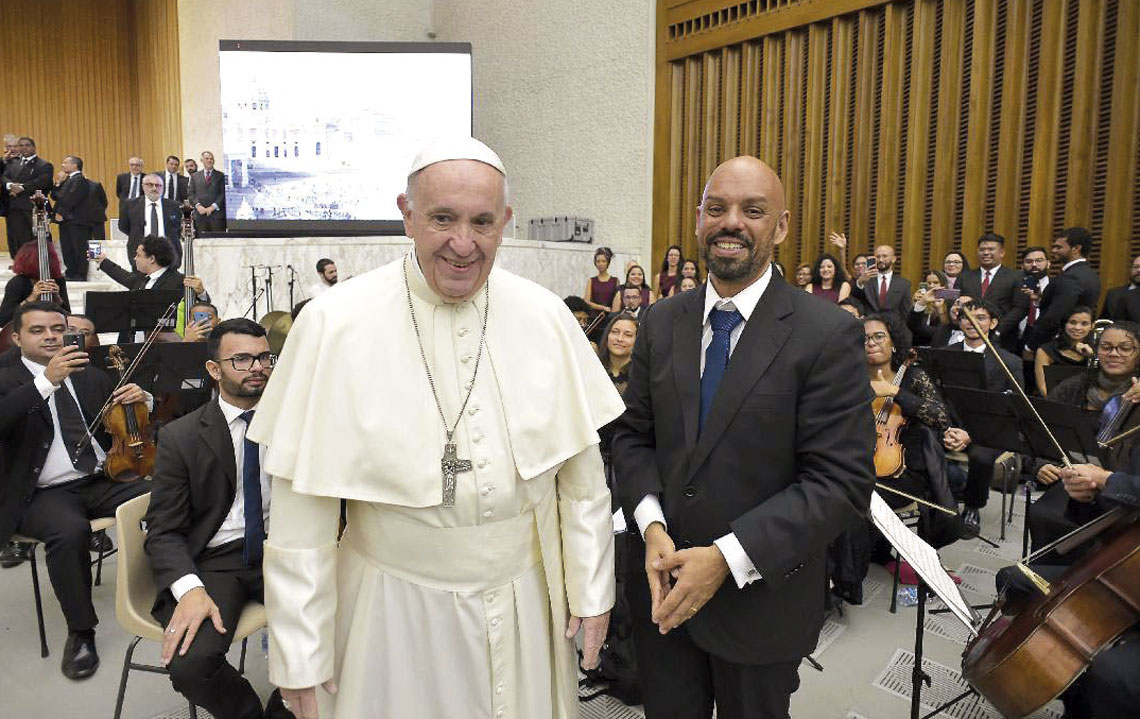
Courtesy of the Federal University of Rio Grande do Norte Philharmonic Orchestra Maestro André Muniz and the UFRN Philharmonic with Pope Francisco in 2018Courtesy of the Federal University of Rio Grande do Norte Philharmonic Orchestra
OSUSP is part of the University’s annual budget through PRCEU, but is currently raising funds via the Rouanet Law (a federal instrument providing tax breaks for cultural projects). “Our concerts are free to attend, but the expenditure on an orchestra is high,” says Bomfim. Leite says that in 2024, OSUSP secured authorization to raise R$6 million to fund a series of concerts in 2025 and 2026, and presentations in Brasília, Belo Horizonte, Rio de Janeiro, and Salvador are planned for 2026, along with six cities in the interior of São Paulo State. Under the Rouanet Law, at least 20% of the total amount must be raised (i.e., R$1.2 million) to enjoy the benefit. To date, R$800,000 has been raised. “We want to increase our links with private initiative, but without losing our artistic independence,” concludes Leite.
Partnerships with corporations and other institutions are part of daily life for the Federal University of Rio de Janeiro Symphony Orchestra (OSUFRJ), the oldest of its kind in Brazil, celebrating 100 years in 2024. The orchestra is institutionalized; in other words, it is part of the university’s development plan and covered by the annual budget.
Conceived to be exclusively staffed by students of what was then called the National Institute of Music, the orchestra has undergone changes over the course of its journey. In 1931, with the educational reform implemented by President Getúlio Vargas (1882–1954), its musicians came to be exclusively professional. “It now follows a hybrid model, with 47 professional musicians and 90 music undergraduates,” says André Cardoso, professor of conducting at UFRJ and standing maestro of OSUFRJ.
He says that the repertoire is defined based on what the musicians in training will need to play when they join professional orchestras, primarily the European canon, which includes works by composers such as Beethoven (1770–1827) and Brahms (1833–1897). “However, of a total twenty-nine concerts during the 2024 season, we showcased twelve contemporaneous composers, mainly Brazilians such as Ernani Aguiar and Marisa Rezende,” he goes on.
The conductor says that in light of the economic difficulties faced by universities, which have worsened in recent years, partnerships with entities help to make certain orchestra programs possible. “Through partnerships with the Sala Cecília Meirelles, FUNARTE [National Arts Foundation], and consulates, for example, we can pay the fees of guest solo artists and conductors. This enables students to work with other conductors,” he concludes.

OSUSP archives From left in year order, OSUSP program coversOSUSP archives
Partnerships with private initiative have also helped the Federal University of Rio Grande do Norte Philharmonic Orchestra (Filarmônica UFRN) to overcome its financial challenges. Thanks to this input, André Muniz, a professor at the institution, has been able to take the orchestra to play in Germany and at the Vatican. In 2018, the musicians played for Pope Francisco (1936–2025), with a sacred repertoire composed exclusively by Brazilians, such as Grande missa nordestina (Great northeastern mass), by Clóvis Pereira (1932–2024).
To attract a more diversified audience, the orchestra puts on concerts blending a symphonic repertoire and popular music, and one of their performances, featuring the Rio Grande do Norte singer Roberta Sá, nationally famous for her samba and bossa nova, brought together more than 5,000 people.
Comprising fifty scholarship holders, the orchestra is institutionalized, with the main objective of developing the students. “One of our biggest challenges is the high turnover rate,” says the conductor. “When the students have honed their skills, they complete the undergraduate course and move on to their professional careers, and we have to start from scratch again. But that’s the natural cycle of a university.”
One of the biggest challenges for the Federal University of Pernambuco Symphony Orchestra (OSUFPE) is to find their own space. With 70 musicians, almost all undergraduates, they have been performing at venues provided by third parties, such as churches. At the beginning of August, they played at the Santa Isabel Theater in state capital Recife to celebrate the anniversary of UFPE. “Given that the university’s convention center has been undergoing renovation for more than 10 years, we need to find spaces in the metropolitan region for our concerts,” says conductor Helder Passinho Jr., who coordinates the orchestra with conductor Maria Aida Barroso.
Barroso, who also heads the Music Department at UFPE, explains that the orchestra received scholarship grants from the university until 2018. This project is now run by the department itself. “We no longer have scholarships, so student participation comes in the form of an obligatory study discipline,” he says. According to Passinho Jr., being an extension project, the orchestra issues calls for applications to attract musicians from the community, who generally play non-orchestral instruments.

Lucas Emanuel / Courtesy of Federal University of Pernambuco Symphony OrchestraUFPE orchestra performance in August at the Santa Isabel Theater in RecifeLucas Emanuel / Courtesy of Federal University of Pernambuco Symphony Orchestra
The diversity of the repertoire is a concern, though the emphasis is on the European canons. Emeritus maestro Sérgio Dias, who founded the orchestra in 2009 and left in 2023, recalls that the concert which marked the resumption of activities after the COVID-19 pandemic was MPB sinfônico, which put an orchestral slant on northeastern music, choro, and samba. “These days, the zabumba and maracatu drums are part of our orchestra,” he enthuses.
Among Brazil’s university ensembles, the National Symphony Orchestra (OSN) is linked to Fluminense Federal University (UFF)—the institution does not, however, offer a music course. With no educational bias, the orchestral body is made up of 78 professional musicians who play concerts for the community of Niterói, where the campus is located.
Founded in 1961 as the National Radio Orchestra, with the remit of disseminating Brazilian orchestral music, OSN was absorbed into UFF in 1984. The salary of these musicians, who have fixed contracts, is paid by the university. However, the rest of the expenditure, which includes the conductor’s contract, is funded by the box office from performances (all paid), and occasionally by UFF.
Concerts today are divided into three main programs: Alvorada, a Sunday morning series with national and international pieces; OSN Popular, with popular music in a symphonic style; and OSN Cine, which shows Brazilian films while the soundtrack is performed live.
“In 2025, our focus is on works by the composer Guerra Peixe [1914–1993] and within this artistic vein, we are incorporating other musical angles to formulate a repertoire,” explains violinist Deivison Branco, who presided over the OSN artistic committee until this past August. “We are not giving up on Brazilian music—it represents 70% of our repertoire.”
The story above was published with the title “Music, maestro!” in issue 355 of September/2025.
Scientific article
CRUZ, J. B. de B. & CURY, F. “De onde vem essa música?: Um mapeamento de programações da Osusp entre 1976-2019.” In: XXXIII ANPPOM Congress. São João Del-Rey, 2023.
[bibliografia]Book
CARDOSO, A. Orquestra Sinfônica da Universidade Federal do Rio de Janeiro – 100 anos, 1924-2024. Rio de Janeiro: Editora UFRJ, 2024.
Book chapter
BOMFIM, C. C. & CURY, F. “OSUSP 50 anos: Trajetória e papel na Universidade de São Paulo.” In: LEITE, M. Q. (ed.). Cultura e Extensão na USP – Reflexões e impactos. São Paulo: Publicações BBM, 2025.