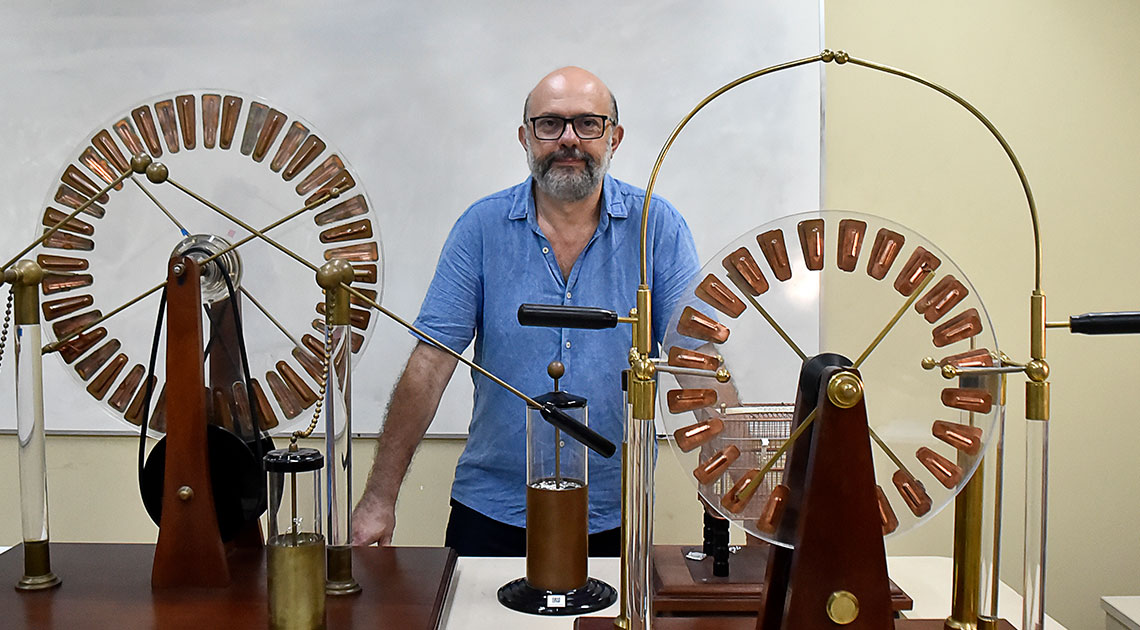
Brazilian physicist Luís Carlos Bassalo Crispino, 54, from the state of Pará, won the 45th José Reis Science Communication Award. The honor was granted this year in the Researcher and Writer category by the Brazilian National Council for Scientific and Technological Development (CNPq). Two decades ago, along with colleagues, he created the Demonstration Laboratory of what was then the Department of Physics at the Federal University of Pará (UFPA), to host undergraduate students and local school groups, as well as a project that promotes lectures on physics. These initiatives were the precursor to the Interactive Center of Science and Technology of the Amazon, whose new headquarters on the university campus opened to visitors in 2022 and which caters to students from public and private schools. Crispino is the coordinator of the Graduate Program in Physics at UFPA and leads the Gravity at Amazonia (Gravazon) research group, which focuses primarily on the study of black holes. He discussed his activities in a video call with Pesquisa FAPESP.
Of the science communication activities that you carry out, which had the greatest influence on you winning the award?
I think the recognition was a result of my body of work. I have spent over two decades working on science communication. We began in 2004, with the Demonstration Laboratory, inspired by a model I encountered as an undergraduate at USP. At first, we opened the doors to those from within the university itself, students from the undergraduate programs, but later we expanded to students from public and private schools, all free of charge. There is also the Physics and Technology for School project, which brings scientists, teachers, and university students to give lectures in schools. Within this project, we created Vocational Lectures, focused on guidance for students, and later the Girls in Science project. The latter, in fact, arose from my personal experience with my wife, Ângela Burlamaqui Klautau, who is also a physicist. These projects together culminated in the creation of the Interactive Center of Science and Technology of the Amazon.
What is the size of the audience reached?
We can host groups of up to 200 people per day, on Mondays, Wednesdays, Thursdays, and Fridays. On Tuesdays we hold internal seminars to train the team. And on Saturdays we offer training for students who want to participate in the Brazilian Astronomy and Astronautics Olympiad. We started out in a single classroom, and since 2022 we have been operating in a two-story building, with over 10 rooms, including a library and repair room. We also created the Interactive Physics Museum, where people enter and interact with the equipment, always under supervision, both to ensure safety and to preserve the materials. The museum was designed to be a well-appointed environment, with a richer sensory and educational experience.
You have already taken activities to river-dwelling and Indigenous communities. How were those experiences?
Yes. One memorable example was the annular solar eclipse in October 2023, a rare phenomenon that could be observed in the Amazon. The next one visible here won’t occur for another 100 years. I was in Portugal, but I organized everything remotely with the Municipal Department of São Felix do Xingu, where the phenomenon could be seen in its entirety. The main event took place in the city, with several telescopes to observe the eclipse, but I also asked that equipment be taken to an Indigenous village. The video of the event was moving, featuring a soundtrack of Indigenous music. We have also loaded equipment onto a boat and taken it to a riverside community. The idea is to one day have our own boat that we can sail among the dozens of islands around Belém, stopping at each one and offering this experience. That’s the dream.
Speaking about your academic path, you started your undergraduate studies in physics and engineering at UFPA in 1987, but transferred to the physics program at the University of São Paulo, in the state capital. Why?
At the time, UFPA was going through a different phase. There wasn’t enough critical mass, either in terms of faculty or academic structure. I’ve always studied a lot on my own, but I felt that, if I had access to a better structured education, I could better develop myself. My father helped me, even though I had a scholarship. I was even a recipient of a scientific initiation grant from FAPESP. At USP, not only did I have access to the more elaborate experimental subjects, but I also discovered the Demonstrations Laboratory of the Physics Institute, which was later renamed Ernst Wolfgang Hamburger [1933–2018], the originator of the project in the 1970s. The space had and still has equipment for doing experiments with magnetism, optics, mechanics, electricity, acoustics, and thermodynamics. This laboratory at USP served as inspiration for what we created in Belém.
You also helped implement, at UFPA, the first PhD program in physics in the Amazon region. What obstacles did you have to overcome?
The master’s program in physics at the institution, created in 1986 as the first in the Amazon, faced difficulties at first due to a lack of teaching staff with PhDs, and its first dissertation was only completed 10 years later. After pressure from CAPES [The Brazilian Federal Agency for Support and Evaluation of Graduate Education] in the 1990s, I helped restructure the program in 2003. We trained the faculty, increased scientific research, and reduced the time spent on the preparation of dissertations, which allowed the creation of the PhD program seven years later. Today, the Gravazon group, which I coordinate, is internationally recognized and trains students from undergraduate to PhD levels, mostly from the region itself, with excellence.
How do you see the role of science communication today?
We are living in a time when universities are under attack, with denialism and widespread distrust of science among a significant section of the population, and I believe that this is also related to the behavior of some scientists and members of the academic community. There are not enough lectures, public events, or spaces where it is possible to show society what is being done within academia.
There are several science communication initiatives on digital platforms. What is the importance of going beyond them?
I don’t have personal social media profiles, but all of our initiatives have a website, Instagram, Facebook, and YouTube channel. But I also strongly believe in in-person experiences. When you watch a video, how do you know if it really happened or if it was edited? If the person is there, in person, they activate it, create the spark, and turn on the lamp by cranking the handle—and they experience science. There is that saying: “If you tell me, I forget. If you teach me, I remember. If you involve me, I learn.” Learning is linked to experience.
What is the role of schools and their laboratories in this scenario?
I don’t know whether the school I attended had a laboratory, but I definitely never went there during class. This happens because a laboratory class is very demanding. The teacher needs to prepare the space in advance, conduct the practical work, and then clean everything up afterwards, since each class may conduct different experiments. I see schools as a key factor in science communication. Even in regions without internet access, if teachers can present science effectively, we can make significant progress.