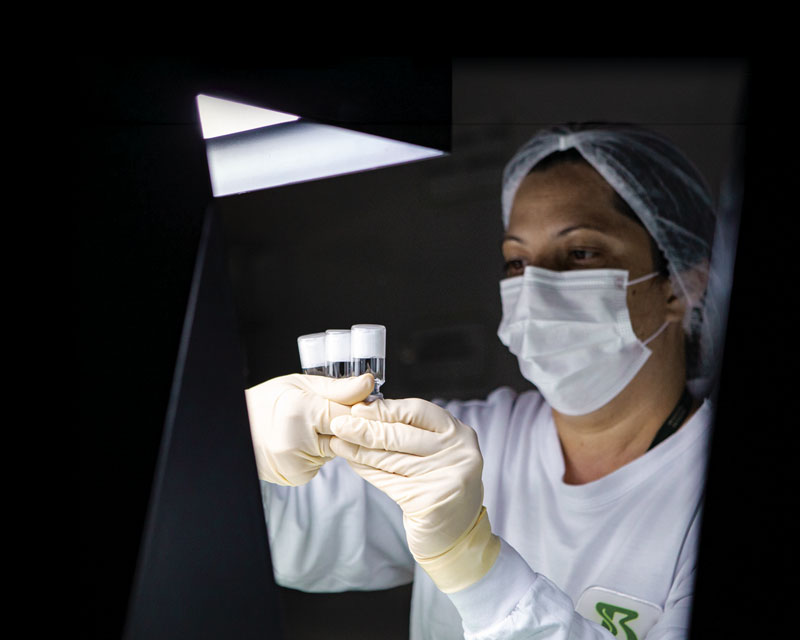
Renato Rodrigues / Butantan Institute CommunicationA technician performs a visual inspection of a batch of Butantan-DVRenato Rodrigues / Butantan Institute Communication
Compared to the control, a single dose of only 0.5 mL of the candidate vaccine against dengue from the Butantan Institute, Butantan-DV, provided lasting and elevated protection against the disease. It reduced the risk of people presenting symptoms (mild, moderate, or severe) of dengue by an average of 67.3%, even long after its administration—on average, for 3.7 years.
In an article published in August in the journal The Lancet Infectious Diseases, this level of protection is slightly lower than that reported in a study published in February in The New England Journal of Medicine. In that study, the overall decrease in symptom prevalence with the Butantan-DV vaccine was 79.6%, which was measured two years after administration. Now, after almost double the time, the immune response induced by the vaccine has decreased slightly but remains significant.
The new and most important data revealed here are that the vaccine provides increased protection in the most concerning cases. This vaccine reduced the risk of developing severe dengue or dengue with warning signs by 89% after virus exposure. Produced with an attenuated version of four varieties (serotypes) of the dengue virus, the Butantan-DV was 64.6% effective in reducing risk in patients from 2 to 6 years of age, 70.6% effective for those 7 to 17 years of age, and 72.8% effective for those 18 to 59 years of age. It had an overall efficacy of 75.8% against dengue serotype 1 and 59.7% against serotype 2. Infections by serotypes 3 and 4 were not detected during the monitoring phase, which was concluded before the epidemic this year, and, for now, the level of protection provided by the vaccine against these two varieties of the virus is unknown.
“The peak of protection occurs during the first year of vaccination, after which a drop in the production of antibodies is normal. We will continue to monitor the data, but as of now, they suggest that it is not necessary to adopt a booster dose,” explains Fernanda Boulos, medical director of the Butantan Institute and coordinator of the clinical trials with Butantan-DV, the initial development of which was supported by funding from FAPESP.
In the tests, 10,259 people were selected to receive the vaccine, whereas 5,947 were administered an inactive compound (placebo). Neither the physicians nor the participants knew who was receiving what. The frequency of adverse events, generally local pain, fever, and red spots on the body, was greater among those who took Butantan-DV (53%) than among those who received the placebo injection (45.6%). Moreover, the rates of severe adverse events were similar in the two groups: 6.2% in the first group and 6.6% in the second one.
“The vaccine remained highly effective and had solid safety data,” affirms physician and virologist Maurício Nogueira, of the School of Medicine of Rio Preto (FAMERP), lead author of the article in The Lancet Infectious Diseases and coordinator of one of the test centers. “We cannot afford to have a vaccine that is more or less safe,” he says.
According to Boulos, the new data are being submitted to the Brazilian Health Regulatory Agency (ANVISA), which is responsible for approving drugs and foods in the country, and the patent application for the vaccine has already been filed. The process of scaling up production and evaluating the quality of the vaccine is now underway. “Once this phase is complete, we will be able to calculate our production capacity better,” affirms the researcher. “If everything goes well, we hope that approval by ANVISA is granted in the first half of next year,” she says.
In January of this year, the Brazilian Ministry of Health included the first vaccine against dengue, Qdenga, in Brazil’s public health care system (SUS). Manufactured by the Japanese laboratory Takeda, the vaccine is intended for use in children aged 10 to 14 years.
Scientific articles
NOGUEIRA, M. L. et al. Efficacy and safety of Butantan-DV in participants aged 2–59 years through an extended follow-up: Results from a double-blind, randomised, placebo-controlled, phase 3, multicentre trial in Brazil. The Lancet Infectious Diseases. Aug. 5, 2024.
KALLAS, E. G. et al. Live, attenuated, tetravalent Butantan-Dengue Vaccine in children and adults. The New England Journal of Medicine. Feb. 1, 2024.