
Back in high school, Regina Helena Ferraz Macedo used to spend class time sketching. Her biology teacher assumed she wasn’t paying attention and gave her a low grade. But Macedo never let go of either world—art or science. She studied fine arts in the US, then returned to Brazil and enrolled in biology at the University of Brasília (UnB).
Years later, as a professor and researcher at UnB, she devoted her research to studying the behavior of tropical bird species, including the guira cuckoo (Guira guira), blue-black grassquit (Volatinia jacarina), buff-necked ibis (Theristicus caudatus), several hummingbird species, the curl-crested jay (Cyanocorax cristatellus), the blue-and-yellow macaw (Ara ararauna), and the campo flicker (Colaptes campestris). Her research revealed how tropical birds, such as those in Brazil, follow different reproductive strategies to their Northern Hemisphere counterparts, which must contend with long, harsh winters.
Since retiring from UnB last year, the 66-year-old ornithologist has embraced her artistic side and returned to painting. A native of São Paulo, now 66, she lives with her husband in a spacious house with a garden in Park Way, near Brasília’s airport. Her two daughters, Natasha and Chantal, sometimes serve as models for her paintings.
Bird behavior
Institution
University of Brasília (UnB)
Educational background
BA in Liberal Arts from Pine Manor College (1979), BA in Biology from UnB (1983), MA in Education from Lesley University (1984), and both an MS (1986) and PhD (1991) in Zoology from the University of Oklahoma
You’ve studied a wide range of bird species. Which was the most remarkable?
I’ve mentored students working with all sorts of species, but the ones I found most rewarding were those where I was out in the field myself. My PhD focused on the guira cuckoo, and I continued that research for over a decade. It explored the intersection of competition and cooperation—one of the big questions in animal behavior: how competition operates within cooperative social systems. The grassquit started out as a small project—something more manageable for a master’s student who was afraid of climbing trees. This bird performs an incredible, acrobatic display and raises all sorts of questions related to sexual selection, which was a topic I hadn’t delved into yet but found fascinating. So I ended up going into sexual selection research, starting with the grassquit. These are two very different fields of research—cooperation and sexual selection. The guira cuckoo and the grassquit became the mainstays of my research.
Aren’t competition and cooperation opposing forces?
They are, but in any social system, they have to coexist in balance. You’re never going to eliminate competition entirely, nor achieve flawless cooperation. That messy interface was precisely what fascinated me. Guira cuckoos live in social groups of up to 13 adults. They form pairs—though not necessarily monogamous ones—and within the group, several females reproduce. Both males and females compete for nest space. Often, females that haven’t started laying will throw out the eggs of those who have. And it doesn’t stop there—sometimes they’ll even kill the hatchlings. Competition for nesting space can be brutal.
At some point, they must stop the killing, right? Otherwise, the species wouldn’t survive.
Exactly. Eventually, they have to stop destroying eggs so that the nest can develop—and some chicks can survive. One hypothesis I explored was that the individuals doing the sabotaging were those who had failed to reproduce during that nesting round. Typically, the dominant female in the group hierarchy is the last to begin laying. Until then, she clears the nest—removing any eggs that show up—to reserve space for her own clutch. Males likely toss eggs or kill chicks when they haven’t mated, though it’s hard for them to know which offspring are theirs. Ultimately, the group has to reach a tipping point where everyone commits to the nest and moves forward together. Competition peaks at the start of the breeding season, which in Central Brazil begins with the rainy season, around August or September. At that stage, the dominance structure is often still in flux. But if the group doesn’t succeed in raising chicks by the season’s end, they’ve lost their window—once the dry season sets in, it’s game over. The climate itself places a boundary on competition. And then there’s the group’s genetic structure—related individuals change the hierarchical dynamics. There’s still a lot we don’t fully understand. I hope more researchers build further on this line of research.
Openings for researchers in animal behavior used to be limited in Brazilian universities
In what ways do guira cuckoos cooperate?
It’s tied to the relationship between sociality and predation risk. When I used to climb trees to monitor nests, I’d often see one bird standing guard nearby while the others foraged farther away. That sentinel would give alarm calls at the first sign of danger, triggering the whole group to rush back and erupt in frantic vocalizations. Guira cuckoos forage on the ground, moving together like a miniature herd. One of the clearest advantages of group living is protection from predators. Another important mechanism is cooperative breeding.
How does cooperative breeding work?
Take the campo flicker, for example: only one breeding pair is active, while the “helpers”—often their grown offspring from previous seasons—stand guard at the nest when their parents are away. That system is actually more common than what we see in guira cuckoos, whose nesting strategy has been documented in just 12 to 15 species out of more than 9,000 known bird species. Cooperative breeding seems to be more frequent in tropical regions—likely because the environment is more stable, without the harsh winters. One of my students, Raphael Igor, did extensive research on the campo flicker.
Why is it important to balance field observations with experimental research?
Scientific inquiry often begins with a random observation in the field. Just today, on my way home near the airport, I noticed a field teeming with hundreds of southern lapwings. That kind of setting is a perfect starting point to ask questions like: Why is this species so cooperative? What draws them to this spot? You’ll see 200, sometimes 300 of them congregating daily. Field observation is essential at first, to describe a phenomenon, pose a question, or develop a hypothesis.
You have also run captive studies, haven’t you?
Yes, I maintained an aviary at UnB for 20 years, where we housed grassquits. It’s often a faster route to answering questions—we did some great experiments there. We noticed that grassquits behaved a bit differently in captivity. For instance, in the aviary, they would sometimes perform their signature jump without singing—but in the wild, I never saw a single jump that wasn’t accompanied by their distinct vocalization. In nature, they often perch and sing without leaping. But in captivity, silent jumps were quite common—possibly because they didn’t need to attract mates or stay alert for predators, or maybe just to conserve energy.
Your team also found that grassquit vocalizations vary by region.
Yes, that was a project by one of my final students, Edvaldo Silva Jr. It began when I was browsing bird recordings in the Cornell Lab’s archives and heard a Caribbean grassquit. Its vocalization was noticeably different from the ones we’d recorded in Brazil. Birds typically have common dialects, but when a species is widely distributed, their vocalizations become slightly different in each place. So let’s say you introduced a Central Brazilian grassquit into the Caribbean. Two things might happen: the females there might find his song appealing—or they might not recognize it at all. These regional song differences matter a lot when it comes to reintroducing endangered birds. They can make or break a successful reintroduction—and over time, may even drive speciation itself, leading to the emergence of entirely new species.
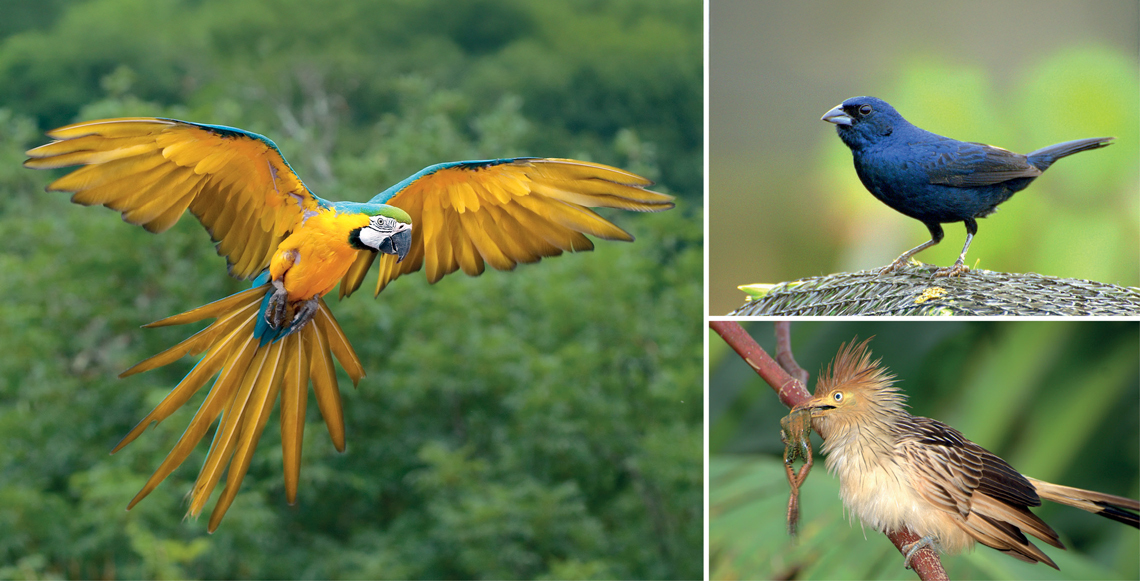
Luc Viatour / Wikimedia Commons | Dario Sanches / Wikimedia CommonsThe blue-and-yellow macaw—now frequently seen in Brasília; the blue-black grassquit—whose song changes depending on the region (top right); and the guira cuckoo—a known nest raiderLuc Viatour / Wikimedia Commons | Dario Sanches / Wikimedia Commons
Was vocal communication a core focus of your research, or more of a side project?
Bioacoustics became a research line I introduced in our lab at the University of Brasília, back when it was still fairly uncommon in Brazil. It all started with a student, Pedro Diniz, who wanted to study the rufous hornero. I didn’t have any recording equipment, but he had a recorder—and tons of passion. He made real progress, completed a solid PhD, and that’s when I started getting involved. I took a course in bioacoustics, brought in collaborators, and learned how to make recordings myself. Other labs were already researching bird vocalizations at the time, but not necessarily in the context of behavior.
Your master’s was on a rodent species. Why?
After I graduated with my biology degree from UnB, I got a job as a secretary at the Canadian Embassy. Almost a year in, I went back to UnB to pick up some documents and happened to bump into one of my former professors, Cleber Alho. He asked, “Want to go to the US for a master’s on a scholarship?” I said, “Absolutely! But what would I be doing?” I was sent to the University of Oklahoma with a project they wanted me to work on—on rodent taxonomy. I spent the whole program visiting museum collections, taking 24 measurements on each tiny skull of Bolomys lasiurus using a caliper. By the end of my master’s, I was completely disillusioned. I thought, “This isn’t biology—not the kind I love.” I didn’t know what I did love, until I took an ornithology class taught by Douglas Mock. He focused a lot on animal behavior in his lectures. I became hooked. “This is what I’ve been looking for,” I thought. My advisors—Michael Mares at the University of Oklahoma and Cleber Alho at UnB—fully expected me to stay in taxonomy. But the moment Michael left for a conference, I bolted from the museum. When he got back, I apologized profusely and told him I was switching to behavior. I’d already moved to a new lab and arranged for a new advisor, Gary Schnell.
What has changed since you began researching animal behavior at UnB?
During my first ten years, I felt like I was working in the dark. At the time, there were very few academic openings for researchers in animal behavior anywhere in Brazil. I remember once, a student enrolled in a master’s program under a genetics professor but also wanted to study behavior. We co-led a project using flies. When we presented it to the grad committee, a faculty member from another department laughed and said, “Since when do flies exhibit behavior?” I thought, “Dear God, I’m stuck in the Middle Ages.” It took years before more labs emerged across Brazil and animal behavior gained recognition as a serious field.
That colleague’s comment is pretty shocking…
I returned to Brazil with a strong foundation in sociobiology, which was already well established—especially in the US [sociobiology explores social behavior in animals, including humans, through the lens of evolution, psychology, and genetics; see the E. O. Wilson obituary in Pesquisa FAPESP issue n° 312 and the Carlos Brandão interview in issue n° 317]. When I taught my course on animal behavior and sexual selection, I always began with a disclaimer: explaining a behavior, even in humans, is not the same as approving of it. People sometimes lean on biology to justify uncomfortable behaviors like infanticide—which, yes, occurs in many species, including humans. Yes, we can explain it biologically, but that doesn’t mean it’s acceptable to us. You can’t just take evolutionary or ecological reasoning and apply it directly to human behavior—it doesn’t work that way, and it can send the wrong message. That distinction was often hard for people to grasp. In 2011, I launched a class called Sexual Selection and Reproduction, and 130 students enrolled—but there were only 25 seats. It took a while for people to realize I wasn’t going to teach the Kama sutra—that it was about animal biology.
You’ve studied dragonflies, primates—even whales. What do such wildly different animals have in common?
The underlying principles are the same. You can apply the same behavioral hypotheses to humans, mammals, reptiles, even insects. What differs is each species’ biology—and the specific ways selective pressures act on them. Ultimately, all organisms are driven by three biological imperatives: survive, find food, and reproduce. Sociality is another common theme. Living in groups helps reduce predation risk—but it also brings new challenges, like competition for food and mates. That dynamic plays out across the entire animal kingdom, from backyard lizards to humpback whales. I didn’t usually seek out new species to study—but my students often pushed me there. One of them, the brilliant Diana Lunardi, wanted to study humpback whales. I said, “Do you see any humpback whales around here in the Cerrado (wooded savanna)?” But she teased my interest in other questions—like foraging, predation, and mating—and eventually convinced me.
In tropical forests, reproduction can occur throughout the year and that reduces the intensity of mate competition
In 2014, you and Glauco Machado of the University of São Paulo coauthored Sexual Selection: Perspectives and Models from the Neotropics [Oxford, UK], arguing that sexual selection in tropical regions operates differently than it does in temperate zones. What sets it apart?
In the tropics, there’s little to no seasonality. In temperate zones—where winters are harsh—breeding seasons are very short, and that shapes behavior. It tends to increase competition for mates, for instance. In places like the Amazon, reproduction can occur throughout the year and that reduces the intensity of mate competition. The problem Glauco and I kept running into—and which eventually led us to write the book—was the assumption among many North American and European researchers that their findings applied globally. These researchers would study just a handful of species—often in laboratory settings—and then make sweeping claims about animal behavior. Glauco and I disagreed. We pushed back and gathered a broader community of scientists to challenge those assumptions. We were able to demonstrate that the patterns we saw in Brazil and across the tropics simply didn’t align with the behavioral findings coming from US and European researchers. The tough part was getting published. Our findings didn’t fit the frameworks that journal reviewers—most of them from the Global North—expected. I would argue that it was because we weren’t working with zebra finches, the standard model organism for so many behavioral studies. Nor were we using lab-bred budgies, which are mass-reared in the US and Europe. We were studying wild tropical species, in their natural habitats. The book was a protest—a challenge to dominant ideas that didn’t suit the tropics. And little by little, as more Brazilian researchers enter international circles, our conceptual framework has gained acceptance [see Pesquisa FAPESP issue n° 244].
What other ideas have you helped challenge or change?
I contributed to early discussions on using genetics to investigate kinship, which turned out to be essential for understanding animal behavior—especially in birds. Around four decades ago, the prevailing view was that birds were monogamous, mammals were not, and fish were… well, hit or miss. Sure, birds often paired off—one male, one female—but what went on inside the nest was a whole different story. Often, the chicks didn’t belong to the male partner. We even found cases where the chicks weren’t related to the nesting female. From an evolutionary point of view, that kind of genetic mixing is beneficial—it boosts genetic diversity. We found that in many species, rates of extra-pair mating—either copulation or paternity—were surprisingly high. I believe this behavior is closely tied to predation—arguably one of the most brutal forces in natural selection. In the case of the grassquit, 80% of the broods in one of our study areas were eaten by predators. But grassquits breed multiple times—four or five—during the rainy season. A male will mate not only with his nest’s female, but also with females from surrounding nests. He spreads his genes far and wide, increasing the odds that some of his offspring will survive. The evolutionary advantage here is avoiding total reproductive failure—ensuring that at least one chick makes it. And for the species as a whole, it enhances genetic diversity, which is also beneficial.
Are you interested in how urbanization affects bird behavior?
Some of my students have explored this topic. One in particular—Renata Alquezar—did a fantastic and important PhD project showing how airport environments influence bird vocalizations. Noise pollution has major effects—not just on song, but on birds’ biology and how they interact with one another. Some species shift their singing schedule to avoid the loudest times with frequent takeoffs. Others actually change the pitch of their songs. They start singing at a higher frequency and boost their volume—much like we shout over the noise in a crowded bar.
In São Paulo, for example, you’ll hear thrushes singing at 2 a.m.
At 2 a.m.? That’s far from normal. We’ve also found that some birds just can’t adapt to highly urban areas—they disappear. The ones that stick around are the most flexible, the best urban adapters. Species like the rufous hornero, house wren, thrush, and great kiskadee are urban regulars—they thrive in city environments. But many others just can’t cope. Back in the 70s and 80s, campo flickers and guira cuckoo flocks were everywhere in Brasília. Now, they’re a rare sight. On the flip side, we’re now seeing a surge of blue-and-yellow macaws—birds typically found in the Amazon—showing up in large numbers. Something is driving them into this region.
Some bird species living near airports shift their singing schedule to avoid the loudest times with frequent takeoffs. Others actually change the pitch of their songs
How is life one year after retiring from UnB?
Stepping away from the university wasn’t easy. I still had work to do and students to mentor. But I’ve always believed in leaving the party while it’s still lively. And I had this long-standing passion for art that I was finally ready to explore. I set out to start a new path—and it’s been wonderful. No pressure, no stress. I’m still getting used to life without deadlines. It’s strange, after decades of rushing from task to task.
What’s it like to take up an old passion?
My love of painting never faded. I’ve always lived with one foot in the art world. Even at my university, I’d find myself noticing the way light hit someone’s ear and thinking, “what a beautiful color.” I kept a modest artistic practice over the years. I painted when I had time and occasionally put on a show. So this new phase isn’t exactly a rediscovery. I started taking classes again—with instructors who were young, 30-something painters… I had to step back into the role of student, hearing feedback and being corrected. That part took some getting used to. I still read a lot about genetics, physiology—biology in general. I’ll read one science book, then two fiction books to balance it out. I love short stories with happy endings—they help restore my faith in humanity. I especially enjoy painting portraits. Landscapes are fun too, but they’re easier—you can add a branch or move a rock and no one questions it. But capturing the human face? That’s a whole different level. You need real precision to get the expression, the eyes, just right.
How long have you been painting portraits?
Since I was about seven or eight. I used to sit my little sisters down and demand they stay still so I could draw them. But of course, they’d squirm and protest—it never quite worked out. These days, my daughters are my favorite models. For Christmas, I always ask, “Can I have an hour in the studio to photograph you?” Then I paint from those photos. It’s my way of keeping them close. One lives in São Paulo, the other in Brasília. I even managed to hold a few art shows while I was still at UnB. My most recent one was last year at Brazil’s Supreme Court of Justice.
How did biology enter your life when you were clearly already set on art?
My dad was in the Air Force and got transferred to Canada when I was about six. We came back when I was nine, and at that point, I couldn’t read or write in Portuguese and barely spoke it. My mom took a job at the American School so my sisters and I could study there. By the time I was 16 or 17, I had fallen in love with biology. After high school, I got a scholarship to study fine arts in the US. I moved to Boston alone at 18. I spent two years studying fine arts, but I also took electives in marine biology, genetics, and cell biology. I loved every one of them. But art was still my main focus. Then I came back to Brasília and had a moment of clarity: “I’m not going to make a living off painting.” Honestly, even today, I don’t think I could. I made the practical choice and enrolled in biology at UnB. I’ve never once regretted it.
The above interview was published with the title “Regina Macedo: The art of observation” in issue 352 of April/2025.
Republish