Brazil’s new National Plan for the Recovery of Native Vegetation (PLANAVEG), launched in December by the Ministry of the Environment and Climate Change (MMA), set out the country’s latest strategies for the goal of recovering 12 million hectares (ha) of native vegetation by 2030. The commitment was made as part of the Paris Agreement, an international treaty signed in 2016 by 195 countries with the objective of curbing the impacts of climate change and limiting global warming to below 2 degrees Celsius.
According to PLANAVEG 2025–2028, four “intersecting strategies” (monitoring, stimulating the production chain, funding, and research) will be combined with “implementation arrangements” with the objective of recovering native vegetation in permanent conservation areas, legal reserves, and protected areas, in addition to public areas and low-productivity farms.
Biologist Rita Mesquita, Secretary of Biodiversity, Forests, and Animal Rights at the MMA, argues that is important to recover species diversity, ecological processes, and environmental services to prevent loss of the natural system’s capacity to respond to future impacts, such as those caused by climate change. “To this end, it is essential to have good information about all biomes, because each ecosystem will follow a different trajectory based on its unique environment,” she explains regarding regeneration behavior.
A study published in the journal Biological Conservation in February could contribute to efforts by environmental and land management agencies by identifying priority areas for recovery in each of the six Brazilian biomes: the Amazon, the Cerrado (wooded savanna), the Caatinga (semiarid scrublands), the Pampas, the Atlantic Forest, and the Pantanal. Priority areas are selected based on the amount of land available for native species and potential for improving functional connectivity—when the landscape allows for species dispersal and establishment through the movement of pollen, seeds, and organisms between fragments of vegetation.
The study involved more than 80 researchers from universities, research institutions, and environmental organizations across Brazil and abroad. The results were reached using a methodology that combined the development of species distribution and territory connectivity models with the application of a linear programming algorithm to optimize restoration, prioritizing areas with the greatest impact on ecosystem diversity and integration.
“The model simulates how each pixel of a deforested area would be restored and identifies how each criterion can be optimized,” explains biologist Luisa Fernanda Liévano-Latorre, lead author of the article and a researcher at the International Institute for Sustainability (IIS), a private environmental organization based in Rio de Janeiro. One of the model’s features determines the potential distribution of each species in a chosen area.
The study authors identified 76 million ha as priorities for restoration across the six biomes. The areas were previously covered by natural ecosystems and are now occupied by crops, pasture, and commercial forests. Urban areas and mining regions, where the regeneration of native vegetation is unfeasible, were excluded.
In relation to biodiversity, the group analyzed 8,692 plant species (angiosperms) and 2,699 animal species from both terrestrial and aquatic environments. They concluded that if 30% of the priority areas were regenerated, the habitat available to these species could increase by as much as 10%, while functional connectivity could increase by an average of 60% compared to the current situation, which was used as a control.
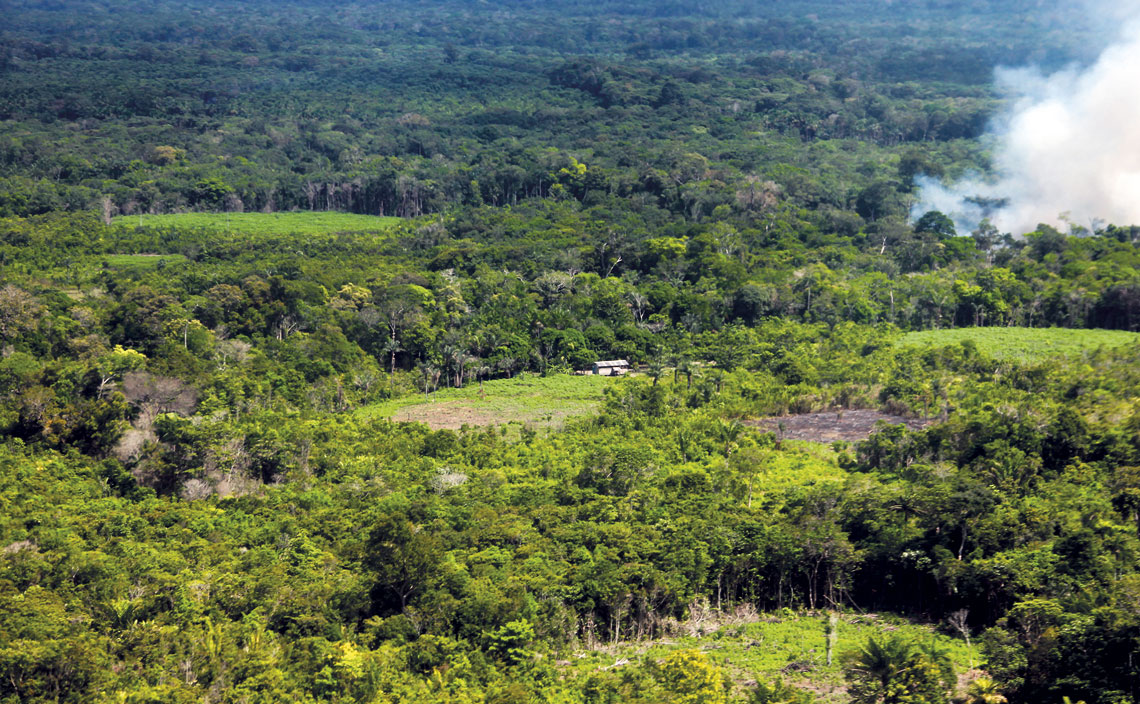
Catarina Jakovac / UFSCForest undergoing regeneration, interspersed with areas of slash-and-burn agriculture in Central AmazoniaCatarina Jakovac / UFSC
The study analyzed organisms with various dispersal capabilities, covering a broad spectrum of fauna and flora, making the outcome more reliable. The benefits would be most significant in the Cerrado, where connectivity would increase by more than 80%, followed by the Amazon, the Atlantic Forest, and the Caatinga (over 70%), then the Pampas and the Pantanal (up to 50%).
Mesquita points out that in addition to highlighting areas where efforts should be focused, the connectivity data are important to public management, saying: “they need to be used more in decision making, including in relation to production plans, since production is ineffective in unviable landscapes.” The biologist, who did not participate in the study, believes the restoration of native vegetation should seek to make ecosystems more resilient.
The Biological Conservation article classified some of the identified areas as high priorities due to being high in biodiversity and facing strong pressure. Many are transitional zones between biomes. In the Amazon, the areas are mostly located in the deforestation arc at the southern border of the biome.
According to the study, if 30% of its restorable areas were recovered, the region could retain more than 50% of its maximum carbon storage potential, significantly helping to mitigate climate change. The Amazon has the greatest carbon capture capacity of the ecosystems analyzed.
“Thinking about the Amazon as a whole, success is limited by two factors: the number of times the rainforest has been cut down, meaning the frequency of deforestation; and the history of use before regeneration began,” explains biologist André Giles, a postdoctoral researcher at the Federal University of Santa Catarina (UFSC). Giles was lead author of a study published in the journal Communications Earth & Environment in December that suggested indicators for measuring the success of regeneration and support actions designed to preserve the territory and mitigate climate change in the Amazon.
The study involved 29 researchers from Brazil and foreign institutions—including Mesquita, from MMA—who identified four key indicators: basal area, which represents the forest structure and vegetation density; structural heterogeneity, which measures variations in the size of the trees, indicating a more balanced ecosystem; native species richness, which describes the biodiversity of the secondary forest; and aboveground biomass, which indicates the amount of carbon stored in the vegetation, essential for estimating the role of the forest in mitigating climate change.
“It is not just about planting trees, but about rebuilding complex ecosystems,” emphasizes agricultural engineer Ima Vieira of the Emílio Goeldi Museum of Pará, coauthor of the article. “Our indicators show exactly how to do that efficiently and measurably.”
The authors defined the indicators based on analyses of 448 secondary forest parcels in 24 locations across the Amazon, establishing reference values to assess the integrity of forests after 5, 10, 15, and 20 years of regeneration, which enabled them to compare forest development with ideal restoration standards.
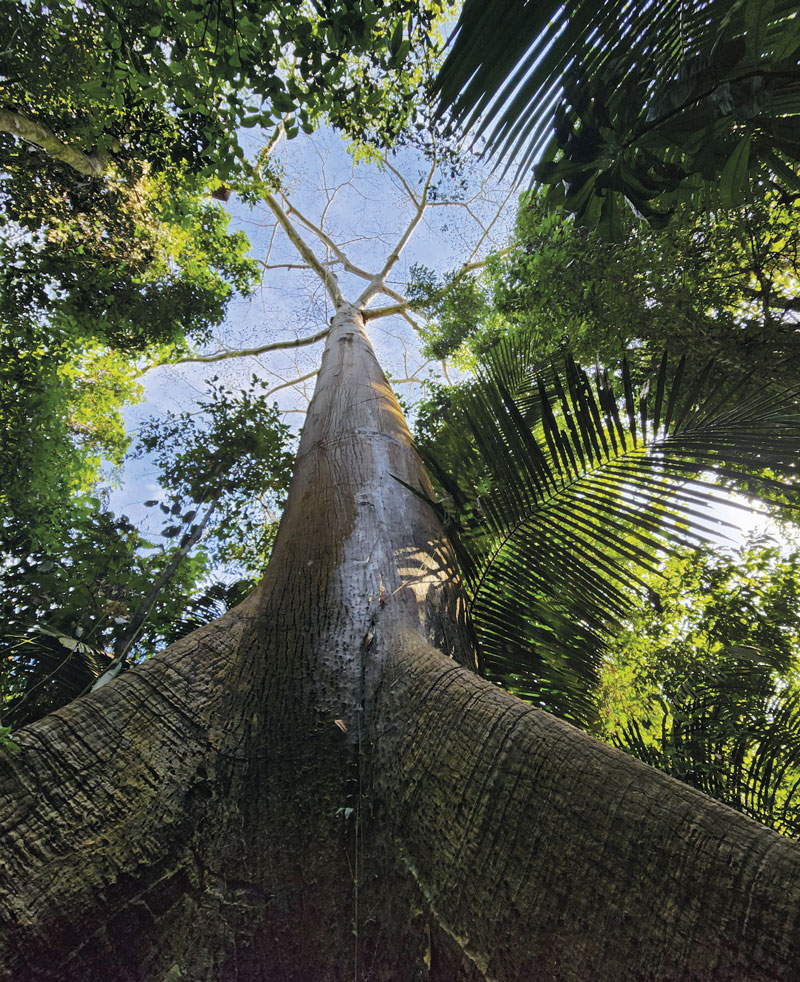
André Giles / UFSCKapok tree (Ceiba pentandra), a remnant of original forest in a restored area in the Tapajós-Arapiuns Sustainable-Use Reserve in ParáAndré Giles / UFSC
“We created a model with an optimal natural regeneration scenario to define the values of this restoration trajectory,” explains Giles. “From there, we arrived at what indicators are important to integrity, and how they have to act together to achieve the expected result in flora restoration.”
Based on the analyses carried out to determine the recovery trajectory, the researchers realized that the impacts are more severe in areas that have suffered from deforestation multiple times or that have been subject to long periods of agricultural use. Soil texture and compaction also influence the restoration process. “Soils containing more clay can limit the establishment of new species, possibly because they are more susceptible to degradation through use,” explains Giles.
Although the data and indicators are restricted to the Amazon, it may be possible to adapt them to similar ecosystems. Biologist Fátima Arcanjo, who did not participate in the study, says data for the Atlantic Forest, the ecosystem where she does her research, is still limited. “Here, the scenario would be different because there is greater degradation and less ecological connectivity. It is thus necessary to consider active restoration,” she points out, referring to the practice of planting native seedlings.
Arcanjo is a professor at the Federal University of Uberlândia (UFU) and head of a flora restoration project at the Applied Ecology Laboratory of the Federal Rural University of Rio de Janeiro (UFRRJ). Her team is investigating gradual ecological changes that occur over time in the composition, structure, and functioning of vegetation in areas of the Atlantic Forest undergoing active restoration.
An article published in the journal Nature Sustainability in February warned that over 186,000 ha of mature forest in the biome gave way to crops, pasture, livestock and commercial forestry between 2010 and 2020, The authors identified 14,401 sites of deforestation, totaling 186,289 ha, many of which appeared to have been cleared illegally.
The data indicate that 73% of mature forest losses occurred on private land, with the largest amount of deforested area (40% of the total) situated within large properties. “The sizes of these areas are directly related to the production methods and the type of activity for which the native vegetation is being cleared,” explains ecologist Silvana Amaral of the Brazilian National Institute for Space Research (INPE), lead author of the article.
Not even protected areas, such as conservation units and Indigenous lands, escaped the destruction of native forests, exposing failures in the enforcement of the Atlantic Forest Law of 2006, which establishes specific rules for the use, exploitation, and conservation of the biome.
The study used a combined methodology of remote sensing, spatial statistics, and geospatial data to map and understand the loss of old-growth forests where degradation was not visible in satellite imagery. This approach, which could be applied to other biomes, made it possible to identify the main drivers of deforestation, the people involved, and the flaws in conservation policies.
“In addition to providing the data used and results, we described all the steps we took. Adapting the method to another biome would require professionals who are experts in that ecosystem and are able to recognize the different land uses and covers to which the native vegetation has been converted,” explains Amaral.
The story above was published with the title “Where to reforest” in issue in issue 350 of april/2025.
Scientific articles
LIÉVANO-LATORRE, L. F. et al. Addressing the urgent climate and biodiversity crisis through strategic ecosystem restoration in Brazil. Biological Conservation. Vol. 302, 110972. Feb. 2025.
GILES, A. L. et al. Simple ecological indicators benchmark regeneration success of Amazonian forests. Communications Earth & Environment. Vol. 5, 780. Dec. 20, 2024.
AMARAL, S. et al. Alarming patterns of mature forest loss in the Brazilian Atlantic Forest. Nature Sustainability. Online. Feb. 13, 2025.