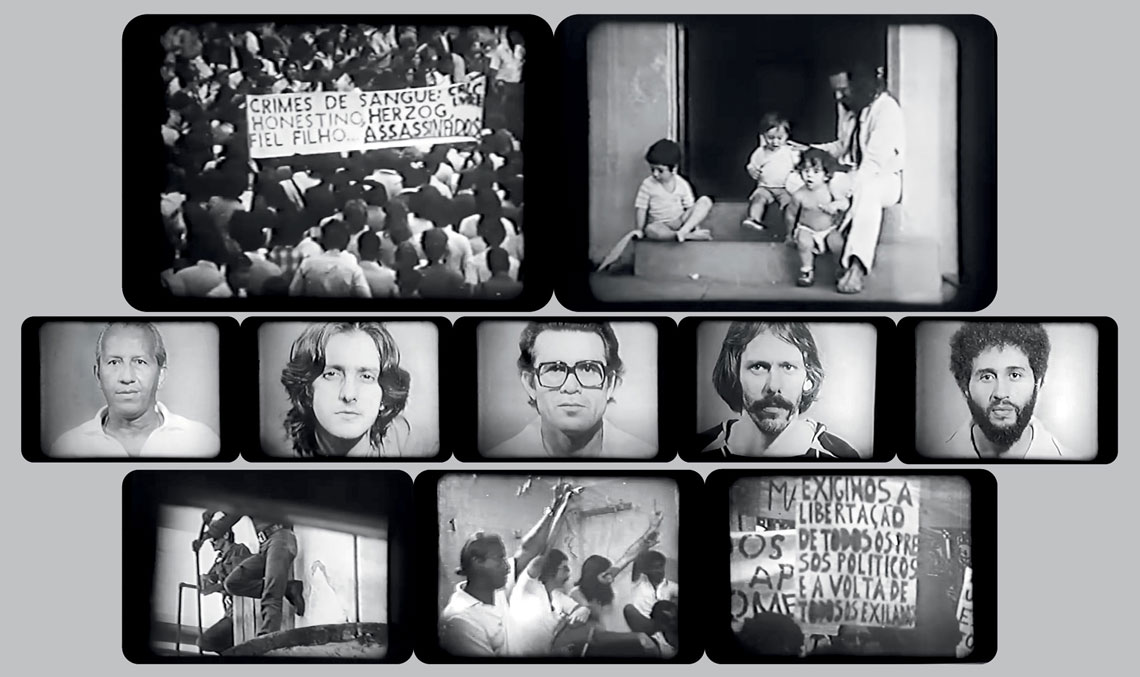
A film made by 14 political prisoners during a hunger strike at Frei Caneca prison in Rio de Janeiro, in August 1979—at the height of Brazil’s military dictatorship (1964–1985)—was given a second chance at public screening last year. Açúcar, água e sal (Sugar, water, and salt), a 15-minute short film, has been available since March on the YouTube channel run by Práticas do Contra-arquivo, a research group at the Pontifical Catholic University of Rio de Janeiro (PUC-RJ).
When they shot the film in 1979, the prisoners hoped to pressure Brazil’s National Congress to expand the scope of the Amnesty Law it was about to vote on. They had access to a handheld camera, originally allowed inside to film the birthday of one prisoner’s son during a visiting day, and later used it to record testimonials and scenes from the hunger strike. The film negatives were smuggled out of the prison. A friend of the prisoners took on the task of filming street protests and assembling the final cut. The film’s title refers to the homemade saline solution that some prisoners drank to survive the strike.
After 32 days, the prisoners ended their protest without seeing their demands met. The film was only completed after the Amnesty Law had been approved—too late to influence the vote—and was publicly screened just once, in 1999, at a meeting of former resistance members. Decades later, a growing scholarly interest in footage shot by both professional and amateur filmmakers during Brazil’s military dictatorship—when political repression and censorship stifled the circulation of such images—led to the film’s reemergence.
“We hope to recover images the military regime never wanted to be seen,” says Patrícia Furtado Mendes Machado, a professor at PUC-Rio and head of Práticas do Contra-arquivo. The original negatives of Açúcar, água e sal are housed in Brazil’s National Archives in rather poor condition. But Machado managed to obtain a digitized copy from former guerrilla fighter Paulo Roberto Jabur, one of the prisoners who wielded the camera back in 1979.
The short film contains rare glimpses of political prisoners’ daily lives during a pivotal moment in Brazil’s democratic opening—while also exposing the deep tensions that defined the regime’s final years. The Amnesty Law allowed exiled politicians and activists to return home and shielded state agents who had committed torture and murder. But it excluded those convicted of robberies, kidnappings, and terrorist acts. The prisoners who staged the 1979 hunger strike were serving time for such charges and would have to fight lengthy court battles to win their release.
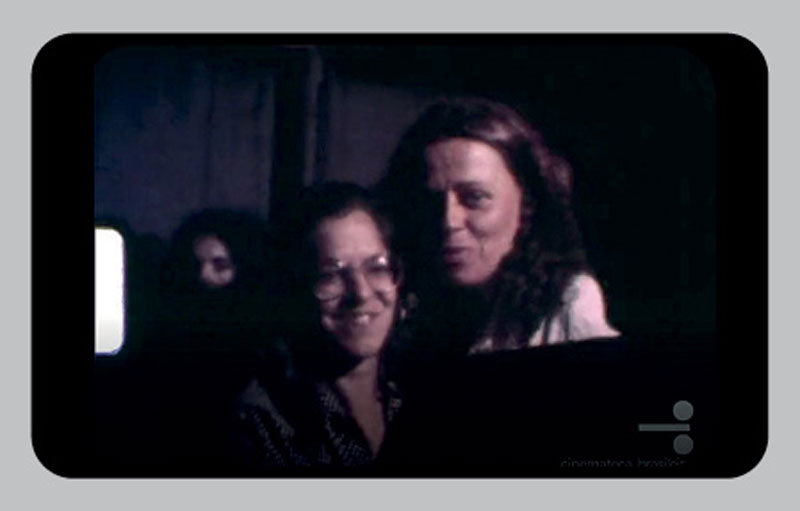
Cinemateca BrasileiraFormer guerrilla fighter Inês Etienne Romeu (left) with actress Norma Bengell on the day of her release in 1979Cinemateca Brasileira
With funding from the Rio de Janeiro State Research Foundation (FAPERJ), Machado and her team launched a project in 2023 to build an archive of images made outside state control—material that can challenge not only the dictatorship’s official narrative but also other dominant accounts of that period. Machado calls this collection a “counter-archive,” borrowing a term from a Canadian research network focused on preserving the audiovisual memory of marginalized groups, including Indigenous peoples, Black communities, women, immigrants, and LGBTQ+ individuals.
The Brazilian researchers also adopted a methodology developed by French historian Sylvie Lindeperg, of Université Panthéon-Sorbonne in Paris, in her study on Night and Fog (1956), a documentary on the Holocaust by French director Alain Resnais (1922–2014). “Beyond analyzing the films, we investigated the historical context in which these images were created to understand how they survived and how they’ve been reinterpreted over time,” says Machado, who authored the book Cinema de arquivo: Imagens e memória da ditadura militar (Archive films: Images and memory of the military dictatorship; Sagarana, 2024), based on her doctoral thesis defended at the Federal University of Rio de Janeiro (UFRJ) in 2016. In her book, she examines the complex journeys of images like those shot by filmmaker Eduardo Escorel and journalist and film critic José Carlos Avellar (1936–2016) during the funeral procession of Edson Luís de Lima Souto (1950–1968).
Edson Luís, a student killed by riot police during a protest in Rio de Janeiro in March 1968, became a symbol of resistance, and his death sparked outrage across the country.
Escorel left the film reels with a friend working at the cinematheque of Rio’s Museum of Modern Art (MAM) and was only able to recover them in 2007, alongside footage shot by José Carlos Avellar. During her research, Patrícia Machado discovered that some of these scenes were later used in short films about torture in Brazil, produced between 1969 and 1970 by French filmmaker Chris Marker (1921–2012). Documents she located suggest that the Cuban Institute of Cinematographic Art and Industry (ICAIC) was likely the source of this material.
“There were international solidarity networks that helped circulate these films at festivals and in underground circuits, hoping to generate international pressure against Brazil’s dictatorship,” says Carolina Amaral de Aguiar, a historian at the Institute of International Relations (IRI) of the University of São Paulo (USP). Aguiar researched Marker’s collaborations with Cuban filmmakers in her doctoral dissertation, defended at USP in 2013.
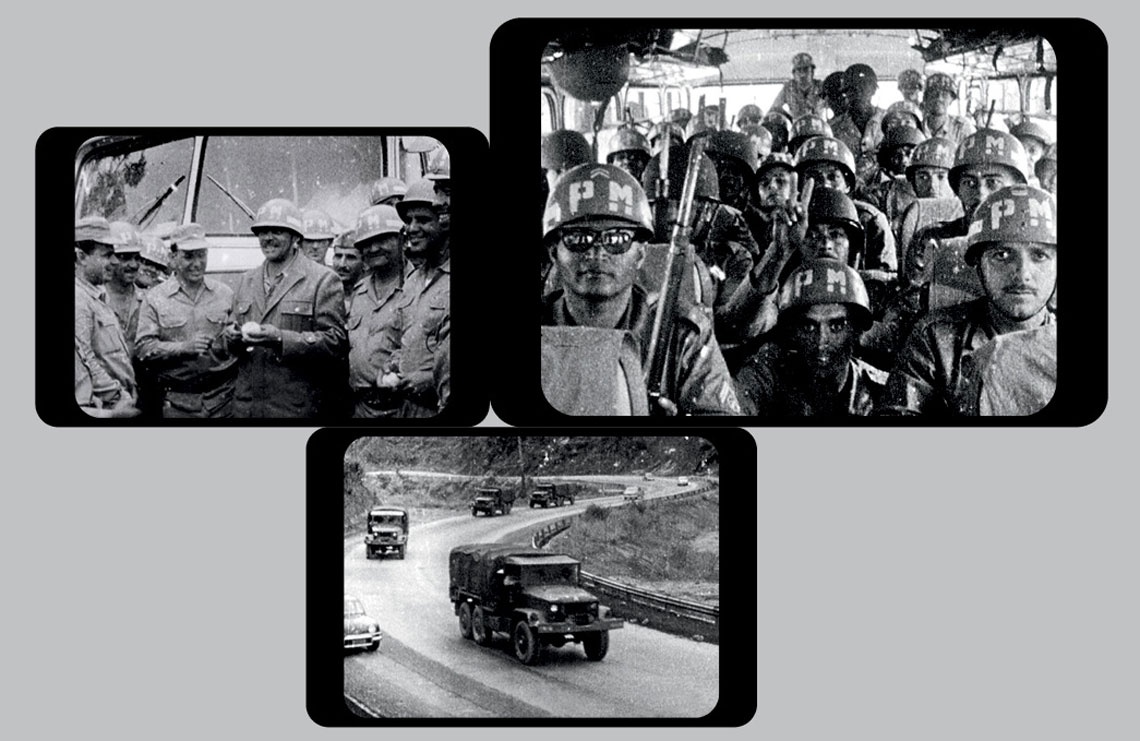
1964, antecedentes / Source Unknown / National ArchiveTroops moving toward Rio de Janeiro following the onset of the 1964 coup, from footage preserved in the National Archives1964, antecedentes / Source Unknown / National Archive
Additional evidence of these transnational networks was recently uncovered by historian Marcos Napolitano, also from USP, in a Soviet newsreel aired just days after Brazil’s 1964 military coup. The six-minute, soundless footage is now available on the Russian platform Net-Film. While some shots are similar to images circulated by Brazilian newsreels of the era, others appear unique. Among the images that caught Napolitano’s attention were scenes of clashes between the Brazilian military and demonstrators protesting the coup in downtown Rio de Janeiro. “We don’t know who captured these images or how they ended up in the Soviet Union, but they reveal the extent of resistance to the coup in its earliest moments, which was minimized by official accounts and the mainstream press in 1964,” says Napolitano.
As part of a thematic research project funded by FAPESP, Napolitano is currently reviewing television news programs produced by the now-defunct TV Tupi network. He hopes to explore how the broadcaster covered the days immediately following the military takeover. The vast archives kept by TV Tupi, which went bankrupt and off the air in 1980, were transferred in 1987 to the Brazilian Cinematheque in São Paulo. Among its holdings are 150,000 news reports aired between 1950 and 1974, of which 77,000 have been cataloged so far. Yet only a small portion has been digitized. Historian Eduardo Morettin, who heads the project from the Department of Cinema at the School of Communications and Arts (ECA) at the University of São Paulo (USP), says the team hopes to contribute at least 200 hours of newly digitized, previously unavailable footage to the Cinematheque’s collection—roughly 10% of what is currently accessible. “This material can shed light on how Brazilian television shaped public memory of these events and influenced the political debates of the military era,” Morettin explains.
The PUC-Rio research group has also been working on several parallel research fronts. One of them is exploring films made by women during the dictatorship, following an extensive survey of multiple archives led by independent researcher Nayla Guerra, a cultural producer at the Brazilian Cinematheque. Drawing on a FAPESP-funded undergraduate research project at ECA-USP, conducted between 2019 and 2021, Guerra uncovered records of 222 short films made by 121 women filmmakers during the dictatorship. She compiled her findings into the book Entre apagamentos e resistências: Curtas-metragens feitos por diretoras brasileiras (1966–1985) (Between erasure and resistance: Short films by Brazilian women directors [1966–1985]), published by Alameda last year.
“The existence of these films shows that women played a prominent role in resisting the regime,” says Thais Continentino Blank, of the Fundação Getulio Vargas Center for Research and Documentation of Contemporary Brazilian History (CPDOC-FGV) in Rio de Janeiro. In collaboration with Patrícia Machado, Blank has also been researching the biography of actress and filmmaker Norma Bengell (1935–2013), a feminist activist and outspoken defender of political prisoners during the dictatorship.
In 1974, Norma Bengell joined forces in France to produce a short film about Inês Etienne Romeu (1942–2015), a former guerrilla fighter who had spent 96 harrowing days imprisoned in Casa da Morte (“House of Death”)—a clandestine torture center in Petrópolis, Rio de Janeiro—and later served time in a regular prison. The film, created by a feminist collective called As Insubmusas and directed by renowned French actress Delphine Seyrig (1932–1990), was screened at festivals as part of a campaign for Etienne Romeu’s release.
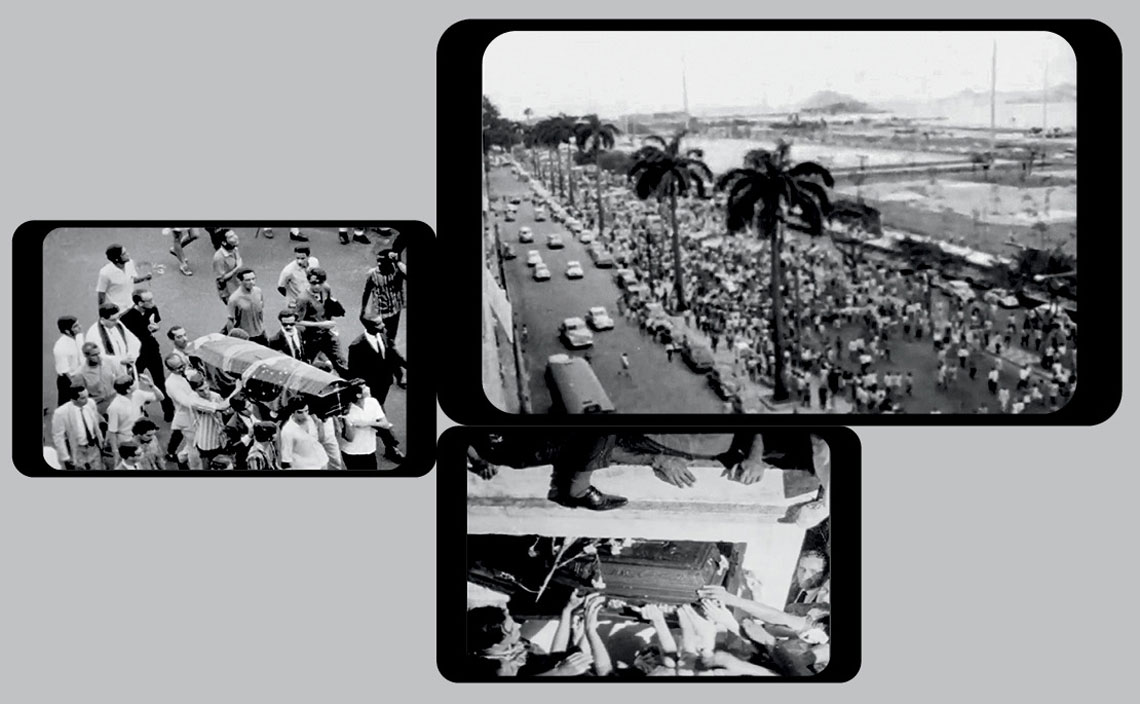
Cinema de Arquivo: ImagenseE Memória da Ditadura Militar / Courtesy of Sagarana EditoraThe funeral procession and burial of student Edson Luís, filmed by Eduardo Escorel in 1968Cinema de Arquivo: ImagenseE Memória da Ditadura Militar / Courtesy of Sagarana Editora
Romeu was finally freed in 1979, following Brazil’s Amnesty Law, and her first moments of freedom were captured on film by Bengell, who met her in person for the first time that very day. Shot on a Super 8 camera, the nearly 11-minute film was preserved in Bengell’s personal archive, which was later acquired by the Brazilian Cinematheque. Digitized in 2022, this rare footage is now publicly accessible via the Cinematheque’s Cultural Content Bank, hosted on its website.
Historians exploring the period have also made new discoveries by revisiting materials produced by the military regime itself. One such scholar is Fernando Seliprandy of the Federal University of Paraná (UFPR). During his FAPESP-funded postdoctoral research at ECA-USP, completed in 2023, Seliprandy analyzed two films preserved at Brazil’s National Archives, both made in 1972 to celebrate the 150th anniversary of Brazil’s independence.
One film was directed by journalist, politician, and businessman Amaral Netto (1921–1995) and funded by cooking gas distributors. The other was sponsored by Souza Cruz, then a major cigarette manufacturer. “These films reveal how the military regime’s official propaganda relied on private producers and corporate sponsorships to maximize its reach,” says Seliprandy.
According to researchers interviewed for this article, Brazil’s National Archives hold an enormous trove of still-untapped material, much of it yet to be cataloged. Among these neglected collections is a set of amateur films assembled in the 1980s by Clovis Molinari Junior (1953–2019), a longtime staff member of the institution.
One highlight of the collection is a 31-minute film that documents key events leading up to the 1964 military coup, including the movements of troops rebelling against President João Goulart (1919–1976), and the waves of civil unrest that followed his overthrow. “The donor of this footage remains unidentified, as do the people behind the camera,” says historian Mariana Lambert Passos Rocha, an archivist at the National Archives who analyzed the film as part of her master’s thesis, defended at Fundação Getulio Vargas (FGV) in Rio de Janeiro in 2023. After examining the markings on the reels kept in the archive, Rocha concluded that the final edit of the film was most likely assembled in 1977—a time when it was still uncertain whether Brazil’s military would move toward a democratic opening. “That could explain why the footage remained hidden for so long,” Rocha suggests.
The story above was published with the title “xxx” in issue in issue 348 of february/2025.
Projects
1. Audiovisuals, history, and preservation: The place of Brazilian newsreels and television reports in the construction of memory (1946–1974) (nº 22/06032-0); Grant Mechanism Thematic Project; Principal Investigator Eduardo Victorio Morettin (USP); Investment R$1,767,131.92.
2. Audiovisuals and the 150th anniversary of Independence (1972): Circulation of images of the nation at the crossroads of authoritarian modernization (nº 21/07062-8); Grant Mechanism Postdoctoral Fellowship; Supervisor Eduardo Victorio Morettin (USP); Beneficiary Fernando Seliprandy Fernandes; Investment R$112,757.50.
3. Between erasure and resistance: Short films made by female Brazilian directors (1966–1985) (nº 18/22648-6); Grant Mechanism Undergraduate Research Grant; Supervisor Eduardo Victorio Morettin; Beneficiary Nayla Tavares Guerra; Investment R$15,211.46.
Scientific articles
BLANK, T. C. & MACHADO, P. F. M. Em busca de um método: Entre a estética e a história de imagens domésticas do período da ditadura militar brasileira. Intercom: Revista Brasileira de Ciências da Comunicação. Vol. 43, no. 2. 2020.
BLANK, T. C. & MACHADO, P. F. M. Inês e Norma: Caminhos cruzados em imagens, arquivo e militância. Acervo, Vol. 37, no. 1. 2024.
NAPOLITANO, M. O golpe de Estado (1964) no Brasil visto por um cinejornal soviético. Fotocinema. no. 20. 2020.
SELIPRANDY, F. Circuitos da propaganda oficiosa: Amaral Netto comemora os 150 anos da Independência (1972). Estudos Históricos. Vol. 37, no. 82. 2024.
Books
GUERRA, N. Entre apagamentos e resistências: Curtas-metragens feitos por diretoras brasileiras (1966-1985). São Paulo: Alameda, 2024.
MACHADO, P. Cinema de arquivo: Imagens e memória da ditadura militar. Rio de Janeiro: Sagarana, 2024.