


“What’s it called? Raio que o parta?! Good Lord… Heaven forbid!” That was the reaction of a resident of Santarém (Pará) upon learning that the colorful mosaic on the facades of some neighborhood houses had such an unexpected nickname—one that translates literally to “may lightning strike him/it,” and more loosely to “to hell with him/it.” The statement was collected by researchers who compiled the book Raio que o parta: Uma arquitetura marcante no Pará (Raio que o parta: A striking architectural style in Pará; Editora Blucher), published last year and available for free download.
Between the 1950s and 1960s, facades covered in mosaics made from tile shards first spread through Belém, and later across the rest of the state of Pará. “The murals with their motifs of geometric patterns, lightning bolts, and representations of Amazonian fauna, symbolize a popular assimilation of modernism,” says architect Cybelle Salvador Miranda, coordinator of the Laboratory of Memory and Cultural Heritage of the Federal University of Pará (UFPA) and one of the authors of the book.
According to the researcher, the expression is attributed to historian and art critic Donato Mello Júnior (1915–1995). During the graduation ceremony of the first architecture class of what was then the University of Pará, in 1966, for which he was guest speaker, Mello Júnior said in his speech: “Many people from Pará [lacking guidance] covered facades with aggressive shapes and multicolored tile-shard mosaics, in a ‘raio que os parta’ style [sic]. Where did such bad taste come from?”
In 2009, Miranda and architect Ronaldo Nonato Marques de Carvalho, also from UFPA, revived the expression cited by Mello Júnior to transform it—now without irony—into the official name of the typology. Many other studies followed this one, culminating in the book published last year by the duo along with architect Laura de Carvalho da Costa, author of the PhD thesis on the topic defended in 2023 at the same institution.
In the work, the authors analyze the characteristics of this architectural language, its complex relationship with public perception over time, and its future prospects. According to Carvalho, the colorful ornamentation is not just an artistic detail, but rather an integral part of this architecture. Among other things, it highlights the shape of the homes, since on most of them the roof slopes from the front facade toward the back of the lot—enhancing the imposing nature of the street-facing side.
Although the Raio que o parta architectural style first emerged in Belém, it can even be found in neighborhoods on Marajó Island, around 90 kilometers from the state capital of Pará. According to the researchers, the spread across the state is probably due to the thousands of visitors to Belém for the Círio de Nazaré—a Catholic festival held in the state capital since 1793, on the second Sunday of October.
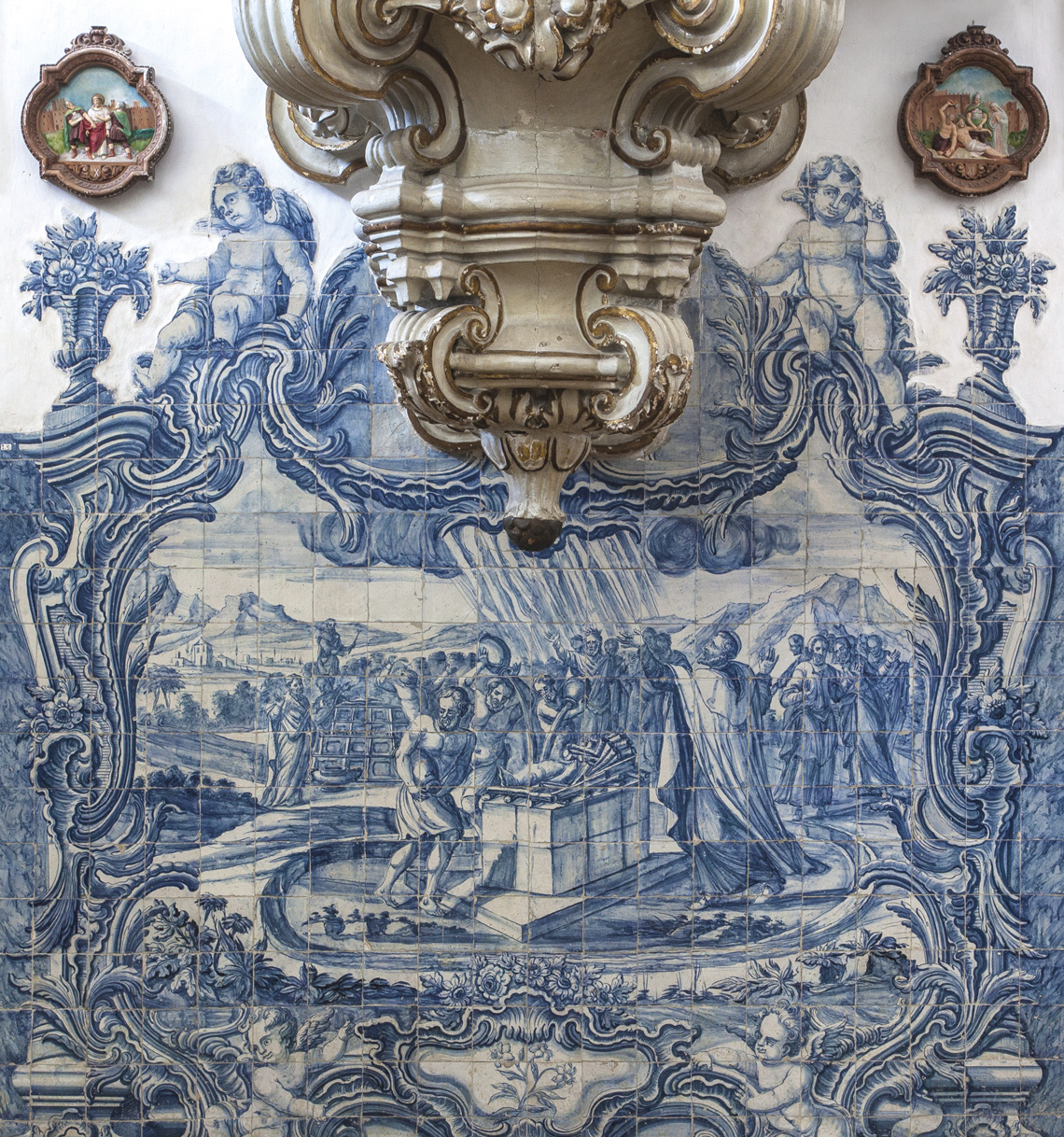
Irene AlmeidaThe mural Milagre do Monte Carmelo, from the eighteenth century, in Paraíba Irene Almeida
The mosaics were initially found on the houses of Pará’s elite and, with time, the style became popular. “At a certain point, some less wealthy families renovated only the facade to add mosaics as a form of ostentation and to increase the property’s value,” observes Carvalho. “The Raio que o parta style became a status symbol.”
For the researchers, this did not happen by chance. “Tile murals act as vehicles of symbolic communication,” says historian André Cabral Honor, from the University of Brasília (UnB), organizer of the book Estudos de azulejaria na monarquia pluricontinental lusitana (Studies of tilework in the pluricontinental Portuguese monarchy; Roma Tre-Press, 2024), available for free download. The collection brings together nine articles by Brazilian and Portuguese researchers who analyze the iconography, meanings, and preservation of Portuguese tile panels, especially from the seventeenth and eighteenth centuries, in both countries.
According to Honor, the Catholic Church was one of the institutions that best understood how to take advantage of this demand for imagery. “To inspire the faithful, tile murals were more effective than paintings on the ceiling. They could be installed at eye level and within hand’s reach,” he emphasizes. The lives of martyrs were often depicted on them, for example. Additionally, the medium democratized the aesthetic experience, “The general public had little or no access to art at that time. The tile murals expanded access to a visual repertoire previously restricted to few.”
As the production of tiles was prohibited in the colonies, Lisbon’s tile producers received orders accompanied by illustrations to be replicated and shipped overseas. These artisans could even add elements that demonstrated their technical and artistic prowess, but had little freedom to change the content without risking upsetting their clients—especially considering that returning a panel made on the other side of the ocean would have been a complicated task at that time. “From the plan with measurements of the installation site, to the choice of the reference image, through scale adaptation, calculating the number of ceramic pieces, production, packaging, transport, and installation, many hands contributed to the final product,” says Honor.
Discussing the originality and uncovering the authorship of the tile panels can be challenging, precisely because of the vast number of procedures involved. As Brazilian architect and researcher Felipe Eugênio da Silva points out in one of the texts from the collection, the mural Milagre do Monte Carmelo (Miracle of Mount Carmel), installed in the eighteenth century in the Igreja de Nossa Senhora do Carmo church, in João Pessoa (Paraíba), used the anonymous print Sacrificio de Elias (Sacrifice of Elijah), published in a 1671 edition of the Royaumont Bible, as its reference.
Even in contemporary and well-documented works, the authors of tile murals can remain unidentified. It is the case with some examples at the Gustavo Capanema Palace, in downtown Rio de Janeiro. The architectural complex, inaugurated in 1945, was built by a team led by architect Lucio Costa (1902–1998) to house the then Ministry of Education and Health. After being closed for a decade and six years of renovation, the building was reopened in May 2025.
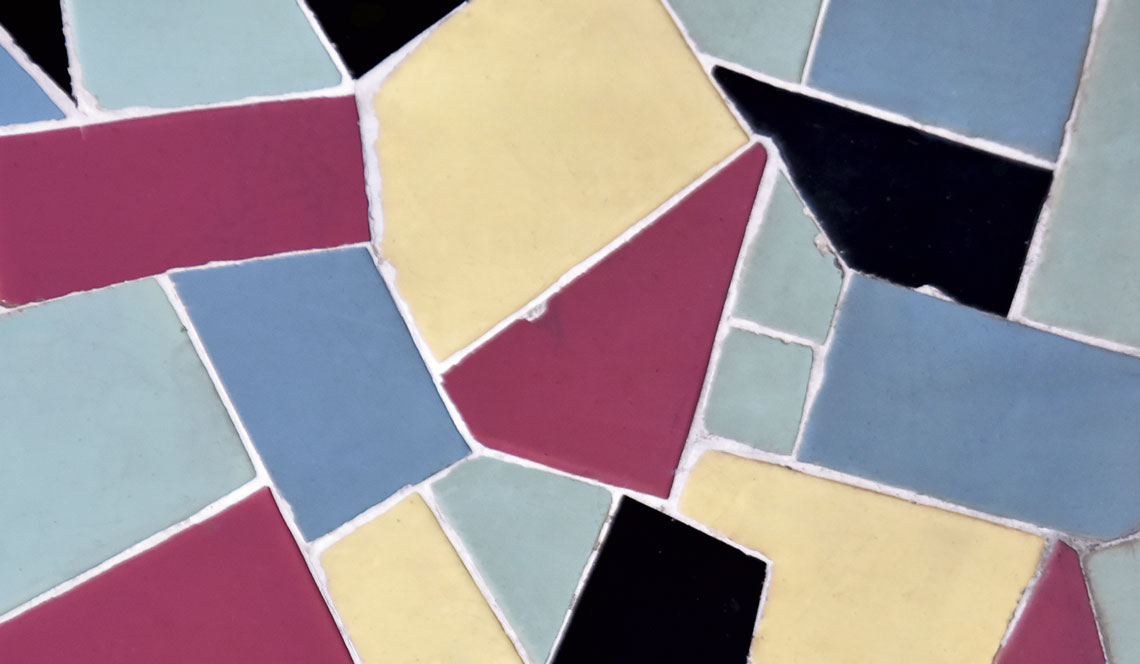
Irene AlmeidaA detail of a panel made with shards of broken tiles Irene Almeida
In an article published in 2023, art historian Iaci d’Assunção Santos, from the State University of Rio de Janeiro (UERJ) and Santa Úrsula University, discusses the authorship of the nine panels installed at the site. Two of them are by painter Cândido Portinari (1903–1962) and even include the finishing tiles—or signature pieces. Another panel is by visual artist Paulo Rossi Osir (1890–1959), who produced all the tiles for the Gustavo Capanema Palace in his workshop, Ateliê Osirarte, in São Paulo.
However, the authorship of the others is unclear. For Santos, this uncertainty allows the set to be understood as the result of a shared effort, woven together by the names Portinari, Osir, and Osirarte itself. “When we talk about the tile-making process, even when the author is clearly identified, the work continues to be defined and marked by the actions and names of all those who contributed to its creation,” says the researcher.
“The question of authorship is just one of the aspects that define the history of tiles,” comments art historian Antônio Celso Mangucci. Based in Portugal since the 1980s, the Brazilian researcher studies Portuguese tilework. In his PhD thesis defended in 2020 at the University of Évora, he studied an eighteenth-century tile ensemble designed by Jesuits to decorate 12 classrooms within the institution. “The designs allude to subjects such as physics and chemistry,” says Mangucci, who runs the website Portuguese Tiles, in Portuguese, Spanish, and English.
His most recent work is the book João Burnay: A coleção de azulejos e a arquitetura neorrenascentista da Quinta da Trindade no Seixal (João Burnay: The tile collection and the Neo-Renaissance architecture of Quinta da Trindade in Seixal; Câmara Municipal do Seixal, 2024). In the book, which has not yet been published in Brazil, the researcher describes the history of the Portuguese building that housed a religious order from the fifteenth to the nineteenth century.
After 1834, the building was secularized. Upon becoming the property of Portuguese industrialist João Burnay, the building underwent renovation and received a vast collection of tiles. “This collection responds to the yearnings of that historical moment: to establish tilework as a symbol of Portuguese identity. That’s because, although the volume of ceramic production in the country was substantial, turning it into artistic heritage was a cultural construct of the nineteenth century,” explains Mangucci.
According to the researcher, the collection of tiles at Quinta da Trindade is composed of many pieces transferred from demolished palaces and convents, removed from their original context to become part of a new narrative. In 1971, Portuguese engineer Santos Simôes (1907–1972) made an inventory of the site and recognized it as a small museum, contributing towards it being listed, and thus protecting the building and its tiles from disappearing.
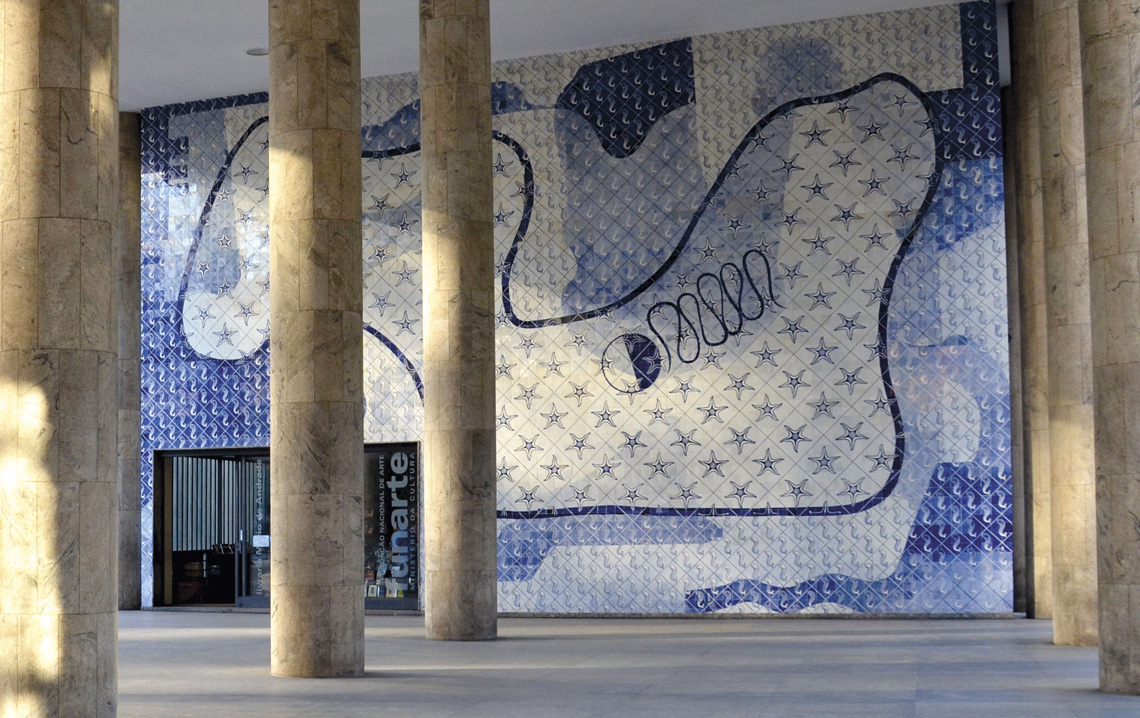
Alessandro Potter / RIOTURA panel by Portinari in the Gustavo Capanema PalaceAlessandro Potter / RIOTUR
The preservation is among the points covered by architect Renata Monezzi in her PhD thesis “Azulejos na arquitetura paulista: Das artes decorativas às artes industriais” (Tiles in São Paulo architecture: From decorative arts to industrial arts), which she defended in 2024 at the University of Campinas (UNICAMP). In her thesis, the researcher analyzes, for example, the tile decoration of four buildings that make up the architectural ensemble built along the Caminho do Mar, literally the road to the sea, as the old road to Santos, the current highway SP-148, used to be known.
The idea of making these interventions along the road came from Washington Luís (1869–1957), who was the president of the State of São Paulo at the time, with the aim of celebrating the Centenary of Independence, in 1922. To execute them, architect Victor Dubugras (1868–1933) was invited, who designed the monuments and buildings, along with visual artist José Wasth Rodrigues (1891–1957), author of the tile panels. “The panels are grounded in nationalist references and reinforced historical narratives about the glories of São Paulo, whether by constructing the idea of the bandeirantes as heroes, or by using other political figures who emphasized the supremacy of São Paulo,” explains Monezzi.
By comparing photographs from the time of the inauguration with the current pieces, the researcher noticed that interventions carried out in the 1960s and 1980s resulted in significant alterations to the original designs. On the panel Rancho da maioridade, for example, Dom Pedro II (1825–1891) and his army were erased. In the new version, the emperor is transformed into a farmer with a short-brimmed hat, and the group of soldiers is replaced by a group of Brazilian backcountry men (sertanejos) on horseback. “The ideas defended in the 1920s were modified to make room for another memory, which celebrated the agricultural elite,” he states. According to Monezzi, these changes compromised the symbolic and artistic integrity of the works.
In Pará, constructions in the Raio que o parta style are at risk. According to Miranda, from UFPA, it is estimated that of around 300 houses in Belém featuring tile shard mosaics, only about 100 remain today. “The proposal to list them has not been well received by the residents,” reports the architect. “As ownership of the houses changes, the emotional attachment to the original designs diminishes. Many mosaics have been painted over and several facades have been redone.”
In the assessment of the researchers from UFPA, preservation of this identity depends on a process of heritage education. In 2024, the university began developing outreach activities, such as cataloging examples and creating a booklet distributed free of charge. “Our aim is to restore pride in such a unique architectural style, but it’s also necessary to provide residents with practical solutions for restoring, cleaning, and reinstalling broken or loose pieces,” concludes Miranda.
The above interview was published with the title “Permanent, but vulnerable” in issue 353 of July/2025.
Scientific article
SANTOS, I. d´A. Feito a muitas mãos: Reflexões sobre a autoria dos painéis de azulejos do Palácio Gustavo Capanema. Revista de História da Arte e da Cultura. no. 2, July–Dec. 2023.
Books
HONOR, A. C. (ed.). Estudos de azulejaria na monarquia pluricontinental lusitana. Roma: Roma Tre-Press, 2024.
MIRANDA, C. S. et al. Raio que o parta: Uma arquitetura marcante no Pará. São Paulo: Blucher, 2024.
