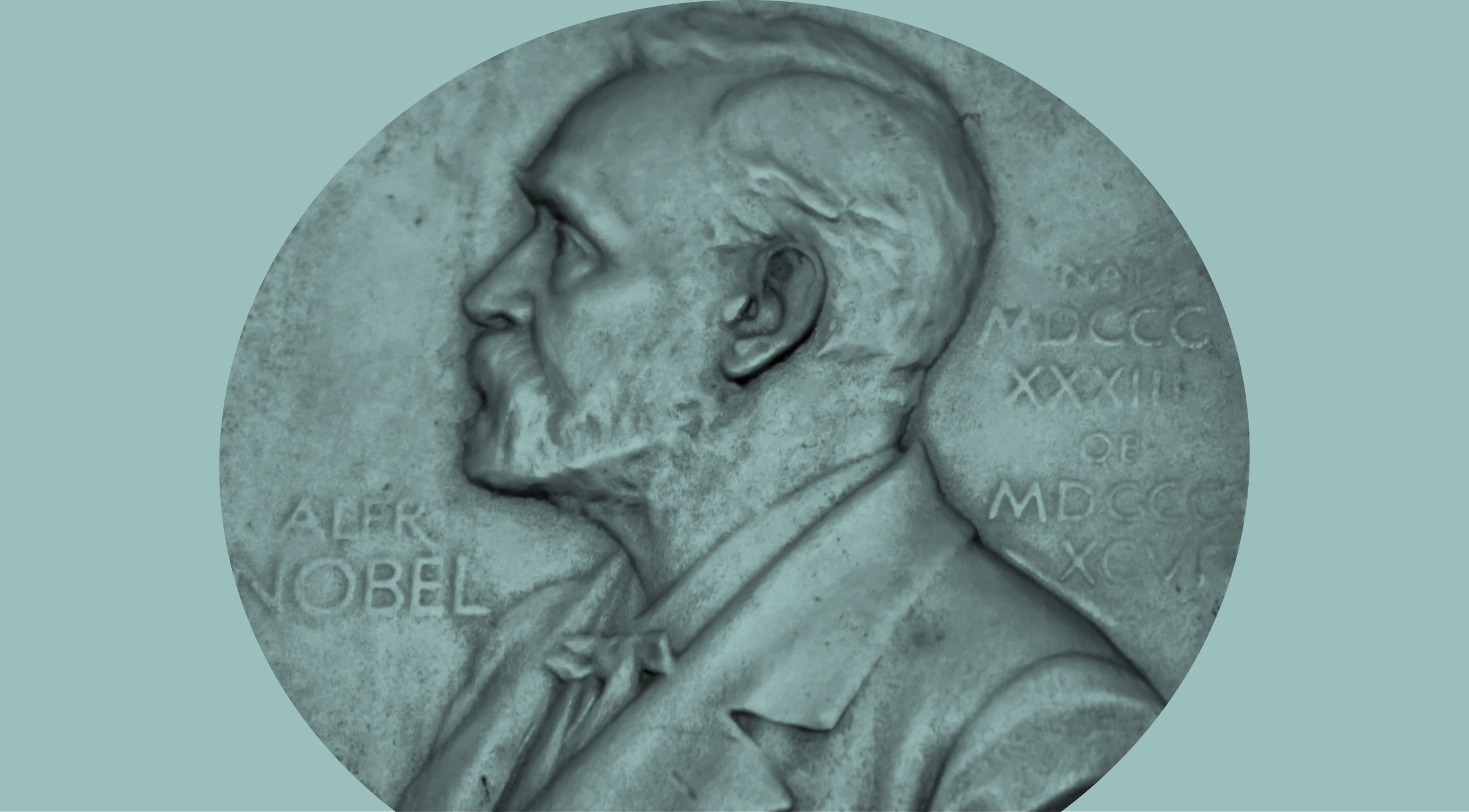
October once again brought the anticipation surrounding the world’s most prestigious scientific honor, awarded primarily by the Royal Swedish Academy of Sciences—with the exception of the Physiology or Medicine and Peace prizes, which are granted by Nobel committees at Sweden’s Karolinska Institute and by a committee appointed by the Norwegian Parliament, respectively. Each prize is valued at 11 million Swedish kronor (about R$6.23 million) and includes a medal to be presented at the ceremony on December 10, the anniversary of the death of Swedish chemist Alfred Nobel (1833–1896). Nobel, who amassed his fortune through inventions such as dynamite, specified in his will that part of his estate should reward individuals who made significant contributions to humanity.
The awarded topics were diverse, each of fundamental importance in its field. Research on the cellular mechanism that prevents severe autoimmune diseases from becoming widespread may inform new drugs and reduce organ-transplant rejection. Advances in understanding the physical properties of atoms and subatomic particles underpin the pursuit of quantum computers. The creation of crystals formed from metal ions and organic molecules, born from curiosity and an appreciation for beauty, has already enabled major applications in gas and fluid absorption. The role of technological innovation in building a sustainable economy also stood out. A Hungarian writer and a Venezuelan politician rounded out the list of honorees.
As often happens, the selection was overwhelmingly male. Of the 14 laureates, only two were women—and just one within the academic categories.

University of Osaka Immunology Frontier Research Center | Institute for Systems Biology (ISB) | Fred Ramsdell / Wikimedia Commons Shimon Sakaguchi, Mary Brunkow, and Frederick Ramsdell identified immune system watchdogsUniversity of Osaka Immunology Frontier Research Center | Institute for Systems Biology (ISB) | Fred Ramsdell / Wikimedia Commons
Physiology or Medicine
Between 1995 and 2003, three immunologists uncovered and detailed how a braking mechanism of the immune system operates: Shimon Sakaguchi, 74, now a professor at Osaka University in Japan; Mary Brunkow, 63, program manager at the Institute for Systems Biology (ISB) in Seattle, USA; and Frederick Ramsdell, 64, of the biotechnology company Sonoma Biotherapeutics in San Francisco. “The discoveries made by these researchers have been decisive for understanding how the immune system functions and why not everyone develops severe autoimmune diseases,” said Olle Kämpe, chair of the Nobel Committee, when announcing the award.
As part of the body’s defense system, T lymphocytes target invading agents, but they can also mistakenly attack the body itself. Normally, malfunctioning T cells are identified and eliminated in the thymus, though some escape this process. Such errors can lead to diseases like type 1 diabetes, multiple sclerosis, and systemic lupus erythematosus.
“Some researchers suspected there might be a secondary control mechanism,” explains immunologist Jorge Kalil Filho, from the University of São Paulo’s School of Medicine (FM-USP). That hypothesis gained strength when Sakaguchi described a new type of cell—the regulatory T cell, or Treg—which acts as a second layer of immune oversight.
Meanwhile, Brunkow and Ramsdell sought the genetic mutation that caused a particular mouse strain, known as scurfy mice, to develop a range of autoimmune conditions. Working at Celltech Chiroscience in Washington State, they identified a mutation in a previously unknown gene, which they named Foxp3.
In 2001, Brunkow, Ramsdell, and colleagues linked Foxp3 mutations to both X-linked polyendocrinopathy and enteropathy (IPEX), a severe autoimmune disorder, as well as to the condition seen in scurfy mice. Two years later, Sakaguchi’s group demonstrated the connection between Foxp3 and the function of regulatory T cells. Understanding how these regulatory cells operate could pave the way for new treatments for autoimmune diseases, reduce transplant rejection, and enhance cancer therapies.

Brandon Sánchez Mejia / UC Berkeley | Harold Shapiro / Yale University | Jeff Liang / UCSBJohn Clarke, Michel Devoret, and John Martinis: quantum tunnelingBrandon Sánchez Mejia / UC Berkeley | Harold Shapiro / Yale University | Jeff Liang / UCSB
Physics
In the centenary year marking the development of the foundations of quantum mechanics, which is the field that examines the behavior of matter and energy at the atomic and subatomic scale, the Nobel Prize was awarded to three researchers who, forty years ago, expanded the boundaries of this discipline: British John Clarke, 83, of the University of California, Berkeley; French Michel Devoret, 72, of the University of California, Santa Barbara, and Yale University; and American John Martinis, 67, also of the University of California, Santa Barbara.
Working together at Berkeley, the trio carried out experiments in 1984 and 1985 demonstrating that unusual quantum properties, which were once thought to exist only in the realm of atoms and subatomic particles, could also be created and measured in far larger, macroscopic systems. They were the first to measure quantum tunneling in a superconducting electronic circuit, where electric current flows with no resistance and therefore no energy loss when cooled to temperatures close to absolute zero. Tunneling underlies the radioactive decay of atoms and is related to the superposition of quantum states, in which a particle can exist in two states simultaneously. Observing this phenomenon in macroscopic systems opened the door to research aimed at developing quantum computers, which rely on manipulating quantum bits (qubits) created and maintained in superconducting circuits.
The superconducting circuit built by the laureates was the physical realization of a theoretical proposal outlined in a 1981 Physical Review Letters article by Brazilian physicist Amir Caldeira, of the University of Campinas (UNICAMP), and his doctoral advisor at the University of Sussex in the United Kingdom, British physicist Anthony Leggett. “Our work served as the basis for the experiments of the three physicists who have now won the Nobel Prize,” says Caldeira.

Shane Collins / Northwestern University | Ashley Mccabe / Brown University | Kiran Ridley / Getty Images Joel Mokyr, Peter Howitt, and Philippe Aghion: sustainable growthShane Collins / Northwestern University | Ashley Mccabe / Brown University | Kiran Ridley / Getty Images
Economics
Half of the prize was awarded to American Joel Mokyr, 79, of Northwestern University in the United States, who identified “the prerequisites for sustainable growth through technological progress.” The other half is shared by Canadian Peter Howitt, 79, of Brown University in the United States, and French Philippe Aghion, 69, of the Collège de France, the European Institute of Business Administration (INSEAD) in France, and the London School of Economics in the United Kingdom, recognized for developing a “theory of sustained growth through the concept of creative destruction.”
“Mokyr is the leading advocate for the connection between the spread of Enlightenment ideas beginning in the 17th century and the Industrial Revolution,” says economist Thales Zamberlan Pereira of the São Paulo School of Economics at the Getulio Vargas Foundation (FGV-EESP). “He argues that England’s secret weapon was applying macro-innovations, major breakthroughs that arose during the Enlightenment, to practical uses, and that disruptive ideas are necessary to generate productivity shocks.” This view aligns with the work of Aghion and Howitt, the other two laureates. “They seek to show that technological innovation is fundamental for explaining long-run economic growth,” adds Luciano Nakabashi of the School of Economics and Administration (FEA) at the University of São Paulo’s Ribeirão Preto campus.
In the 1990s, Aghion and Howitt incorporated the concept of “creative destruction,” originally formulated in the 20th century by Austrian economist Joseph Schumpeter (1883–1950), into an economic growth model. “Using this mathematical framework, they demonstrated that technological innovation is one of the core drivers of economic growth,” explains Nakabashi, currently a visiting researcher at Brown University.
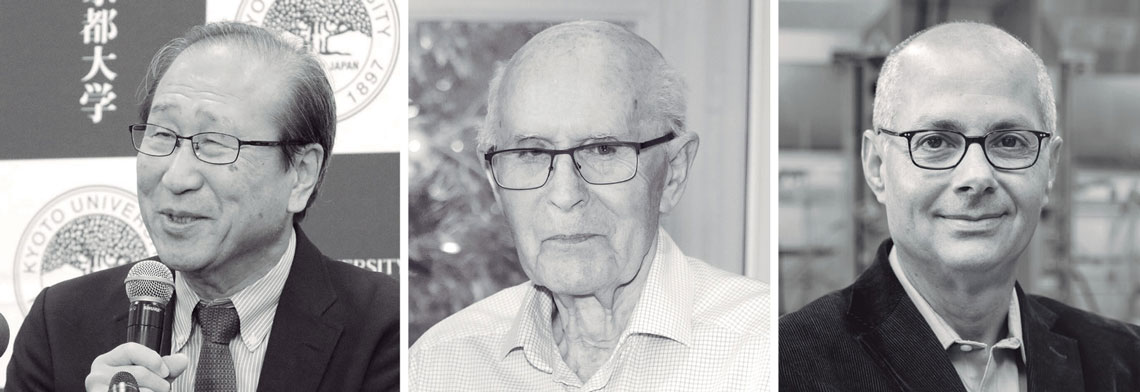
Kyoto University | Paul Burston / University of Melbourne | Brittany Hosea-Small / UC Berkeley Susumu Kitagawa, Richard Robson, and Omar Yaghi developed metal–organic frameworksKyoto University | Paul Burston / University of Melbourne | Brittany Hosea-Small / UC Berkeley
Chemistry
Susumu Kitagawa, 74, from Japan; Richard Robson, 88, from the United Kingdom; and Omar Yaghi, 60, a Jordanian-born American citizen, developed a new form of molecular architecture. Metal–organic frameworks (MOFs)—composed of metal ions (positively charged metal atoms) connected by organic molecules—form crystals with large internal spaces. These structures can capture and store substances, stimulate chemical reactions, and conduct electricity.
In 1989, Robson created a crystal with cavities that allowed ions to enter and exit in fluid form, but its structure was unstable and easily fell apart. The issue was later solved independently by the other two laureates. Kitagawa, now at Kyoto University in Japan, obtained metal–organic structures in 1997 that were able to capture and release gases such as methane, oxygen, and nitrogen without needing water. He later produced flexible crystals that expand when filled and contract again when emptied.
Yaghi’s group, now at the University of California, Berkeley, developed in 1995 a two-dimensional structure with cobalt linkages capable of stably storing molecules, even when heated to 350 °C. The structure he announced in 1999 remained stable at 300 °C even when empty and became famous for having a surface area equivalent to a soccer field in just a few grams.
In Brazil, several research groups use this technology. Chemical engineer Liane Rossi, from the Institute of Chemistry at the University of São Paulo (IQ-USP), develops gas adsorption systems and tests MOFs for soil conditioning. Chemical engineer Christiane Arruda, from the Diadema campus of the Federal University of São Paulo (UNIFESP), focuses on restoring water quality.

Franco Origlia / Getty Images László Krasznahorkai: long sentencesFranco Origlia / Getty Images
Literature
With a 40-year career, Hungarian writer László Krasznahorkai “is a very challenging author,” says Manoel Ricardo de Lima, professor at the School of Letters at the Federal University of the State of Rio de Janeiro (UNIRIO). “His writing is marked by long sentences that follow the characters’ stream of consciousness, and his stories focus on the marginalized, the hungry, the destitute, those who have no place in the world,” he explains.
Born in 1954 in rural Hungary, Krasznahorkai made his literary debut in 1985 with Sátántangó. The novel centers on the arrival of a mysterious outsider in a decaying Hungarian village during the communist era, where residents welcome him as a savior. The book was published in Brazil in 2022 by Companhia das Letras, under its original title and translated from Hungarian into Portuguese by São Paulo translator and psychoanalyst Paulo Schiller. “László often says he mentally constructs his sentences and only writes them once they are fully formed. They are dense, frequently unpunctuated sentences that stretch over pages, making translation extremely laborious,” Schiller remarks.
The publisher also plans to release two additional novels by the author: The Return of Baron Wenckheim (2016) and Herscht 07769 (2021).
Peace
Former Venezuelan congresswoman María Corina Machado is the most prominent opposition voice against the governments of Hugo Chávez (1954–2013) and Nicolás Maduro. Now 58, she continues to live in Venezuela. According to the Nobel committee, she was recognized for acting as a unifying figure of the opposition and for demanding free elections in the country at a moment when “democracy is under threat.”
“Given the symbolic importance of the Nobel Peace Prize, Machado’s selection reflects not only the concern of parts of the international community regarding Venezuela, but also an effort to draw global attention to the need for political transition in the South American nation,” observes political scientist Guilherme Casarões, a professor at Florida International University (FIU) in the United States. He notes, however, that the laureate is considered a controversial figure.
Satire on the Nobel Prize celebrates 35 years of honoring unusual research
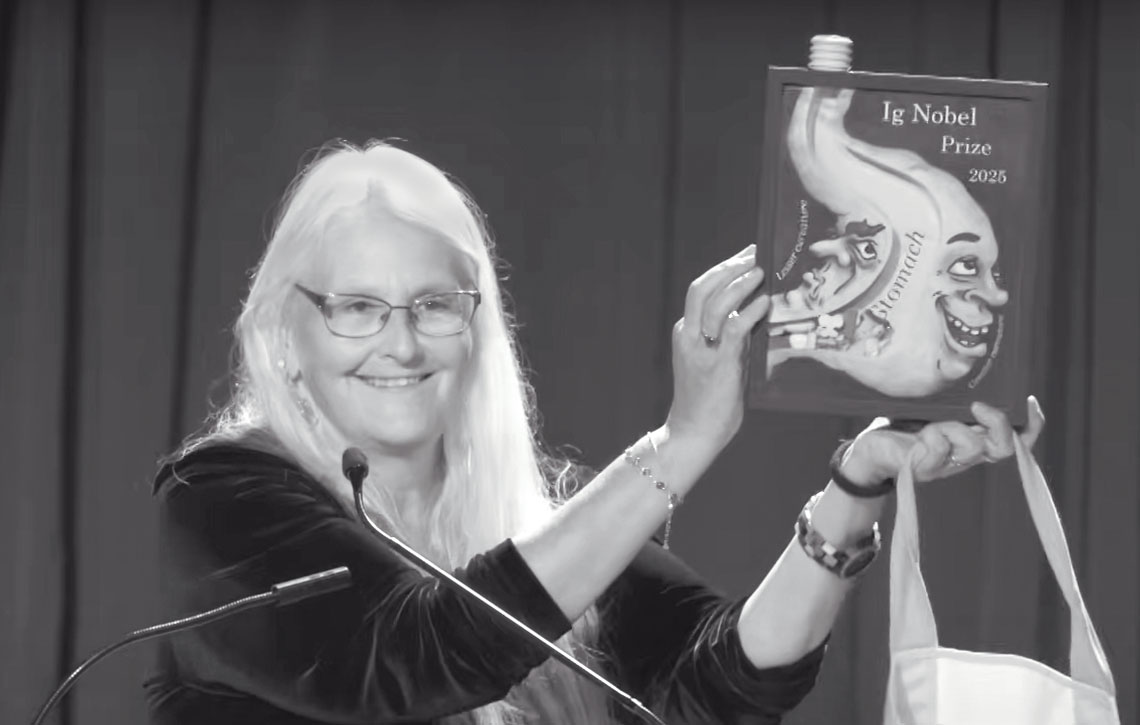
Ig Nobel PrizeJournalist Karen Hopkin presents the awardIg Nobel Prize
The ceremony that precedes the Nobel Prize is a satire that celebrates creativity and humor in science. Its purpose is to make the audience laugh and then think.
This year’s central theme was digestion, celebrated through a mini-opera about situations faced by gastroenterologists and their patients.
With this theme in mind, organizers selected a study by Japanese researchers who painted stripes on cows to resemble zebras to test whether the pattern affected mosquito attacks (it did—striped cows were bitten less). Another study examined the type of pizza preferred by an African lizard species (Agama agama). In physics, four scientists were honored for developing the “perfect” recipe for spaghetti cacio e pepe.
Two award-winning studies explored the effects of alcohol. In aviation research, a group was recognized for examining what happens to bats when they become intoxicated, and the Ig Nobel Peace Prize went to a team that demonstrated that alcohol can improve foreign-language pronunciation.
Works chosen for addressing “indigestible” topics also included the engineering and design prize, awarded to two Indian researchers who proposed eliminating shoe odors by creating a UV-C shoe rack capable of killing odor-causing bacteria. In literature, American physician William Bennett Bean (1909–1989) was honored for his detailed, decades-long records of his own fingernail growth.
Food-related curiosities inspired the pediatrics prize as well: researchers studied what happens to breast milk when lactating women consume a large amount of garlic. The milk’s smell changed and babies nursed more.
The ceremony ended with the traditional shower of paper airplanes and the customary reassurance from Marc Abrahams, mathematician and creator of the awards:
“If you didn’t win an Ig Nobel Prize this year—and especially if you did—better luck next year!”
The story above was published with the title “From basic science to innovation” in issue 357 of November/2025.
Republish