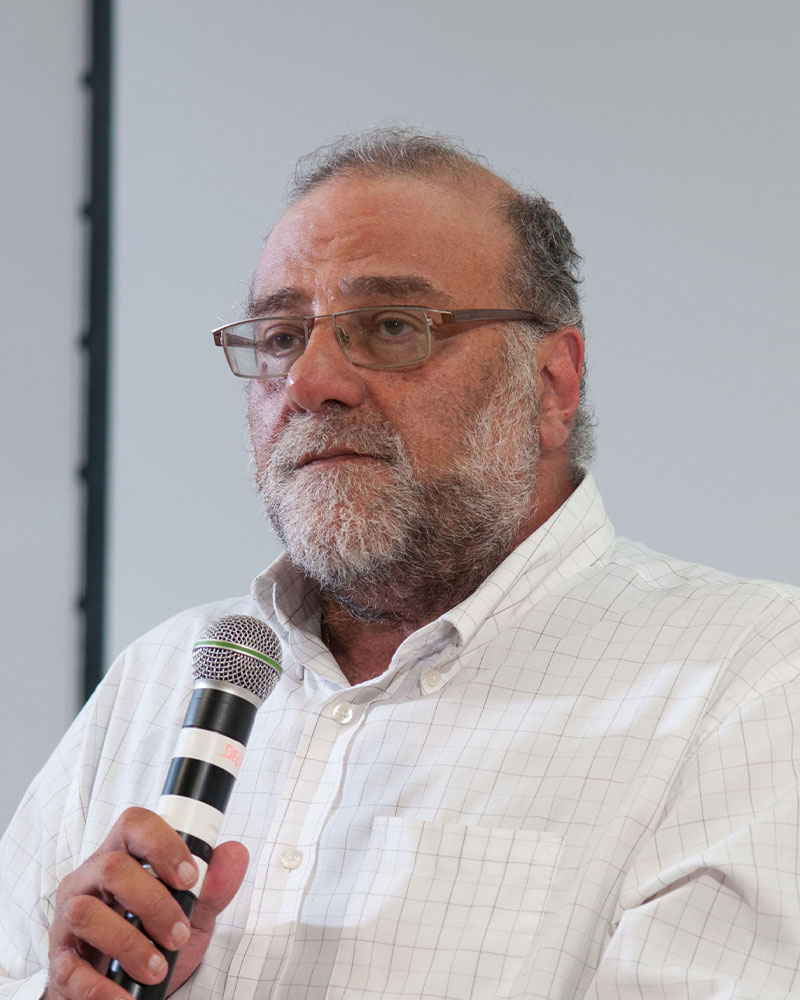
Diogo Vasconcellos / SGCOM-UFRJTanuri’s research was important in making Brazil a world leader in HIV managementDiogo Vasconcellos / SGCOM-UFRJ
Wearing a hat, glasses, and a mask, virologist Amílcar Tanuri looked at the camera and raised his fingers in a V—for victory and for vaccine—after receiving his first dose of the COVID-19 vaccine on January 21, 2021. He was the first employee of the Federal University of Rio de Janeiro (UFRJ) to be vaccinated. Since the beginning of the pandemic, a team led by Tanuri at UFRJ’s Molecular Virology Laboratory had carried out more than 300,000 diagnoses of SARS-CoV-2, the virus responsible for the disease. Their work helped ease the pressure on Brazil’s public health system (SUS) as part of a collaborative effort involving universities across the country. The image became symbolic of his career: he dedicated his life to studying viruses, establishing himself as one of Brazil’s leading experts and working on the front lines of every major epidemic to have occurred in recent decades, from HIV to Zika, from dengue to COVID-19. He died in Rio de Janeiro on September 26, at the age of 67, due to complications during dialysis.
Born in Rio de Janeiro, Amílcar Tanuri began studying medicine at UFRJ in 1977, later completing his master’s degree in biophysics (1985) and PhD in genetics (1990) at the same institution, supervised by Darcy Fontoura de Almeida (1930–2014), one of the pioneers of microbial genetics in Brazil. He did a postgraduate degree in molecular genetics at the University of Sussex (1985), UK, and was a research associate at Columbia University, USA. He was also head of biological sciences at the Rio de Janeiro State Research Funding Agency (FAPERJ).
Although he devoted his career to the study of many viruses, he earned international recognition for his research on HIV (the virus that causes AIDS), focused on understanding its genetic diversity and resistance to medications (see Pesquisa FAPESP issue no. 100). Since 2000, he was a consultant for the HIV Drug Resistance Research Network (HIV ResNet) at the World Health Organization (WHO). His work was fundamental in making Brazil a global reference in controlling and monitoring the virus.
“Brazil was one of the first countries to break the patents on antiretroviral drugs, and Amílcar played a crucial role in that process,” recalls Renato Santana de Aguiar, a virologist from the Institute of Biological Sciences at the Federal University of Minas Gerais (UFMG), who was supervised by Tanuri during his doctorate. In his laboratory, Tanuri tested batches of domestically produced medications, proving their effectiveness and Brazil’s ability to supply them free of charge through the SUS, supporting the country’s decision to break the patents.
He shared the expertise he gained in implementing monitoring and surveillance systems in Brazil with other Portuguese-speaking countries where the HIV epidemic was even more serious, such as Mozambique and Angola. In the latter, between 2004 and 2009, he led the country’s first seroepidemiological survey of the disease. Elsewhere in Africa, he worked on other epidemics in 2005, including Marburg hemorrhagic fever (MHF), caused by a virus belonging to the same family as Ebola.
Virologist Luciana Costa, director of UFRJ’s Paulo de Góes Institute of Microbiology (IMPG), recalls that researchers often worked with limited resources while handling highly contagious samples. In these moments, Tanuri acted as a coordinator, reaching out to institutions and using his contacts to secure the infrastructure needed to keep projects moving. “He was always ready to find solutions and solve problems related to public health,” says Costa.
Tanuri also carried out important research on other viral epidemics, including Zika. In April 2016, a year after the outbreak of the disease in northeastern Brazil, he and his team published an article in Science showing that the virus attacked nervous system cells, shrinking them and inducing cell death. In June of the same year, after sequencing its genome from the amniotic fluid of pregnant women whose babies were born with microcephaly, the group published a paper in The Lancet reporting that Zika can be transmitted vertically (see Pesquisa FAPESP issue no. 240).
“Whenever something new emerged, he would race to understand it, but without letting himself get carried away,” says virologist Ricardo Soubhie Diaz of the Federal University of São Paulo (UNIFESP), who worked with Tanuri since the 1990s. According to Diaz, many scientists are disappointed when their hypotheses are not confirmed. “Amílcar wasn’t like that; he was curious and did not shy away from tasks that seemed impossible.”
Carolina Voloch, a professor at UFRJ and a member of Tanuri’s team at the Molecular Virology Laboratory, says that he remained active until the very end. “In the hospital, he asked doctors to reduce the dose of his sedative medication so he could concentrate better. “He wanted updates about the lab, how the research was going, how the students were doing,” she says. “He was not only a capable scientist—he knew how to bring people together. In the best sense of the word, he was a political figure, someone capable of bringing out the best in everyone.”
In recent years, Tanuri used his networking skills to advocate for a new cause: the creation of the Brazilian Center for Disease Prevention and Control (CPCD-BR). Inspired by the US Centers for Disease Control and Prevention (CDC), the Brazilian counterpart would function as a federal institution capable of providing fast, coordinated, and sustained responses to public health emergencies. The virologist did a postdoctoral fellowship at the CDC between 1996 and 1998 and served as a visiting researcher from 2003 to 2006, as well as being involved in other scientific collaborations with the agency through the Global AIDS Program.
In the first decade of the twenty-first century, he supported nine countries in sub-Saharan Africa in their efforts to tackle the HIV epidemic. For this work, he received an honorary award in 2005 from the US National Center for HIV/AIDS, Viral Hepatitis, STD, and TB Prevention, part of the CDC. “Wherever there was an epidemic, Amílcar was there. He cared deeply about linking scientific research to the public health system,” says immunologist Ester Sabino of the Pathology Department at the University of São Paulo (USP), a consultant for Instituto Todos pela Saúde—the organization leading the CPCD-BR proposal. A member of the Brazilian Academy of Sciences (ABC), Tanuri received the National Order of Scientific Merit from the Ministry of Science, Technology, and Innovation in 1998.
Among colleagues and friends, his absence is already being felt. “I can only hope to be as good a supervisor for my students as he was for me: someone with contagious enthusiasm, passionate about science, and above all, a genuinely compassionate person,” Costa concludes.
The story above was published with the title “At the center of epidemics” in issue 357 of November/2025.
Republish