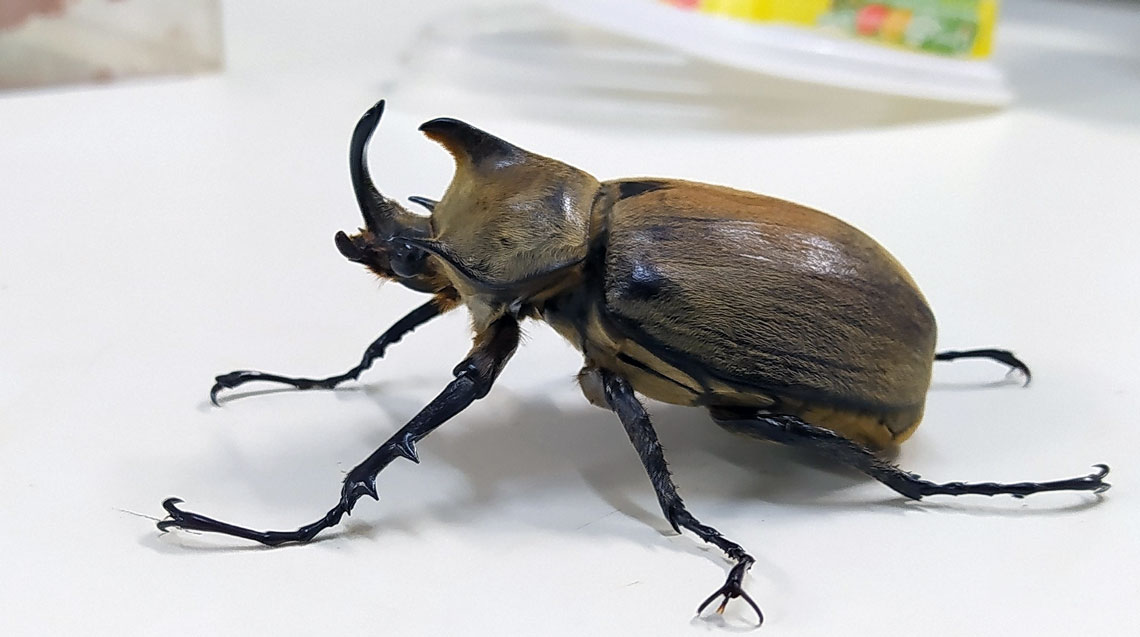
When the Brazilian Federal Revenue Service seized 99 beetles of the Magasoma gyas species in the suitcase of a Japanese man about to board a flight to Thailand from Guarulhos International Airport, in the Metropolitan Region of São Paulo, it turned out to be a lucky day for a group of Brazilian and Canadian researchers. The team wanted to discover whether disproportionately large body parts of insects and arthropods—such as the claws of crabs—could help regulate their body temperature. The seized beetles have long pointed horns.
“The insects were taken to the Museum of Zoology of the University of São Paulo (MZ-USP) and we were able to get access to them before they were euthanized and added to the museum’s collection,” says physiologist Danilo Giacometti, a postdoctoral fellowship researcher at USP, with a grant from FAPESP. He is the lead author of two articles that resulted from the research, which were published in March and May in the journals Insect Science and Integrative and Comparative Biology, respectively.
With the insects in hand, the first stage of the experiment was to heat the environment to 30 degrees Celsius (°C) and let specimens of the beetles with and without horns respond to the heat for 15 minutes. Then, the team used a device to measure the body temperature of the beetles every 30 seconds for 5 minutes.
The results showed that the horn maintained an average temperature during the warming phase and was the first part of the body to cool once the room temperature stopped rising. This was the opposite of what was expected, as the hypothesis predicted that the hemolymph, the name given to the blood of insects, would flow to the horn to prevent the body from overheating, making the horn warmer, as is the case in toucans. On cold days, the blood of these birds flows from the beak to the body, warming the animals breast, but on hot days part of the circulation concentrates in the beak, which acts as a heat sink (see Pesquisa FAPESP issue no. 162). “We didn’t find the same process that occurs in vertebrates probably because the insects do not control the flow of hemolymph as well and the active heat-dissipation mechanism does not occur,” says biologist Alexandre Palaoro, of the Federal University of Paraná (UFPR), one of the coauthors.
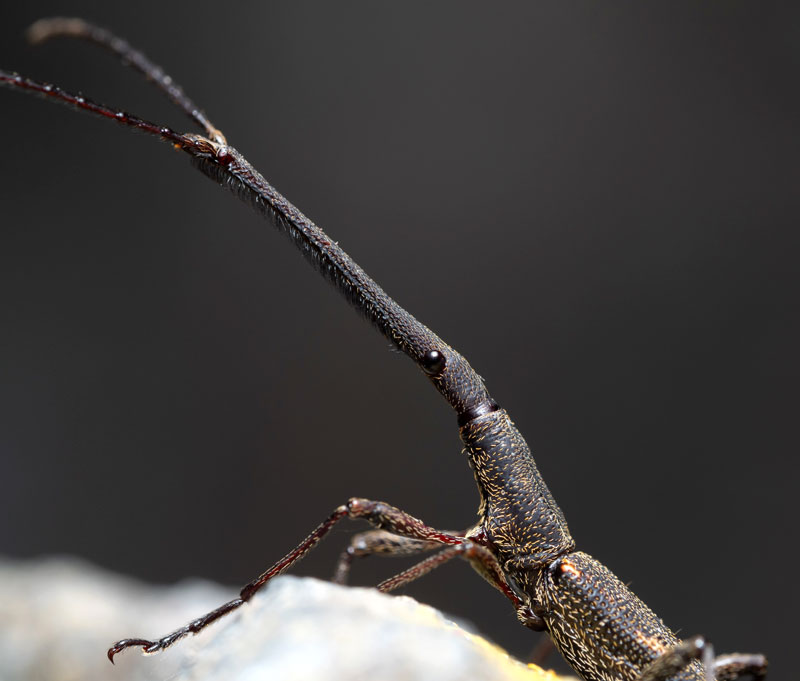
Househopper_jr / iNaturalist The weevil Lasiorhynchus barbicornis is smaller in colder climatesHousehopper_jr / iNaturalist
In active heat loss, a physiological mechanism is activated for body temperature regulation. “It is the case of flying insects that vibrate their wings before taking off to warm up their bodies,” describes Giacometti. Passive thermoregulation is a natural consequence of body parts that have large surface area and little volume and, because of this, gain and lose temperature easily. “In M. gyas, the cooling of the horn suggests that there is very strong passive dissipation.”
Giacometti highlights, however, that active thermoregulation has still not been completely discarded, because some beetles can resist temperatures as high as 50 °C without showing signs of thermal stress. “If we heat the environment further, the beetle might activate some mechanism that has not yet been identified.” Additionally, the team detected the greatest heating in the thorax. That is where the flight muscles are located, and the flow of hemolymph through them generates a lot of heat.
The experiment sparked the group’s creativity, and they decided to invite Canadian biologist Glenn Tattersall, from Brock University in Canada, lead author of the article on the toucan beak, to join the group and write the paper published in the journal Integrative and Comparative Biology. In it, the researchers gathered results from other studies on arthropods with disproportionately large appendages for their body size and examined how they are distributed across different regions of the world. In general, these body parts are the result of evolution, in which males with the largest mandibles attract females and win disputes with other individuals of the species.
After searching through the few articles about thermoregulation in invertebrates, the biologists compiled studies of three beetles—a weevil (Lasiorhynchus barbicornis), an earwig (Labidura xanthopus), and a stag beetle (Lucanus cervus)—and two crabs (Leptuca panacea and L. pugilator), which all have some sort of large claw, horn, or pincer.
The team mapped the animals according to the environments in which they live and discovered that, in colder climates, the earwig has larger appendages and the weevil has smaller ones, whereas in the crabs and the stag beetle there does not appear to be a relationship between appendage size and environmental temperature. The results from the beetles indicate that the structures selected by evolution influence how the animals interact with temperatures.
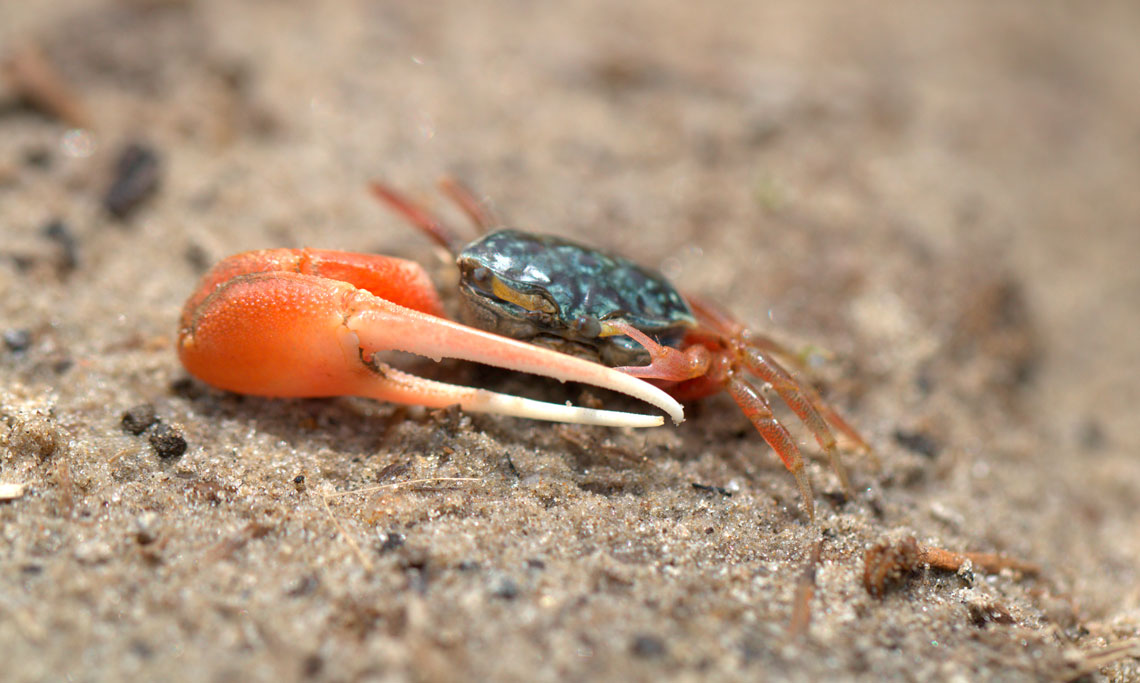
Alexandre Palaoro / UFPRThe thin-fingered fiddler crab, Leptuca leptodactyla, about 1 centimeter wide, has a claw disproportionately large for its body sizeAlexandre Palaoro / UFPR
Another discovery was that the way thermoregulation works depends strongly on the shape of the large body parts. If they are thin and long, they warm up and cool down rapidly. Whereas bulky and compact structures warm up and cool down slowly, retaining heat for longer—similar to a good thermos flask of hot coffee on a cold day.
Not having participated in the study, German biologist Klaus Hartfelder from the Ribeirão Preto School of Medicine (FRMP) at USP, considers it “difficult to see a thermoregulative function” in the horn of M. gyas. “The fixed structure is basically made of cuticle, unlike the beak of the toucan, which is highly vascularized, or even the legs of arthropods, which have a number of muscles,” says the biologist, who studies insect physiology.
Even with this consideration, for Palaoro, the composition of the horn does not completely rule out hemolymph circulation. “They are structures that are very close to the thorax, where there is a large amount muscle. When the beetle contracts and relaxes its body muscles, the entire exoskeleton follows along and receives hemolymph,” he adds.
Although he has reservations about the experiments with M. gyas, Hartfelder acknowledges that crabs and earwigs can regulate heat due to the muscles present in their claws and pincers. “The same occurs with some flying insects that use their wings to warm their bodies even without flying, and need this warming to take off,” he adds.
The group is already planning new studies to test hypotheses. One path is to try and discover how animals of species with large and small appendages for fighting react to warming and cooling. “We have many basic questions to answer. Especially since any appendage, even an exoskeleton, can have thermoregulatory functions,” notes Giacometti. “One question that we want to answer is to what extent insects or arthropods can control the flow of hemolymph to distribute heat.” Palaoro stresses that it is important to consider not only how much heat the animals can retain, but also their ability to change their body temperature very rapidly. “We have to keep in mind that they are very small creatures. For a bee, flying in the sun or in the shade is completely different. This is the fascinating side of temperature variation studies,” concludes the researcher from UFPR.
The story above was published with the title “Small creatures with large thermostats” in issue 357 of November/2025.
Project
Behavioral fever in ectothermic vertebrates: Patterns, processes, and ecological implications (n° 25/06560-5); Grant Mechanism Postdoctoral Fellowship; Supervisor Carlos Arturo Navas Iannini (USP); Beneficiary Danilo Giacometti; Investment R$497,772.00.
Scientific articles
GIACOMETTI, D. et al. Exaggeration through sexual selection may impact the thermal biology of arthropods. Integrative and Comparative Biology. May 1, 2025.
GIACOMETTI, D. et al. Regional heterothermy in Megasoma gyas is not related to active heat dissipation by the horns. Insect Science. Mar. 6, 2025.