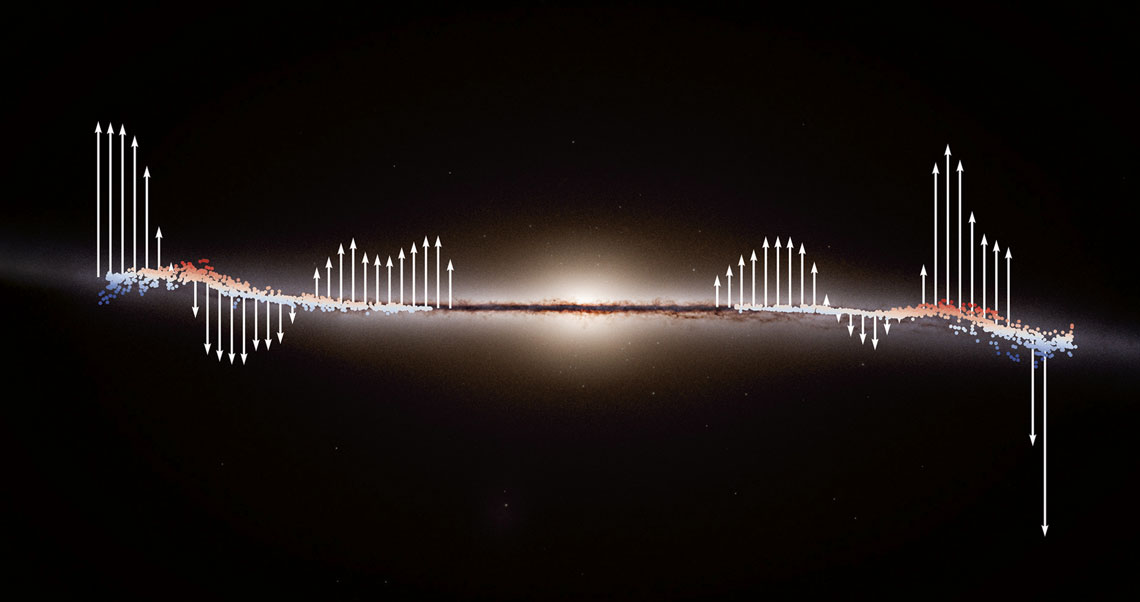
ESA/Gaia/DPACArrows indicate the direction and distance of the movement of stars at the edges of the Milky Way, viewed in profileESA/Gaia/DPAC
The European Space Agency’s Gaia space telescope has discovered a giant wave pushing thousands of stars located between 30,000 and 65,000 light-years from the center of the Milky Way. Like a stone thrown into a lake, the wave causes oscillations that ripple outward horizontally and vertically. Astronomers from Italy, France, Germany, and the USA traced this movement by studying the positions of young giant stars and Cepheid variables, whose brightness oscillates in a predictable way. The rising and falling of the stars may be linked to the Radcliffe Wave, an undulating structure located 500 light-years from the Sun and spanning more than 9,000 light-years (Astronomy & Astrophysics, July).
Republish