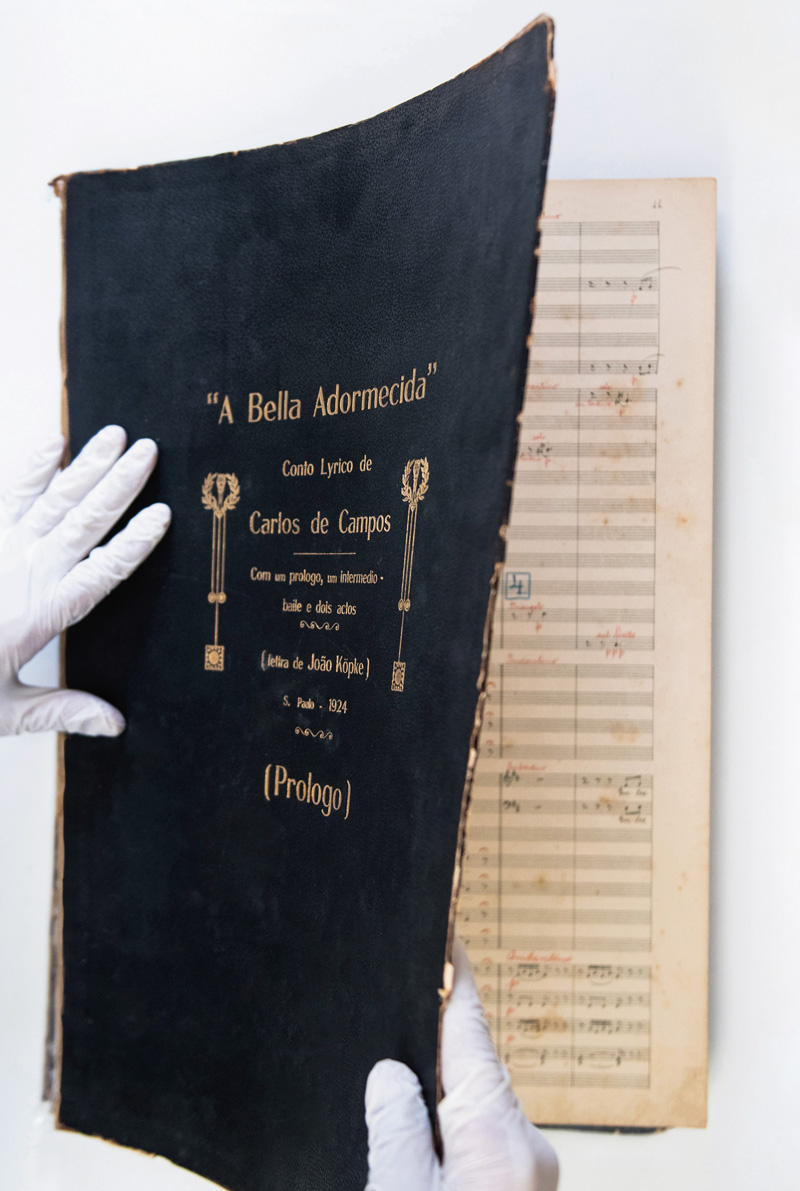
Léo Ramos Chaves / Pesquisa FAPESPA score composed by Carlos de Campos, former professor of the São Paulo Dramatic and Musical ConservatoryLéo Ramos Chaves / Pesquisa FAPESP
Rio de Janeiro was one of the first cities outside Europe to witness a performance of Requiem, by Wolfgang Amadeus Mozart (1756–1791). In 1819 the city hosted a presentation of the funeral mass penned by the Austrian composer in 1791, according to a study by musicologist Ayres de Andrade Júnior (1903–1974) published in the 1960s. The piece also came to São Paulo during the first half of the nineteenth century, according to recent research coordinated by musicologist Paulo Castagna, of the Institute of Arts at São Paulo State University (UNESP), São Paulo City campus.
Over the past three years—two of them funded by FAPESP—the researcher and his team cataloged and organized the entire musical archive (i.e. scores) from the old São Paulo Dramatic and Musical Conservatory Library, a space that functioned between 1906 and 2006 in the downtown area of the state capital, today home to the Praça das Artes (Plaza of the Arts).
The manuscript copy of the Requiem sheet music was among items turned up during the research. Though undated, the document was copied by the master of the São Paulo Cathedral Chapel, Antônio José de Almeida (1816–1876), who took up his post in the 1840s. “It is estimated that the copy was made around 1850,” says Castagna. “This work was expensive and time-intensive in that era. To make a copy and not perform it would be a waste. It is therefore very probable that it was performed.”
In total, Castagna and his team cataloged some 17,000 items from the musical archives of the old conservatory, which today belongs to the São Paulo Municipal Theater Foundation. It is the third largest collection of its genre in Brazil, only losing to those deposited at the National Library (Rio de Janeiro) and the Alberto Nepomuceno Library of the Federal University of Rio de Janeiro (UFRJ). “It is an important collection due to its chronological and stylistic diversity, with works composed in Brazil and overseas between the eighteenth and twentieth centuries, ranging from opera and sacred pieces to band compositions and popular music,” explains the researcher.
According to Castagna, though the collection comprised material purchased by the conservatory itself, the institution also received several donations, such as the personal archives of four composers and former professors at the institution: João Pedro Gomes Cardim (1832–1918), Carlos de Campos (1866–1927), João Gomes de Araújo (1846–1943), and João Gomes Junior (1868–1963). “They are little-known composers, with no recent editions or recordings,” says Castagna. “Cardim, for example, crafted the Hino da Abolição (Abolition Hymn) in 1881 for performances to raise funds for the campaigns of abolitionist Luís Gama [1830–1882].”
The researcher and his team discovered at least 275 original works by the four men. In March, nine pieces composed by Gomes de Araújo for solo piano, or singing and piano, were performed during an event in the auditorium of the UNESP Institute of Arts. “The idea is to make this material available for research, interpretation, and recording.”

Léo Ramos Chaves / Pesquisa FAPESPOn the left, historian Rafael Araújo of the São Paulo Municipal Theater Foundation carefully handles sheet music cataloged by Paulo Castagna and his team from UNESP (right)Léo Ramos Chaves / Pesquisa FAPESP
The project also discovered two works by music professor Presciliano Silva (1847–1897): Missa a 4 vozes e pequena orquestra, op. 17 (Mass for 4 voices and small orchestra, op. 17), and Ganganelli, a piece for fiddle and piano. “He was one of the first Black professors in the São Paulo State educational system and started work in 1891 at the Normal School, now known as the Caetano de Campos State School in the city’s downtown area,” adds Castagna. “The newspapers of that time carry stories that these two compositions were performed to much applause across several Brazilian cities.”
Another researcher seeking to spread the word on works deposited in archives is musicologist Tadeu Moraes Taffarello, of the Center for the Documentation of Contemporaneous Music at the University of Campinas (CDMC-UNICAMP). Since 2021, he has been organizing and editing rare sheet music by composers such as José Antonio Rezende de Almeida Prado (1943–2010) and Dinorá de Carvalho (1895–1980), deposited at the CDMC. With support from FAPESP, Taffarello reviews, digitalizes, and publishes sheet music in free-to-download e-books. This material also provides information on the works and composers, and the editing process.
Created in 1989 by UNICAMP and the Centre de Documentation de la Musique Contemporaine, in France, the Brazilian CDMC received from its French counterpart sheet music and musical recordings of the twentieth century from different parts of the world. “From this overseas exchange came a lot of sheet music and recordings on cassette tape that we are in the last stages of digitalizing,” says Taffarello. The partnership terminated 10 years later.
Today, the CDMC also holds an archive of Brazilian classical music from the twentieth and twenty-first centuries. “Among others, we hold donated personal archives, such as the collection of works by composer Almeida Prado,” he explains. A student of composer and conductor Camargo Guarnieri (1907–1993) and pianist Dinorá de Carvalho, Prado was a professor at UNICAMP between 1975 and 2000, and left more than 570 compositions.
Carvalho, among other accomplishments, founded the Women’s Orchestra of São Paulo, whose first public performance took place in 1940. Their material was also donated to the CDMC. Taffarello recalls that to mark the birth centenary of the pianist in 1995, friends and musical colleagues decided to honor her, and they appealed for anyone in possession of scores composed by the musician to donate them to UNICAMP for a collection of her work there.

Dinorá de Carvalho collection from the Unicamp Center for the Documentation of Contemporaneous MusicAt the piano, Dinorá de Carvalho in the 1920sDinorá de Carvalho collection from the Unicamp Center for the Documentation of Contemporaneous Music
Taffarello has published 12 e-books to date. The next, to be released this semester, will be the sheet music for Manhã radiosa (Radiant morning), by Carvalho. In a preprint article (not yet peer-reviewed) in 2025 Taffarello, pianist and composer Vitor Alves de Mello Lopes, and CDMC librarian Raquel de Souza observed that the piece for solo piano Lá vae a barquinha carregada de? (There goes the little boat loaded with?), published in 1939 by Editora Casa Wagner, was released two years later under the same title and in a simplified version by publishing house Ricordi Brasileira. Even after these two publications, the composer continued to work on the piece and created other versions until arriving at Manhã radiosa, officially released in 1946. “Dinorá’s compositional practice is characterized by construction which often spends years in creation, with different versions of the same piece,” says Taffarello.
It is not always easy to edit the scores. “As in the case of Dinorá, there are often several versions of a composition,” highlights Taffarello. The CDMC partners with the UNICAMP Symphony Orchestra, led by principal conductor Cinthia Alireti, which performs these works in its concerts. This helps to enhance the final result of editing, according to the researcher.
Another challenge is finding the complete scores—during production of the e-book, now in the final stages of editing, about the theater piece Noite de São Paulo (A São Paulo Night) (1936), by playwright Alfredo Mesquita (1907–1986), musically scored by Carvalho. The orchestral sheet music was missing for the song Bamboleia, at the time held by the Mário de Andrade fund of the University of São Paulo’s Brazilian Studies Institute (IEB-USP). The collection is made up of books, scores, manuscripts, records, and other documents produced by the São Paulo-State-born writer, critic, and musicologist. “Dinorá was a contemporary of Mário de Andrade [1893–1945], to whom he dedicated many of his compositions. It’s likely that he himself gave the scoresheet to his friend as a present,” says musicologist Flávia Toni, of IEB-USP, a specialist on the canon of Andrade.
One of Toni’s tasks was to organize Andrade’s discography archive in 1985, through a project coordinated by researcher Telê Ancona Lopez of USP, supported by FAPESP. A professor at the São Paulo Dramatic and Musical Conservatory, he would note his listening impressions on plain cardboard covers that replaced the original factory record sleeves. These notes were contextualized by letters and articles, and led to the 2004 book Popular Brazilian music on the turntable of Mário de Andrade, recently reedited by Edições Sesc in an extended, revised version.
The Caraça College, which functioned between 1820 and 1842 in the state of Minas Gerais, and the Imperial Music Conservatory, founded in Rio de Janeiro in 1848, feature among the first musical archive repositories in Brazil. According to Castagna, the states of São Paulo and Minas Gerais are currently home to the greatest number of these collections—63 and 57 respectively, with a predominance of sacred and band music.
Musicologist Fernando Lacerda Duarte, of the Federal University of Pará (UFPA), has visited 225 cities around Brazil in search of these archives, primarily seeking out sacred music. “They generally need treatment; I once found a collection that included, among other items, sheet music in the roof space of the Belém Cathedral. Sometimes, management changes in a certain parish mean that the archive is discarded, music included,” he says.
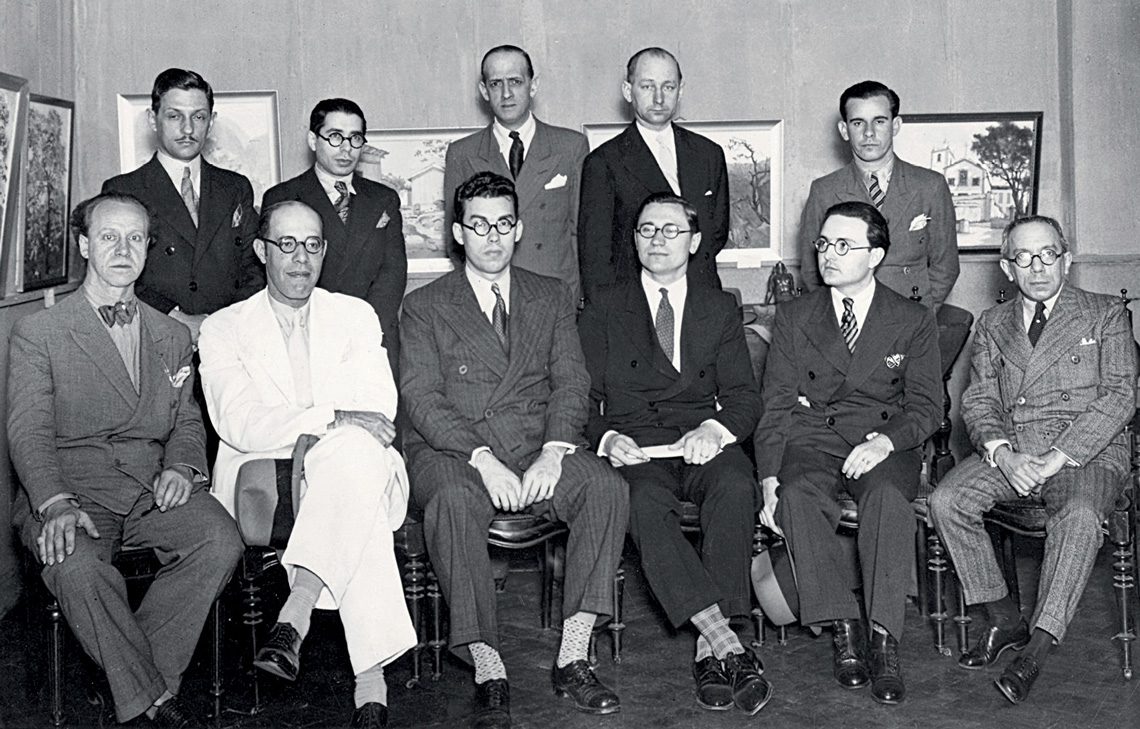
Curt Lange / UFMG archiveMusicologist Curt Lange (fourth from the left) in 1934, at a gathering in Rio de Janeiro, with guests including Mário de Andrade (in white)Curt Lange / UFMG archive
Lacerda’s field research has proven that local language has been used in Catholic hymns in Brazil since the nineteenth century. The Vatican only officially allowed masses and hymns to be sung in Latin, with use of local languages formally permitted only after the Second Vatican Council (1962–1965). “In Brazil, the local or vernacular language, has been used continuously since at least the 1860s,” says the researcher. “As the Church prohibited singing in vernacular, these hymns appeared as popular or traditional melodies, a more efficient way of spreading the gospel.”
Sheet music is not the only source of music history research. In the archive of German Uruguayan musicologist Curt Lange (1903–1997), the letters are the key feature, explains musicologist Edite Rocha, coordinator of the space, housed at the Federal University of Minas Gerais (UFMG) since its inception in 1995. Among records and photographs there are more than 100,000 pieces of correspondence exchanged between Lange and researchers, intellectuals, politicians, and institutions between the 1920s and 1990s.
Starting with his time in Minas Gerais between 1944 and 1945, Lange produced a huge inventory of scores and manuscripts that became one of the world’s key sources of Brazilian music. “Lange organized all the letters he received and also kept a copy of those he sent,” explains Rocha, a professor at the UFMG School of Music. “His correspondence, with lots of stories from backstage, makes him an essential figure for researchers interested in the music and musicology of Brazil and Latin America in the twentieth century.”
The story above was published with the title “The bars of time” in issue 352 of April/2025.
Projects
1. Musicographic collection of the São Paulo Drama and Music Conservatory (1906–2006): Inventory, archival history, heritage assessment, and enabling public research in the processed section (n° 22/05895-5); Grant Mechanism Regular Research Grant; Principal Investigator Paulo Augusto Castagna (UNESP); Investment R$36,062.00.
2. CIDDIC/CDMC Collection: Edition of sheet music and creation of an online archive (n° 21/14527-7); Grant Mechanism Regular Research Grant; Principal Investigator Tadeu Moraes Taffarello (UNICAMP); Investment R$106,269.37.
Scientific articles
TAFARELLO, T. M. et al. Cinco canções para canto e orquestra escritas por Dinorá de Carvalho para a peça teatral Noite de São Paulo: Edição e análise. Revista de Música Vocal Erudita Brasileira. Vol. 1, no. 1, pp. 1–26. 2023.
CASTAGNA, P. Acervos musicais em políticas públicas e institucionais de gestão de acervos. Debates. Vol. 26, no. 1, pp. 159–72. 2022.