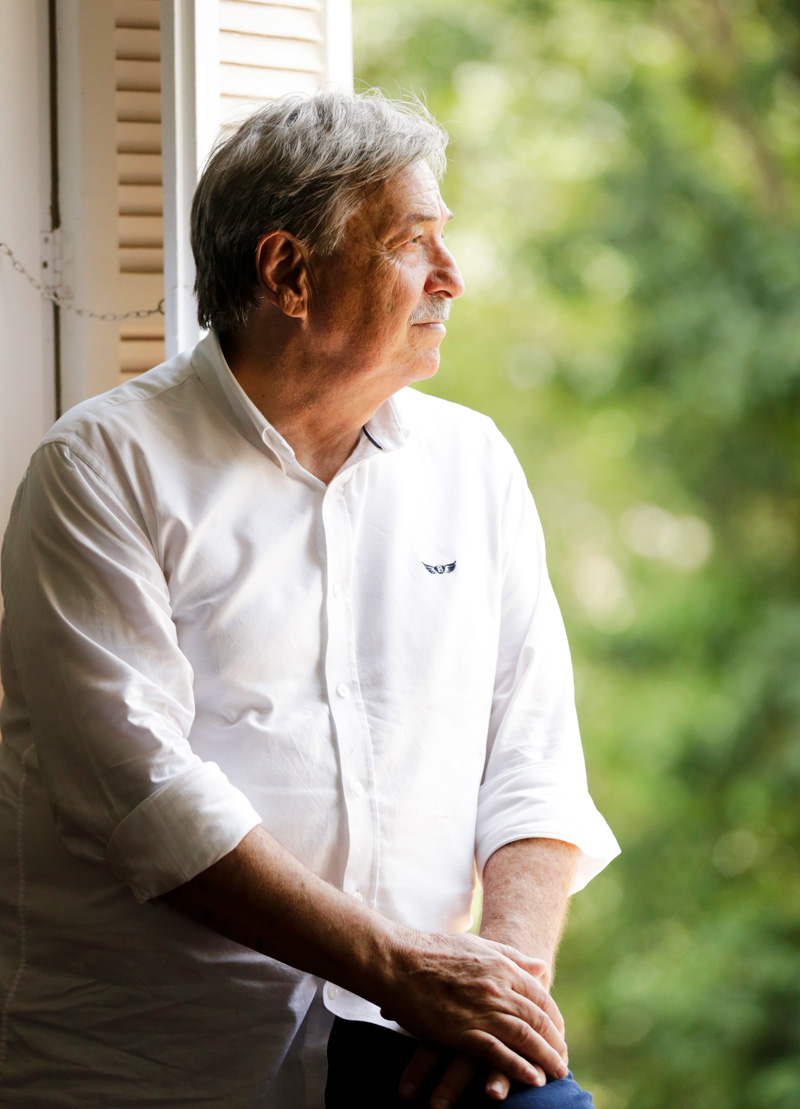
Carla GlarnerParanhos da Costa’s work had a truly global impactCarla Glarner
Mateus José Rodrigues Paranhos da Costa, a pioneer of animal welfare science in Brazil, passed away on July 5 at age 68 in Franca, São Paulo. Since 1986, he had been a faculty researcher in the Department of Animal Science at São Paulo State University’s School of Agricultural and Veterinary Sciences (FCAV-UNESP), in Jaboticabal. He is widely known for his work bridging cutting-edge animal science with in-the-field livestock practices, advancing a more conscientious and sustainable model of cattle ranching.
“Mateus placed Brazil at the forefront of animal behavior science,” said British biologist Donald Broom in an interview with Pesquisa FAPESP. “He was an exceptional communicator, and at multiple major international conferences he presented influential papers on how to effectively engage ranchers in animal welfare research.”
In 1986, Broom—now 82—became the first professor to teach a university course formally titled “animal welfare,” at the University of Cambridge in the UK. In 1992, Paranhos da Costa invited him to deliver a keynote at the 10th Meeting of Ethology, hosted by UNESP in Jaboticabal. “That was when I realized he was already exploring multiple aspects of welfare, including ways to mitigate issues reported by cattle handlers.”
Among Paranhos da Costa’s most cited works is a 2012 paper in Meat Science, which analyzed technical, legislative, and policy initiatives across Latin America designed to advance animal welfare in ranching, with an emphasis on efforts addressing worker training and the development of best-practice guidelines for livestock management. “In Brazil, more than 10 million kilograms of beef are lost each year because of carcass bruising from falls, blows, or slips—losses that could be prevented with more careful handling,” he explained to Pesquisa FAPESP in the feature “Care and empathy for animals”.
In his Meat Science article, Paranhos da Costa noted that livestock handling is most successful when the well-being of workers is also considered. “Improving animal welfare also improves human welfare,” he remarked while wrapping up his presentation at a 2018 workshop in São Paulo, hosted by UNESP, with US researcher Temple Grandin as feature speaker. On that occasion, he was awarded the Temple Grandin Award, a distinction recognizing scientists and professionals who have advanced animal welfare, particularly in cattle ranching.
Grandin, an emeritus professor of Animal Science at Colorado State University and a psychologist and animal scientist by training, revolutionized livestock handling methods on farms and in slaughterhouses. She has published widely in the field—most recently, a February article exploring insights from nonverbal communication in nonhuman mammals. “Professor Mateus was a leader who inspired students to engage in hands-on, applied research aimed at improving the welfare of cattle and many other animals,” she told Pesquisa FAPESP.
Born in Franca, Paranhos da Costa earned his bachelor’s degree in Animal Science from FCAV in 1981. He went on to complete a PhD in Psychobiology at the University of São Paulo’s Ribeirão Preto campus in 1995, followed by a postdoctoral fellowship in animal welfare at the University of Cambridge in 1999. At FCAV, he founded and led the Study and Research Group in Ethology and Animal Ecology (ETCO) in 1992. Over time, ETCO became a reference for science-based livestock management, with more than 120 peer-reviewed articles to its name.
As Fernanda Macitelli—an animal scientist at the Federal University of Mato Grosso (UFMT) and associate researcher at ETCO—recalls, Paranhos da Costa and his students at UNESP coauthored 12 livestock handling manuals, now distributed to farmers by Brazil’s Ministry of Agriculture and Livestock (MAPA). These guides cover key areas such as vaccination, cattle loading, comfort for lactating cows, and animal identification. “Mateus worked tirelessly to raise awareness about reducing the use of hot-iron branding,” Macitelli notes. Thanks to his advocacy, in 2024 São Paulo became the first state to replace hot-iron facial branding of cattle and buffalo vaccinated against brucellosis with ear tags certifying vaccination.
“Mateus was also the researcher most deeply engaged with animal welfare in transport across Brazil,” adds veterinarian Adroaldo José Zanella, who heads the Center for Comparative Studies in Health, Sustainability, and Welfare at USP’s School of Veterinary Medicine and Animal Science (FMVZ). “His work reshaped public policy and was pivotal in establishing the current legal framework for animal welfare in Brazil,” he explains. Among these contributions is National Traffic Council Resolution No. 791 (2020), which consolidated regulations governing the transport of livestock and other animals used in production, sport, leisure, or exhibition.
Between 2009 and 2010, Paranhos da Costa also served as a visiting researcher at the headquarters of the United Nations Food and Agriculture Organization (FAO) in Rome. Italian veterinarian Daniela Battaglia—who heads the FAO’s Gateway to Farm Animal Welfare and coproduces FAOcast, an animal welfare podcast—told Pesquisa FAPESP that the Brazilian scientist’s expertise significantly strengthened FAO’s mission to improve the lives of both animals and people: “His seminal research, vision, and passionate advocacy helped shape the global understanding of animal welfare as an integral part of sustainable livestock production and of the One Health framework.” One Health is an integrated approach that recognizes the interdependence between human, animal, and environmental health.
Paranhos da Costa was also renowned as a capable mentor. “Many of his former students now hold key positions in Brazil and abroad in the field of animal welfare,” notes Zanella. Daiana de Oliveira, professor of Farm Animal Welfare at Linnaeus University in Sweden, highlights his distinctive teaching style: “As a lecturer, he didn’t use slides and instead captivated students with compelling stories; as a supervisor, he proposed thought-provoking challenges and fostered scientific debates with leading international scholars, opening doors for us to the world.”
Paranhos da Costa was receiving treatment for a recurrence of intestinal cancer when he had COVID. He is survived by his wife, Janete; his children, Paula, Mariana, and Gabriel; and three granddaughters.
The story above was published with the title “Well-being for all” in issue 354 of August/2025.