


Imagine a play in which the audience is faced not with lights and curtains, but with darkness. Absolute darkness that begins outside, with the spectator being guided to their seat by the venue staff. If they wish to leave, they have to raise their hand, announce their seat number, and interrupt the show. Those who leave may not return. There are no visible sets. The smell of freshly brewed coffee and the clinking of cutlery announce a kitchen. Later, keys turning in a lock, car horns, and engine sounds suggest a busy street. Then, the sound of water and the smell of soap suggest someone is taking a shower—and the drops that splash onto the audience place them there inside the bathroom. At the end, a light goes on. For the first time, the audience gets to see the faces of the people who led them on this sensory journey: the cast of Teatro Cego.
Composed of both blind and sighted actors and musicians, the company from São Paulo was created in 2012 and is one of 13 Brazilian groups analyzed by Lucas Almeida Pinheiro in the book Teatro e artistas com deficiência visual: Poéticas do acesso à cena (Theater and visually impaired artists: Poetics of access to the scene; Editora Unicamp, 2024). “These shows are not put on exclusively for people with disabilities,” says Pinheiro, a professor of performing arts at the State University of Maringá (UEM) in Paraná. “The challenge for these groups is to redefine the visual dimension so present in theater. In these montages, there is much more detailed work on auditory, tactile, and olfactory resources, and even taste.”
In his book, which resulted from his PhD thesis, defended at the University of Campinas (UNICAMP) in 2022, Pinheiro examines groups that remove the audience’s vision using blindfolds, such as Teatro dos Sentidos from Rio de Janeiro and some works by Noz Cego from Salvador, or by performing in the dark, such as Teatro Cego. “The aim is to give sighted spectators a better idea, even if only temporarily, of the perceptive universe of a person who cannot see,” the researcher explains. “However, in the absence of lighting and visual information, and because it is based on dialogue between characters, this type of staging is not capable of including deaf people who use sign language, for example.”
Some of the groups studied by Pinheiro do not suppress the viewer’s vision, instead using audio description, an accessibility resource. “Conventionally, an audio description professional watches rehearsals or the recordings of shows to find pauses or moments of silence. In these moments, they describe what is happening in the scene. Blind or visually impaired audience members listen to the audio description through headphones connected via radio to the microphone of the person providing the audio description,” says the researcher. “However, this requires certain infrastructure in the space where the show is presented. Ideally, the narrator should be in a soundproof booth so that their voice does not disturb other spectators, but in Brazil they usually work in the same space as the sound and lighting technician.”
Alternatively, some companies produce more descriptive dramaturgical texts. Coletivo Grão – Arte e Cidadania, for example, a group created in São Paulo in 2012 by director, playwright, and producer Cintia Alves and music therapist and composer Juliana Keiko, brings together artists who are sighted, blind, hearing, and deaf. “What these companies do is almost incorporate the audio description into the structure of the show. When an actor enters from one side of the stage and sits down, for example, another character mentions the movement and says ‘Ah, you’re going to sit here,’” explains Isa Etel Kopelman of UNICAMP’s Department of Performing Arts, one of the organizers of a dossier on art and disability published in Pitágoras 500: Revista de Estudos Teatrais (Pythagoras 500: Journal of Theatre Studies) in 2023. “This allows blind spectators to make their own interpretations without an external voice explaining the show.”
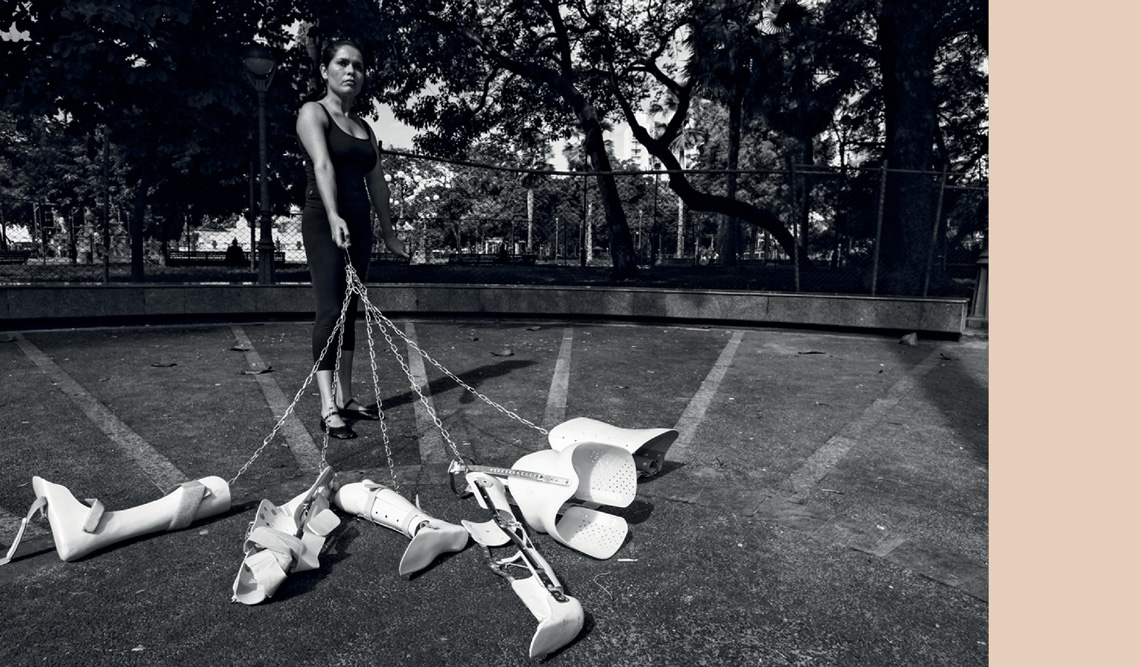
Marcelo Santanna / Courtesy of the artistResearcher and choreographer Carolina Teixeira during a performance of Poética protética (Prosthetic poetics)Marcelo Santanna / Courtesy of the artist
The presence of artists with disabilities on stage is not new. Felipe Monteiro, a performer and professor on the Professional Master’s Program in Arts at the Federal University of Uberlândia (Profartes-UFU), recalls that in the eighteenth century, so-called freak shows were common in Europe, exploiting people with disabilities for entertainment purposes. “In addition to the public humiliation, these people were forced to perform unusual and dangerous activities, such as swallowing objects,” says the researcher, author of the book Subjetividade(s) e(m) performance: Corpo, diferença e artivismo (Subjectivity[ies] and/in performance: Body, differences, and artivism; CRV Publisher, 2020). “Many of them came from poorer social classes and submitted to this treatment as a means of survival.”
Around the mid-twentieth century, the situation began to change as the discourse surrounding human rights grew. In the 1960s, groups outside Brazil made ethical and humanist appeals against the practice. “Artistic expressions by people with different bodies began emerging from the ‘60s onwards, through performance art and initiatives such as the National Theatre of the Deaf, an American company founded in 1967,” continues Monteiro, who has progressive spinal amyotrophy, a neuromuscular disease that causes progressive muscle loss.
The first stage experiences of American director Robert Wilson also date from this period. Wilson, who was one of the biggest names in theater at the time, not only included people with disabilities in his shows, but also addressed the issue in his plots. One of his plays, Deafman Glance (1970), was a silent opera partly inspired by the perceptions of a boy with a hearing impairment. According to Monteiro, the 1980s was an important decade for artists and researchers in the field thanks to the emergence of the disability arts movement in the USA and UK.
In Brazil, similar groups appeared in the 1990s, as reported by Marcia Berselli of the Department of Performing Arts at the Federal University of Santa Maria (UFSM), Rio Grande do Sul. One of them was the Roda Viva Dance Company, created at the Federal University of Rio Grande do Norte (UFRN) in 1995 and originally named Roda Viva Dança sobre Rodas, formed by dancers in wheelchairs. “It was one of the first initiatives in the legitimization of the profession of artists with disabilities in Brazil, whose productions even had an international influence,” says Berselli, who heads a research group called Teatro Flexível: Práticas Cênicas e Acessibilidade (Flexible Theater: Stage Practices and Accessibility). One of the company’s members was researcher, choreographer, and performer Carolina Teixeira. Author of the book Deficiência em cena (Disability on stage), originally published in 2011 and reissued 10 years later, Teixeira’s left limbs are paralyzed due to an ischemic stroke she suffered as a child.
Another initiative from the period was the Benjamin Constant Group. The amateur company for children and teenagers operated between 2003 and 2015 at the Benjamin Constant Institute in Rio de Janeiro, which specialized in helping people with visual impairments. The experience resulted in Corpo Tátil, a professional group founded in 2015, which still exists today and comprises only adults. Both were created by theater director Marlíria Flávia, who has no visual impairment. “She developed practices for allowing the bodies of people who cannot see to mimic the bodies of those who can,” says UEM’s Pinheiro. He offers an example: “For an actor who needs to fish on stage, without ever having fished in their life and never having seen anyone fishing—instead of adjusting the person’s body, Marlíria suggested tying a rope to a chair in the auditorium and asking the actor to pull the rope. Then the process is reversed, and the actor becomes the hooked fish. This creates the physicality of someone who is fishing.”
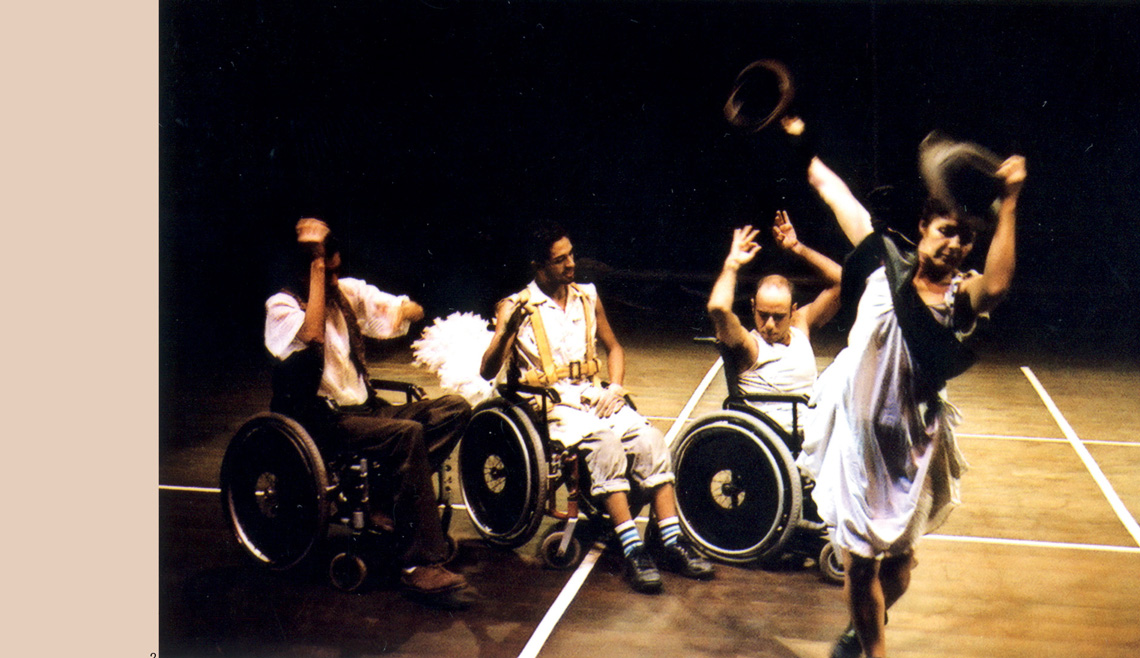
Clarice CajueiroDancer Edu O. (third from left) in a show by the X Dance Improvisation GroupClarice Cajueiro
According to Berselli from UFSM, the process of training artists in Brazil is still very much centered on bodies that respect a standard of normality. “Others who do not fit into these perspectives become dissidents, such as people with disabilities, people in older age groups, or people who challenge gender norms,” points out the researcher. “The topic of inclusivity should be covered more in performing arts courses from undergraduate level onwards.”
Monteiro from UFU is currently working on a research project titled “Corpos diferenciados e artivismo” (Different bodies and artivism). “The idea is to discuss the disabled body without stigmatization or a discourse of overcoming a problem. I do this through stage productions that feature people with disabilities, but that are not emphasized or highlighted for this aspect,” he explains. The list includes productions staged by foreigner performers, such as Nicola Fornoni from Italy and Kamil Guenatri, born in Algeria and based in France, as well as Brazilians, such as the dancers Marcos Abranches from São Paulo and Carolina Teixeira from Rio Grande do Norte, and Edu O., the pseudonym of Carlos Eduardo Oliveira do Carmo, a professor at the School of Dance of the Federal University of Bahia (UFBA).
In his doctoral thesis, defended at the State University of Bahia (UNEB), Edu O. reflected on his experiences in dance based on crip theory (from the word crippled), developed by American academic Robert McRuer of George Washington University, USA, to question the compulsory normativity of the body in society. Based on this theory, Edu O. created his own concept: compulsory bipedalism in dance. “The bipedalism that organizes the world from its point of view wants to exclude other experiences and make them invisible,” says the researcher, who is a wheelchair user.
He is part of the X Dance Improvisation Group, based in Salvador. The company, founded in the late 1990s by UFBA professors Fátima Daltro and David Iannitelli, was not created specifically with physically disabled dancers in mind. However, the involvement of members with disabilities impacted the way the group evolved. Since 2008, for example, its shows have featured audio descriptions, something rarely used in dance productions. “When dance companies do not focus on people with disabilities, they do not welcome us. Their practices and reflections are aimed at a very normative body type: generally young, slim, and white,” says the researcher.
Since 2023, Edu O. has been head of More Access Mapping, the result of a partnership between Brazil’s Ministry of Culture and UFBA. The objective is to conduct a nationwide survey of professionals with disabilities in the performing arts, such as producers, technicians, and artists. The report, currently in the organization and data analysis phase, already features almost 4,000 names. For Edu O., the diagnosis is clear: “There is a lack of visibility, but there is no lack of production.”
The story above was published with the title “Accessible poetics” in issue 351 of May/2025.
Scientific articles
BERSELLI, M. et al. Perspectivas sobre a cena acessível a partir da análise do espetáculo “Birita procura-se”. Urdimento ‒ Revista de Estudos em Artes Cênicas. Vol. 1, no. 50. pp. 1–25. 2024.
CARMO, C. E. O. do. Fissuras pós-abissais em espaços demarcados pela bipedia compulsória na dança. Ephemera: Revista do Programa de Pós-graduação em Artes Cênicas da Universidade Federal de Ouro Preto. Vol. 3, no. 5, pp. 40–61. July 21, 2020.
Books
OLIVEIRA, F. H. M. O. Subjetividade(s) e(m) performance: Corpo, diferença e artivismo. Curitiba: CRV, 2020.
PINHEIRO, L. A. Teatro e artistas com deficiência visual: Poéticas do acesso à cena. Campinas: Unicamp, 2024.
