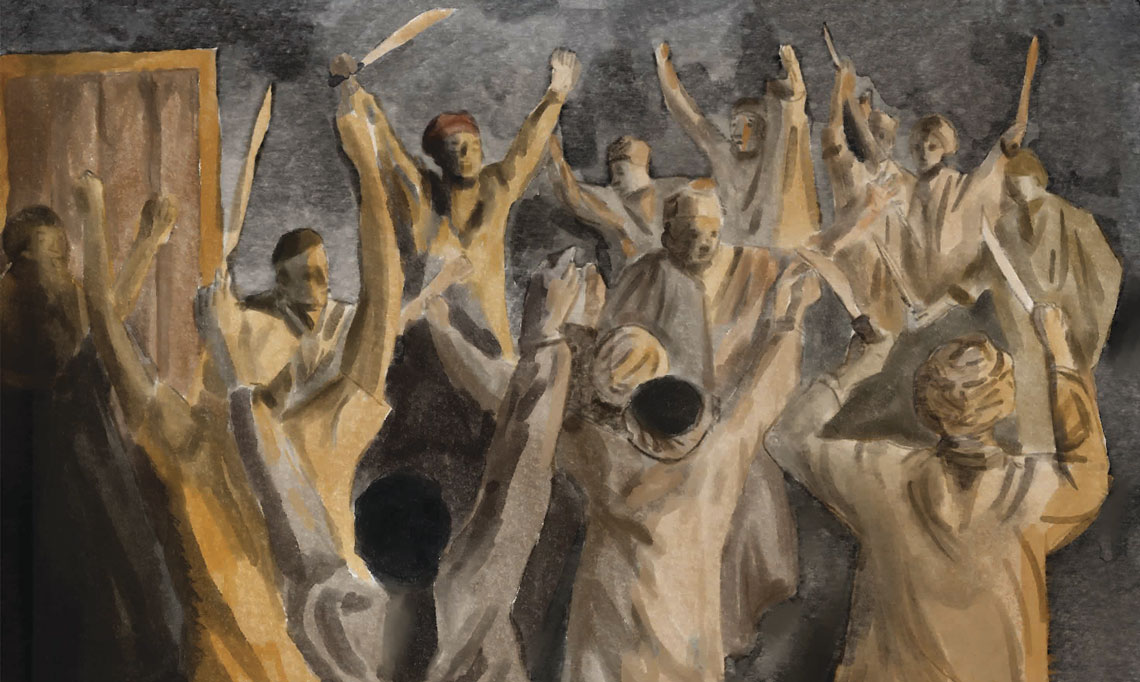
“They say a number of people were hanged/ And the skulls stuck on posts/ Of the abandoned farm/ They howl in the night/ In the forest wind.” The verses are from “Levante” (Uprising), a poem written by writer Oswaldo de Andrade (1890–1954), that was inspired by the Carrancas slave revolt, according to historian Marcos Ferreira de Andrade, professor at the Federal University of São João del-Rei (UFSJ), in the state of Minas Gerais.
The uprising that took place in 1833 in the province of Minas Gerais is considered one of the bloodiest in Brazil’s Southeast during the Imperial period (1822–1889), resulting in 33 deaths. Of these, 21 were enslaved people. Nine members of the Junqueira family (part of the local elite), along with one household dependent and two “people of color”—whom the researcher believes were either enslaved or trusted freedpeople of the family—were also murdered. The episode led to the largest mass execution in Brazilian history, resulting in the deaths of 16 convicted individuals.
The connection between Oswald and Carrancas was no coincidence. According to the historian, two of the modernist’s ancestors, his paternal great-great-uncles, married members of the Junqueira family, which owned the estates where the insurrection took place. The poem “Levante” comes from his first book Pau-brasil (Brazilwood), published in 1925, a year after Oswald revisited the Junqueira family’s estates accompanying Franco-Swiss poet Blaise Cendrars (1887–1961) and other modernist colleagues. “There are strong indications that Oswald drew from a family and collective memory of the region for this poem. They are stories that he certainly heard on his visits to relatives in the interior of Minas Gerais,” states the researcher, who organized and wrote the afterword of the book Caramurus negros: A revolta de escravos de Carrancas – Minas Gerais (1833) (Black Caramurus: The Carrancas slave revolt – Minas Gerais [1833]), published in 2025 by Chão Editora.
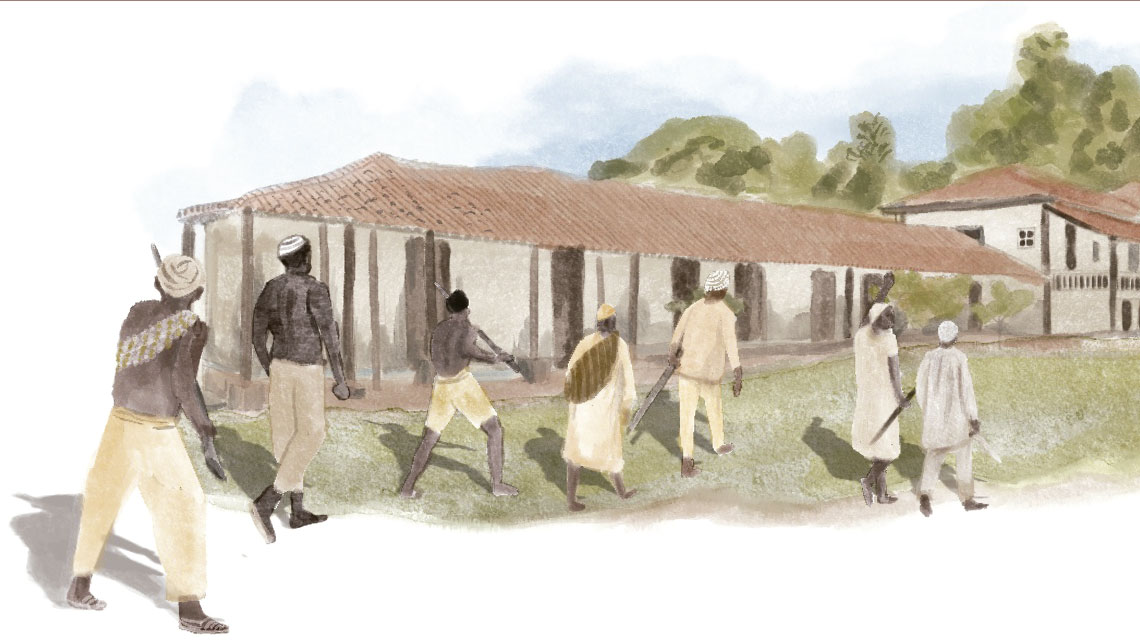
The historian has been investigating the topic for over 30 years. In 1992, he located the criminal case files of the revolt, a bulky manuscript of over 400 pages, in the Archive of the Regional Museum of São João del-Rei, and has been focused on this episode, which took place on May 13, 1833, ever since. On this date, a group of enslaved people from three Junqueira-owned farms—Campo Alegre, Bela Cruz, and Jardim—revolted and killed members of the family using clubs, sickles, and firearms. The revolt is called “Carrancas” for geographical reasons: the lands involved were located in what was then the Parish of Carrancas, a region that, besides Carrancas, included the present-day municipalities of Cruzília, São Tomé das Letras, and Luminárias.
Owners of farms that held over 100 enslaved people, the Junqueiras also owned other properties in addition to the three mentioned, where they raised cattle and pigs, and cultivated cereals, sugarcane, and tobacco. One member of the family, Gabriel Francisco Junqueira, was elected deputy for the province of Minas Gerais in the General Assembly (the equivalent of today’s National Congress) in 1831 and was the main representative of the Liberal Moderado party (Moderate Liberal Party) in the region. “Although it was not opposed to the monarchy, this political faction questioned the fact that the Imperial Majesty held full powers,” says Andrade. “Upon being elected, Junqueira defeated the candidate of the then emperor, Pedro I [1798–1834], and made enemies in the region.”
According to the historian, a rumor planted by a former ally of the Junqueiras, cattle farmer and businessman Francisco Silvério, spread among the family’s enslaved people. Silvério identified with the Restauradores political group (literally, ‘restorers’), also called the Caramurus. They advocated for the return to Brazil of Pedro I, who had left for Portugal in that very same year, 1831, after abdicating the throne in favor of his son, Pedro II (1825–1891). In March 1833, they stormed the capital of the province of Minas Gerais, Ouro Preto, in a conflict known as the Military Sedition.
On that occasion, Silvério told Ventura Mina, the leader of the enslaved people on the Junqueira farms, that the Caramurus had ended slavery in Ouro Preto. Meanwhile, Mina and his companions remained under the control of that family. “That was the tipping point for the uprising,” says Andrade. But, according to the researcher, the enslaved people were not mere pawns. “They mobilized around the struggle for freedom,” he adds.
Ventura Mina led around 60 enslaved people across the three farms and was eventually killed on one of them—Jardim. The revolt was quashed and the insurgents were arrested. Of the 31 accused, 16 were hanged. Another person condemned to death, Antonio Rezende, had his sentence commuted to life imprisonment to act as executioner for the other defendants. A further four were flogged. Ten of the accused were acquitted. The “skulls stuck on posts” from Oswald’s poem would have been the decapitated heads, whose images have lingered in the region’s collective imagination.
Despite the commotion, the uprising received minimal attention in the newspapers at the time. “There was a strategy of misinformation and censorship by the authorities to avoid panic among landowners and part of the free population,” says Andrade. According to the historian, fear of the revolt inspired a law, the bill for which was submitted to the Brazilian House of Representatives in June 1833, shortly after the insurrection. The proposal called for enslaved individuals who killed their owners to be punished more quickly, but it only became law in June 1835, less than five months after the Malê Revolt broke out in Salvador.
The uprising in Bahia occurred in the early hours of January 25, 1835, when a group led by the Malês, the name given to Nago Muslims, took to the streets of the city. “The authorities managed to suppress the roughly 600 insurgents after around three hours,” says historian João José Reis, of the Federal University of Bahia (UFBA), author of Rebelião escrava no Brasil (Slave rebellion in Brazil; Companhia das Letras, 2003), a reference work on the subject. The revolt was led by enslaved and freed Muslims. However, records reveal that non-Muslim Africans also took part in the uprising. Sixteen people were sentenced to death, but only four were executed.
A fictionalized version of the revolt, which marks its 190th anniversary in 2025, is depicted in the film Malês, directed by Antônio Pitanga. The feature-length film was released in October in Brazilian cinemas, after being showcased in festivals in Brazil and at the universities of Harvard, Princeton, and Pennsylvania in the USA. “The script is generally faithful to the events,” says Reis, who served as a consultant for the film.
 Valentina Fraiz
The Malê Revolt left behind an extensive body of documentation. “There are more than 500 statements, interrogations, and reports. It is one of the most thorough inquiries in the Americas for this type of uprising,” explains the historian. “It is an extremely rich collection of material, not only about the revolt, but about how life was for the Africans in the city and their relationships with their owners and neighbors.”
In Reis’s assessment, the rebellion was an antislavery movement with a strong Nago ethnic base, the name the Yoruba (an African ethnic group) were known in Bahia. The term Malê itself comes from imalè, meaning Muslim in the Yoruba language. Furthermore, the uprising had no jihadist overtones, as stated by other researchers, such as anthropologist and physician Raimundo Nina Rodrigues (1862–1906). “Many of the insurgents carried small devotional Arabic texts as ‘amulets,’ with protective prayers. However, the documentation shows that it was not a movement to establish a Muslim state in Bahia.”
Researcher Fernanda Pereira Mendes has been studying these amulets of African Muslims, written in Arabic, during her postdoctoral fellowship at the School of Philosophy, Languages and Literature, and Human Sciences of the University of São Paulo (FFLCH-USP), with funding from FAPESP. “These enslaved people wrote passages from the Qur’an and other literary works they remembered to keep their culture alive, as well as continuing to practice Islam,” explains Mendes, who is investigating possible connections between these Arabic texts and nineteenth-century Brazilian literature.
According to her, such handwritten manuscripts, some in the form of small booklets, represent one of the earliest testimonies of Arabic religion, culture, and language in Brazil, predating the records of Lebanese immigrants who arrived at the end of the nineteenth century. “The manuscripts are important for preserving African culture, but they also constitute a heritage in their own right,” she notes.
According to Reis, although unsuccessful, the insurrection spread fear throughout the Empire and led the provincial and imperial governments to intensify the repression of enslaved and freed people. After examining the episode in detail, the historian has been exploring the life stories of Africans who lived in Salvador in the nineteenth century. He is currently preparing a biography of merchant Manuel Joaquim Ricardo, owner of a cereal store in the Santa Bárbara Market, in Salvador, the state capital of Bahia. At the same market, Elesbão do Carmo, a Muslim known as Dandara, cited in the inquiry of the revolt, ran a tobacco stall. “Through the documents, I am seeking to reconstruct Manuel’s network of relationships,” he says. Reis is also studying other revolts in the Recôncavo Baiano region during the early nineteenth century, where enslaved Hausas (an African ethnic group) played a fundamental role, unlike the Malês Revolt, which was led by the Nago.
If in the case of the Malês Revolt investigations into the episode, its participants, and motivations were extensive, no such records exist for the uprisings in Alagoas. In their absence, historian Danilo Luiz Marques, of the Federal University of Alagoas (UFAL), found details in correspondence and reports exchanged between authorities that reveal the resistance of the region’s enslaved and freed people. In an article published at the end of last year, the researcher looks at some of these conspiracies and rebellions.
One of them was an uprising planned for Christmas in 1815, supposedly led by Hausa Muslims who had fled from Bahia towards the district of Alagoas, and which also included enslaved people from small local properties. “These enslaved individuals had a certain degree of mobility because they were responsible for providing for themselves as well as their masters,” explains the historian.
In July of that year, authorities in Alagoas, suspecting a revolt, requested logistical support from the captaincy of Pernambuco, enabling them to deploy a force of around 200 Indigenous people to help capture the suspects. The searches continued for months, and at the beginning of 1816, the trial of 28 people accused of “premeditated sedition” took place in Recife (Pernambuco). Twenty-three of them were sentenced. Two died in prison, and another two were hanged.
However, according to the historian, it is likely that the revolt had been planned solely by enslaved and freed people from Alagoas. “The ombudsman Antônio Batalha, who held a position of great political importance, likely invented this story to show that his work was being done well in the district and that this conspiracy only occurred because of the arrival of the fugitive Malês from Bahia,” says Marques.
Another revolt in Alagoas analyzed by the researcher in the article is the Marimbondos (meaning ‘hornets’) uprising (1851–1852). The spark for this mobilization was the announcement that decrees 797, of civil registration of births and deaths, and 798, of the general Census of the Empire, were set to come into effect. According to the researcher, this news was interpreted by poor free people and freed individuals as a scheme for enslavement and reenslavement. “The common people dubbed the measures the ‘Law of Captivity,’” he says.
At the time, notices of the laws were posted in churches and in public offices, and large groups began heading to these locations with the aim of destroying the announcements. “The furious noise of the population was compared to the buzzing of hornets, which ended up giving the movement its name, also known as the ‘Ronco das Abelhas’ (literally, the snore of the bees),” says Marques. “It was a leaderless movement that united White and Black people, men and women.” According to the historian, uprisings for the same reason in Pernambuco, Paraíba, and northern Minas Gerais led the Empire to revoke both decrees.
The story above was published with the title “Days of struggle” in issue 357 of November/2025.
Project
Arabic and Afro-Islamic sources of nineteenth-century literature: Gonçalves Dias, Castro Alves, and Machado de Assis (n° 23/16601-5); Grant Mechanism Doctoral Fellowship; Supervisor Michel Sleiman (USP); Beneficiary Fernanda Pereira Mendes; Investment R$341,560.08.
Scientific articles
MENDES, F. P. Breve inventário dos manuscritos em grafia árabe produzidos por negros muçulmanos no Brasil oitocentista. EXILIUM Revista de Estudos da Contemporaneidade. Vol. 6, no. 10, pp. 279–94, 2025.
MARQUES, D. L. Malês, cabanos e marimbondos: Histórias da resistência negra em Alagoas (1815-1852). Sankofa. Vol. 17, no. 29. pp. 58–83, 2024.
Books
ANDRADE, M. F. de (Ed.). Caramurus negros – A revolta dos escravos de Carrancas, Minas Gerais (1833). São Paulo: Chão Editora, 2025.
REIS, J. J. Rebelião escrava no Brasil: A história do levante dos malês. 3rd ed. São Paulo: Companhia das Letras, 2023.